Quotulatiousness

December 19, 2025

“2014 was the hinge, the year DEI became institutionalized across American life”

Filed under: Business, Education, Government, Media, Politics, USA — Tags: , , , , , — Nicholas @ 05:00

In Compact, Jacob Savage talks about the “Lost Generation” … not a reference to the group before the “Greatest Generation” who fought and died in their millions in the trenches of World War One … but a much more recent group who are still becoming living casualties of a war fought without weapons and uniforms, but just as bitter and unnecessary:
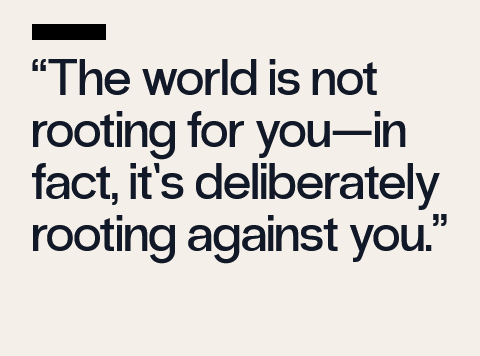
In retrospect, 2014 was the hinge, the year DEI became institutionalized across American life.

In industry after industry, gatekeepers promised extra consideration to anyone who wasn’t a white man — and then provided just that. “With every announcement of promotions, there was a desire to put extra emphasis on gender [or race],” a former management consultant recalled. “And when you don’t fall into those groups, that message gets louder and louder, and gains more and more emphasis. On the one hand, you want to celebrate people who have been at a disadvantage. On the other hand, you look and you say, wow, the world is not rooting for you — in fact, it’s deliberately rooting against you.”

As the Trump Administration takes a chainsaw to the diversity, equity, and inclusion apparatus, there’s a tendency to portray DEI as a series of well-meaning but ineffectual HR modules. “Undoubtedly, there has been ham-fisted DEI programming that is intrusive or even alienating,” explained Keeanga-Yamahtta Taylor in The New Yorker. “But, for the most part, it is a relatively benign practice meant to increase diversity, while also sending a message that workplaces should be fair and open to everyone.”

This may be how Boomer and Gen-X white men experienced DEI. But for white male millennials, DEI wasn’t a gentle rebalancing — it was a profound shift in how power and prestige were distributed. Yet practically none of the thousands of articles and think-pieces about diversity have considered the issue by cohort.

This isn’t a story about all white men. It’s a story about white male millennials in professional America, about those who stayed, and who (mostly) stayed quiet. The same identity, a decade apart, meant entirely different professional fates. If you were forty in 2014 — born in 1974, beginning your career in the late-90s — you were already established. If you were thirty in 2014, you hit the wall.

Because the mandates to diversify didn’t fall on older white men, who in many cases still wield enormous power: They landed on us.

[…]

Institutions pursuing diversity decided that there would be no backsliding. If a position was vacated by a woman or person of color, the expectation was it would be filled by another woman or person of color. “The hope was always that you were going to hire a diverse candidate,” a senior hiring editor at a major outlet told me. “If there was a black woman at the beginning of her career you wanted to hire, you could find someone … but if she was any good you knew she would get accelerated to The New York Times or The Washington Post in short order.”

The truth is, after years of concerted effort, most news outlets had already reached and quietly surpassed gender parity. By 2019, the newsrooms of ProPublica, The Washington Post, and The New York Times were majority female, as were New Media upstarts Vice, Vox, Buzzfeed, and The Huffington Post.

And then 2020 happened, and the wheels came off.

[…]

There are many stories we tell ourselves about race and gender, especially in academia. But the one thing everyone I spoke to seemed to agree on is it’s best not to talk about it, at least not in public, at least not with your name attached. “The humanities are so small,” a millennial professor nervously explained. “There’s a difference between thinking something and making common knowledge that you think it,” said another.

So it came as a bit of a shock when David Austin Walsh, a Yale postdoc and left-wing Twitter personality, decided to detonate any chance he had at a career with a single tweet.

“I’m 35 years old, I’m 4+ years post-Ph.D, and — quite frankly — I’m also a white dude,” he wrote on X. “Combine those factors together and I’m for all intents and purposes unemployable as a 20th-century American historian.”

The pile-on was swift and vicious. “You are all just laughable,” wrote The New York Times‘ Nikole Hannah-Jones. “Have you seen the data on professorships?” “White males are 30 percent of the US population but nearly 40 percent of faculty,” tweeted a tenured professor at GWU. “Hard to make the case for systemic discrimination.”

It didn’t matter that as far back as 2012 women were more likely to be tenure-track across the humanities than men, or that a 2015 peer-reviewed study suggested that STEM hiring favored women, or even that CUPAHR, an association of academic DEI professionals, found that “assistant professors of color (35 percent) and female assistant professors (52 percent) are overrepresented in comparison to US doctoral degree recipients (32 percent and 44 percent respectively).”

As in other industries, what mattered were the optics. When people looked at academia, they still saw old white men. Lots of them.

“A big part of why it’s hard to diversify is the turnover is really slow,” a tenured millennial professor explained. “And that’s become worse now, because Boomers live a long time.” Many elite universities once had mandatory retirement at 70. But in 1994, Congress sunsetted the academic exemption for age discrimination, locking in the demographics of the largely white male professoriate for a generation.

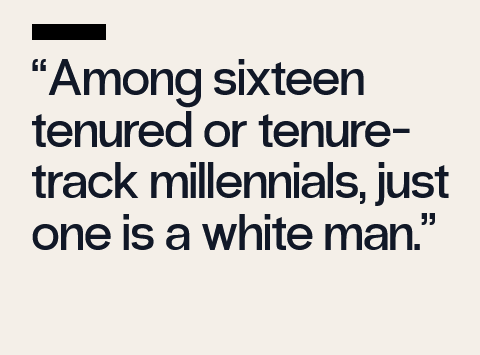
White men may still be 55 percent of Harvard’s Arts & Sciences faculty (down from 63 percent a decade ago), but this is a legacy of Boomer and Gen-X employment patterns. For tenure-track positions — the pipeline for future faculty — white men have gone from 49 percent in 2014 to 27 percent in 2024 (in the humanities, they’ve gone from 39 percent to 21 percent).
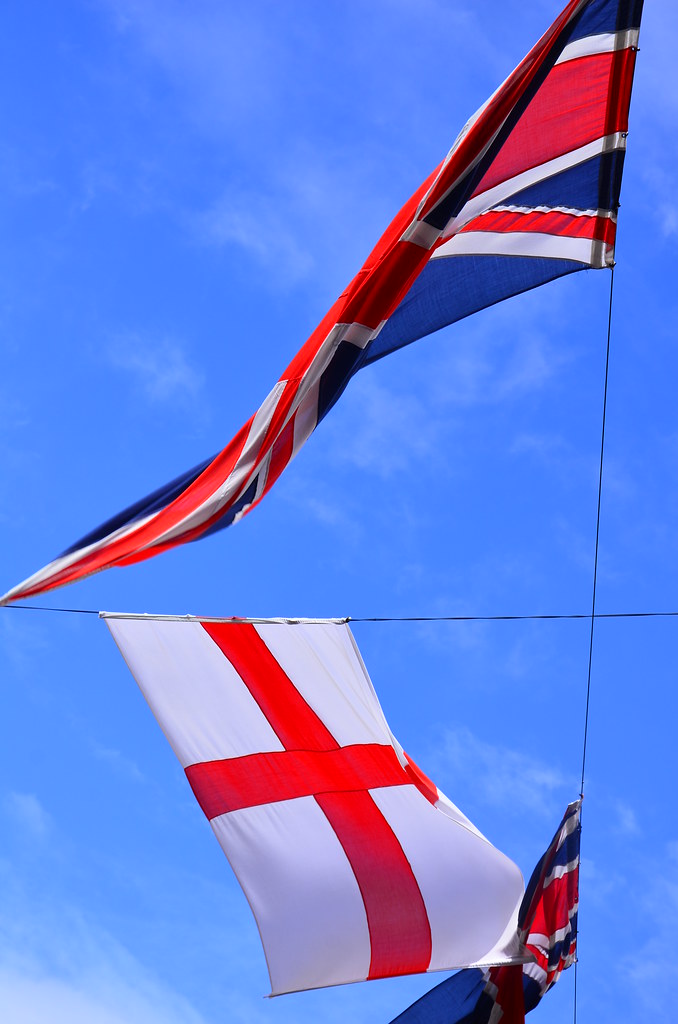
The strange rebirth of English patriotism

Filed under: Britain, Media, Politics, Religion — Tags: , , , , , , , — Nicholas @ 04:00

In The Conservative Woman, Niall McCrae discusses what he calls “a new crusade” as the downtrodden English rediscover — or in many cases, discover for the first time — patriotic feelings for their nation, and earn the scorn and contempt of the ruling class and their media fart-catchers:

“Union Jacks and crosses of St George” by Ben Sutherland is licensed under CC BY 2.0 .

A wave of patriotism swept across England last summer. Flags were tied to lampposts up and down the country, but while these displays had wide public support, the intelligentsia were troubled, particularly as the colours were often flown in areas of cultural diversity or on roads passing hotels accommodating illegal immigrants. This suggested provocation, rather than the use of national flags to celebrate sporting success.

Politicians and Guardian commentators were careful not to appear too negative, but they emphasised unity and inclusion over nationalistic fervour. The Union Jack was preferable to the St George’s Cross, because they associated the latter more with the far right (this is not accurate, as groups such as the National Front and BNP rallied under the Union Jack).

The Union Jack (properly termed “flag” as a jack is hoisted at sea), comprises the crosses of St George, St Andrew and St Patrick. It is perhaps the most impressive flag in the world, a classic design of great cultural impact. How globalists, the EU and Islamists would like to banish it!

The “Unite the Kingdom” march led by Tommy Robinson in September, which brought a million people to the streets of London, was a marvellous spectacle of patriotism. For the counter-Jihad movement, conflict in the Middle East is regarded as an existential struggle against militant Islam. Israeli flags are often waved towards pro-Palestine marchers, and the London rally gave several Zionists a platform at Whitehall. However, the vast majority of marchers were there for one country only – their own. This was truly a British event, with a roughly equal mix of Union and St George flags, alongside some Welsh dragons and Scottish saltires, and Irish tricolours too.

Significantly, there was another symbol prominently at the London march: the Christian cross. A poignant moment was at the ramparts of Westminster Bridge, where a fearless young man mounted the head of the stone lion and from that precarious pedestal raised in one hand the flag of St George, and in the other a wooden cross. (https://www.instagram.com/reel/DOpagGvkQk9/)

I first observed the resurgence of Christian faith at the huge protests against the Covid-19 regime. Several marchers bore crosses, or placards asserting the power of God over earthly evil. The Book of Revelation was quoted, and when the “vaccine” was launched it was cast as the “Mark of the Beast”.

Socially unacceptable they may have been, but now St George and Christian crosses are regularly appearing together in gatherings for patriotic or traditional causes. In his book Worth Dying For: The Power and Politics of Flags (2017), Tim Marshall observed that “with the rise of Islam in Europe, these symbols are likely to be increasingly used by the far right to try to define the continent as what they think it is, and in opposition to what they think it is not”. You can’t get a book released by a mainstream publisher without expressing such approved outlook, but Marshall is making the mistake of blaming patriots for the devaluing of their national flag; it is surely the subversive ideology of the progressive left that has taught generations that national pride is regressive and bigoted. Meanwhile “woke” warriors are not shy of waving the Pride rainbow, transgender stripes and the flag of Palestine. And the likes of Hope Not Hate had no complaint about huge fascist-style marches awash in the blue and yellow stars of the EU.

Brendan O’Neill on the Islamophobia racket

In the National Post, Brendan O’Neill criticizes Australian Prime Minister Anthony Albanese in particular, but he’s just the most recent exemplar of western politicians trying to blame society in general and “right wing extremists” in particular for the terrorist attacks by Islamic extremists:

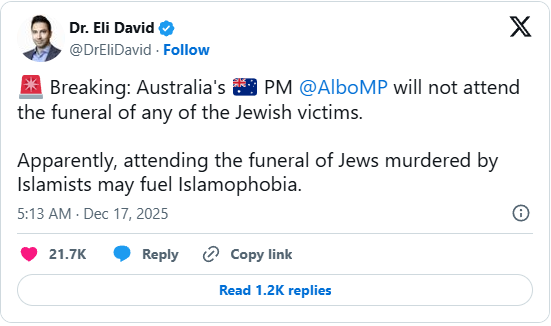
Australian Prime Minister Anthony Albanese spoke a total of 5,022 words in the day after the slaughter of Jews at Bondi Beach. And not one of those words was “Islam”. Or “Muslim”. Or even “Islamic extremism”.

He did talk about the “far right” though. Twice. We need to tackle “the rise of right-wing extremist groups”, he said.

What an odd thing to focus on the day after a father-and-son Islamofascist outfit had mown down 15 innocents, all while proudly displaying the black flag of ISIS.

To fret about the far right hours after suspected Islamic militants had carried out the worst slaughter of Jews in Australian history is cognitive dissonance of epic proportions.

It would be like turning up to the bloody aftermath of a KKK massacre and flat-out refusing to say the words “Klansmen”, “racist” or “white supremacist”. Well, we wouldn’t want to offend the pointed-hood community.

Some Australians were dumbfounded by the PM’s bullish refusal to name the ideology that fuelled this act of antisemitic savagery.

After all, at the time he was holding forth on the various threats to the Aussie way of life, officialdom had found the killers’ ISIS flag and other paraphernalia suggesting they had taken the knee to the death cult of radical Islam.

“What happened at Bondi was an act of radical Islamic terrorism”, thundered Sean Bell of the populist party One Nation. If the PM “cannot be honest” about the “radical Islamic ideology”, he said, “then he has no place leading the country”.

It’s hard to disagree. The first duty of a leader following the barbarous slaying of citizens is to tell the truth. If Albanese can’t even bring himself to mouth the words “Islamic extremism”, how’s he going to fight it?

The PM’s yellow-bellied dodging of the i-word was shocking but not surprising. Other Western leaders have behaved similarly in the wake of Islamist outrages. They have furiously thumbed their thesauruses for spins on the word “extremist” — fanatic, militant, evil — all so that they can avoid committing that most gauche faux pas in polite society: talking about the problems in Islam.

This is the dire handiwork of the Islamophobia industry. For years now, Islam has been ruthlessly ringfenced from free, frank discussion.

Mock Muhammad and you’ll be damned as “phobic”. Crack a joke about the Koran and you can expect a mob of fundamentalists at your front door. Say Islam has an extremism problem and the self-elected guardians of correct-think will drag you off for re-education.

We’ve witnessed the rehabilitation of medieval strictures against “blasphemy”. The end result is that even as women and children writhe in agony from the wounds inflicted on them by Islamist militants, still our leaders won’t say that i-word. It clogs in their throats. They dread cancellation more than they cherish truth.

[…]

After every attack, the same platitudes are trotted out. “Nothing to do with Islam”. “Islam is a religion of peace”. We’re gagged from naming the threat we face, from correctly identifying the men who are killing our fellow citizens.

Believe them when they show you what they are, Oz edition:

In The Line, Ariella Kimmel thinks there are signs that at least some political figures are getting the right lessons out of the events of the last few years:

In the wake of the terrorist attack in Bondi Beach, it seems as if leaders are finally starting to realize the risk of allowing antisemitic extremism to run unchecked for years.

Calgary’s new mayor offered a powerful example of what this means in practice.

At Calgary City Hall’s Chanukah celebration, Mayor Jeromy Farkas delivered remarks that stood out not only for their eloquence, but for their accountability. He spoke plainly about antisemitism and acknowledged the very real fear that Jewish communities are living with. Most importantly, he made clear that civic leadership means showing up publicly, consistently, and without excuses.

In a room of just over a thousand, he declared “let me be absolutely crystal clear. There is no place for antisemitism in Calgary. Not on our streets, not in our schools or campuses, not at protests, not online, not hidden behind slogans, not excused as politics, because Jewish lives are not expendable. Jewish safety is not expendable.”

That moment was especially symbolic given Calgary’s recent past. Two years ago, then-Mayor Jyoti Gondek refused to attend a Chanukah event amid pressure and controversy. Farkas’ presence this week marked a break from that pattern. It signalled that someone, finally, was willing to take responsibility.

That is what leadership looks like.

The Bondi Beach attack should force a reckoning in Canada. If we want to avoid becoming the next headline, this country must do more than mourn; we must decide, clearly and concretely, that extremism has consequences and that antisemitism will not be indulged.

In Canada, politicians were quick to offer condolences. Statements flowed with the standard lines – “my thoughts are with the community”, “our government condemns all forms of hate”, “no one should be targeted for practicing their religion”. The words are familiar, and quite frankly hollow, because for the past two years, many of the same leaders issuing their thoughts and prayers have either ignored, excused, or actively engaged with movements that normalize hostility toward Jews.

Since October 7, Jewish Canadians have watched as public spaces became hostile territory. Synagogues require police protection, while Jewish schools are shot at and community centres are defaced. Rallies openly glorify terrorist groups, call for the destruction of Israel, and chant slogans that any reasonable person understands as genocidal, such as calls to “globalize the intifada”, “from the river to the sea Palestine will be free”, “there is only one solution, intifada revolution”, and “resistance is justified”.

What makes the current moment particularly dangerous is the gap between rhetoric and reality among leaders. Politicians speak of fighting hate while refusing to enforce existing laws against intimidation, mischief, and hate-motivated harassment. They speak of unity while legitimizing groups and movements that openly reject the safety of Jewish communities, even giving funding through government programs meant to combat antisemitism, to organizations that perpetrate it. They issue statements condemning violence abroad while tolerating the ideological conditions that make violence inevitable at home.

Pick One: G1 (FAL) vs G3 (H&K) w/ John Keene

Filed under: Germany, History, Military, Weapons — Tags: , , , , , — Nicholas @ 02:00

Forgotten Weapons
Published 2 Aug 2025

If you had to pick one, would you take a G1 (FAL) or a G3 (H&K)? Both are 7.62mm NATO rifles adopted by Germany. The G1 has more features and capabilities, like the carry handle, bipod, multiple muzzle devices, and adjustable gas system. The G3, on the other hand, is simpler, without things to change for better or worse. So which would you take?
(more…)

QotD: “1998 was the official start of the Girlboss Era”

Filed under: Media, Quotations, USA — Tags: , , , , — Nicholas @ 01:00

    Paltrow seemed to arrive on the scene having everything and wanting for nothing.

Funny, that’s also the most accurate description of an AWFL ever penned. Who the hell are they, and where did they come from? How do they have the free time and endless disposable cash to do literally every single thing they do?

    In 2001, she promoted Shallow Hal — in which she played Rosemary, an obese woman whose “inner beauty” is only visible to Hal (Jack Black) — by talking about doing practice runs in her character’s fat suit. “I got a real sense of what it would be like to be that overweight, and every pretty girl should be forced to do that.”

Wait, this is supposed to be a hit piece? Because that might be the most sensible thing I have ever heard a woman say. Yes, definitely they should be forced to do that, if not the full Norah Vincent. If you’re halfway presentable, ladies — hell, if you’re not grossly deformed — you’re playing life on “God mode”. Look at all the simps in your social media feeds, and tell me I’m wrong. Being forced to go around in a fat suit for a week or two is a necessary corrective.

    Paltrow’s first big trip on the Hollywood hater-go-round was 1998, the year she won the Best Actress Oscar for Shakespeare in Love and gave a memorably messy, genuinely emotional acceptance speech. (Days after her win, Salon was among many outlets eviscerating her.) What viewers didn’t see, Odell notes, is the amount of effort by Miramax head Harvey Weinstein to make Shakespeare a winner, raise the profile of his still-independent studio, and solidify his belief that Paltrow belonged to him.

I’m going to stop here, because there’s really no point. I just wanted everyone to remember Shakespeare in Love. You do remember Shakespeare in Love, don’t you?

Of course you don’t; it was silly and forgettable at the time, and now is remembered, if at all, as a bizarre footnote — it’s the movie that won Best Picture over Saving Private Ryan. From the perspective of 2025, then, it sure looks like 1998 was the official start of the Girlboss Era.

Severian, “Kvetching Up With Karen: DC Edition”, Founding Questions, 2025-08-14.

Powered by WordPress