Quotulatiousness

December 11, 2025

US Democrats, like Canadian Liberals, love performative gestures but ghost on delivery

Filed under: Cancon, Media, Politics, USA — Tags: , , , , , , — Nicholas @ 05:00

I’ve remarked many times that Canada’s federal Liberals love themselves some photo ops, sound bites, ribbon-cuttings, and making announcements in front of temporary stages … they can’t help themselves, they’re what happens to theatre kids who don’t have to grow up. The American Democrats seem to be falling into the same pattern of “putting on a show” rather than implementing policies that address whatever the declared problem really is:

In 2015, the City of Los Angeles announced an ambitious plan (led by the person we then referred to as Mayor Yogapants) to completely eliminate traffic deaths by 2025. It was a vision: Vision Zero, they called it. Ten years later, traffic deaths in Los Angeles have doubled. A wonderfully progressive local government announced a plan to eliminate something, so we got much more of that thing. A community group, @peoplesvisionzero, is now trying to carry out some version of the failed plan with guerilla traffic engineering, sneaking new safety infrastructure into place without city permission. Recent result:

In similar fashion, Gavin Newsom announced his ten-year plan to end California homelessness in 2008. I struggle with the math, but there’s a possibility that we’ve passed the ten-year mark since then. […]

Theater-kid governance is the empty-to-the-point-of-ruin declaration of a symbol-desire, a performance about what we want and don’t want. It doesn’t do anything; it’s a posture, not an action. To the extent that it does do any actual thing in physical reality, it creates pots of money to be looted by NGOs and metastasizing government bureaucracies.

Infamously, when California audited $24 billion in state homelessness spending last year, auditors couldn’t track where a bunch of the spending went, or figure out what it had paid for. See also the growing scandal over Somalian immigrant social services fraud in Minnesota. Facial expressions are made. Symbols are invoked. Money goes … somewhere. It’s a show, with a rich loot bucket, not an actionable set of policies that produce positive trends toward declared goals. By the way, it’s been fifteen years since the Obama administration and a Democratic-majority Congress made healthcare affordable.

California infrastructure is a persistent disaster, because the California legislature and our sociopathic idiot governor are deeply invested in signaling about warm and wonderful trans kids and standing up to Mean Orange Hitler. They don’t stoop to highways and bridges — they’re much too progressive. Related, the increasingly sharp near-term projected decline of fuel production in California is becoming a national security problem in a state that needs to gas up a lot of military traffic. The state performs constantly against Big Oil and its mean climate change agenda, and somehow keeps losing refineries. The endless symbol-gestures cause the loss of real things.

Lines of Fire: Operation Market Garden Part 2 of 2 – WW2 in Animated Maps

Filed under: Britain, Germany, History, Military, USA, WW2 — Tags: , , , , , — Nicholas @ 04:00

TimeGhost Cartographic
Published 10 Dec 2025

September 17, 1944. A slight morning fog over Britain gives way to clear skies, as the first of hundreds of Allied aircraft leave the ground to execute the largest airborne operation ever attempted. Will Montgomery’s gamble pay off? Or are the Germans in the Netherlands far less beaten than he believes? Last time out we covered the planning, rationale, and logistics of the idea. Now, watch it unfold from beginning to end, map by map.
(more…)

Your words are violence to an astounding 91% of US college students surveyed

Filed under: Education, Media, Politics, USA — Tags: , , , , , — Nicholas @ 03:00

J.D. Tuccille presents some depressing poll results from American college students who have massively bought into the illogical position that words can be the same as actual violence:

Of all the stupid ideas that have emerged in recent years, there may be none worse than the insistence that unwelcome words are the same as violence. This false perception equates physical acts that can injure or kill people with disagreements and insults that might cause hurt feelings and potentially justifies responding to the latter with the former. After all, if words are violence, why not rebut a verbal sparring partner with an actual punch? Unfortunately, the idea is embedded on college campuses where a majority of undergraduate students agree that words and violence can be the same thing.

Most Believe Words Can Be Violence

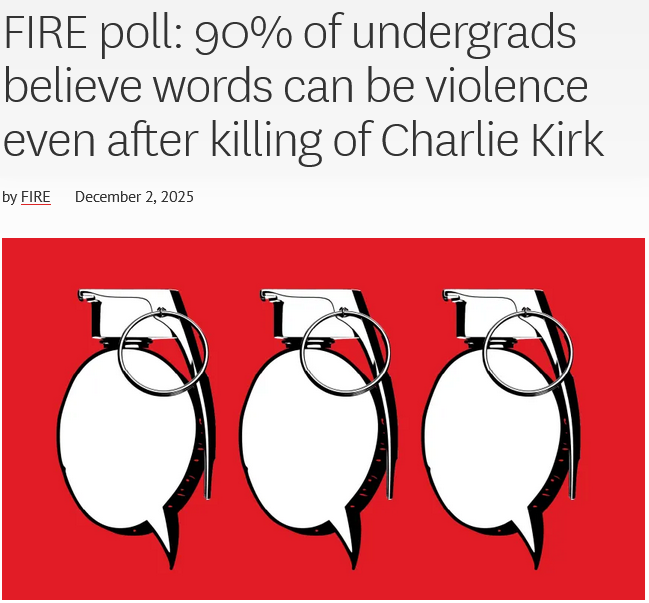
“Ninety one percent of undergraduate students believe that words can be violence, according to a new poll by the Foundation for Individual Rights and Expression [FIRE] and College Pulse”, FIRE announced last week. “The survey’s findings are especially startling coming in the wake of Charlie Kirk’s assassination — an extreme and tragic example of the sharp difference between words and violence.”

The survey posed questions about speech and political violence to undergraduate students at Utah Valley University, where Kirk was murdered, and at colleges elsewhere — 2,028 students overall. FIRE and College Pulse compared the student responses to those of members of the general public who were separately polled.

Specifically, one question asked how much “words can be violence” described respondents’ thoughts. Twenty-two percent of college undergraduates answered that the sentiment “describes my thoughts completely”, 25 percent said it “mostly” described their thoughts, 28 percent put it at “somewhat”, and 15 percent answered “slightly”. Only 9 percent answered that the “words can be violence” sentiment “does not describe my thoughts at all”.

It’s difficult to get too worked up about those who “slightly” believe words can be violence, but that still leaves us at 75 percent of the student population. And almost half of students “completely” or “mostly” see words and violence as essentially the same thing. That’s a lot of young people who struggle to distinguish between an unwelcome expression and a punch to the nose.

Depressingly, 34 percent of the general public “completely” or “mostly” agree. Fifty-nine percent at least “somewhat” believe words can be violence.

In 2017, when the conflation of words and violence was relatively new, Jonathan Haidt, a New York University psychology professor, worried that the false equivalence fed into the simmering mental health crisis among young people. He and FIRE President Greg Lukianoff wrote in The Atlantic that “growing numbers of college students have become less able to cope with the challenges of campus life, including offensive ideas, insensitive professors, and rude or even racist and sexist peers” and that the rise in mental health issues “is better understood as a crisis of resilience”.

Conflating Words and Violence Encourages Violence

Telling young people who haven’t been raised to be resilient and to deal with the certainty of encountering debate, disagreement, and rude or hateful expressions in an intellectually and ideologically diverse world plays into problems with anxiety and depression. It teaches that the world is more dangerous than it actually is rather than a place that requires a certain degree of toughness. Worse, if words are violence it implies that responding “in kind” is justified.

“At a time of rapidly rising political polarization in America, it helps a small subset of that generation justify political violence,” Haidt and Lukianoff added.

Britain’s Top 10 UGLIEST Aircraft

Filed under: Britain, History, Humour, Military, Technology, WW1, WW2 — Tags: , , , , , — Nicholas @ 02:00

Rex’s Hangar
Published 13 Aug 2022

Today we take a look at the top 10 ugliest aircraft every to grace the skies of the United Kingdom. Some were failures, some were hugely successful, but all were lacking in the good looks department, lets check out these ugly planes!
(more…)

QotD: Being a bore

Filed under: Humour, Quotations — Tags: , , — Nicholas @ 01:00

Of course, the true bore, like the true eccentric, doesn’t know or even suspect that that is what he is. The eccentric does strange things because to him they are the most natural things in the world to do. The true bore doesn’t know that he is boring others because what he says is so very interesting to himself, which is why at dinner parties my wife sometimes has to kick me under the table.

My problem is that I have two modes of socializing: to be silent or boring. I cannot make small talk, for when I try to do so my words turn to dust in my mouth, as it were, before I have even uttered them. I can talk only on matters of impersonal interest.

My problem is that I am a serial monomaniac, with one subject occupying the foreground of my mind for up to a few months. In the midst of my enthusiasm, I cannot imagine that other people are not as fascinated by the subject as I. The subject of my monomanias are various: Haitian history; the disappearance of the cuckoo from the English countryside; the life of Caradoc Evans, the Welsh writer of the early part of the 20th century; etc. I never stick with anything long enough to be a scholar of it.

When my wife kicks me under the table, it is usually in mid-anecdote. I cannot stop straightaway, abruptly, for that would look peculiar, as if I were having a fit or a stroke. But I have to bring it to a quicker end than I had anticipated, omitting details that to me had seemed choice and amusing. Often, I have to admit, my wife has heard them before.

Of course, I don’t agree that I am being, or have ever been, boring. Bores don’t know that they are boring, just as people with halitosis don’t know that their breath smells. I look at the people around the dinner table and think they are glued to what I am saying. The fact that I don’t really give them any alternative doesn’t occur to me. How, in any case, could anyone be uninterested in the story of le Roi Christophe who built, or had built, one of the wonders of the world, La Citadelle, near Cap-Haitien, or of how people threw bricks through Caradoc Evans’ windows, so disgusted were they by his literary portrayal of his countrymen? In those days, literature was important.

Theodore Dalrymple, “Full Bore”, Taki’s Magazine, 2020-05-29.

Powered by WordPress