
Quotulatiousness

December 8, 2025

If Britain’s political leadership were trying to destroy the country, what would they have done differently?

My Canadian readers — and possibly the occasional Aussie or Kiwi — can read Spaceman Spiff‘s essay and feel it applies almost 100% to our respective nations as well:

Image from Postcards from the Abyss

Britain is a disaster. The country seems to be in terminal decline.

Not only do we see a lack of ability to turn things around we witness leaders and prominent decision makers evidently clueless about normal life and the hardships many now face.

The political and media classes best reflect this phenomenon. Their views are insular, fictional and at odds with reality. They promote unorthodox ideas that are widely derided yet their enthusiasm is evident as are their hostile responses to being challenged.

Minor comments about immigration are treated as precursors to genocide. Criticism of a biased media unwilling to report events is dismissed as conspiracy. No discussion of climate policy and its unaffordable costs is tolerated. Deviation from the establishment view means excommunication and social exile.

Those in leadership positions drive Britain’s descent into authoritarian governance. Attempts to discuss changes to society leads to extreme overreactions, including jailing noticers, something they now boast about.

Britain has become a madhouse. Our leaders are unable to think like normal people. None of them are facing reality. They seem crazy.

Or, rather, they seem neurotic.

Neurosis is everywhere

Britain has degenerated into a technocratic regime that views the public as its enemy. Normal people disgust the country’s leaders and it shows. They no longer hide their contempt.

But there is a palpable sense of fear emanating from the powerful. Their reactions to normal events paint a troubling picture of who is leading the country, particularly the political and media classes.

If the British establishment were a person we would think them mentally unstable. The qualities we see most are those of a neurotic individual, a type that is well understood.

Here are some features visible in Britain’s ruling class.

Chronic anxiety and worry

A key attribute of neurosis is persistent fear or worry. Rumination is commonplace, circling around and around the same problems. There is also a tendency to overreact, with the response disproportionate to the issue at hand.

The current British regime is wracked with anxiety and worry. This defines them. They are vocal about their concerns.

We are reminded of an endless series of horrors we must attend to; systemic racism, lack of diversity, an imperial past and our cultural dominance along with our impact on the world.

One simple example illustrates the degree to which minds can become distorted by excessive worry.

James Watt perfected the steam engine in 1769 which kickstarted in the industrial revolution, changing the world forever. This would ultimately elevate most nations on earth and led eventually to the establishment of cheap abundant energy for almost everyone.

Until recently these events were viewed as an epoch-defining moment of engineering brilliance. Now this has been recast as a dark stain on Britain’s place in the world, with climate zealots keen to blame the British for all pollution caused by industrialization.

Instead of pride we now see embarrassment and even anxiety about the “damage” Britain has done to the world because it ushered in an era of cheap widespread energy for everyone.

Any rational person would understand this extreme view to be a distortion of reality and excessively negative, yet it permeates everything. Those who rule Britain are ashamed of our past. They worry about it. Only they do this, normal people are proud of our history.

[…]

Welcome to the madhouse

A system of governance driven by neurotics takes on their characteristics. Britain has become a neurotic bureaucracy; a neurocracy.

Neurotics overthink and live inside their heads. They lack the calm, detached strength needed to govern sensibly. Power structures inevitably take on these qualities.

The British government has become paranoid. Digital IDs, internet regulation, censorship. They jail normal people for social media posts. Dissenting views are increasingly punished with custodial sentences.

These are not the actions of the mentally strong. This is an embattled minority fighting reality and becoming desperate.

A gulf is opening between the rulers and the ruled. Increasingly no common ground is even conceivable as the fictions needed to maintain narratives grow. They become overtly false but are needed to feed the neurosis.

One of the things I like about the social media site formerly known as Twitter is how quickly authoritarian bullshit like this can get called out:
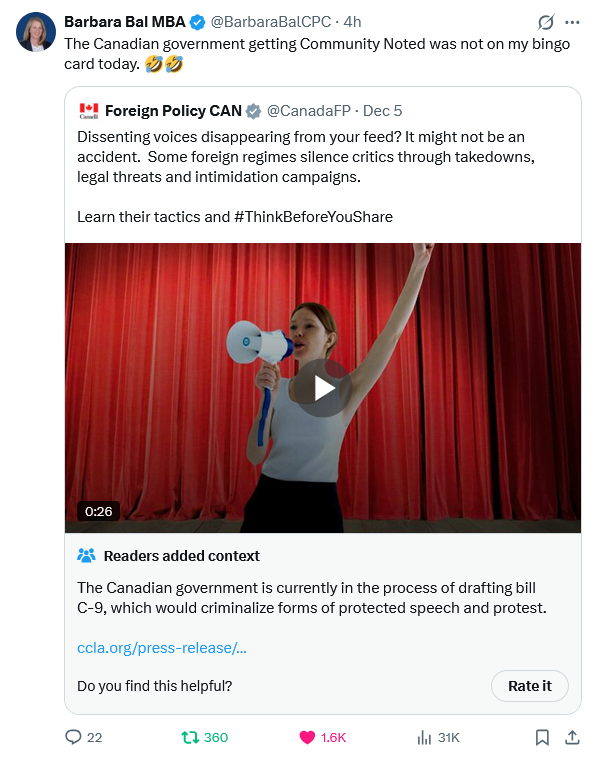
Update, 9 December: Welcome, Instapundit readers! Please do have a look around at some of my other posts you may find of interest. I send out a daily summary of posts here through my Substackhttps://substack.com/@nicholasrusson that you can subscribe to if you’d like to be informed of new posts in the future.


Hungary 1956: The Day Hope Met Soviet Steel – W2W 056

Filed under: Europe, History, Military, Russia — Tags: , , , , , , , — Nicholas @ 04:00

TimeGhost History
Published 7 Dec 2025

Here we trace how, only eleven years into Soviet rule, Hungary’s brief hope after Stalin’s death ignites into demands for reform, free speech, and withdrawal of Soviet troops. Students mass in Budapest, the secret police fire on demonstrators, and the uprising spreads as workers’ councils seize factories and crowds pull down Stalin’s statue. Imre Nagy promises neutrality and multi-party politics, but Moscow wavers, then sends in overwhelming force. As tanks return to Budapest, street fighting erupts, radios broadcast desperate pleas, and the revolution is crushed, leaving thousands dead and a generation convinced that the thaw was an illusion.
(more…)

“Canadian culture” apparently doesn’t include books anymore

Filed under: Books, Business, Cancon, Government — Tags: , , — Nicholas @ 03:00

In the latest SHuSH newsletter, Ken Whyte considers what the omission of financial goodies for the Canadian publishing industry in the latest federal budget (unlike the CBC, music, film and TV subsidies) says about the government’s view of what “Canadian culture” actually is:

You might have noticed that last month’s federal budget introduced a whack of new cultural spending. The CBC got another $150 million, the Canada Music Fund took $48 million, film and television raked in over $300 million. Books? Nothing.

The budget’s rationales for this new spending are to foster a sense of cultural identity and belonging in Canada, to sustain an informed citizenship, and to protect vulnerable industries. The unwritten context is the recent American assault on Canada’s independence. You would think there would be room for books in this sort of budget. Is there anything more foundational to Canadian identity and an informed citizenry than books by Canadians and about Canada?

Yet somehow our political leadership overlooked the literary sector. It’s odd. The first thing our politicians do when they want to explain or advance their own careers is knock on a publisher’s door.

Granted, it’s usually the door of an American publisher, because the net result of our government’s efforts to nurture the publishing sector in Canada over the last several decade has been to drive Canadian-published books from more than 20 percent of those sold in Canada to less than 5 percent. We have the weakest domestic publishing industry in the developed world. Our prime ministers think nothing of taking their books to New York-based Penguin Random House or Simon & Schuster. Most of our most prominent fiction writers give all their North American rights to US publishers instead of separating out Canadian rights and leaving them with a Canadian publisher. It’s a travesty.

I have a solution. In fact, I have many solutions. I have a whole book of solutions coming in January from Canadian public policy guru Richard Stursberg. It looks like this:

Richard’s solutions are not the same as my solutions. I like his, too. I’m not picky. I’m going to flood the zone with solutions and hope people in Ottawa wake up to the fact that we have a problem. The solutions will almost all involve more public support of the industry, not because I’m keen on public support of the industry, but because we have ample proof that the alternative to more public support is no domestic book publishing industry. Also, if you’ve been following us here (see SHuSH 232, The Wasteland), you know this is a “you broke it, you own it” moment for our federal government.

So here’s my solution de jour. Given that books are fundamental to any notion of Canadian identity, given that our domestic publishing sector is pathetically weak, given that any self-respecting country needs to be able to publish its own stories rather than rely on the branch plants of an increasingly difficult neighbour to do it for us, we arrange the following.

We massively expand Canada’s public lending right program (PLR). At present, the ridiculously underfunded PLR pays out about $15 million a year to some 20,000 authors whose books are circulated in Canada’s public libraries. The distributions are based on a complicated formula that mostly notices how many libraries hold the author’s book. It’s capped at $4,500 an author, and most receive only a few hundred dollars annually.

We expand the PLR’s spending envelope by a factor of ten: $150 million. Does that sound like a lot of money? It’s not. It comes to about $3.75 per capita. That’s about a tenth of what we spend annually on the CBC, which employs roughly the same number of people as book publishing. It’s about a tenth of what we spend in direct funding and tax credits on film & television. It’s less than half what we’re spending on newspaper and magazine subsidies. A small price to rebuild a decimated publishing sector.

I think you could argue that the dollar amount should be much higher. As a society, we believe that books are more important than the products of other media. The governments don’t give you free cable or a free opera pass or a free spotify subscription: they give you free books through public libraries, because books are that important to the well-being of our citizenry. We’re so good at promoting the value of our public libraries that four out of every five books read in Canada are borrowed rather than bought. If books are that important, $150 million is a bargain.

Eating aboard a US Submarine during World War 2

Filed under: Food, History, Military, Pacific, USA, WW2 — Tags: , , , , — Nicholas @ 02:00

Tasting History with Max Miller
Published 1 Jul 2025

Slow-cooked steaks with tomatoes and onions with mashed potatoes and gravy

City/Region: United States of America
Time Period: 1945

Being a crew member aboard a submarine during World War II was one of the most dangerous jobs in the US military with a fatality rate of over 20%. This, and the extremely cramped and uncomfortable quarters, were why the food aboard a US sub was really good. If nothing else, at least you had delicious food to keep you going.

These steaks cook up to be fall-apart tender and delicious, and the mashed potatoes have wonderful flavor, even if the texture is a little different from regular mashed potatoes. They kind of remind me of the mashed potatoes I’d get as a kid in school, which were also probably made from dehydrated potatoes.

    SWISS BEEF STEAKS
    Portion: 1 (6-ounce) steak.
    100 PORTIONS
    Beef, bone-in……60 pounds
    OR
    Beef, boneless……42 pounds
    Flour……2 pounds……1/2 gallon
    Salt……6 ounces……3/4 cup
    Pepper……1/2 ounce……1 3/4 tablespoons
    Fat……2 pounds……1 quart
    Tomatoes……12 pounds, 12 ounces……2 No. 10 cans (6 1/2 quarts).
    Onions, sliced……6 pounds……4 1/2 quarts
    Salt……1 ounce……2 tablespoons
    Flour (for gravy)……1 pound……1 quart
    Water, cold……
    Cut meat into 6-ounce steaks 1 to 1 1/2 inches thick.
    Sift together flour, salt and pepper. Pound into steaks.
    Cook steaks in fat until browned on both sides. Place in roasting pans.
    Add tomatoes. Cover with onion slices. Sprinkle with 1 ounce salt.
    Cover pans. Cook in slow oven (300°F.) 3 hours or until steaks are tender.
    Drain liquid from Swiss steaks. Make a paste of flour and water. Stir into steak liquid. Cook until thickened. Pour over steaks. Reheat.

    MASHED POTATOES (Using dehydrated, shredded potatoes)
    Portion: Approx. 4 1/2 ounces (approx. 2/3 cup).
    100 PORTIONS
    Water……5 pounds, 8 ounces……2 gallons
    Potato shreds, dehydrated, precooked……5 pounds……2 gallons
    Salt……3 ounces……6 tablespoons
    Milk, liquid, hot……3/4 gallon
    Butter, melted……1 pound……1 pint
    Heat water to vigorous boil. Pour over potatoes. Cover.
    Let stand in warm place 15 minutes or over low heat 10 minutes.
    Add salt. Stir vigorously 15 to 20 minutes or until smooth.
    Add milk and butter. Whip until light. Serve immediately.
    The Cook Book of the United States Navy by the United States Department of the Navy Bureau of Supplies and Accounts, Washington, D.C., 1945

(more…)

QotD: Austerity versus “austerity”

Filed under: Economics, Government, Media, Quotations — Tags: , , — Nicholas @ 01:00

Too great attention to the use of language is a distraction from the essential and easily becomes mere pedantry; but to pay too little is to risk being deceived or manipulated by those who use language wrongly. Words, Aristotle said, should not bear more precision than possible; but neither should they bear less than possible.

Words have connotations as well as denotations, and one way of insinuating an untruth into someone’s mind is to disconnect the two, so that the denotation and the connotation are at variance and even opposite. An excellent example of this is in the use of the word austerity as applied to certain government economic policies. Frequently one reads, for example, that the difficulties of countries such as Britain and France in the matter of responding to the Covid-19 epidemic were caused by previous government austerity, that is to say, failure to spend more. But irrespective of whether, had the governments spent more (and France already devotes a greater proportion of its GDP to healthcare than the great majority of countries at the same economic level), the epidemic would have been more easily mastered, their policies in restricting their expenditure cannot be called austerity, because they still spent more than their income: as, in fact, they had done almost continually for forty years.

Supposing I were to say, “This year I’m going in for austerity. Last year I spent ten per cent more than my income, but this year I am going to spend only five per cent more,” you would think I were uttering a sub-Wildean paradox. But if I were to say only, “This year I’m going in for austerity,” you would think I were going to wear a hair shirt and subsist on locusts and honey. To say that the British and French governments have exercised austerity is to mean the first and imply the second, which is clearly dishonest: though we should note that the proper term, reduction of the deficit, is neutral as to whether it is economically wise or unwise. After all, I can borrow equally to start a business or drink champagne for breakfast.

Theodore Dalrymple, “Controlling Thought”, New English Review, 2020-06-09.

Update, 9 December: Welcome, Instapundit readers! Please do have a look around at some of my other posts you may find of interest. I send out a daily summary of posts here through my Substackhttps://substack.com/@nicholasrusson that you can subscribe to if you’d like to be informed of new posts in the future.

Powered by WordPress

