
World War Two
Published 1 Nov 2025Rommel pushes his HQ toward the front, seizes the oasis at Marada, and sends a long-range Italo-German column deep toward Murzuk to harden his forces for true desert warfare. A brutal Ghibli sandstorm shows how the Sahara itself is a third enemy, choking engines, wrecking vehicles, and nearly killing Rommel in the air. At the same time, ULTRA intelligence finally reaches Wavell, Malta’s bombers are forced off the island under relentless Luftwaffe pressure, and Rommel is already ordering preparations to hit El Agheila despite supposedly leaving for Berlin.
(more…)
November 2, 2025
North Africa Ep. 6: Do You Smell What The Fox Is Cooking?
Comments Off on North Africa Ep. 6: Do You Smell What The Fox Is Cooking?
Canada finally getting serious about the military? Ignore the words and wait for concrete actions
 The Canadian military used to be one of the best in the world. We “punched above our weight” as the hoary old cliché had it. But it was true. Then came Lester Pearson and the notion of peacekeeping, which is related to but not the same thing as having a military prepared to fight. Then came Pierre Trudeau and his loyal acolyte Paul Hellyer and the notion that merging the Canadian army, the Royal Canadian Navy (RCN), and the Royal Canadian Air Force (RCAF) into a single organization — the Canadian Armed Forces (CAF) — would magically reduce our military spending while maintaining our military power. It may have saved some money on paper, but its real impact was allowing the federal government to cut, cut, cut until the CAF was no longer capable of fielding significant numbers of combat troops, aircraft, or naval vessels and we began quietly withdrawing from our NATO and UN commitments (while still propagandizing about being a “soft power” superpower and persuading Canadians that we were still world leaders in peacekeeping).
Later Canadian governments have made noises about correcting the mistakes of the past half century and getting proper equipment — and enough of it to matter — and resurrecting the fighting capabilities (and numbers) of the CAF … even bringing back the proper names of the RCN and RCAF … but the promises were rarely implemented and even more rarely maintained beyond the life of a given government.
Our allies have been urging us to take the military more seriously for so long that it seems inevitable that any new expansion plans will fade into the mist just as quickly as all the previous fever dreams. Even when the government actually provides new funding, the bureaucracy is so incapable that time expires before they actually spend some or even all of it. All of which is why I’m highly skeptical that ongoing noises about increased military spending will actually result in anything more than a higher head-count in the civil service and lots (and lots, and lots) of re-announcing the spending plans:
In summer 2023, NATO held its largest-ever air exercise in Germany. Canada did not take part because its fleet was up on bricks.
Understaffed by around 10,000 regular soldiers, thanks to a 12 per cent attrition rate, the CAF was rocked by sexual misconduct scandals and chastised by a government more focused on culture change than war fighting.
Critics like Mark Norman, a former vice-chief of the defence staff, said Canada was increasingly seen as irrelevant in Washington.
But Norman said he is encouraged by the Carney government’s moves.
“Let’s be clear, the Forces are still in a decrepit state. We haven’t resolved the fighter jet or recruitment problems, or produced a defence industrial strategy. But I acknowledge that the prime minister has done a lot to try to refocus the government and, more broadly, Canadians,” he said.
A major problem for all governments has been actually spending money approved by Parliament. This week’s PBO report said that between 2017/18 and 2023/24, actual capital spending fell short of planned expenditure by $18.5 billion. Every year, the Department of National Defence failed to spend an average of $2.6 billion of its procurement budget.
“The scale of the planned increase raises questions about the government’s capacity to manage a higher volume of procurement activity and the domestic defence industry’s ability to support it,” the report said.
Norman suggested the new Defence Investment Agency, headed by former banker Doug Guzman, is a positive development. “The public service is not designed to produce operational outcomes, so the (appointment of an outsider) is encouraging,” he said.
According to David Pugliese, the Canadian Army is looking to vastly expand the existing army reserves:
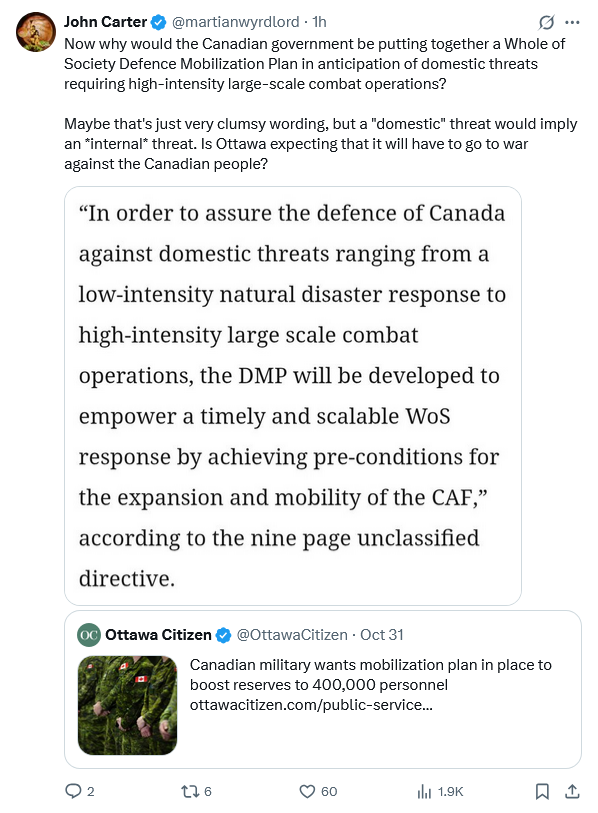
The Canadian military has set in motion an initiative to increase the number of its part-time soldiers from the current 28,000 to 400,000 as part of an overall mobilization plan, according to a directive approved by senior leaders.
The directive, signed by Chief of the Defence Staff Gen. Jennie Carignan and defence deputy minister Stefanie Beck on May 30, 2025, outlines the need to increase the current reserve force from 23,561 to 100,000 and supplementary and other reserves from the current 4,384 to 300,000.
Beck and Carignan approved the creation of a “tiger team” which will work on setting the stage for a Defence Mobilization Plan or DMP to accomplish such a goal. That team will examine what changes are needed to government legislation to allow for such a massive influx of Canadians into the military.
Beck and Carignan pointed out that the plan would require a Whole of Society or WoS effort, meaning that all Canadians would have to contribute to the initiative.
“In order to assure the defence of Canada against domestic threats ranging from a low-intensity natural disaster response to high-intensity large scale combat operations, the DMP will be developed to empower a timely and scalable WoS response by achieving pre-conditions for the expansion and mobility of the CAF,” according to the nine page unclassified directive.
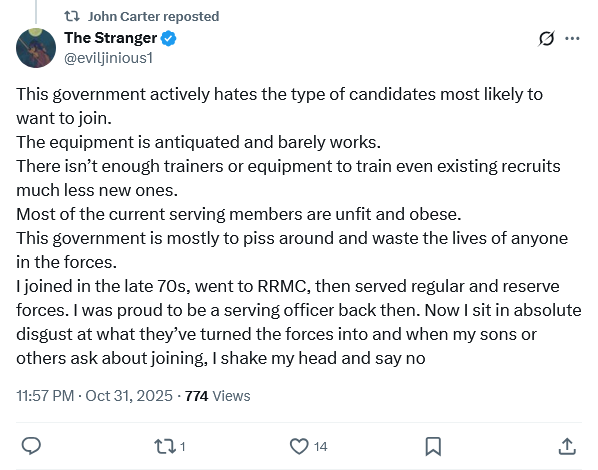
The initiative has drawn some critical responses on the social media site formerly known as Twitter:
Comments Off on Canada finally getting serious about the military? Ignore the words and wait for concrete actions
Biryani from 16th Century India
Tasting History with Max Miller
Published 27 May 2025Basmati rice cooked with spiced ghee, lamb, onions, and chickpeas
City/Region: Mughal Empire | India
Time Period: 16th CenturyIt’s likely that the word biryani comes from Persian, which would have made its way to India with the Mughal court of the emperor Babur in the 16th century. The actual dish of rice and meat cooked with ghee, however, had been around for hundreds of years before that, appearing sometime in the Vedic Period (1500 B.C.E. – 500 B.C.E.).
Whatever its true origins may be, biryani carries influences of Indian and Mughal (and thus Persian) cuisine and is delicious. The spices make the whole house smell amazing, and the rice is simultaneously fluffy and has the richness of fried rice thanks to the spiced ghee. It’s a bit of work, but it is so, so good.
10 seer meat, 3 1/2 seer rice; 2 seer ghi; 1 seer gram; 2 seer onions; 1/4 seer salt; 1/4 seer fresh ginger; 2 dam garlic, and round pepper, cinnamon, cardamoms, cloves, 1 dam of each: this gives six dishes.
OF BREAD
… Bread is made in the pantry. There is a large kind, baked in an oven, made of 10 s. flour; 5 s. milk; 1 1/2 s. g’hí; 1/4 s. salt. They make also smaller ones. The thin kind is baked on an iron plate. On sér will give fifteen, or even more. There are various ways of making it: one kind is called chapáti, which is sometimes made of khushkah; it tastes very well, when served hot …
— Ain-i akbari by Abu’l-Fazl ‘Allami, 16th century
Comments Off on Biryani from 16th Century India
QotD: The “Blob”, aka the Deep State
The parasitic unholy alliance of Big Corporations, Big Government, Big Bankers and their entire fan club and cheer squad of supporters. Dangerously, this also includes the watchdogs: the Spy Agencies and large parts of the media. The Blob takes money from citizens, pays other parts of the Blob (eg USAID, The UN, The BIS, The World Bank etc), pretends to “help” some token victim group or environmental cause, or even to monitor or audit The Blob, but the outcome benefits The Blob more than the victims. They line their own pockets and increase their own privileges.
The Blob also includes a special category of “useful idiots” who naively assist them in looting Western Civilization. These people are paid in status or an illusory sense of purpose rather than money. They may not realize they are part of the self-serving Blob, and in the long run are not only harming the trees, birds and whales they say they want to save, but are harming their own health, wealth, national security, and worse, that of their children.
Jo Nova, “The Secret Ruling Class – Why the anonymous Blob needs to be invisible”, JoNova, 2025-07-18.
Comments Off on QotD: The “Blob”, aka the Deep State
November 1, 2025
MAGA is not a monolith, thank goodness
In The Line, Alex Muir looks at Canada-US relations (such as they are currently) and why MAGA not being a monolith is something Canadian politicians need to understand to stand any chance of successfully navigating our dealings with President Trump and his administration:

If there’s one thing that we’ve seen in recent days, as Donald Trump plays an endless game of “deal or no deal” with countries around the world, it’s that the current administration is volatile.
Why? One answer to that question is factionalism — to an extent that has enshrined unpredictability as a core operating principle of the second Trump term.
Canadians are particularly exposed to this. From north of the 49th, it looks like American policy is oscillating between nationalist populism, business pragmatism, tech conservatism, and social traditionalism. That is, however, a misreading. Administration policy is remarkably consistent if you focus on the current rather than the waves. First and foremost, the president and his team obsess over visible status, a game you can play through flattery or strength and symbolic gesture — there are winning examples of both.
In concrete policy terms, the Trump administration expects us to help them on missile defence, border control, and maritime security. They expect access to our resource and energy assets, on their terms. And they want our manufacturing sector to relocate to America. They also expect Canada to know its place as a loyal American ally.
Zoom out to the bigger picture and all the daily clutter can be understood as moves to advance, or at least attempt to advance, those broad goals. And that understanding, in turn, can help inform a successful Canadian response to U.S. actions.
[…]
You cannot understand what is happening today if you do not understand what factions hold sway within this new structure. I recommend thinking of the United States as a monarchy wearing a representative democracy’s clothes. Decisions do not rest in the administrative state, or even in a political party (like Hungary), they rest in the attention of a restless and aging president and those known to have his ear, and his trust. How close to the president a decision-maker is, and who else has a voice on any given topic, goes a long way toward explaining outcomes.
The various MAGA factions colonizing D.C. share several important background beliefs on Canada. First, and arguably most important, they don’t notice it much, and care even less. Second, they assume all foreigners want to be Americans, or are somehow defective if they do not. Third, Canadians look and sound so much like Americans that the latter assumption is magnified.
Fourth, there is a wide streak of Manichaeism in several of the factions that make up the administration, and the MAGA movement more generally. This means resistance, or even evasion, is quite likely to be taken as evidence of ill intent — or even outright evil intent — as opposed to the furtherance of legitimate competing interests. All of these are wrapped up in a fairly magnificent degree of self-involvement. America is so big, so rich, and so strong, that all administrations overwhelmingly focus on domestic issues and domestic politics since nothing that happens outside their borders is generally seen as existential. (Whereas American elections and culture wars absolutely are.)
For Canada, this has meant many things, none of them positive. We’ve seen the rapid (and apparently random) escalation of tariffs (so far mostly on specific goods, or things not explicitly covered by USMCA), plus the endlessly repeated threats of higher duties in response to perceived Canadian provocations. There have been threats and intermittent moves to sideline Canada from vital security relationships, including the Five Eyes and NORAD. Canada has committed to some initiatives in order to satisfy American demands, like intensified border enforcement initiatives and committing new resources to national security priorities. It is difficult, however, to get out in front of a rapidly moving target in terms of the administration’s desired outcome.
And that’s the crux of the matter — what do the factions of the administration see when they look at Canada, and what do they want? Answering that question involves understanding what the factions are. The following summary of the factions within MAGA has been condensed from my other work, and should help Canadians understand the complexity of what we must face.
Comments Off on MAGA is not a monolith, thank goodness
EBTpocalypse imminent?
The US government’s extended “shutdown” may trigger the loss of Supplemental Nutrition Assistance Program (SNAP) benefits to around 10% of America as of Saturday. A few years ago, Nathan Mayo pointed out that despite the good intentions of the SNAP program, it isn’t actually doing the job it is meant to be performing:

A recent administrative action has permanently increased benefits for the Supplemental Nutrition Assistance Program (SNAP) by 25 percent. Unfortunately, this historic boost fails to address the structural problems that plague this nearly 60-year-old program.
The official Supplemental Nutrition Assistance Program (SNAP) webpage proudly proclaims that, “SNAP provides nutrition benefits to supplement the food budget of needy families so they can purchase healthy food …”
To that admirable end, the program formerly known as food stamps distributed $79 billion to 40 million people last year. Yet this desire to provide wholesome food to needy families conflicts with clear evidence that wholesome food is not what they think they need. Whether they play by the rules or not, people receiving SNAP benefits currently spend between 70-100 percent of that benefit on things other than healthy food.
Government researchers determined that average SNAP recipients increase their food expenditure by only 30 percent of the value of their benefits. In other words, a person previously spending $300 on food a month who qualifies for $100 of food stamp benefits will start spending $330 on food and shift the $70 from his existing budget to other purposes. This surprisingly low percentage suggests that food is not recipients’ top priority, as people who were in dire need of food would be expected to boost their food budget by the full value of the benefits.
What of the hope that needy families will buy nutritious food? According to a study of a major retailer, recipients spend about 20 percent of their total grocery budget on junk food, with soft drinks as the top purchase—enough to supply a family of four with 20 two-liters of soda per month. Given the marginal amount of SNAP spent on food and the typical benefits for a family, SNAP literally expands the grocery budget by the exact amount needed to cover the junk food. SNAP recipients also spend about 27 percent less on fruits and vegetables than non-SNAP households. This difference cannot be attributed to a lack of access because around 85 percent of SNAP purchases are made at large chain grocery stores with vast produce selections. However, one factor in these choices is likely smaller grocery budgets and the fact that fresh produce is more expensive.
A less savory contributor to this poor nutrition may be that SNAP encourages unhealthy purchases through the “house money” effect. When gamblers win money, they are less careful with their winnings since they view the “house money” as more disposable than their own cash. Similarly, when people receive SNAP dollars, they are sometimes less careful about their purchases than they would be with their hard-earned dollars.
On the one hand, the lack of SNAP benefits might be lower impact than expected, or it might mean most major American cities go “full Mad Max“:
There are 41.7 million Americans slurping up Supplemental Nachos And Porkrinds (SNAP) benefits. That’s an amazing number, and it shows just how far down the bread and circuses route that we’ve gone. I was surprised at the number, but I can now surmise that the only people voting for Democrats are single white women and freeloaders. But I repeat myself.
The federal government shutdown is, as I write this, dragging into its fourth week. I’m generally pretty happy about that since the impact to almost everyone I know is … zero. However, that may soon change. EBT cards, (EBT stands for Entitled Bums Treats) are about to have a zero balance.
The Democrats in the Senate have voted a dozen times as I write this to not fund the SNAP (Socialist Nourishment And Pampering) program. The reason? This is one of their key weapons against Trump. They want to blame Trump for not having a budget because it won’t fund the SNAP (Scam Network for Appetite Pandering) program. Since people who use EBT (Endless Bailout for Takers) aren’t generally the ones who pay attention to anything that takes longer than 17 seconds, they’ll buy it.
Some states (Virginia, for one) realize that the place will look like Mad Max in by Monday if the pizza rolls stop flowing, and have found some cash in the couch cushions to kick the can down the road. New Jersey doesn’t even own a couch, so they have no money, and Connecticut has mobilized their National Guard for emergency ramen drops.
No more swiping for that purple drank or Hot Pockets®. When the EBT (Everyone But Taxpayers) card goes dry, life may get … interesting.
What will happen? “Mostly peaceful” flash mobs looting grocery stores. These flash mobs will make the 2020 riots look like a church picnic gone wrong because someone demanded gluten-free tofu.
Because SNAP (Subsidized Nuggets for Apathetic Parasites) isn’t just a program: it’s the duct tape holding urban America’s powder keg together. As mentioned, there are 41.7 million people, about 12.3% of the U.S. population, who rely on those cards for daily food.
H/T to Clayton Barnett for that link.
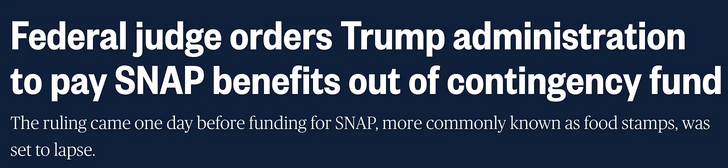
Oh, but wait … yet another judge has issued a ruling directing the federal government to ignore the lack of congressional approval or funding:
An order today from a federal judge in Massachusetts requires the Trump administration to pay SNAP benefits even though Congress hasn’t funded the current operation of the program.
Judge Indira Talwani, an Obama appointee, concludes that people will be harmed if SNAP benefits are not provided, and Congress previously appropriated contingency funds for emergencies in the SNAP program, so there’s no need for current appropriations — the executive branch must use emergency and contingency funds to pay for current operations despite the absence of current appropriations.
[…]
Defendants — the Trump administration — are required to use contingency funds to pay for current operations, whether or not Congress has funded current operations. A court has just concluded that a federal program must operate in the absence of current appropriations. That’s … an interesting choice.
Update, 3 November: Welcome, Instapundit readers! Please do have a look around at some of my other posts you may find of interest. I send out a daily summary of posts here through my Substack – https://substack.com/@nicholasrusson that you can subscribe to if you’d like to be informed of new posts in the future.
The Spanish-American War 1898
The Great War
Published 13 Jun 2025In the last years of the 19th century, tension was building in the Caribbean. American newspapers were filled with grisly reports of Spanish atrocities against the people of Cuba struggling for independence. US businessmen and expansionist politicians also saw practical opportunities in Spain’s struggles: great power status and an empire for the United States. It’s the Spanish-American War.
(more…)
Comments Off on The Spanish-American War 1898
QotD: Bullies
Theodore Dalrymple, interviewed by James Glazov in “Our Culture, What’s Left Of It”, FrontPage, 2005-08-31.
Comments Off on QotD: Bullies


