Quotulatiousness

November 21, 2025

“You too can be a Tactical Espionage Dollar-Store Hobo for less than $1000”

Filed under: Books, Military, Technology, Tools, USA, Weapons — Tags: , , — Nicholas @ 05:00

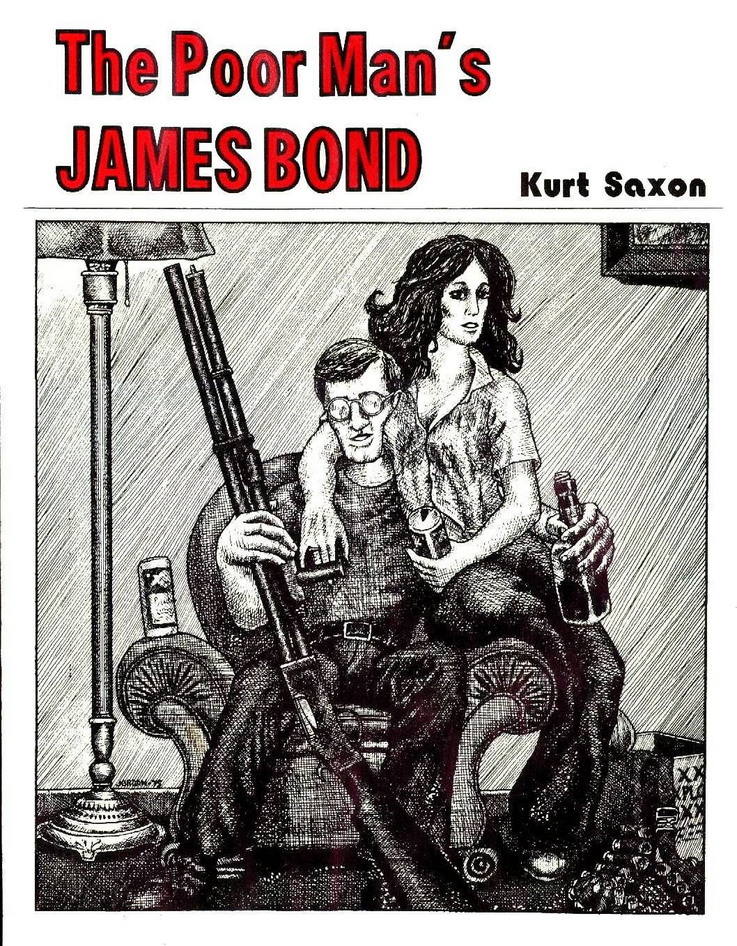
At Anarchonomicon, Kulak is at it again … this time it’s a long, long post about how to manage “James Bond tricks” without a “James Bond budget”.
I have now seen 5+ different spy films, In which a CIA or MI6 spy has to breach a chainlink fence. An ordinary chainlink fence.

There’s barb or razor wire up top that prevents our hero from just climbing it … So he or she has to breach it. And on FIVE SEPARATE OCCASIONS … I have seen the goofiest inventions in the world come out. $10,000 super-spy wrist watches with hidden lasers in them, super-secret hairpins with scissors in them made of magic cutting alloys, aerosol sprays that instantly oxidize and rust out a massive section of solid steel fencing (don’t breathe that spray) allowing the spy to just push out a Wile E. Coyote style hole of fencing …

Completely over-designed over-specific insanity that’d cost thousands of dollars, and would basically instantly betray the CIA or MI6 was behind the breach …

Of course no sane human being would ever use those techniques even if they existed. The one semi-plausible breech I’ve seen is in Fight Club Ed Norton and Brad Pitt toss a rug over the razor wire surrounding a medical facility so they can climb the fence … but even this strikes me as profoundly unideal … Would you really want to PLAN on risking nasty lacerations climbing OVER razor wire? That seems more like a desperate break-out trick. Not a Break-in trick.

Of course this is all insane because BREACHING A FENCE is maybe the most SOLVED problem out there, 80% of people reading this already have the tools to do it.

You just use wirecutters or a multitool. Ideally creating a single vertical slit so you can crawl through without the breach being visible unless you look very closely. (be sure to fold the slit back as you crawl so you don’t cut yourself on the jagged edges.

Often the crappiest $15 Chinese Multi-tool is up for the task (although test it out on a random fence on a walk before you gamble on it).

(Note that a “Leatherman” is just a good make of multitool, and outperforms even larger wire-cutters … Your cheepo crappy surplus multi-tool will take more elbow grease (if it works, test it))

Almost everything on the pop-culture side of the tactical world is like this … There’s an obsession with ultra-expensive James Bond scifi inventions that double as a luxury brand to match your tuxedo … When in reality the cheapest rusty junk from your granddad’s tool shed probably gives you vastly more capability.

And even In the world of prepping, tacticool influences, camping, modern combat, and all matters “survival”, “guerilla”, and “outdoors adventure” there’s an intense focus on expensive kit.

All your favorite influencers are sponsored by various product sellers, and half the reason people watch them is for the vicarious or personal thrill of collecting expensive Gucci kit and showing off their rare or designer rifles and Military Artifacts.

Most will assemble load-outs, rigs, and rifles, far less as a preparation for disaster or war, or an exercise in capability expansion, and more as an artistic expression, fashion statement, or historical exercise … Whether they will admit it or not most of the people who buy Yugoslavian combat webbing, or archaic experimental 80s rifles meant for an upcoming war in the scifi future of 2005 have more in common with historical reenactors than they might care to admit … They just chose wars that didn’t happen towards the end of the cold war, instead of The American Revolution, 1812, or the Civil War.

It’s astrology for boys!

As such one could be forgiven for believing that the great wars of the 21st century to come, and the Urban Battlefield that much of the world is quickly becoming, is a “pay to win” combat-zone. And that unless one has close to 100,000 dollars for body Armour, thermal vision, night vision, precision optics, gucci rifles, and all manner of overpriced gadgets and gizmos that they are simply screwed in any 21st century conflict.

This is not the case. Indeed in some cases it is almost the opposite: given how mass surveillance defines the modern battlefield, there’s a lot of kit I wouldn’t want to use just for risk of dropping it and the Glowies tracking down the only 10-20 people who’ve ordered Czechoslovakian Mag-Pouches via NSA copies of online transaction records, or by just calling the 3 sellers who ever had them.

Put simply Skill, knowledge, resourcefulness, and a more than abundant paranoia are more overpowered than almost anytime since the neolithic period … Basic resourcefulness, daring, courage, B-Grade high-school shop-class craftiness, low level chemistry knowledge, basic boy-scout skills, physical fitness (tall order I know), and a nigh primitivist obsession with the pre-computer way of doing things … Is sufficient to achieve a shocking level of capability and inflict an extraordinary level of damage in any near-future conflict, tyrannical regime, or low intensity resistance.

The most important kit in any future conflict isn’t free. But it is near free.

Available at shockingly low prices from dollar-, convenience-, hardware-, surplus-, grocery-stores, and pawn shops … The necessary equipment and capabilities to fight a high impact Guerilla Campaign are available in almost any town of 20,000 almost anywhere in the western world.

Sadly in spite of being largely legal throughout most of the US and not a few odd other countries (assuming one navigates the proper tax stamps and legal statements) I will not be presenting a guide on how to manufacture black-powder, explosives, firearms, or more exotic weaponry … This is all largely trivially covered by Chemistry Youtube in a level of detail I could never hope to match and with a level of responsibility and maturity far beyond my juvenile imagination, and with a level of expertise and experience I cannot pretend to … Seriously! Chemistry/explosive Youtube is really cool, Some of this stuff is should be taught in schools, so historically relevant and useful is it.

If one Navigates to my Earlier “Warlord’s Reading List” you’ll find many listed works (not least published by the US, Canadian, British, and Swiss Governments) that give detailed guides to the manufacture of explosives, chemical weapons, rocket weapons, improvised firearms, homemade flamethrowers, etc … All from other publishers that I can gesture at without exposing me to legal risk and most of them largely available online in PDF form, or from Amazon, and sometimes from the governments themselves.

The EU (with NATO) as a substitute empire

Filed under: Europe, Government, History, Military, USA — Tags: , , , , — Nicholas @ 04:00

On his Substack, Lorenzo Warby discusses the European Union (and its essential military support, NATO) as an imperial subsitute in a post-imperial age:

Historian Timothy Snyder makes an argument in various lectures and on his Substack that what became the EU was a replacement for empire. I think he is right, but not in the way he suggests. Prof. Snyder holds that what became the EU is an economic replacement because he appears to believe that empire was economically beneficial to their metropole economies.

This seems clearly wrong. Every maritime imperial metropole got richer after it lost its empire. This is true whether they were part of what became the EU or not: the obvious example of the latter being Japan and its dramatic postwar economic success after being stripped of its empire and devastated by American bombing. For the economies of all the former maritime-empire states, access to the US market, and the US-led maritime order, was much more valuable, and way cheaper, than empire.

It is not clear that even Britain made a “profit” from its Empire, once you consider military and administrative costs. Portugal had the largest maritime empire — relative to the size of its metropole — for longest and is the poorest country in Western Europe. Compare that to rather wealthier land-locked Switzerland, which never had an empire.

Empires are what states do.1 It is foolish to presume that any particular state action is beneficial to those that a state rules. Having an empire increases the power of state, and the opportunities within the state apparat. That is more than enough to motivate territorial imperialism, whether by land or by sea.

Conspicuous absences

A conspicuous absence from Prof. Snyder’s analysis of what-became-the-EU is NATO. There are a lot of regional economic cooperation organisations around the word. None of them are remotely as integrated as the EU because none of them have the equivalent of NATO.

In order to pool sovereignty within the EU, states first have to have their territorial sovereignty guaranteed. This guarantee is precisely what NATO provides.

The post-Versailles European order of 1919-1939 was unstable because it interspersed between Germany and the Soviet Union a series of small states that the victors of 1914-1918 could not readily reach. NATO has two huge advantages that the nation-states of Eastern Europe did not have in the 1919-1939 period — NATO is a geographically contiguous alliance and it includes the United States. The purpose of NATO, in the famous words of its first Secretary-General, being:

    to keep the Soviet Union out, the Americans in, and the Germans down.

In other words, the purpose of NATO was to provide a comprehensive solution to the structural weakness of the 1919-1939 Versailles order. A solution that the countries of Eastern Europe availed themselves of as soon as they could.2

The other conspicuous absence from Prof. Snyder’s analysis of the EU as a substitute to empire is Oceania. His analysis is deeply “(North) Atlantic”. It looks much less impressive from a Pacific perspective.

Japan was a maritime empire which lost the Second World War. It did not join anything like the EU. Australia gave up its (small) maritime empire. It also did not join anything like the EU. Both are very much postwar economic success stories. Participating in the maritime order with good internal institutional structures was enough: no other substitute for empire was needed for economic success.


  1. The Conquistadors were a mixture of private adventurers and state agents, but their conquests were incorporated by the imperial Spanish state. The use of corporations as instruments of imperial expansion — most famously the Dutch and British East India Companies — was an unusual feature of European imperialism, but such companies were licensed by their state and their territorial holdings were eventually fully incorporated as state possessions.
  2. For all sorts of reasons, we should distinguish between the postwar order of 1945-1991 and the post Cold War order of after 1991. So much of contemporary madness only really got underway in the 1990s.

The “spat” between China and Japan is far more important than western media are reporting

Filed under: China, Japan, Media, Military, Pacific, USA — Tags: , , , , , — Nicholas @ 03:00

Claire Berlinsky explains why we should be paying far more attention to what our media are treating as a minor diplomatic spat as Beijing reacts furiously to the new Japanese PM’s comments:

You need to see the Chinese media today to get a feel for this. Front pages of the relevant organs are devoted to frothing in fury at Japan. They’re rectifying bad thoughts like a house on fire.

Here’s why I’m worried by this. Both the Chinese- and Japanese-language press are treating this as a major diplomatic incident. (In English, it’s mostly being described as “a row” or “spat” — then back to Trump and Epstein.) Let me walk you through what it looks from Beijing and Tokyo, with help from ChatGPT on the translations.

The trigger was a comment in by the new Japanese prime minister, Sanae Takaichi. She told a parliamentary committee that a Taiwan contingency involving the use of force might constitute a “sonritsu kiki jitai” (a “survival-threatening situation” — I think we’d use the phrase “existential threat”) for Japan under its 2015 security laws, and justify the exercise of collective self-defense, using Japan’s self-defense forces.

Beijing exploded. China summoned the Japanese ambassador in Beijing for a formal démarche, and it allowed the PRC consul general in Osaka, Xue Jian, to post a (now-deleted) tweet calling for her decapitation—”that dirty head that trespassed should be cut off, are you ready?” The Xue Jian post has, of course, become a media event of its own. Beijing issued a travel advisory urging Chinese citizens to avoid Japan, and told students to “carefully reconsider” study plans. It stepped up coast-guard activity near the Senkakus, and cancelled the Xi–Takaichi bilateral at the G20.

But this arid account doesn’t begin to convey the way the Chinese and Japanese media are talking about this. The Chinese coverage is nothing short of hysterical. To read the Party-line outlets, you’d think Takaichi had just ordered the immediate re-invasion of Manchuria. Her comment, they said, was an evidence of a “dangerous rightward turn” in Japanese politics. They’re calling it a “sky-collapsing opening“, accusing her of “reckless ranting” and tearing up the China-Japan relationship.

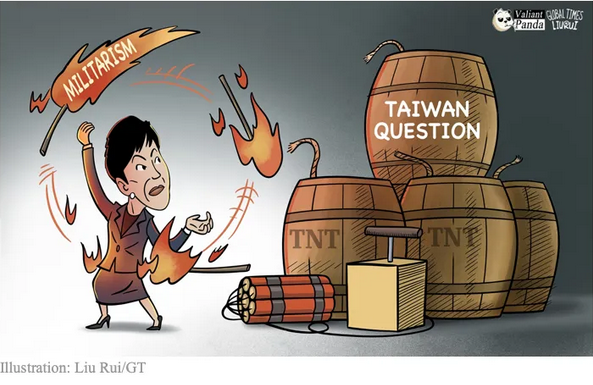
The headline in a widely circulated China Daily article:”If China and Japan go to war, Japan will be destroyed“. They found the inevitable panel of “peace-loving international friends” — including Okinawan peace activists and pro-PRC overseas Chinese — to denounce Takaichi as the reincarnation of “Japanese militarism”. The peace activists dutifully warned that the Japanese people would be “dragged into catastrophe” by their government. A CNR column accuses her of “brazen provocation”, and claims that “Taiwan compatriots are also outraged” at the prospect of Taiwan being turned into a battleground between China and a “militaristic” Japan.

The Party line: Taiwan is a “settled” internal issue; any talk of Japanese collective self-defense in the Strait is aggression and a “serious violation” of the post-1945 order. Takaichi represents “unrepentant militarism.” Chinese pieces quote her opponents at length to argue that “sober Japanese elites” are deploring her recklessness. Chinese-language coverage of the travel advisory is not treating it as a minor consular notice. They’re claiming it’s the first coercive step.

In Japan, this is front-page foreign policy news, not a minor gaffe. Mainichi ran an editorial saying, more or less, that Takaichi’s words were legally consistent with the 2015 security laws, but prime ministers should be more discrete about hypothetical military contingencies and show more prudence. Opposition figures are saying she “went too far” and threw the relationship into “a very grave state”. They called it “frivolous” for a commander-in-chief to talk so specifically about use-of-force scenarios.

On the other hand, there’s clearly a domestic constituency that sees this as long overdue. Some in her party see any hint of retraction as “weakness toward China”, and they’re praising her for drawing a firm line on Taiwan. (The coverage about whether to expel Xue Jian is divided: His post was a death threat, obviously, but the Foreign Ministry seems reluctant to escalate this further.)

TV explainers are reminding viewers that the 2015 security legislation already contemplated a Taiwan contingency — what’s new is that the prime minister has now said this out loud. And a prime minister with an openly revisionist profile — that’s definitely new.

So there’s a lot of signaling going on. Beijing is signaling to its own public: “We’ll never again let Japanese militarism threaten China. The Party is the bulwark against a repeat of the 1930s.” To Tokyo: “We’ll punish any step toward military involvement in the Strait, first with economic coercion — then worse. We are not kidding about this.” To the wider region and Washington: “Japan is a destabilizer — this woman isn’t right in the head. If things go wrong in the Taiwan Strait, blame Tokyo. Remember Pearl Harbor.”

Update, 23 November: Welcome, Instapundit readers! Please do have a look around at some of my other posts you may find of interest. I send out a daily summary of posts here through my Substackhttps://substack.com/@nicholasrusson that you can subscribe to if you’d like to be informed of new posts in the future.

URZ: Czech Prototype Universal Modular Weapon

Forgotten Weapons
Published 7 Jul 2025

The URZ (Univerzální Ruční Zbraň, or Universal Hand Weapon) was a 1966 project designed by Jiří Čermák (designer of the vz.58 rifle). He envisioned a weapons system family with largely interchangeable elements that could be configured as a service rifle, carbine, light machine gun, vehicular machine gun, or precision rifle. The Czech military was not interested, but Čermák was able to convince the government to allow its development for export instead.

The design is a delayed-blowback system using rollers, and belt-fed. The first few examples were made in 7.62x39mm, but development switched to 7.62x51mm NATO in a rather surprising move. Presumably this was intended for sale to unaligned nations who were interested in the NATO cartridge, but still — seeing its development in then-communist Czechoslovakia is pretty unusual. Ultimately only 9 examples were built before the project was abandoned.

Thanks to the Czech Military History Institute (VHU) for graciously giving me access to this one-of-a-kind prototype to film for you! If you have the opportunity, don’t miss seeing their museums in Prague:
https://www.vhu.cz/en/english-summary/
(more…)

QotD: Why did the (western) Roman Empire collapse?

Filed under: Europe, History, Military, Quotations — Tags: , , , , — Nicholas @ 01:00

But if the Roman Empire (in the West) went down fighting, why did it collapse? Of course there is no simple answer to that question. The mass migrations of the fourth and fifth century clearly played a very large role, but then the Romans had defeated other such migrations (recall the Cimbri and the Teutones) before. There are strong indicators that other factors, unrelated to our current topic were also at play: the empire had been economically weakened by the Crisis of the Third Century, which may have disrupted a lot of the trade and state functions that created the revenue to fund state activity. At the same time, the Crisis and the more challenging security situation after it meant that Roman armies grew larger and with them the burden of paying and feeding the soldiers which further hurt the economy. Meanwhile, long exposure to Roman armies on the frontiers of the empire had begun to erode the initially quite vast qualitative advantage the Romans enjoyed; the gap between Roman and “barbarian” military capabilities began to shrink (although it never really vanished altogether in this period). But some of the causes do bear on our topic but in quite the other direction from what the Niall Fergusons of the world might assume.

Let’s start with the foederati.

After the Constitutio Antoniniana, there was no longer much need for the auxilia, as all persons in the empire were citizens, and so the structure distinction between the legions and other formations fades away (part of this is also the tendency of the legions in this period to be progressively split up into smaller units called vexillationes, meaning that the unit-sizes wouldn’t have been so different). But during the fourth century, with frontier pressures building, the Romans again looked for ways to utilize the manpower and fighting skill of non-Romans. What is striking here is that whereas in some ways […] the auxilia had represented almost a revival of the attitudes which had informed the system for the socii, the new system that emerged for using foreign troops, called foederati (“treaty men”) did not draw on the previously successful auxilia-system (which, to be clear, by this point had been effectively gone for more than a century). Instead, the Romans signed treaties with Germanic-speaking kings, exchanging chunks of (often depopulated, war-torn frontier) land in exchange for military service. Since these troops were bound by treaty (foedus) they were called foederati. They served in their own units, under their own leaders, up to their kings. Consequently, all of the mechanisms that encouraged the auxilia to adopt Roman practices and identify with the Roman Empire were lost; these men might view Rome as a friendly ally (at times) but they were never encouraged to think of themselves as Roman.

The reason for this different system of recruitment seem to be rooted in financial realities. The Roman army had already been expanded during the Crisis of the Third Century and only grew more under Diocletian and Constantine, probably by this point being between 400,000 and 500,000 men (compared to 300,000-350,000 earlier in the empire). Moreover, Diocletian had opted to reform the empire’s administration with a much more intensive, top-down, bureaucratic approach, which imposed further costs. Taxes had become heavy (although elites were increasingly allowed to dodge them), the economy was weak and revenues were short. The value of the foederati was that the empire didn’t have to pay them; they were handed land (again, in war-torn frontier zones) and expected to use that to pay for their military support. At the time, it must have seemed a brilliant work-around to get more military power out of a dwindling tax-base.

(I feel the need to note that I increasingly regard Diocletian (r. 284-305) as a ruinous emperor, even though he lacked the normal moralizing character flaws of “bad emperors”. While he was active, dedicated and focused, almost all of his reforms turned out to be quite bad ideas in the long run even before one gets to the Great Persecution. His currency reforms were catastrophic, his administrative reforms were top-heavy, his tax plan depended on a regular census which was never regular and the tetrarchy was doomed from its inception. Diocletian was pretty much a living, “Well, You Tried” meme. That said, to be clear, Diocletian wasn’t responsible for the foederati; it’s not quite clear who the first foederati were – they may have been the Franks in 358, which would make Julian (as a “Caesar” or junior-emperor under Constantius) the culprit for this bad idea – he had a surplus of those too.)

The problem, of course, is right there: the status of the foederati made it impossible for them to ever fully integrate into the empire. They had, after all, their own kings, their own local laws and served in their own military formations. While, interestingly, they would eventually adopt Latin from the local population which had already done so (leading to French, Spanish and Italian) they could never become Roman. That wasn’t always their choice, either! As O’Donnell (op. cit.) notes, many of these foederati wanted to be “in” in the Roman Empire; it was more frequently the Romans who were busy saying “no”. It is striking that this occurs in a period where social class in the Roman world was generally calcifying. Whereas citizenship had been an expanding category, after the Constitutio Antoniniana, the legal categories of honestiores and humiliores (lit. “respectable” and “humble” people, but in practice, “wealthy” and “commoners”) largely replaced citizenship as the legal dividing lines of Roman society. These were far less flexible categories, as economic social mobility in the ancient world was never very high. Even there, the tax reforms of Diocletian (with some “patches” under Constantine) began, for tax purposes, to tie tenant farmers (“coloni“) to their land, essentially barring both physical and economic mobility in the name of more efficient tax collection in a system that strongly resembled later medieval serfdom.

Nevertheless, the consequence of this system of organization was that as often as the foederati provided crucial soldiers to Roman armies, they were just as frequently the problem Roman armies were being sent to address. Never fully incorporated into the Roman army and under the command of their own kings, they proved deeply unreliable allies. Pitting one set of foederati against the next could work in the short-term, but in the long term, without any plan to permanently incorporate the foederati into Roman society, fragmentation was inevitable. The Roman abandonment of the successful older systems for managing diverse armies (on account that they were too expensive) turned the foederati from a potential source of vital manpower into the central cause of imperial collapse in the West.

Bret Devereaux, “Collections: The Queen’s Latin or Who Were the Romans, Part V: Saving and Losing and Empire”, A Collection of Unmitigated Pedantry, 2021-07-30.

Powered by WordPress