Quotulatiousness

November 18, 2025

Canada’s divide isn’t left versus right, it’s old versus young

Older Canadians seem to be taking joy in sticking up their elbows and robbing younger Canadians of opportunities, jobs, and hope. It’s quite literally un-Canadian, but the Boomers have always been a generation apart and this is merely the latest manifestation of their self-centred worldview. Alexander Brown wonders if this divide can be fixed before the country itself is ruined:

“eLbOwS uP!”

“Talk to your parents,” the host of an event for Pierre Poilievre joked on Saturday in Vancouver — an event I happened to attend. “But be patient. Be kind.” And he’s right.

The cross-talk, the rock’em sock’em robots, the continued slap-fight between warring consultant tribes, it isn’t getting us anywhere, clearly. When the present iteration of the party of the status quo wedges a nation against itself, and denies a reform election after a decade of haphazard redistribution, non-growth, and abject decline, you get a traditional voter-demographic breakdown flipped entirely on its head.

The party of seemingly endless opposition dominated with youth, held strong with the 35-54s, but found itself walloped 52% to 34% among those aged 55+. Since then, those 55+ numbers have only widened, as the “safe” choice, that more stately actor (when he’s not radicalizing those who don’t know any better with claims of false invasion) can do little wrong, even coming out of “middling” budget heading to a vote Monday, and with a nation remaining pessimistic about its future prospects.

If the Liberals are voted down Monday, they would likely relish that opportunity to seize on a majority. The spin is already built in.

    The Conservatives don’t want to stand up against Trump!

    At a time like this, when we should be coming together, it’s un-Canadian …

    We’re supposed to be one Team Canada right now (offer void in British Columbia, Ontario, and Quebec), we can’t afford Pierre Poilievre’s divisive Trumpiness.

On and on. Yada and yada.

Nowhere in that comms exercise, drummed up by those who spend more time in America or the Arab Emirates, or meeting with Chinese proxies than they’d publicly care to admit, would there be a defence of younger Canadians, of those still on the launch pad, worried about, say, supposed ‘fixes’ to immigration riddled with creative accounting and more of the same.

Nowhere would they address housing, set to get much, much worse, under both the federal Liberals and targets they’re admitting they won’t come close to hitting, and Ontario’s ‘Conservative’ premier who leads the galaxy in not getting off his ass to get out of the way on starts and lowering punitive development costs.

Nowhere would one find a stout defence against “deconstruction“, or the daily humiliation ritual of flags flying that aren’t our own, or imagined and inflated woke excess meant to sully the memory of our war dead and marginalize normal people.

Following recent debates sparked by Without Diminishment, where we’ve argued a version of “it’s not just the economy, stupid,” when it comes to what’s animating young people and young conservatives — actually talk to them, and half of them are trending towards fascism with how alienated they feel by a lack of upward social mobility, or a society without rules or those willing to enforce them — it’s been easier for some serving in established camps to mischaracterize these conversations as focusing too much on culture, or, ridiculously, “blood and soil nationalism”. But we’re not. If one is dealing in good faith, it’s plain to see we’re trying to talk about both.

Of course, the Liberals survived Monday’s budget vote … for now:

When I saw Elizabeth May stand up and ask Mark Carney what looks like a completely planted question, I assumed the budget would pass and I was correct. Planted questions normally come from government MPs and are a soft way for the government to push their agenda.

This time, it wasn’t a Liberal MP, well at least not a Liberal MP in name and fact. Instead it was Green leader, or deputy leader, or let’s be honest the lonely lady in the corner who is the only Green MP asking the question.

That statement put the Liberals one vote closer to passing their budget and of course May later confirmed ahead of the vote that she would back the budget. This was after saying couldn’t back the budget, might back the budget, would probably back the budget, definitely wouldn’t back the budget and finally would back the budget.

How anyone can take Elizabeth May seriously is beyond me.

How the other votes went…

Ahead of the vote there were lots of questions about how things would go. Would all MPs show up or be able to vote online? Would people abstain? Would MPs vote for the budget without crossing the floor?

In the end, the budget passed 170 to 168 with two NDPers abstaining. That leaves five votes not accounted for and we will figure out.

Here is how the vote went.

Now, some members who were not in their seats did vote electronically. I didn’t see Matt Jeneroux vote electronically and I’m told that he is in British Columbia with is family. Also not voting, Conservative MP Shannon Stubbs.

Conservatives Andrew Scheer and Scott Reid both voted no but only in the time that is allowed for MPs voted electronically to claim tech problems. They were both in the House, so why were didn’t they vote in person?

Regardless, the NDP rushed out to say they voted against the budget but also made sure that it passed with their two abstensions.

As for all this talk of a Christmas election, had the government lost this vote and the PM gone to see the Governor General tomorrow, the earliest election date would have been December 25.

A Christmas election.

Canada’s major projects announcements are an economic “hostage release” program

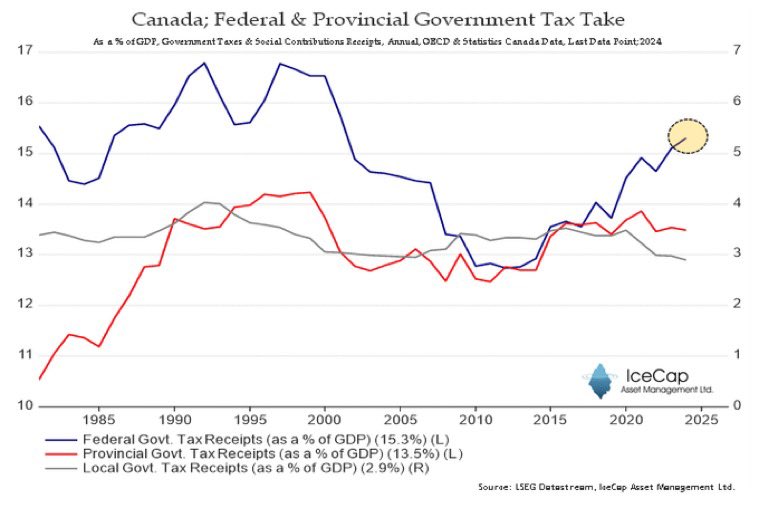
On the social media site formerly known as Twitter, David Knight Legg vents about Dear Leader Carney’s penchant for even-more-Trudeauesque-than-Justin performative governing. Far more emphasis is put on the PR value of an announcement than on the common sense practicality of the thing being announced. And Carney is also starting to re-announce already announced “projects” as if speaking it aloud will magically manifest it into reality:

Canada’s major projects announcements are a national embarrassment — an economic “hostage release” program — that tells the world just how uninvestible Canada has become under the Liberal party.

1970s central planning Liberal govt arrogance is at an all time GDP destroying high.

Try naming another OECD nation (we’re at the bottom now) where the press waits with bated breath for a “dear leader” politician who has never built anything in his life to fly in to grant a bureaucratic benediction on a few projects his bureaucrats will allow past the gate of the caps, taxes, green rules and red tape his govt imposes on everything.

Idea: set up the Major Dumb Redtape office in Calgary instead and get rid of the 10 anti-business rules written into law by the Montreal green alarmist fringe that’s holding Canadian energy, ag, forestry, and manufacturing back while other nations grow …

But PM Carney seems to like his bureaucratic power over what used to be a leading free market economy. Even while our GDP grinds down to the worst in the OECD.

The arrogance is breathtaking.

So is the ineptitude. This same central planning genius just punched a record new $78billiom hole through our public finances because he can’t manage basic public service delivery without more crushing debt.

The budget is a train wreck solidifying the final year of a Liberal decade steeply eroding purchasing power, national wealth, personal security and living standards and public services.

The irony is that this has driven Canada to ever-greater 51st state economic dependency. Donald Trump didn’t do that. They did.

But he’s been a too-convenient way to con the elderly with “elbows up” PR.

But should the next generation really be forced to lend this govt another $78bn in addition to the 1 trillion they’ve already taken to fund their failed decade of central planning, green slush funds and EV mandates while real infrastructure projects wait years for the Liberal party to bless them?

It’s not going to last.

Fitch just questioned the sustainability of all this. Unlike our lacklustre press they aren’t buying “net debt” or “operating/investment” Liberal financial illiteracy.

I had high hopes PM Carney would return fiscal sanity to Canada after openly borrowing Conservative policies to get elected by cutting the carbon and cap gains taxes.

But this budget, this major projects farce and his inability to kill a dozen economy killing rules of his own govt is showing the work how uninvestible Canada has become — and it’s accelerating national economic decline.

2026 is the end of the Liberal lost decade. First recession. Then debt downgrade. Then an election. And Carney can go back offshore to his assets and all the other global investors who like him don’t invest in Canada under Liberal mismanagement.

@SteveSaretsky thx for the brilliant line chart as usual.

A day later, after his post got significant attention on the social media site formerly known as Twitter, he posted this follow-up:

This angry post I wrote a day ago got 300,000 views.

Canadians are tired of the fake “major projects” PR by the same people who prevented those projects for a decade with their green taxes and prohibitions.

Announcing the release of 7 hostage projects is a joke. Some of these projects aren’t major and most aren’t new. None needed the govt to do anything but get out of the way from the beginning.

All the several hundred major projects still in purgatory need is for this govt to reverse their anti-job and anti-infrastructure tanker ban, industrial carbon tax, emissions cap, and electricity regs.

Oh — and also clarify by law that in Canada property rights are not overridden by leftist judges and UN wishful thinking.

Then get out of the way so a couple trillion dollars can flow in, major projects can get built and the govt revenue will flow to better public services — and to pay down that debt they just added $78bn to.

Vickers Heavy Machine Gun

Filed under: Britain, History, Military, Weapons, WW1, WW2 — Tags: , , , — Nicholas @ 02:00

Forgotten Weapons
Published 14 Dec 2016

I may be a bit biased here, but I believe that the Vickers gun is one of the best all-around firearms ever made. It was designed during an era of experimentation and craftsmanship, with a quality and care that would make it today prohibitively expensive. It was exemplary in action, and served in every environment on earth through six decades and in the hands of 50 different nations. It was an infantry gun, an aircraft gun, an armored vehicle gun, and a shipboard gun.

Captain Graham Hutchison recorded this account of the Vickers in action during an attack on High Wood in August 1916 (exerpted from “The Grand old Lady of No Man’s Land by Dolf Goldsmith):

“For this attack, [ten] guns were grouped in the Savoy Trench, from which a magnificent view was obtained of the German line at a range of about 2000 yards. These guns were disposed for barrage. On August 23rd and the night of the 23rd/24th the whole Company was, in addition to the two Companies of Infantry lent for the purpose, employed in carrying water and ammunition to this point. Many factors in barrage work which are now common knowledge had not then been learned or considered. It is amusing today to note that in the orders for the 100th Machine Gun Company’s barrage of 10 guns, Captain Hutchison ordered that rapid fire should be maintained continuously for twelve hours, to cover the attack and consolidation. It is to the credit of the gunners and the Vickers gun itself that this was done! During the attack on the 24th, 250 rounds short of one million were fired by ten guns; at least four petrol tins of water besides all the water bottles of the Company and urine tins form the neighborhood were emptied into the guns for cooling purposes; and a continuous party was employed carrying ammunition. Private Robertshaw and Artificer H. Bartlett between them maintained a belt-filling machine in action without stopping for a single moment, for twelve hours. At the end of this time many of the NCOs and gunners were found asleep from exhaustion at their posts. A prize of five francs to the members of each gun team was offered and was secured by the gun team of Sgt. P. Dean, DCM, with a record of just over 120,000 rounds.”

The attack on the 24th of August was a brilliant success, the operation being difficult and all objectives being taken within a short time. Prisoner examined at Divisional and Corps Headquarters reported that the effect of the Machine Gun barrage was annihilating, and the counterattacks which had attempted to retake the ground lost were broken up whilst being concentrated east of the Flers Ridge and of High Wood.

In 1963 in Yorkshire, a class of British Army armorers put one Vickers gun through probably the most strenuous test ever given to an individual gun. The base had a stockpile of approximately 5 million rounds of Mk VII ammunition which was no longer approved for military use. They took a newly rebuilt Vickers gun, and proceeded to fire the entire stock of ammo through it over the course of seven days. They worked in pairs, switching off at 30 minute intervals, with a third man shoveling away spent brass. The gun was fired in 250-round solid bursts, and the worn out barrels were changed every hour and a half. At the end of the five million rounds, the gun was taken back into the shop for inspection. It was found to be within service spec in every dimension.

During its service life, the Vickers was made in .303 British, .30-06, 0.50 Vickers, .50 High Velocity, 7×57 Mauser, 7.65×53, 8mm Mauser, 8mm Lebel, 7.7 Japanese, 6.5×54 Dutch, 7.9x57R Dutch, 7.62 NATO, 7.62x54R, 8x52R Siamese, 11mm Vickers, and three different 40mm cartridges.

The Vickers was retired from British military service in 1968, having finally become obsolete. Its GPMG role was taken over by the FN MAG, and its long range indirect fire role performed by 3″ mortars. The Vickers was a weapon which required training and dedication to master, but rewarded its users with phenomenal endurance and a wide range of capabilities. Among all contenders, only the Browning machine gun can attempt to compare to the outstanding qualities of the Vickers, and even the Browning fails to match the elegance of the stalwart Brit.

QotD: Echoes of the Thirty Years’ War

Filed under: Britain, Europe, France, History, Quotations, Religion — Tags: , , , , — Nicholas @ 01:00

It’s much easier to attack cultural institutions than political ones, and because the Church was also a political institution — a big one — it was convenient to attack a guy like Cardinal Wolsey, Tetzel the Indulgence Merchant, and so on. You can always frame it in the traditional medieval way: “The king has been led astray by his evil counsellors”. It’s not a coincidence that Reformed polities were also the most politically efficient; the Prods won the Thirty Years’ War, thanks in no small part to very Catholic France (under Cardinal Richelieu) adopting Protestant attitudes, strategies, and tactics.

The analogy only extends so far, of course. Hillaire Belloc has argued that the dissolution of the monasteries in England kicked out one of the three legs supporting English culture — by putting all that land and money under the State’s direct control (that “Tudor revolution in government” again), the State and the Economy are inextricably merged. It’s proto-fascism (recall that The Servile State was written in 1912). Not only is this true, it doesn’t go nearly far enough. Back in 1912, the Church was still alive as a cultural force. The Media was still at least somewhat capitalist — in competition for eyeballs — and in many cases led The Opposition, which also still existed as a cultural force.

Nowadays, of course, not only are the State and the Economy indistinguishable, they’re also indistinguishable from The Media. There IS no “opposition”; whatever anemic resistance to The State is stage managed like pro wrestling. Real dissidents are in the positions of recusants in Tudor England, except that the Church, instead of sending priests to minister to us in secret, is sending battalions of Inquisitors to help hunt us down.

In short, there’s no entry point for a new “Reformation”. As bad as the Period of the Wars of Religion was, gifted leaders had structural ways to achieve their objectives and keep the peace. Henry of Navarre could proclaim that “Paris is worth a mass”; Cardinal Richelieu could proclaim raison d’etat; the old Peace of Augsburg system — cuius regio; eius religio — could work well enough with a prince who understood his people and chose not to push too hard. “Separation of Church and State” wasn’t articulated as a formal political principle until the 19th century (and only there because it was badly misconstrued), but as a practical solution to politico-cultural problems it works just fine …

… provided you’ve got the structures in place to handle it, and we don’t. The Church, the State, the Economy, the Media, Academia, Technology … who can say where the one ends and the other begins? It’s all Poz, and there’s no aspect of our lives that the Poz doesn’t touch, because instead of separate and often competing socio-governmental structures, they’ve all merged. They’re ALL Poz.

Severian, “Reformation”, Founding Questions, 2022-03-07.

Powered by WordPress