
Quotulatiousness

November 3, 2025

“Vice-Admiral Angus Topshee more or less kiboshed the notion of building new submarines here in Canada”

Filed under: Cancon, Germany, Military, Weapons — Tags: , , , , — Nicholas @ 05:00

Assuming that this government or the next one follows through with current plans, the Royal Canadian Navy (RCN) will replace the four current British-built Victoria-class submarines with up to a dozen new subs based on either the German Type-212CD design or the South Korean KSS-III. There is no reason at all that these new submarines need to be built in Canada, as there is no existing shipyard with any experience in this kind of vessel and no chance that creating a domestic submarine industry would be anything more than a perpetual money-sink. Our existing shipyards can, at a stretch (and at a significant cost increase), build surface ships from small motorboats up to frigates, destroyers, and larger supply ships, but there’s always a hefty premium for building the hulls here because once the order is complete, the shipyard can rarely use that skilled workforce and their specialized expertise to build more ships for other navies, so the yards shrink, the workers move on and a decade or so later, we have to start all over again from basically nothing.

Submarines are even more specialized than the ships the RCN is likely to buy, and there’s almost zero chance an allied navy or a neutral power would choose to have submarines built in Canada. The head of the RCN, Vice-Admiral Topshee clearly recognizes this:
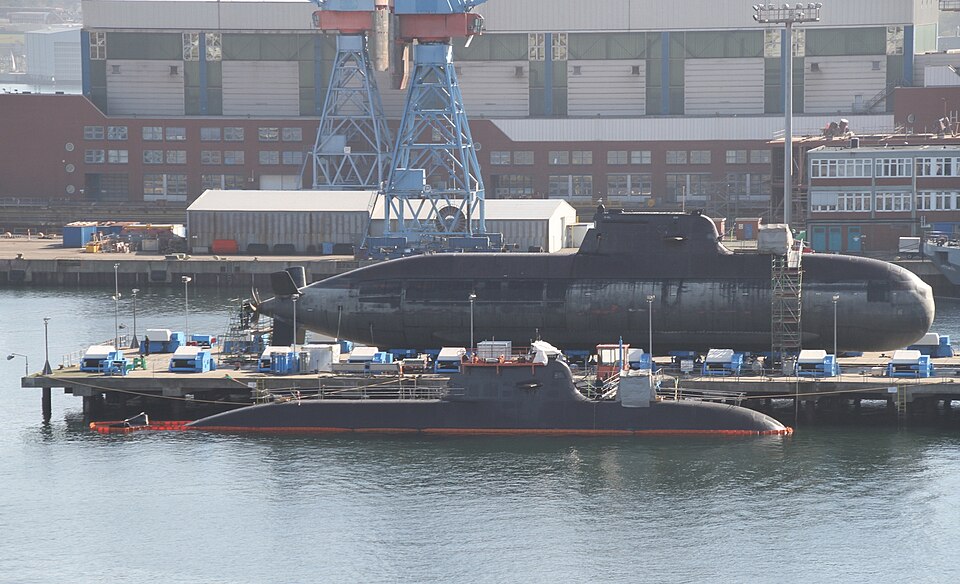
Type 212 submarines at the HDW shipyard in Kiel, Germany, 1 May 2013.
Photo by Bjoertvedt via Wikimedia Commons.

On Thursday in South Korea, Royal Canadian Navy Vice-Admiral Angus Topshee more or less kiboshed the notion of building new submarines here in Canada. He cited two major concerns: One, that we need these submarines “quickly.” And two, that our demand for submarines couldn’t possibly sustain an operation on its own.

“A submarine industry requires a consistent production line, and to be able to build enough submarines … to sustain a production line will be a real challenge,” Topshee said at the Hanwha Ocean Shipyard, where he, Defence Minister David McGuinty and Prime Minister Mark Carney tickled the periscope on one potential replacement for Canada’s aging-out Victoria-class subs.

Both Hanwha and ThyssenKrupp say it’s technically possible they could build the subs in Canada; it would just take a long time to lay down the infrastructure, and we’re in an uncommon hurry. We are assured plenty of Canadian steel and sweat will go into maintaining them.

And I suspect that won’t be very controversial, if at all. We’ve had American submarines, British submarines and German submarines in the past. Submarines are just something that are not made in Canada, like a lot of other things: jumbo jets, fighter planes, aircraft carriers, pineapples, cellular telephones, home electronics.

And we’re fine with it. Aside from the odd Avro Arrow obsessive, everyone seems to accept we’ll be buying new fighter jets off the peg from abroad — assuming we ever come to a final decision on which to buy, of course.

The question is, why isn’t that controversial? Or, why is it by contrast seen as controversial to buy surface vessels from abroad. Whoever’s fault it is, Canadian shipbuilding for the navy is a scrapyard of blown deadlines, outrageous cost overruns and sometimes outright failure. If we’re happy with South Korean or German subs, why not South Korean or German or Danish frigates and destroyers — or passenger ferries, for that matter?

Until this silly “elbows up” narrative took hold, no one seemed to care very much where our ferries were built: Marine Atlantic sails Chinese-built ferries between Cape Breton and Newfoundland with barely a whisper of controversy. But the entire political class is now essentially united against BC Ferries’ decision to buy Chinese ferries from the same shipyard. The fact that BC Ferries needs ferries almost seems like an afterthought.
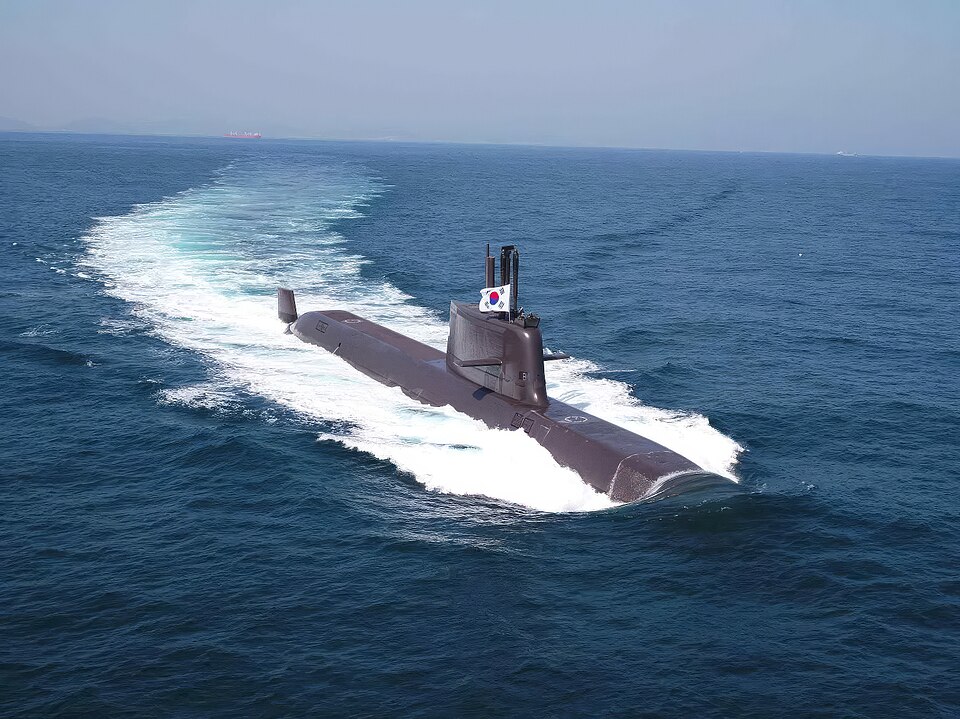
ROKS Shin Chae-ho, a KSS-III submarine at sea on 4 April, 2024.
Photo from the Defense Acquisition Program Administration (DAPA) via Wikimedia Commons.

Update: Noah posted a Q&A session with his readers that included some comparisons of the two contending designs for the Canadian Patrol Submarine Project (CPSP):

Q4. Have you had a chance to compare the AIP on the Ks III & 212CD yet with respect to Time underwater. There are different numbers floating around with new systems?

The truth is that no manufacturer is going to give you the accurate endurance. None. That is a closely guarded secret. I can say the KSS-III is higher, though out of respect for everyone and to not get myself in trouble I won’t say numbers. Both have endurance of several weeks and fit the HLMR.

I do plan to go into details about the systems themselves soon though, so I’m not leaving it alone!

Q5. The Type 212 has been described as an “ambush” submarine silently lying in wait for Russian subs. What advantages does the 212 bring to the Pacific?

Understand that both the KSS-III and Type 212CD are products of different needs and philosophies. Both focus on different strengths, in this case the 212CD puts almost all its efforts into being as stealthy and quiet as possible.

Its not just about ambush. Its about survival. The Type 212CD is designed to operate in the shallow, tight waters of the Baltic, and the littoral regions of the North Sea. That isn’t just about submarines but also being survivable against a dense field of Russian Maritime Patrol Aircraft and Anti-Submarine Helicopters.

That means a lot of effort was taken to ensure they’re as quiet and undetectable as possible. That’s where things like the Diamond-Shaped hull are supposed come into play, the use of non-magnetic stainless steel.

A lot of its value comes in what role you expect it to play. It is still an excellent asset in the littoral regions of the pacific, however it isn’t optimized for prowling around the open ocean, deep-diving nature of the Pacific. That is the domain of platforms like the KSS-III, at least in my opinion.

That doesn’t mean it can’t, but just as the KSS-III can also operate in the littoral regions of the Baltic doesn’t mean it’s optimized too. That’s the thing about CPSP. There’s a lot of requirements, a lot of different environments we expect these subs to operate in, and both [designs] focus on different priorities.

The advantages it has as a stealth-optimized platform don’t disappear. It could easily act in complement to other assets like U.S. and future Australian SSN [which] are more optimized for operations in the wider Pacific.

Strengths and weaknesses.

Update, the second: South Korea looks to be joining the nuclear-powered navy club with a new class of Korean subs to be built in Philadelphia using US navy nuclear propulsion technology.

South Korea has been wanting to get in the SSN club for a long time. Good on them for their persistence.

I’m not sure how this will work out. The Philadelphia Shipyard, even at its heyday, never built nuclear powered ships of any kind.

The South Koreans build a solid conventional submarine, the KSS-III that they offered to Canada recently, but nuclear submarines are at another level. Besides the infrastructure issues specific to nuclear shipbuilding at the shipyard that would need to be addressed, there is the fact that the U.S. nuclear workforce and hardware providers are already behind schedule with expected demands. While another yard is great, whoever is going to successfully solve those two structural issues needs superhuman abilities and one heck of a funding line.


Plastic Fantastic: How the Modern World Became Synthetic – W2W 051

Filed under: Europe, History, USA — Tags: , , , , , — Nicholas @ 04:00

TimeGhost History
Published 2 Nov 2025

From the miracle material of the 1950s to the global crisis of the 21st century — this is the story of how plastic reshaped our lives, our economies, and our planet.

Born from wartime innovation, plastic promised a future of convenience, color, and endless possibility. From nylon stockings to Tupperware parties, it defined modern life — light, bright, and disposable. But the same durability that made it revolutionary also made it permanent.

In this episode of War 2 War, we trace how postwar optimism turned into an age of overproduction and pollution — how a chemical miracle became the material legacy of the modern world. Join us as we uncover how the postwar dream of “Better Living Through Chemistry” changed everything — forever.
(more…)

The BC government “has been doing everything in its power to have Aboriginal title triumph across B.C.”

Filed under: Cancon, Government, Law, Liberty, Media, Politics — Tags: , , — Nicholas @ 03:00

A Fraser Institute commentary by Bruce Pardy addresses the role of the NDP government of British Columbia in undermining the established laws on land title in the province among other actions to the advantage of First Nations bands and to the definite disadvantage of ordinary British Columbians:

Recently, British Columbia Attorney General Niki Sharma said that fee simple title in private property is superior to Aboriginal title. She’s a day late and a dollar short. In fact, her NDP government, led by Premier David Eby, has been doing everything in its power to have Aboriginal title triumph across B.C.

A B.C. Supreme Court judge has granted several First Nations a portion of a 1,846-acre land claim on Lulu Island. B.C. Supreme Court

A few days earlier, the City of Richmond sent out a letter to more than 125 property owners warning them that the security of their land is in doubt. “For those whose property is in the area outlined in black,” the letter reads, “the Court has declared aboriginal title to your property which may compromise the status and validity of your ownership … The entire area outlined in green has been claimed on appeal by the Cowichan First Nations.”

The Richmond letter is a consequence of a recent decision of the B.C. Supreme Court, which awarded Aboriginal title over 800 acres of land in Richmond to the Cowichan First Nation. Wherever Aboriginal title is found to exist, said the court, it is a “prior and senior right” to other property interests, whether the land is public or private.

It is finally dawning on British Columbians that obsequious devotion to reconciliation is putting their land at risk. Sharma claimed that B.C. was pursuing multiple grounds of appeal, but that makes her a hypocrite. Her government did not robustly defend in court against the Cowichan claim. And in a dozen other ways, the Eby government has sought to put title and control of B.C. into Aboriginal hands.

In early 2024, it proposed to amend the province’s Land Act, which governs the use of Crown land in B.C. It planned to give B.C.’s hundreds of First Nations a veto over mining, hydro projects, farming, forestry, docks and communication towers. The government tried to consult quietly, but the backlash was immediate. It withdrew the proposals, promising to be more transparent. But it did not shelve its objectives or its plans. And did not deliver on its promise. Instead, it sought to make agreements over specific territories with specific Aboriginal groups, often negotiated covertly and announced after the fact.

In April 2024, the Eby government recognized Aboriginal title to Haida Gwaii, the archipelago on Canada’s West Coast. Around 5,000 people live on Haida Gwaii. About half are Haida, who voted overwhelmingly in favour of the deal. But non-Haida residents had no say. The Haida agreement says private property will be honoured, but private property is incompatible with Aboriginal title, which is communal. If Haida Gwaii really is subject to Aboriginal title, then no one can own parts of it privately.

Update: I forgot to include the URL to Mr. Pardy’s article … fixed now.

Swedish Kulspruta m/36 Double Browning MGs

Filed under: Europe, History, Military, WW2 — Tags: , , , , — Nicholas @ 02:00

Forgotten Weapons
Published 18 Jun 2025

Despite being a neutral power during World War Two, Sweden had a variety of very interesting small arms — like their dual-mount Browning m/36 machine guns. These were originally adopted because the Swedes wanted a heavier medium MG cartridge and didn’t think their delayed-blowback Schwarzlose guns could handle it. The cartridge was 8x63mm, pushing a 219 grain projectile at 2500 fps. The m/36 Browning was a water cooled gun, an improvement on the older M1917 design. It not only handled the powerful new round, but it could also be easily swapped to the older 6.5x55mm round to use stocks of existing ammunition (and it would be later adapted to 7.62mm NATO as well). Most of the guns were built as matching pairs for antiaircraft use, with mirrors left and right side feeds and in effective recoil-absorbing cradle mounts.

Special thanks to Bear Arms in Scottsdale, AZ for providing access to this rare pair of guns for today’s video!
(more…)

QotD: Was Alexander “the Great”?

Finally, I think we need to talk briefly about Alexander’s character and his immediate impact in all of this. As I noted above, Alexander was charismatic and even witty and so there are a number of very famous anecdotes of him doing high-minded things: his treatment of Darius’ royal household, his treatment of the Indian prince Porus, his refusal to drink water in Gedrosia when his soldiers had none, and so on. These anecdotes get famous, because they’re the kind of things that fit into documentaries and films very neatly and making for arresting, memorable moments. But there is a tendency to reduce Alexander’s character to just these moments and then end up making him out – in a very Droysen-and-Tarn sort of way – into the “Gentleman Conqueror”.

And that’s just not a reading of Alexander which can survive reading all of any of our key sources on him. The moment you read more than just the genteel anecdotes (“for he, too, is Alexander”, – though note that Alexander’s gentle words do not keep him from trying to use Darius’ family to extort Darius out of his kingdom, Arr. Anab. 2.14.4-9), I think one must concede that Alexander was quite ruthless, a man of immense violence. I mean, and I want to stress this, he killed one of his closest companions with a spear in a drunken rage. I do not think there is a collection of polite-but-witty one-liners to make up for that. But Cleitus was hardly the only person Alexander killed.

Alexander had Bessus, the assassin of Darius, mutilated by having his nose and ears cut off before being executed (Arr. Anab. 4.7.3). He has 2,000 survivors of the sack of Tyre crucified on the beach (Q. Curtius Rufus 4.4.14-17). Because he resisted bravely and wouldn’t kneel, Alexander had the garrison commander at Gaza dragged to death by having his ankles pierced and tied to a chariot (Q. Curtius Rufus 4.4.29). Early in his reign, Alexander sacks Thebes and butchers the populace, as Arrian notes, “sparing neither women nor children” (Arr. Anab. 1.8.8; Arrian tries, somewhat lamely, to distance Alexander from this saying it was is Boeotian allies who did most – but not all – of the killing). Of the Greek mercenaries enrolled in the Persian army at Granicus – a common thing for Greek soldiers to do in this period – Arrian (Anab. 1.16.6) reports that he enslaved them, despite, as Plutarch notes, the Greeks holding in good order and attempting to surrender under terms before they were engaged (Plut. Alex. 16.13). Not every opponent of Alexander gets Porus’ reward for bravery and pride.

Meanwhile, Alexander’s interactions, as noted above, with the civilian populace were self-serving and generally imperious. That’s not unusual for ancient armies, but I should note that Alexander’s conduct towards civilians was also no better than the (dismally bad) norm for ancient armies: he foraged, looted what he wanted, occasionally burned things (including significant parts of Persepolis, the Persian capital), seized land and laborers for his colonies and so on. Alexander’s operations in Central Asia seem to have been particularly brutal: when the populace fled to fortified settlements, Alexander’s orders were to storm each one in turn, killing all of the men and enslaving all of the women and children (Arr. Anab. 4.2.4, note also 4.6.5, doing the same in Marakanda).

And this, at least, brings back to our original question: Was Alexander “Great”? In a sense, I think the expectation in this question is to deliver a judgment on Alexander, but I think its actual function is to deliver a judgment on us.

The Alexander we have in our sources – rather than in the imperialistic hagiographies of him that still condition so much popular memory – seems to have been a witty, charismatic, but arrogant, paranoid and violent fellow. As I joke to my students, “Alexander seems to have enjoyed two things in life, killing and drinking and he was only good at the former”. He could be gentle and witty, but it seems, especially towards the end of his reign, was more often proud, imperious and murderous.

He was at best an indifferent administrator and because he was so indifferent to that task, most of his rule amounted to questions of the men he chose to do the job for him, and those choices were generally quite poor. He made no meaningful preparations for the survival of his empire, his family or his friends upon his death; Arrian (Anab. 7.26.3) reports famously that his last words were, when pushed by his companions to name a successor, τῷ κρατίστῳ (toi kratistoi), “to the strongest”. Translation: kill each other for it. And they did, killing every member of Alexander’s family in the process.1

He was not a great judge of men – for every Perdiccas, there is a Harpalus – or a great military innovator. He largely used the men and the army that his father gave him, and where he deviated from the men, the replacements were generally inferior. That said, he was an astounding commander on campaign and on the battlefield, managing the complex logistics of a massive operation excellently (until his pride got the better of him in Gedrosia) and managing his battles with unnatural calm, skill and luck. He was also, fairly clearly, a good fighter in the personal sense. Alexander was a poor ruler and a lack-luster king, but he was extremely good at destroying, killing and enslaving things.

To the Romans – who first conferred the title “the Great” on Alexander, so far as we know (he is Alexander Magnus first in Plautus’ Mostellaria 775 (written likely in the late 200s)) – that was enough for greatness. And of course it was enough for his Hellenistic successors, who patterned themselves off of Alexander; Antiochus III even takes the title megas (“the Great”) in imitation of Alexander after he reconquers the Persian heartland. Evidently by that point, if not earlier, the usage had slipped into Greek (it may well have started in Greek, of course; Plautus’ comedies are adapted from Greek originals). It should be little shock that, for the Romans, this was enough: this was a culture that reserved their highest honor, the triumph, for military glory alone. And it was clearly enough for Droysen and Tarn too: to be good at killing things and then hamfistedly attempt – and mostly fail – to civilize them, after all, was what made the German and British Empires great. It had to be enough, or else what were all of those Prussian officers and good Scottish gentlemen doing out there with all of that violence? To question Alexander might mean questioning the very system those men served.

What is greatness? Is it pure historical impact, absent questions of morality, or intent? If that is the case, Alexander was Great, because he killed an exceptionally large number of people and in so doing set off a range of historical processes he hadn’t intended (the one he did intend, fusing the Macedonian and Persian ruling class, didn’t really happen) which set off an economic boom and created the vibrant Hellenistic cultural world, outcomes that Alexander did not intend at all. This is a classic “great, but not good” formulation: we might as well talk of “Chinggis the Great”, “Napoleon the Great” or (more provocatively) “Hitler the Great” for their tremendous historical impact. Yet this is a definition that can be sustained, but which robs “greatness” of its value in emulation.

One cannot help but suspect in many of these circumstances, “greatness” is about killing larger numbers of people, so long as they are strange people who live over yonder and dress and pray differently than we here do. It is ironic that Tarn credited Alexander with imagining the unity of mankind, given that Alexander was in the process of butchering however many non-Macedonians was required to set up a Macedonian ethnic ruling class over all other peoples. One suspects, for Droysen and Tarn, it was “greatness”, to be frank, because they understood the foot inside the boot Alexander was planting on the necks of the world, was European and white and so were they. In that vision, greatness is “our man” as opposed to “their man”. But that is such a small-minded, petty form of greatness, “our killer and not your killer”.

Does greatness require something more? The creation of something enduring, perhaps? Alexander largely fails this test, for it is not Alexander but the men who came after him, who exterminated his royal line and built their kingdoms on the ashes of his, who constructed something enduring. Perhaps greatness requires making the world better? Or some kind of greatness of character? For these, I think, it is hard to make Alexander fit, unless one is willing, like Tarn was, to bend and break the narrative to force it. Had Alexander, in fact, been Diogenes (Plut. Alex. 14.1-5), rather than Alexander, but with his character – witty, charismatic, but imperious, arrogant and quick to violence – I do not think we would admire him. As for making the world better, Alexander mostly served to destroy a state he does not seem to have had the curiosity or cultural competence to understand, as Reames puts, it, “not King of Asia, but a Macedonian conqueror in a long, white-striped purple robe” (op. cit. 212). He surely did not understand their religions.2

In a sense, Alexander, I think, serves as a mirror for us. We question the greatness of Alexander and what is revealed are the traits, ideals, and actions we value. Alexander’s oversized personality is as captivating and charismatic now as it was then, and his record as a killer and conqueror is nearly unparalleled. But what is striking about Alexander is that beyond that charisma and military skill there is almost nothing else, which is what makes the test so discerning.

And so I think we continue to wrestle with the legacy and value of Alexander III of Macedon.

Bret Devereaux, “Collections: On the Reign of Alexander III of Macedon, the Great? Part II”, A Collection of Unmitigated Pedantry, 2024-05-24.


  1. I thus find it funny that every few years another “inspiring” anecdote about Alexander’s wise last words filters around the internet that Alexander’s actual reported last words were so grim and heartless.
  2. On this, see F. Naiden, Soldier, Priest and God (2018).

Powered by WordPress


