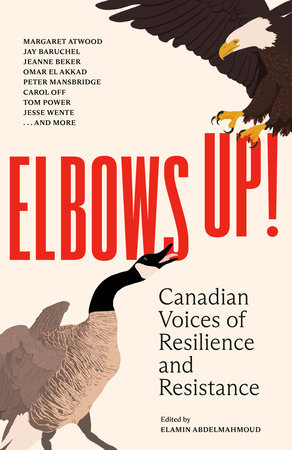
In the latest SHuSH newsletter, Ken Whyte discusses one of the most cynical and blatant attempts to “Maplewash” US product as 100% home-grown Canadian: a book of essays by living and dead Canadian authors, titled with the Liberals’ moronic “Elbows Up” slogan … with all the profits going to Random Penguin’s US corporate headquarters:
Ever since the Trump tariffs against Canada were launched last spring, US firms operating in Canada have been engaged in a variety of maple-washing tactics to shield themselves from consumer backlash. Some are as simple as new labelling — “prepared in Canada!” More audacious was McDonald’s effort to make everyone forget it’s the White House’s caterer of choice: a partnership with Canada’s sweetheart, Shania Twain.
You might think the McDonald’s gambit would be hard to top, but Penguin Random House has done it.
Penguin Random House Canada is a division of Penguin Random House LLC, corporate headquarters at 1745 Broadway, 3rd Floor, New York, New York, 10019. Penguin Random House LLC is in turn controlled by Bertelsmann, a media conglomerate in Gütersloh, Germany, but legally and operationally, it is a US company. Its executive leadership, including CEO Nihar Malaviya, works out of the above address. Strategy and publishing priorities are set in New York, and profits in PRH’s many far-flung international divisions flow to New York. You can see why this firm, with its dominant position in the Canadian market, might feel vulnerable and want to camouflage its Americanness when everyone starts shouting “buy Canadian!”
[…]
There are at least four levels of cynicism to Elbows Up!
The first — let’s call it eye-popping — is that Penguin Random House Canada would use so many of its own authors as human shields in a trade war. I mean, that’s cold. You not only have to conceive it, you have to be confident the authors are so oblivious that they won’t notice — or so obliged that they won’t care — that they’re laundering the reputation and protecting the economic interests of a US multinational and that the net proceeds from their rousing defence of Canadian sovereignty are going straight to 1745 Broadway, 3rd Floor, New York, New York, 10019, along with the licensing rights to their contributions.
[…]
The third level of cynicism — gobsmacking — is that Penguin Random House Canada used its McClelland & Stewart imprint for this atrocity.
I’m not sure there’s ever been a more important Canadian cultural institution than M&S. In the second half of the twentieth century, it was synonymous with Canadian literature. It published the core of the modern Canadian canon — Margaret Atwood, Leonard Cohen, Alice Munro, Mordecai Richler, Mavis Gallant, Robertson Davies, Rohinton Mistry, and many others. More than that, M&S was a symbol of our cultural sovereignty. Its catalog is the closest thing we’ll ever have to the Elgin Marbles.
Jack McClelland, who built the company, ran into financial trouble and sold M&S to strip-mall baron Avie Bennett in 1986. In 2000, Bennett cashed out, selling 25 percent of M&S to Penguin Random House and granting 75 percent to the University of Toronto because federal rules required majority Canadian ownership of cultural enterprises. It was an ingenious deal: UofT played the stooge of Canadian control; PRH had its way with the jewel of Canadian publishing; M&S remained eligible for federal grants because of its “Canadian ownership”. Then, in 2011, the U of T quietly transferred its shares to PRH, giving the multinational full ownership, never mind the foreign-ownership rules. UofT explained that playing the stooge of Canadian control was no longer “a core business” of the university. The house that built Canadian literature, along with its full catalogue of Canadian classics was now fully domiciled at 745 Broadway, 3rd Floor, New York, New York, 10019. The feds didn’t lift a finger.
I don’t know what you’d call that but a cultural crime.
And I don’t know what you can say about PRH using M&S for its maple-washing exercise beyond that it’s gloating.
The final level of cynicism — this one’s just sad — is that Elbows Up! is a forgettable book. It has none of the freshness, quirkiness, and genuine intellectual engagement of The New Romans. It takes as its title a partisan Liberal slogan from the last election (an act of toadying that probably qualifies as its own level of cynicism). A few of the essays, particularly those by the younger writers, are interesting, but none of them has much to say about Canada’s current predicament or the nature of the Canada-US relationship. I was struck by how many of the contributors can’t see beyond their narrow professional or personal identities. It’s as though they’ve never before been called upon to consider Canada as a whole. They lack the vocabulary to contribute anything meaningful. Also, the emotional tone is oddly flat from start to finish.