
Quotulatiousness

October 14, 2025

The Thatcher Centennial

Filed under: Britain, History, Media, Politics — Tags: , , — Nicholas @ 05:00

Monday was Thanksgiving Day in Canada, Columbus Day in the United States and — at least for some — the Margaret Thatcher Centennial in Britain:

Former British Conservative Prime Minister Margaret Thatcher in 1983. She was in office from May 1979 to November 1990.
Photo via Wikimedia Commons.

One hundred years ago – October 13th 1925 – Margaret Hilda Roberts was born in Grantham, Lincolnshire, an English market town in the East Midlands. She was raised in the flat above her father’s grocery shop. That’s to say, she came from the same class as the ladies out on the streets of Epping and elsewhere protesting the rape of their children and their demographic dispossession in one of the oldest nation-states on earth, and despised by Starmer et al for not getting with the death-by-diversity programme.

Young Margaret grew up to become a research chemist, a barrister, and finally a politician called Mrs Thatcher — always “Mrs Thatcher”: I cannot claim to have given her any other specific advice but I did suggest she should not accept her alleged upgrade to “Baroness Thatcher”, as if one of the rare consequential members of the political class was of no greater rank than such wretched figures as Harold Wilson and Jim Callaghan. The only guy who got any mileage out of it was CNN’s Larry King, who took to introducing her as “Margaret The Lady Thatcher”, like Sammy The Bull Gravano. She achieved greatness as a missus, and should have remained so, like Mr Gladstone rather than Mr Gravano.

Mrs Thatcher shaped events as opposed just to stringing along behind them. There have been nine prime ministers since, but, like a guest on my Saturday music show, I can’t name them, can you? Trimmers and opportunists, charlatans and at least one traitor (Johnson). Her present successor has momentarily thrilled the pseudo-Tory press by being marginally less disastrous in her conference speech than she was expected to be, so weird kinky mummy fetishists like the Telegraph‘s Tim Stanley are now drooling excitedly if dementedly that “Mummy is back“. The Conservative Woman is rightly contemptuous. Mrs Badenoch seems a pleasant enough lady after a fashion, but a third-of-a-century ago, when I last lived in London, certain types of women would put their business cards in red telephone boxes offering, ah, specialised services to middle-aged men whereby one could be fitted with an oversized nappy and put in a giant pram to throw your toys out of, after which Nanny would have to discipline you. It does not seem to me a useful political framing.

It does, however, testify to the long shadow of Mrs Thatcher. At the Tory conference, she was much invoked — for the same reason pre-Trump Republicans used to cite Reagan: he was the last good time before Bush/Dole/more Bush/McCain/Romney … So it goes with Maggie, the last good time before Wossname/Whoozis/Whatever/the “Heir to Blair”/Fat Blair/the Hindu Hedge-Funder … It is forty-six years since Mrs T arrived in Downing Street. She quite liked “Winston”, as she was wont to refer to him (although whether to his face remains unclear), but she would have found it odd had the 1986 Conservative conference banged on about him incessantly. That is not an encouraging sign, either for the party or for the country.

Mrs Thatcher’s success bred a lot of resentment, not least among the resentful twerps of her own party, who eventually rose up and toppled her — over her attitude to Europe, of course. Just after the Fall of Thatcher, I was in the pub enjoying a drink with her daughter Carol after a little light radio work. A fellow patron, the “radical” “poet” Seething Wells, decided to have a go at her in loco parentis, which is Latin for “in the absence of her loco parent”. After reciting a long catalogue of Mrs Thatcher’s various crimes, he leaned into Carol, nose to nose, and summed it all up: “Basically, your mum just totally smashed the working classes”.

Carol was a jolly good sport about it, as always, and bought him a pint. And it has to be said that this terrible indictment loses a lot of its force when you replace the word Thatcher — or “Vatcha!”, as the tribunes of the masses liked to snarl it, with much saliva being projected down the length of the bar — with the rather less snarl-worthy formulation “your mum”.

White Hoods, Bloody Hands: The Klan as America’s First Terrorists – W2W 048

Filed under: History, USA — Tags: , , , , , , , , — Nicholas @ 04:00

TimeGhost History
Published 12 Oct 2025

From Pulaski to Stone Mountain to Brown v. Board, the Ku Klux Klan evolves from Reconstruction terror to a decentralized, Cold War–era movement that bombed churches, lynched citizens, and hid behind “anti-communism”. We trace the First, Second, and Third Klans — rituals, networks, and the brutal campaign against desegregation and civil rights.
(more…)

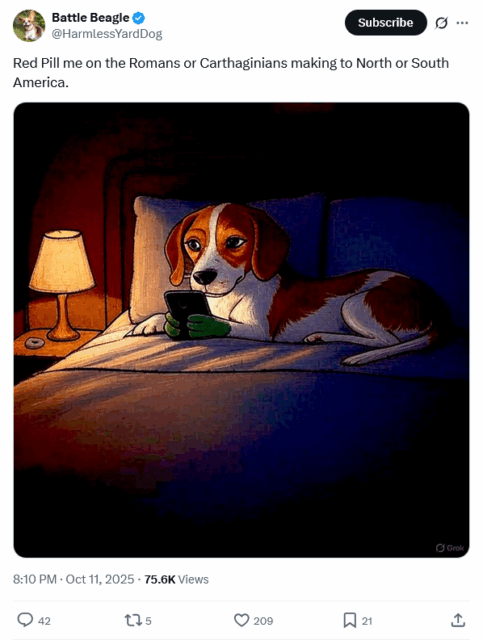
Carthaginian or Roman America?

Filed under: Africa, Americas, History, Technology — Tags: , , , , , — Nicholas @ 03:00

On the social media site formerly known as Twitter:

    Alaric The Barbarian @0xAlaric

    There’s a handful of evidence for this. Most of it’s a little fringe or circumstantial, but it exists.

    – 500s BC Carthaginian navigator Himilco described the Sargasso Sea; the original work is now lost but it was quoted in Ora Maritima a century later. If you can make it there and back, you know trade winds well enough to take Columbus’ route.

    – There’s quite a lot of copper “missing” from the Great Lakes area, and there was more bronze in the Old World than could have possibly been supported by the known copper mining infrastructure there … despite 7,000-year-old copper mines in that region, the local natives didn’t seem to really use copper for much aside from odd pictographic disks.

    – The Tecaxic-Calixtlahuaca head, discovered in 1933, was a bearded terracotta head made before European contact with modern-day Mexico. Its features and style don’t match local populations or material cultures, and it’s been dated to centuries prior. Roman experts ID it as 200s AD Roman art. Even the archaeological community isn’t sure what to make of this one; their best (non-)explanation is “it was a prank”.

    – Numerous odd discoveries were made of Old World artifacts in the American West throughout the 19th century. Alleged Roman coins, weapons, tools, etc. Some of these were hoaxes; others have been lost to time; others seem almost covered up. The wildest example is Kincaid’s alleged 1909 discovery of an ancient Egyptian-style tunnel annex hidden in the walls of the Grand Canyon, full of artifacts; and, a similar alleged discovery around Death Valley. The former was reported to have been investigated (maybe covered up?) by the Smithsonian, though they deny this; the latter is on government land now.

    – Various Old World artifacts seem to show New World goods or maps; there is a depiction of a pineapple at Pompeii, for example, and c. 350 BC Carthaginian coins show a map of the Mediterranean including the Americas to the west. Certain of Ptolemy’s odd geographic ideas are “corrected” (such as his earth-size estimate) by placing the Antilles as the Fortunate Isles. The Piri Reis Map, compiled in 1513 but surely copied from much older sources, shows a fairly accurate east coast of the Americas, as well as Antarctica. Diodorus Siculus may have even described the Americas as found by the Phoenicians, then kept secret …

    – This of course predates Rome and Carthage, but a wide swathe of native cultures had extraordinarily similar oral histories of being visited by ethnically distinct people from the east who taught them aspects of civilization … “But that’s probably nothing, right?”

    The field awaits its smoking gun, its Rosetta Stone. But I believe something is out there, just waiting for an enterprising follower of Schliemann to discover it. There’s *something* there.

And in response:

    John Ringo SF Author @Jringo1508

    The part that does it for me (that there was pre-Viking contact) is just studying the development of pottery and metallurgy in the Old World vs New.

    Old World: Burnt bits of clay with markings on them. Poorly formed “pottery” charms. Better made pottery charms. Pottery dishes. Metal ore based glazes. Simple, low temperature, metals.

    New World: POTTERY FULLY FORMED AND GOLD AND SILVER EXTRACTION BECAUSE NATIVE AMERICANS ARE AWESOME!

    The Carthaginians had a process of going to less advanced areas, teaching them some simple “advanced” technologies that in some way helped out the Carthaginians then trading with them for “stuff”. They’d teach pottery or better pottery techniques so that they (the Carthaginians) didn’t have to load themselves down with empty pots to pick up “stuff”.

    They’d then trade stuff like bronze daggers for gold, silver and spices.

    So, it entirely makes sense (if you understand the currents) that a Carthaginian/Phoenician (they’re the same) trading/exploring fleet would make it across the Atlantic in one direction (probably in winter), set up a trading center somewhere and start trading wares. They’d leave a few behind to build up a store then sail back.

    If they went over in winter and sailed back in summer, good chance they were wiped out by hurricanes.

    It could have happened multiple times with a small group of colonists left behind. Their genes would disappear in the wash.

    But going from zero to FULLY FORMED POTTERY has always been my reason to know that there was early contact.

DSA’s Unique Titanium FAL Project

Filed under: USA, Weapons — Tags: , , , , — Nicholas @ 02:00

Forgotten Weapons
Published 28 May 2025

DS Arms got some billet titanium and decided to make a batch of titanium receivers and other parts. This turned out to be a nightmarish amount of work, and two of the receivers had to be scrapped, leaving only 10 completed. They also made a number of other titanium parts, including flash hiders (which this rifle has) and gas blocks (which this one does not). Between the titanium and aluminum parts and the choice of a lightweight configuration, this FAL tips the scale at just UNDER 7.5 pounds (3.4kg). That is a very remarkable achievement, and does so without making sacrifices in durability or features. It is slightly sharper recoiling than a standard 50.00 FAL (which weighs almost 10 pounds / 4.5kg), but not uncomfortable at all — the recoil is less than I had expected.

Unfortunately DSA does not appear to have any plans to make addition titanium receivers, but this small batch serves as a very cool proof of concept!
(more…)

QotD: The trade in fake doctor’s notes

Filed under: Britain, Bureaucracy, Business, Health, Quotations — Tags: , , , , — Nicholas @ 01:00

A suspended doctor in England is running a company that sells people sick notes to excuse them on medical grounds from their work. “When you’re ill,” said an advertisement for the company, “our prices will make you feel better”.

A reporter for the Daily Telegraph newspaper managed to obtain a certificate from the company to excuse him from work for five months, because he claimed (falsely) to be suffering from the long-term effects of COVID. He obtained the note without providing any medical evidence whatsoever.

The only thing that surprised me about this was that anyone thought that it was necessary in Britain to buy or pay for such a certificate. I thought of the famous lines of Humbert Wolfe, the otherwise all-but-forgotten England man of letters:

    You cannot hope
    to bribe or twist,
    thank God! the
    British journalist.
    But, seeing what
    the man will do
    unbribed, there’s
    no occasion to.

The same might almost be said of British doctors, many of whom, I suspect, issue such certificates incontinently, for one of two reasons: fear of their patients, and sentimentality.

Not surprisingly, doctors do not like unpleasant scenes in their consulting rooms, and refusal of requests for time off sick can easily lead to such scenes, and occasionally to threatened or actual violence.

Naturally, no doctor likes to think of himself as a coward, the kind of person who caves in to such threats. The best way to avoid so humiliating a thought is never to risk having to think it, that is to say by granting the patients’ wishes in this matter immediately.

But in order to do this without feeling self-contempt, it is necessary to rationalize, that is to say to find supposed reasons for why everyone who wants a certificate should be given one. The English philosopher F.H. Bradley once said that metaphysics is the finding of bad reasons for what we believe on instinct, adding however that it was a human propensity to do so. In like fashion, we could say that doctors find bad reasons for giving sick certificates when they suspect that not to do so might lead to a confrontation with a patient.

Thus they convince themselves that if a person tells them that they are unfit for work, for whatever reason, it would be wrong to question it. No one would make a claim to be unable to work unless he were in some way discontented, unhappy, depressed, anxious, stressed, in a word suffering, and it is the object of doctors to reduce human suffering.

The doctor is aided in this train of thought by the looseness of psychiatric diagnosis, so that practically all forms of distress can be fitted into the procrustean bed of diagnosis. Even outright faking can now be construed as an illness or disorder, provided only that it goes on for long enough or is deceptive enough.

Does this mean that the patients seeking sick notes are all faking it? The matter is more complex than this would suggest. There is, of course, conscious, outright fraud, but this is comparatively rare. Just as doctors don’t like to think of themselves as cowards in the face of their patients, so patients don’t like to think of themselves as frauds.

Distress can be conjured out of almost anything and is not necessarily proportional to whatever causes it. Dwelling on the ill treatment one has suffered — and who has not suffered ill treatment at some time in his life? — can magnify something minor into something major, to the point at which it seems almost to have ruined one’s life. And it is certainly capable of rendering a person unfit for work in his own estimation — though in fact continuing at work would be a remedy for, rather than an exacerbation of, the problem.

However, where economic loss is not too severe when stopping work on medical grounds is possible, medical grounds will be both sought and found. In the days of the Soviet Union, the workers had a saying: “We pretend to work, and they pretend to pay us.” In our kinder and more enlightened societies, we pretend to be ill, and they pretend to treat us — except that the word “pretend” does not quite capture the subtlety of the transactions between doctor and patients.

Theodore Dalrymple, “Make Me Sick”, New English Review, 2025-07-04.

Powered by WordPress


