
World War Two
Published 27 Sept 2025As Italy’s war effort collapses across Greece and North Africa, Hitler is forced to intervene. This episode explains why German troops are sent to Africa in early 1941 and sets the stage for Rommel’s arrival and the birth of the Desert War. The North African campaign begins not with a plan — but with a crisis.
(more…)
September 28, 2025
North Africa Episode 1: Hitler’s Hand Forced
Comments Off on North Africa Episode 1: Hitler’s Hand Forced
The beginning woodworker … an easy mark
On his Substack, Christopher Schwarz posts a weekly “earlywood” article pulled from his extensive back-catalogue of woodworking books and magazine articles. This week, he addresses the plight of the beginner in the woodworking hobby just before the internet became ubiquitous:
When people begin woodworking, most go through a phase (I did) in which they are willing to soak up every single piece of information they can find. Many will subscribe to multiple woodworking magazines, buy astonishing numbers of woodworking books, seek out catalogs and advertisements for woodworking tools, and buy anything they can afford that looks remotely useful.
This is when people are vulnerable. They need guidance. Unfortunately, woodworking is a mostly solitary pursuit. And so we spend incredible, astonishing and shocking amounts of money on equipment, books and instruction. And most of it is of questionable worth.
Because of this phenomenon:
- The woodworking magazine business had a glut of magazines. When we ran the numbers in the 1990s, we surmised that there should be three magazines serving woodworkers. Instead, there were more: Fine Woodworking, WOOD, American Woodworker, Woodsmith, Shopnotes, Workbench, Popular Woodworking, Woodworker’s Journal, Woodshop News, Woodcraft, Weekend Woodcrafts, Woodwork and a host of specialized magazines. What propped up these magazines? Beginners. Eventually, most woodworkers winnow their subscriptions down to one or two magazines. But the spendthrift beginner made it possible for many magazines to survive.1
- The woodworking book industry produced a glut of books. In the 1990s, my mailbox was stuffed with new woodworking books every week. It wasn’t unusual to see seven or eight new woodworking titles in a month. That’s coo-coo. Why did this work? New woodworkers wanted the latest information. New books are better than old books (duh!). And so publishers churned out books that had an 18-month life cycle before disappearing forever.2
- The woodworking tool industry thrives on new SKUs. After covering woodworking tool manufacturers for nearly three decades, it’s obvious that they introduce new products every year to goose sales. That’s why you have a new crop of cordless drill/drivers every year. And it’s also why you have a rash of odd products that seem (on the surface) to be innovative – silicone glue brushes, painter’s pyramids, many router table jigs, marrying a chisel with a rasp, aluminum squares, putting a laser on everything, oddball and worthless sanders (the Black & Decker Mouse; Porter-Cable Profile Sanders), and battery-powered clamps and tape measures. The list is endless, and it’s not a modern phenomenon. When my grandfather was woodworking in the 1970s, he was charmed by a jig that let you cut dovetails with a corded drill. The only people who are dumb enough to fall for these products are beginners and woodworking journalists. Beginners don’t know better, and journalists need copy to fill the empty space between the covers.3
Some of you might be thinking I’m exaggerating my experiences. I’m not. The good news is that the Internet did a Half-Nelson on most of these stupid business practices. When people now go through their “indiscriminate sponge” phase, they do it on YouTube and soak up as much ridiculousness as they wish.
For free. Mostly.
Eventually, they will be able to ignore the tool-chugging nincompoops and focus on what’s important: Building basic skills using simple and robust tools (and maybe a few well-built machines).
Honestly, it’s a good thing to be a bit jaded about the woodworking tool and publishing industries. It makes you a better consumer and encourages us to do better. So please, for the sake of the future of the craft, don’t buy the Bench Cookies.
- Some modern context follows. Many of these magazines have disappeared or have been consolidated. But you know what? I still think we have too many woodworking magazines these days. Or not enough. I forget which is right.
- More modern context follows. Most of these publishers have gone tits up. And good riddance. We don’t need a new book every year on advanced router techniques.
- Modern context follows. Nothing has changed here.
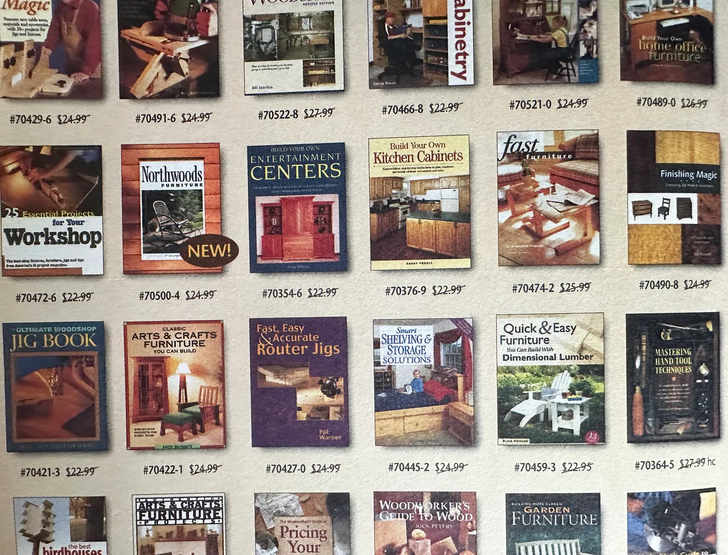
I matched this profile of the “indiscriminate sponge” beginner and I had huge numbers of woodworking books and magazines … until I finally noticed that the magazine articles in the latest issue were basically the same as the ones I’d first seen three years earlier, just with more gee-gaws and doo-dads added (microadjusters-for-everything were flavour of the month when I finally exited my sponge phase).
Comments Off on The beginning woodworker … an easy mark
S-Boats – Guide 438
Drachinifel
Published 3 May 2025The S-Boats, fast attack craft of the Kriegsmarine, are today’s subject.
(more…)
Comments Off on S-Boats – Guide 438
QotD: Pre-modern armies on friendly territory
Being on territory where the administrative apparatus is the army’s own or friendly to them can vastly simplify the logistics problems of moving through the territory. And we want to keep in mind throughout all of this that the army does not want to be stationary, it is trying to go places. Ideally, the army is attempting to move out of territory we control and into territory the enemy controls, or at least move away from our main administrative centers (cities, castles) to meet an approaching enemy army and by defeating it prohibit a siege. So our concern is not merely victualing our force but doing so while it is moving in a way that facilitates its rapid movement.
But first, we need to talk about the lay of the land. As we’ve discussed, the pre-industrial countryside is not just a uniform blanket of farms; instead settlements are “nucleated” – farms cluster in villages and villages “orbit” (in a sense) towns (which may “orbit” yet larger towns), which usually administer those villages. The road and path system that the locals themselves have created will in turn connect fields to village centers, one village to the next and all of the villages to the town. This makes everything easier on our army which is also using those roads and paths to move – even if the paths are rudimentary, without modern location-finding data, armies use paths and settlements to know where they are. The main body of the army, with its large train of wagons, supplies and troops is going to generally move along major roads (which typically connect towns with other towns) but smaller detachments can move along the pathways between smaller settlements. That means what we have access to is not a vast field of possible maneuver but a spider’s web of pathways which meet and cross at settlements.
Moving through this pathway network, in friendly territory the army can lean on the likely compliance of the local population and the local administrative apparatus, which makes everything easier. Moreover, with control of the area, the army can send out messengers and riders who move faster than the army on its direction of march, making arrangements in advance for what the army needs, drawing supplies from the populace and (maybe) making arrangements to pay them either at the time or in the future. Doing so in hostile territory is much trickier as those messengers would be vulnerable and might reveal the army’s location and direction of march, things it might really rather want to conceal. So assuming the populace and local administration are “friendly”, how do we manage the complexity of getting the food and other supplies they have into the hands of the army?
The simplest method was some form of “billeting”, in use in various forms through antiquity to the early modern, though it seems particularly prominent in the Middle Ages and the first two centuries of the early modern period. Clifford Rogers (Soldiers’ Lives through History: The Middle Ages (2007), 76-78) provides a good “standard practices” overview of the process for a medieval European army. Once drawn up the army was organized into smaller units (often called “banners” because they marched behind a banner); we’ll come back to this again when we talk about marching speeds but it also matters here. Each banner would assign one of its horsemen as a “harbinger” who would ride ahead of the army (supervised by the king or commander’s marshals), ideally a full day ahead. These harbingers (because there might be quite a few of these fellows) also acted as a limited cavalry screen. They would both designate where the army would camp next (with the marshals marking out specific encampments) and make arrangements for food and housing.
In practice “arrangements” here meant frequently that the soldiers, when they arrived the following day were quartered in the homes of the local civilians, often densely packed into small towns or farming villages. If they had the means the locals might try to provide the army a market to buy food and supplies; more often the locals who had soldiers quartered on them were often expected to feed and resupply those soldiers. Notionally this was often supposed the be compensated and notionally kings issued dire warnings against soldiers taking more than they were allowed or abusing the locals. Rogers (op. cit.) is, I think, unusually sanguine in assuming these repeated regulations meant the knights and soldiers were often restrained; in an early modern or Roman context we tend to view the same sort of repeated promulgation of the same laws to mean that abuses were common despite repeated efforts by the central government to stamp them out. In practice reimbursements seem to have often been at best incomplete, where they happened at all and abuses were common.
Certainly as we see these practices more clearly in the early modern period, having soldiers quartered on your village could be economically devastating (see Parker, op. cit. 79-81); having to feed a half-dozen soldiers for a few days plus marching provisions could easily tip a small peasant household into shortage. And we should also be pretty clear-eyed here about what it would mean for a local population to have a large body of armed men (many in the hot-headed years of their youth) functionally turned loose on an unarmed civilian population and told that they could demand to be given whatever they needed; far more disciplined and better controlled armies still left a trail of theft and rape behind them as they moved. Nevertheless, this solution was simple and so for armies with very limited administrative capacity and rulers anxious to shift the burden of military activity away from their own coffers, billeting remained an attractive solution. It was still common enough in the 1700s to have been a major complaint by British colonists in North America, the bulk of whom upon achieving their independence promptly wrote an amendment in their constitution effectively banning the practice (the third amendment for the curious).
A better option for a town or city was instead to establish a market outside the town and arrange for the army to resupply and camp there and not in the town itself, with only small groups of soldiers permitted inside the walls at any given time. Needless to say, it is typically only fortified towns that really have the bargaining power to pull this off. The provision of a market for the gathering mass of crusaders outside of Constantinople in 1097 was a key diplomatic sticking point, with Alexios Komnenos I (the Byzantine Emperor) using his control over both the market and passage over the straits to Asia Minor as bargaining chips to get concessions out of the Crusaders. Likewise towns in Roman provinces seem to have fairly regularly paid exorbitant sums to avoid having armies quartered on them, as Cicero documents in his time in Cilicia (e.g. Cic. Ad Att. 5.21), sometimes in cash and other times in kind (e.g. Plut. Luc. 29.8). It speaks to how destructive billeted soldiers could be that towns that could went to extraordinary lengths to keep even friendly armies outside of the town walls.
Armies might also rely on local contractors to provide supplies, especially if they were going to operate in the region at some length. We’ve already mentioned the Army of Flanders’ pan de munición, provided by contractors. There’s also some evidence for the use of private contractors in supporting Roman armies, though the trend in current scholarship (particularly Erdkamp but also Roth op. cit.) has tended to stress the limited and often marginal role of such contractors. Given the evidence I think Erdkamp has it right here; contractors for supplies existed in the Roman world, but were fairly small supplements to a system (detailed below) that mostly ran on taxation and requisition; most of what we see in the Roman world are just normal sutlers selling luxury foods to soldiers who want to spice up their rations.
As armies grow larger and more complex in the early modern period, we see an effort to move away from destructive “billeting”, often hindered by the weak administrative apparatus of the state and limited financial resources; armies won’t move into permanent barracks on the regular in Europe until the early 1700s. One solution was to take those market towns and their lodgings and turn them from an ad hoc response to a permanent network, as Spain did along the “Spanish Road”, a network of routes taken by Spanish troops traveling overland from the Mediterranean coast in Savoy to the Low Countries during the Eighty Years War.
The way this worked was: To avoid having their reinforcements pillage their way across their own lands or alienate key friends on the way to the Eighty Years War (1568-1648) in the Low Countries, the Spanish government established a standard system for the supply of troops en route – key market towns were designated as étapes or “staples”, standard stop-over and stockpile points. These tended to be key trade towns on the roads (indeed as I understand it étape in this sense originally meant “market town”) which already had some of the infrastructure required. These étapes would then be directed in advance of a movement of troops to stockpile provisions and prepare lodgings for a specific number of advancing soldiers and paid (in theory) in advance. Householders who incurred costs (typically lodgings, sometimes food) could present receipts (billets de logement) to their local tax collector which would count against future liability.
Yet the system here is incomplete and it is striking that when given the opportunity of setting up étapes in Spain itself the crown declined, citing the cost and administrative burden of organization. The greater diplomatic difficulties and consequent stronger bargaining position of communities on the Spanish Road may have a lot to do with the different decisions. The real impetus for the structure of the étapes on the Spanish road was diplomatic: the route was a patchwork, with some territories controlled by the Spanish crown, some by the friendly German Habsburgs and others by the various small statelets of the Holy Roman Empire, any of whom if sufficiently offended might refuse Spanish reinforcements transit (the Holy Roman Emperor could shut the whole route down himself). Consequently the disruption that Spanish troops caused on the route had to be limited for the route to be sustainable at all.
States with a bit more administrative capacity, on the other hand, generally tried to avoid billeting at all, even in regularized form. We’ll see this again when talking about army movement, but control is a key concern in campaigns. Soldiers, after all, are not automatons and so keeping an army together and moving towards a single objective is difficult. Soldiers get bored, wander off, decide to steal or break things (or people) and so on. It is easier to keep an eye on soldiers if they are all in a central camp or barracks and keeping an eye on everyone in turn makes it a lot easier to ensure that everyone shows up promptly to muster in the morning with the minimum of hassle. So if a general can, he really would want to keep everyone out of towns and villages and in a regular marching camp. Doing so demands yet more discipline because of course the soldiers would rather sleep in houses than in tents, but it has substantial advantages.
But an army that can lean on the local administrative capacity can simply demand that local administrative apparatus, whatever its form, coordinate the collection and transport of supplies (over short distances) to the army, enabling the army to camp out in a field and get its grain DoorDashed to it. Thus the Romans, when in friendly territory, for instance first identify the local government – usually a town but it could also be a tribal government in non-state regions – and then requisition food from that government, transmitting their demands in advance and letting that local administration figure out the details of getting the required food to the required place. That lets Roman armies camp in their fortified camps away from civilian centers, with attendant advantages for discipline; and indeed, Roman armies typically avoid permanent or even temporary bases in towns, instead using the threat of billeting to get the supplies they needed to stay in regular camps and later permanent forts.
While the elites who run these local systems of government could provide such requisitions themselves (and might in extremis to avoid retaliation by their superiors; the Romans interpret failure to provide requested supplies as “rebellion” and respond accordingly), in practice they’re going to pass along as much of the costs as they can to the little guy. In some cases, requisition demands are so intense we hear of towns having to buy or import grain to meet the demands of passing armies; Athens had to do this in 171 during the Third Macedonian War to avoid the wrath of Rome (Liv. 43.6.1-4). Caesar likewise relied heavily on food supplies contributed by either allied or recently defeated communities in Gaul (Caesar, BG 1.16, 1.23, 1.40, 1.37, 2.3, 3.7, 5.20, 6.44; he does this a lot) to supplement regular foraging operations. Those sources of supply in turn influence his campaigning, as Caesar is forced to move where the grain is in order to resupply (e.g. Caes. BG 1.23). And I want to be clear even these systems of requisition could mean real hardship on a population as a large army could easily eat all of the surplus grain in a province and then some.
The exact structure of that requisition could vary; in some cases it was a extraordinary tax (which is to say, it was just seized), but in many cases it was organized as a forced sale (often at below market prices) or even rebated against future tax obligations. In the Roman Empire we know that in many provinces, initially ad hoc systems of food requisition from conquered or “allied” (read: subordinated) communities were first regularized so that the demands were set at a steady amount, then monetized as military operations moved further away, until eventually being formalized as a taxation system. Thus the primary Roman tax system of the imperial period grew not out of the tax system the Romans had in Italy (which was mostly dismantled in the second century as the tremendous wealth of the provinces made it unnecessary) but as a regularization of systems of requisition and extortion meant to support armies. The Romans also took advantage of the Mediterranean (where naval transport could break the tyranny of the wagon equation) to ship food from one theater to another (so long as operations were fairly close to coastal ports); this was in the Republic coordinated by the Senate which could direct Roman officials (typically governors of some sort) or non-Italian allies in one region to obtain supplies by whatever means and send them another active military theater (Plb. 1.52.5-8, Liv. 25.15.4-5, 27.3.9, 31.19.2-4, 32.27.2, 36.3-4), in some cases even establishing transit depots which could support operations in a large naval theater (e.g. Chios, Liv. 37.27.1). In particular, grain taxed in Sicily was frequently redirected to support Roman military operations across the Mediterranean.
All of this of course assumes that the army enjoys either the use of the local administrative system or the compliance of the local population. But of course in enemy territory – which is where your army wants to go – you cannot rely on that.
Bret Devereaux, “Collections: Logistics, How Did They Do It, Part II: Foraging”, A Collection of Unmitigated Pedantry, 2022-07-29.
Comments Off on QotD: Pre-modern armies on friendly territory


