In UnHerd, Edward Luttwak suggests that despite President Trump calling the Russians “paper tigers”, the non-US members of the NATO alliance could more appropriately be described that way:
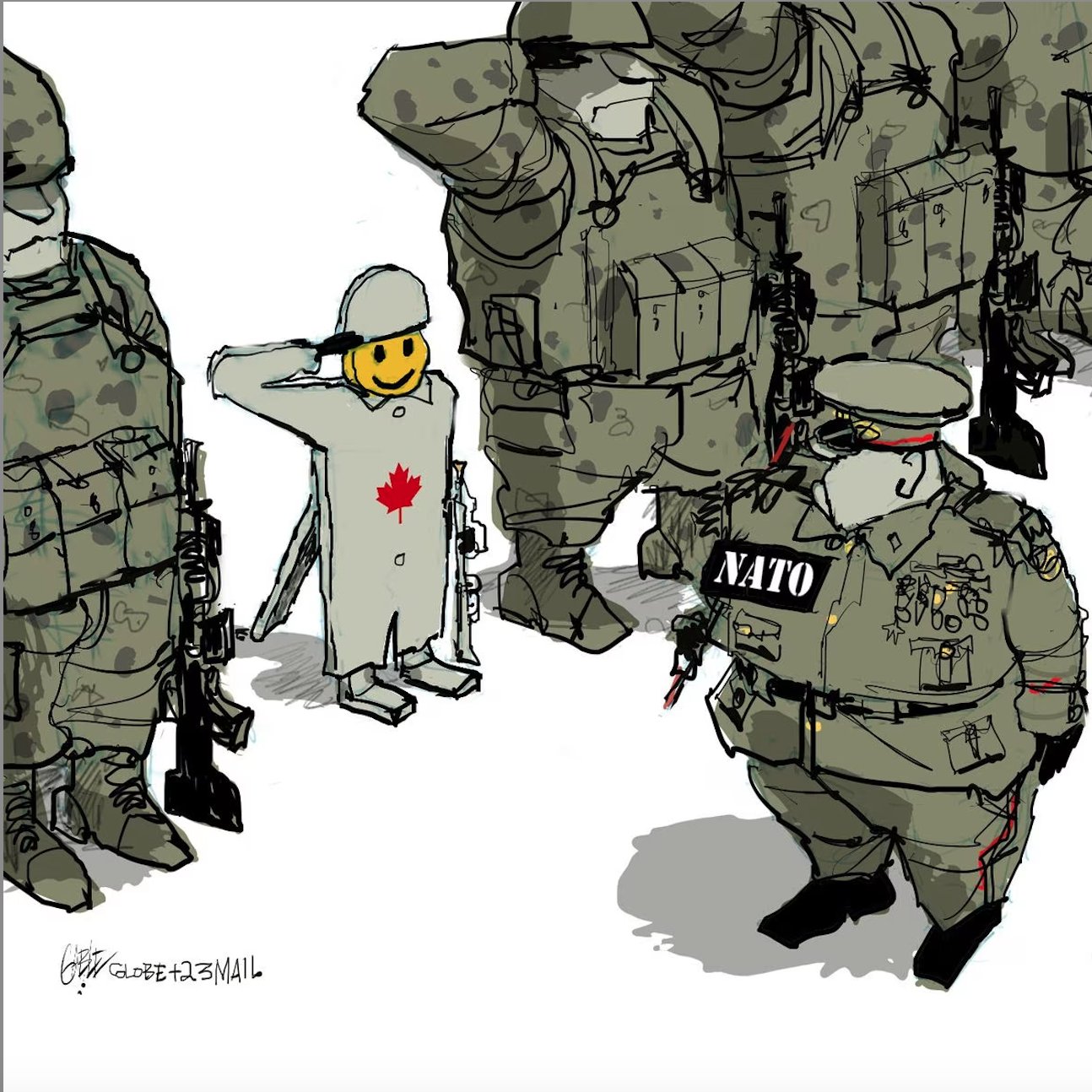
It’s been an open secret for decades that Canada’s NATO contributions are more rhetoric than reality, but it’s true of many of the European NATO allies, too.
… simply raising defence spending will not turn Europe’s states into genuinely effective military powers. For one thing, the GDP criterion is much too vague to mean much. Finland, for instance, spends only 2.4% of its GDP on defence and yet can mobilise some 250,000 determined soldiers. Other Nato members, which spend much more than the Finns, obtain far less for their money.
Moreover, focusing on GDP instead of force requirements — so many battalions, artillery regiments, fighter squadrons — is nothing but an invitation to cheat, an opportunity lustily taken up across the continent. The latest Spanish submarine, for instance, is not imported for €1 billion or so from Thyssen-Krupp, which supplies navies around the world with competent, well-proven submarines. Instead, it was proudly designed and built at the Navantia state-owned Spanish shipyard: for €3.8 billion, roughly the cost of a much bigger French nuclear-powered submarine. As a feeble justification for that absurdly high cost, Spain’s defence minister cited a supposedly advanced air-recirculation system — so greatly advanced, in fact, that it is not actually ready, and will not be installed even in the submarine’s next iteration.
Soon, though, Italy will outdo Spain’s platinum submarine: by including a new bridge to Sicily, set to cost some €13.5 billion, into its 2% of GDP Nato spending quota. The government’s excuse is that some 3,000 Italian troops may need to cross the Strait of Messina were the Italian army ever to be fully mobilised. But it would be much cheaper to fly them individually, each trooper in his own luxurious private jet. Even without the bridge, meanwhile, Italy’s cheating on the 2% target is bad enough. Most notably, much of the Italian Navy’s spending goes towards warships made by Italy’s state-owned Fincantieri shipyard. But there is not enough money for the fuel and maintenance expenses to operate more than half of them, meaning another industrial subsidy is camouflaged as defence spending. All the while, Italy refuses to increase its defence budget beyond the very modest target of 2% — which it has yet to meet.
As for Germany, three and half years since the start of the Ukraine war, with ever more ambitious rearmament plans loudly promised, the total number of personnel in uniform has actually slightly decreased. And, aside from beginning a multi-billion euro purchase on an Israeli missile-defence system, nothing much has happened. Despite its high demand in Ukraine, even the battle tank, that German specialty, is being produced in very, very small numbers: so low that the annual output could be lost in a morning of combat. In May 2023, indeed, a meagre 18 Leopard tanks were ordered to replace older models lost in Ukraine. The expected delivery date? Between 2025 and 2026! Then, in July, Germany purchased a further 105 advanced Leopard 2A8s. That is the number needed to equip a single brigade, the German force stationed in Lithuania — and they are expected to arrive in 2030!
The sad truth, then, is that Germany has yet to start working in earnest to correct the extreme neglect inflicted on its armed forces during the long Merkel premiership, when she kept saying that “even if we had the money we would not know how to spend it”. All the while, German helicopters lacked rotors and tanks lacked engines. The exceedingly slow recovery of the German army is especially frustrating because Nato is not actually short of air or naval forces. What it lacks are ground forces, soldiers more simply, or rather soldiers actually willing to fight. Having added Estonia, Latvia and Lithuania to the alliance, tiny countries with outsized defence needs, the alliance faces a severe troop deficit across the entire Baltic sector. The troops so far sent by Nato allies, such as visiting Alpini battalions from Italy, cannot improve the maths.
Update, 30 September: Welcome, Instapundit readers! Please do have a look around at some of my other posts you may find of interest. I send out a daily summary of posts here through my Substack – https://substack.com/@nicholasrusson that you can subscribe to if you’d like to be informed of new posts in the future.