
The Korean War by Indy Neidell
Published 23 Sep 2025The Korean War reaches one of its bloodiest battles as UN forces clash with North Korean defenders on Heartbreak Ridge. The US 2nd Division suffers heavy losses, with entire companies wiped out to the last man. At the same time, the Marines introduce a revolutionary new tactic in modern warfare — transporting troops via helicopter right to the front lines during battle. Meanwhile, UN Commander Matt Ridgway refuses to resume peace talks in Kaesong, sparking further tension with the Communist side. As the battle rages, the question remains: can there be peace in Korea, or only more heartbreak?
Chapters
00:00 Hook
00:43 Recap
01:14 Heartbreak Ridge
04:02 To The Last Man
06:06 What Ridgway Wants
08:00 Effects of the Treaty
10:13 New Strategy
11:29 Supply by Helicopter
12:31 Summary
12:45 Conclusion
15:34 Call to Action
(more…)
September 24, 2025
The Korean War Week 66: The Hell of Heartbreak Ridge – September 23, 1951
It won’t work – the minister responsible knows it, but they’re going ahead with it anyway
The “it” in the headline is the federal government’s gun confiscation program, which they claim will reduce crime but they already know it won’t do any such thing. What it will do is take away from literally the most law-abiding, responsible citizens their legally purchased property and leave illegal guns in the hands of criminals … at an ever-increasing estimated cost to the taxpayer. In The Line, Matt Gurney covers the details:
The federal gun confiscation program […] is illogical. It won’t save lives or make the public safer. The federal government doesn’t really even expect it to work, and is only going ahead with it because they’ve been stuck with a dumb proposal the Trudeau government made almost five years ago. If they could do it all over again, they wouldn’t, but they feel like they’ve blocked themselves in and have no choice but to proceed so that they don’t anger part of their electoral coalition, mainly voters in Quebec.
That might sound like a blistering criticism of the program, the kind of thing you’ve read in any number of my columns before. It’s actually what the public safety minister thinks about it. He just didn’t know he was being tape recorded when he said so. In a 20-minute conversation Gary Anandasangaree had with a firearms owner he rents a home to, which was recorded and then leaked, the minister says all of the above things. (He has also confirmed the recording is legitimate.)
Awkward for the minister, clearly, but I actually give him credit. The minister’s comments on tape are a confession, and an admission of defeat. They’re also, hands down, the most honest thing a Liberal government official has said on the gun control file in five years. Given that the minister responsible is freely telling people the program is a bad idea he’s stuck with and that won’t work, a sensible government would probably take this opportunity to walk away from the program.
Unfortunately, that’s not what this PM has chosen. It’s full speed ahead with an idea so bad Anandasangaree wishes he’d never been saddled with it.
Let’s talk about what this program is for a second. And forgive me, there’s quite a bit of history here. During Justin Trudeau’s first term, his only majority, his government had proposed a series of fairly moderate changes to the gun control laws they had inherited from Stephen Harper. As I’ve written often since, the proposals were a mixed bag. Some were okay. Some were bad. But they more or less left the well-functioning Canadian gun control system intact. They nibbled around the edges enough so that they could tell their voters that they had gotten tougher. But they generally didn’t try to fix what wasn’t broken.
But then politics got in the way, as it always does. Trudeau lost his majority in 2019 and became ever-more dependent on voter efficiency and wedge issues. And then in 2020, there was a horrible massacre in Nova Scotia. That catastrophe had nothing to do with our gun control laws; the weapons used were brought in illegally from the United States, as is typical of guns used in gun crime. But the Trudeau government seized on the opportunity — never waste a crisis, right? — to announce that they were “banning” “assault rifles”.
A lot of quotes above. So let me explain. First of all, there really wasn’t much of a ban. Anyone who owned one of the newly banned rifles was allowed to keep them. And as for assault rifles, actual assault rifles — rifle-calibre weapons that use high-capacity detachable magazines and can fire in fully automatic mode — have been banned in Canada for decades. This isn’t a problem that we actually had. And the government tacitly admitted as much when they began fudging the words they used to describe them. In acknowledgement that there were no actual assault weapons to ban, they started talking about assault-style weapons.
“Style” is a tell. You wouldn’t take medicine-style pills, or munch on a food-style snack. Because you’d know better. Trudeau et al knew better. It didn’t stop them. They needed something to announce, and by God, they were going to announce it!
And as we’ve noted several times, the Trudeau government got addicted to the media high of making big showy announcements. So they started doing repeat announcements over a period of time, and thanks to the spinelessness of Canadian legacy media even before Trudeau started directly subsidizing them, the media sugar high got repeated as well. It didn’t take long for the lesson to be learned that making an announcement was cheaper than doing the thing that was announced, and we quickly transitioned to a world where it was the announcement that mattered, not the thing.
At Junk Economics, Bryan Moir sums up the stupidity:
You want blunt? Fine. Here it is:
Listen: politics is kabuki theater and promises are props. Here we have a government rolling out a nationwide confiscation-style buyback and calling it “voluntary” — which is like calling income tax “optional” if you want to be arrested. The minister tells citizens, in public, “it’s voluntary”, then admits in private he’ll criminalize non-compliance, will “bail you out” if it goes that far, and says the whole exercise exists because the party must keep the promise and because the Quebec caucus wants to show muscle. That’s not statesmanship. That’s PR with a warrant.
They lecture you about being “tough on guns” while refusing to be tough on the people who actually bring violence into our streets. The minister himself says if he could do it over he’d target illegal guns and put criminals in jail — not law-abiding owners. Translation: the policy is ideologically driven and politically performative, not strategically intelligent. You don’t cure gang violence — which the cops tell you comes from illegal trafficking and cross-border smuggling — by borrowing billions to buy back legally purchased rifles. That’s like throwing sandbags into a burning house and patting yourself on the back for “doing something”.
And then there’s the logistics and the cost — the ugly part they don’t want on camera. The federal pot is capped at about $742 million and the program is rolled out in fits and starts. Major police forces are already saying “no thanks”, which means the feds must either stand down, contract a patchwork of municipal services, or try to outsource enforcement. Any of those choices blows up the promise in different ways: it becomes toothless, it becomes wildly more expensive, or it becomes a federal-provincial fight that will make the Notwithstanding clause dust-ups look like backyard squabbles. Pick your disaster.
Remember the math: a capped pool of cash plus a growing list of banned models (hundreds, then thousands) equals many owners getting nothing while the bureaucracy eats up the rest on administration, contracts, security, staffing, and political “bribes” (a nicer word for handouts to get agencies to play ball). If the fund runs out — and the minister openly says “it’s capped; when it’s gone, it’s gone” — you’ll have a bunch of people stripped of legal property, out of pocket, and the state triumphant only in optics. That’s confiscation without fair market compensation; it reads like policy designed by accountants and sold by televangelists.
Worst of all: while Ottawa gamely auctions off the idea of virtue, or was that “Canadian values”, real problems pile up. Fire seasons rage, hospitals are full, kids wait for surgeries, food banks are overwhelmed and the cost of living keeps rising— and Mark and Gary are borrowing money to offer coupons for now-illegal guns. If you wanted a textbook case of political misallocation, this is it: symbolic policy delivered with symbolic money so the party can say it kept a promise, while the public pays the bill and crime networks keep smuggling.
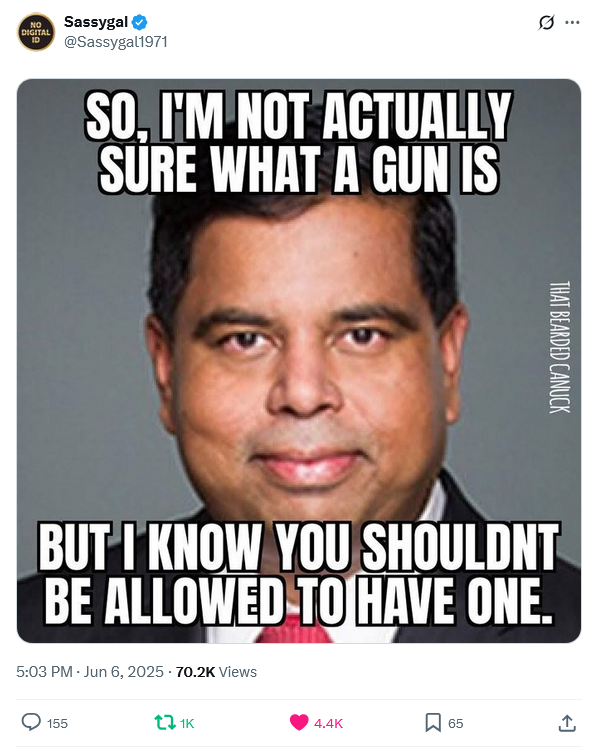
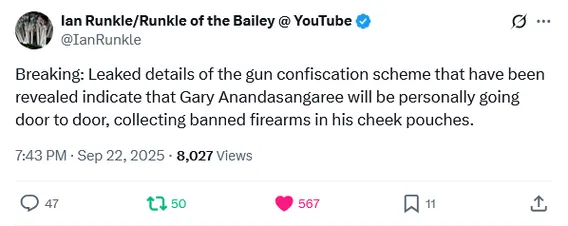
On the gun confiscation program in particular, thank goodness you can always depend on social media to find the funny side of any issue:
Zardoz: A Technocratic Parody
Feral Historian
Published 30 Jun 2023After another viewing, I now think of Zardoz as an unintentional parody of the technocratic mindset that was congealing in the 1970s. It’s a strange film, a sometimes tedious film, but it’s worth a look if only because there’s nothing else quite like Zardoz.
I keep saying “Immortals” when I mean “Eternals” and I had to recut this one a bit due to some semi-random copyright issues so I apologize for any perceptible jank.
The tip jar at Ko-Fi helps keep Feral Historians in the woods and off the streets.
🔹 Ko-Fi | ko-fi.com/feralhistorian
QotD: The political divisions of humanity
… the various divisions between human beings — communists vs. fascists vs. loyal American patriots — we have lived with all our lives are less important, less fundamental, than the basic one that Heinlein identified: “The human race divides politically into those who want people to be controlled and those who have no such desire”. Call the first group authoritarians or feudalists and the second, generic libertarians.
The first time, in the history of Western Civilization, that this became an issue, was the Renaissance/Reformation. Information suddenly came flooding, unbidden, into Europe, from North Africa, through Galileo’s telescope, out of Gutenberg’s printing press, and a dozen other undesirable, unlicensed, and deplorable sources. It must have been a nightmare for the aristocrats who considered themselves to be in charge, the kings and barons and bishops and bullies. They struggled in vain to get it back under control. They got the Church to condemn it. They intimidated and tortured its emissaries when they could. They invented universities to get a handle on it, a collar around its neck, but it was a lost cause. In just a couple of centuries (compared to the previous 500 generations), people — ordinary people; who the hell did they think they were? — came to know too much for the good of Authority.
And they soon proved it, in the American Revolution, which told 10,000 years of kings to go to hell, and the French Revolution, which cut to the chase and removed their overly-pampered heads. I have actually seen the blade. Many other revolutions followed, worldwide, and people began to learn, slowly and awkwardly, to live their own lives. The one good thing to come out of the brutal and deceitful Russian Revolution was the ultimately individualistic philosophy of refugee Ayn Rand.
Otherwise, it was a naked attempt by the authoritarians, the feudalists, to regain control of the masses that the Czar had clumsily let slip through his overly-manicured fingers. Whenever human beings have clashed over whether their lives should be controlled by others or not, it has almost certainly been a matter of who gets to be the next king, baron, bishop, commissar, etc., a battle between liberated entities and those who would restore feudalism.
L. Neil Smith, “The Deep State”, Libertarian Enterprise, 2019-04-14.


