
Quotulatiousness

August 27, 2025

In praise of the book

Filed under: Books, Media, Technology — Tags: , , , — Nicholas @ 05:00

Ted Gioia contemplates the glorious future of the book:
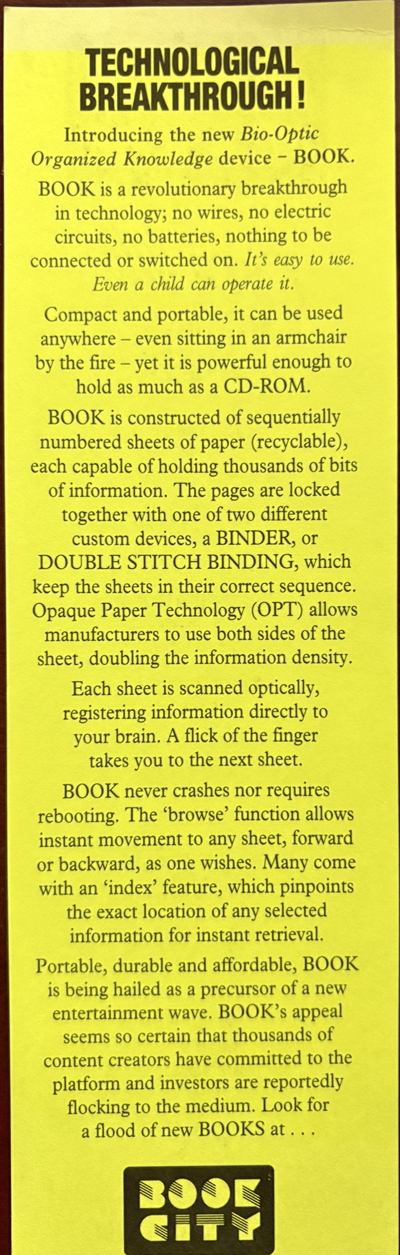
A decades-old bookmark from a Toronto Book City location (probably the store on the Danforth near Chester).

Can you imagine data storage that never needs an upgrade. Even better, there’s no subscription fee. And the system never crashes — there hasn’t been a single minute of down time in recorded history.

And there’s still more:

  • There are no terms of service.
  • No hidden fees.
  • No customer service bots to deal with.
  • No annoying follow-up spam emails and texts.
  • No privacy intrusions or surveillance of any sort.
  • No data incompatibility issues now or in the future.
  • No advertising or solicitations of any sort.

The list continues — no cookies, no credit cards, no come-ons, no conditions. None of that.

What a miracle!

I’m talking about my favorite handheld device, and I don’t need a cloud to hold its contents. Just a shelf.

You guessed it — I’m referring to books. They’re the greatest hard storage concept in human history, and nothing else comes close.

The book is the ultimate killer app.

People have been predicting the death of the book for decades. The Internet was going to make them obsolete. But somehow they survived.

The launch of the Kindle in 2007 posed a bigger threat. Even I was convinced — at least for a while. I bought a Kindle and tried it out, plunging with enthusiasm into the world of eBooks and digital storage.

But a month later, I’d returned to physical books. It was a better experience in every way.

It didn’t help when Amazon started deleting books from Kindles. Much to the customers’ surprise, they learned that they didn’t own the book they had bought — they were merely “purchasing a license to the content“.

Access can be terminated. And Amazon is the ultimate terminator.

That’s never happened to any physical book on my shelf. I own thousands of them, and nobody has ever revoked my access. I can also sell or give them to others, and they will retain rights in perpetuity.

You can’t do that with a Kindle. You’re not allowed to sell an eBook. You can’t even donate it to a library. Your license is restricted and non-transferable.

But transferability is how books and literary culture survive. Books are supposed to move without friction across generations and borders and boundaries. Some books have had dozens of owners over hundreds of years — creating a legacy unknown in the world of digital technologies.

Even more insidious, Amazon will update books on your Kindle — changing the text without the reader or author’s permission. That’s happened, for example, to books by Roald Dahl, R.L. Stine, Ian Fleming, and Agatha Christie. If somebody in a position of power decides that an author’s work is problematic, your e-book gets cleansed.


The Korean War Week 62: Chinese Break Off Peace Talks! But Whose Fault Is It? – August 26, 1951

Filed under: China, History, Military, USA — Tags: , , , , — Nicholas @ 04:00

The Korean War by Indy Neidell
Published 26 Aug 2025

The Chinese claim that American bombers have attacked the Kaesong conference area and break off the peace talks. The UN delegation smells a set up. Meanwhile, the Battle of Bloody Ridge is in full swing and earning its name, as the casualties mount on both sides.

Chapters
00:41 Recap
01:11 A ROK Success
01:47 Bloody Ridge
06:17 Soviet Reinforcements
07:08 Operation Strangle
11:06 Summary
11:45 Conclusion
13:37 Call to Action
(more…)

Operation Raise the Colours

Filed under: Britain, Liberty, Media, Politics — Tags: , , , , — Nicholas @ 03:00

Gawain Towler on the groundswell of quiet patriotic display in England, against the active attempts by local governments to suppress any and all flag-waving or even flag-flying by the plebs:

It was a seemingly innocuous tweet during the 2014 Rochester and Strood by-election that exposed a deep cultural rift. Emily Thornberry, then Labour’s shadow attorney general, a paragon of establishment elite thought, posted a photo of a terraced house in Strood adorned with multiple St George’s Cross flags, a white van parked outside.

No caption, just “Image from #Rochester”. To Thornberry, the image spoke for itself: a symbol of backward, flag-waving patriotism, the domain of the “white van man” she and her metropolitan peers presumably viewed with quiet derision. She expected her audience to share the contempt, to chuckle at the vulgarity of overt Englishness. But the backlash was ferocious. The public saw snobbery, a sneering dismissal of ordinary lives. Thornberry resigned from the shadow cabinet that day, rebuked by Ed Miliband for disrespecting hardworking families. I played a modest role in that storm, forwarding the tweet to Guido Fawkes and The Sun, which amplified the outrage and forced the reckoning.

That episode, now over a decade old, feels eerily prescient as I contemplate the “raising the flag” phenomenon sweeping Britain in recent weeks. What began as scattered acts of defiance has blossomed into a nationwide movement: St George’s Crosses and Union Jacks hoisted on lampposts, motorway bridges, and public spaces from Birmingham’s Shard End to Tower Hamlets in east London, Southampton to Brighton, and even Cannock. Roundabouts painted red and white, zebra crossings marked with the cross, symbols of England asserting themselves in the urban landscape. Last night I cycled through London’s Labour stronghold of Lambeth, and road markings have been transformed with the St George’s Cross, a quiet but bold reclamation in one of London’s most diverse boroughs. Dubbed “Operation Raise the Colours” by organisers (though it is hard to describe the phenomenon as organised), it has seen thousands of flags raised, with fundraising efforts like Birmingham’s £16,000 drive sustaining the effort. I support this gentle uprising, for it breathes life into symbols long marginalised. Yet I acknowledge the disquiet it stirs: in a polarised society, such displays can evoke unease, linked in some minds to far-right agitation or the riots of summer 2024, that and deeper darker memories of NF marches in the 1970s.

Why is this happening now? The timing aligns with the anniversary of last year’s Southport tragedy and ensuing unrest, where misinformation, both from the state and other bad actors, fuelled anti-immigration protests that spiralled into violence. Many participants frame it as a response to “two-tier policing”, swift crackdowns on native demonstrations while pro-Palestinian marches proceed with apparent leniency. It’s a broader reclamation of national pride amid economic stagnation, unchecked migration, and a sense of cultural dilution. For the overlooked, those Thornberry’s tweet mocked, this is a way to say, “We belong here”. and stronger yet, but uncontroversial in any other land than our own, “This is our land”.

It’s contemplative defiance: not riots, but ribbons of red and white asserting identity in a nation where Englishness often feels like an afterthought.

M1922 BAR Cavalry Light Machine Gun

Filed under: History, Military, USA, Weapons — Tags: , , , , — Nicholas @ 02:00

Forgotten Weapons
Published 21 Apr 2025

After World War One, there was a lot of tinkering with the BAR by the US military. It was recognized as being a very good platform, but the original M1918 configuration left a lot to be desired. It was deemed too heavy to use effectively from the shoulder, but also not really well suited to sustained fire. In an effort to optimize it for use as a dynamic support weapon by a small squad, the Infantry & Cavalry Board requested a model with a heavier barrel and lightweight bipod in 1920. Six experimental examples were made form existing BARs, and the design was formalized two years later as the Model 1922.

This pattern of BAR has a heavy finned barrel to give it more sustained fire capacity and a folding bipod and rear monopod for more accurate use prone. The Board also experimented with larger magazines, and ended up recommending a 30-round size — although this was never put into production. In total, 500 of the Model 1922 guns were made, all converted from existing BARs. Experimentation continued slowly, and eventually in 1937 a lighter pattern was adopted as the M1918A1. The Model 1922 was formally declared obsolete in April 1941, and virtually all of them were rebuilt to the new M1918A2 pattern for use in World War Two. Surviving examples like this one are extremely rare — this is the only known example in private hands.
(more…)

QotD: A critical bureaucratic talent

Filed under: Bureaucracy, Humour, Quotations — Tags: , , — Nicholas @ 01:00

“Gentlemen! Gentlemen!” The Patrician raised his hands in a conciliatory fashion. “It seems to me,” he went on, taking advantage of the brief pause, “that what we have here is a strictly magical phenomenon. I would like to hear from our learned friend on this point. Hmm?”

Someone nudged the Archchancellor of Unseen University, who had nodded off.

“Eh? What?” said the wizard, startled into wakefulness.

“We were wondering,” said the Patrician loudly, “what you were intending to do about this dragon of yours?”

The Archchancellor was old, but a lifetime of survival in the world of competitive wizardry and the byzantine politics of Unseen University meant that he could whip up a defensive argument in a split second. You didn’t remain Archchancellor for long if you let that sort of ingenuous remark whizz past your ear.

“My dragon?” he said.

“It’s well known that the great dragons are extinct,” said the Patrician brusquely. “And, besides, their natural habitat was definitely rural. So it seems to me that this one must be mag—”

“With respect, Lord Vetinari,” said the Archchancellor, “it has often been claimed that dragons are extinct, but the current evidence, if I may make so bold, tends to cast a certain doubt on the theory. As to habitat, what we are seeing here is simply a change of behavior pattern, occasioned by the spread of urban areas into the countryside which has led many hitherto rural creatures to adopt, nay in many cases to positively embrace, a more municipal mode of existence, and many of them thrive on the new opportunities thereby opened to them. For example, foxes are always knocking over my dustbins.”

He beamed. He’d managed to get all the way through it without actually needing to engage his brain.

Terry Pratchett, Guards! Guards!, 1989.

Powered by WordPress


