
Quotulatiousness

August 25, 2025

George Orwell’s Down and Out in Paris and London

Filed under: Books, Britain, France — Tags: , , , , , , — Nicholas @ 05:00

Down and Out was one of the first Orwell works I read as an adult, having encountered Animal Farm and Nineteen Eighty-Four as school texts. I would not say that I enjoyed the book so much as it gave me a very different view of both cities between the wars and encouraged me to seek out more of Orwell’s work. On his Substack, Rob Henderson considers the book and its author:
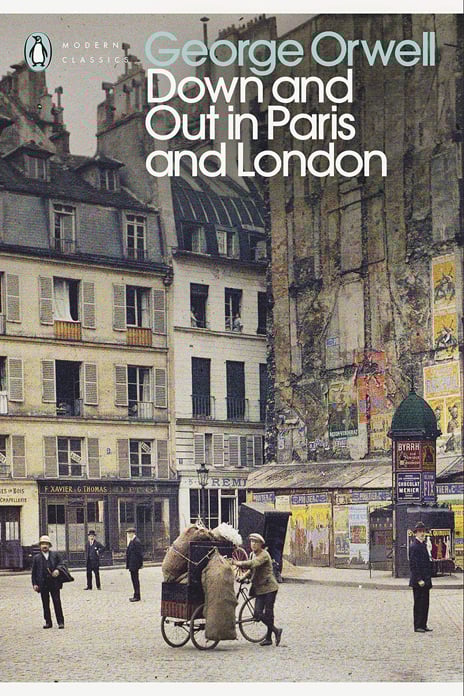
I was in high school the first time I read Down and Out in Paris and London (1933) by George Orwell. A memoir about his time in the slums of France and England.1 Orwell, while in Paris, worked as a plongeur — a person employed to wash dishes and carry out other menial tasks in a restaurant or hotel. Plongeur sounds much better than “bus boy”.

Because, at the time, I was also working as a busboy and dishwasher, I enjoyed Orwell’s description of employment in a busy restaurant. He wrote that the work itself was simple, like sorting a deck of cards, but when done against the clock it became exhausting. That captured exactly how I felt on my Friday and Saturday evening shifts.

Later I was disappointed to learn that Orwell had come from privilege. The guy went to Eton, a prestigious all-boys school. The book recounted his experiences with slum tourism. When he was penniless during the periods described in Down and Out, particularly during his return to London, his well-to-do family could and did take him back in for temporary periods so he could eat well and shower. At first this made the story feel less authentic.

Over time, though, I came to see it differently. It took someone like Orwell to write about life in the slums in a way that other educated people would pay attention to. I had to go through something similar. Only after spending time around the upper middle class did I understand how to describe my life in a way that would actually make them pay attention.

[…]

In the second half of Down and Out in Paris and London, Orwell describes living rough in London’s East End, staying in lodging houses and casual wards. He worked alongside the city’s laborers to understand poverty from the inside.

Down and Out in Paris and London was Orwell’s first published book, written when he was in his mid-twenties. It is striking is how little he romanticized the idea of being an impoverished bohemian in world-class cities, the way so many others of his background might have done. Instead, he treated his immersion in the Parisian and London underworlds as an attempt to strip away the prejudices he had inherited as an upper-middle-class Etonian.

The book is restrained in its politics. Orwell rarely pauses for commentary, preferring to tell the story as it happened and saving his more general conclusions for a couple of chapters at the end. This is more or less the same approach I took with Troubled; describe the world as it was, or at least as I remember it, and let the meaning emerge on its own.

One of the strongest features of Down and Out is its focus on the psychological effects of petty humiliations. Orwell describes kitchens where people from every corner of Europe are screaming at each other in different languages, frantically trying to keep pace with the chaos. If you have ever watched one of those Gordon Ramsay shows, you have some idea. He admired the strange order that somehow emerged from the chaos.

This voyeuristic quality is part of the book’s appeal. We all go to restaurants and see only the polished surface, knowing almost nothing about what happens behind the doors. Likewise, we all encounter homeless people in daily life and know little about how they live. Back in the 1930s, you didn’t have to make many mistakes to find yourself in a tough spot. My guess is that because society today is wealthier, there are more social services available, and powerful recreational drugs more accessible, the typical homeless person (he uses the word “tramp”, which was a prevailing term at the time) Orwell encountered nearly a century ago is very different from those we see today.

During his year and a half working menial jobs in Paris, Orwell wrote a few books, all rejected by publishers in London. None of this appears in Down and Out. He never dwells on his literary ambitions or his many failures. He does not even treat “writing” as a subject worth mentioning. For him, sleeping on a bench along the Embankment was a detail that mattered more than discussing proofs with an editor. Struggle is more interesting to read about than success. Sometimes people ask me if I’ll write a follow up to Troubled. No way. No one wants to read a whole book about a guy who went to elite universities and then blathers on about his subsequent prosperity. The thought of it induces a feeling in me of both amusement and nausea. Even if I focused on the unexpected struggles and costs of upward mobility, the stakes are so low that I can’t bring myself to take it seriously.


  1. It just occurred to me that this was in 2005. Around once a week I’d stop by my high school library after class and browse the shelves. By 2006 and 2007, I noticed fewer and fewer students actually reading in the library and more and more of them on the desktop computers, watching videos on a new website called “YouTube”. Can’t help but wonder how much streaming videos have reduced interest in reading among young people.

Vietnam 1950: Giáp Crushes France on Route Coloniale 4 – W2W 41

Filed under: Asia, France, History, Military — Tags: , , , — Nicholas @ 04:00

TimeGhost History
Published 24 Aug 2025

Viet Minh forces shift to the offensive, attacking French troops up and down the country. As guerilla war reigns in the southern half of Vietnam, more organised attacks begin in the north up near Hanoi. France cycles through multiple new commanders, trying to stem the tide. But do they truly have a hope of turning this around? Or are they just delaying the inevitable?
(more…)

Defending your life against an intruder can get you charged in Canada

Filed under: Cancon, Humour, Law, Liberty — Tags: , , , , — Nicholas @ 03:00

Terry Burton‘s satire-that-is-too-close-to-being-true:

A Recent Case in Ontario

An Ontario man recently had the unthinkable happen: he defended his home. Unfortunately for him, this occurred in Canada, where the laws surrounding self-defence have taken a dive off the deep end of “wokeness”. The police, after deep reflection (and a healthy dose of Diversity, Equity, and Inclusion training), chose to charge the homeowner and not the intruder. Why?

Let’s break down the madness.

How a Home Invasion Might Go in 2025 Canada:

Homeowner (middle-class taxpayer, not currently oppressed):
“Hello, sir. You appear to have broken into my home and possess a 7-inch knife. May I inquire about your intentions?”

Intruder (career criminal with a social media following):
“I’m just here to grab some electronics, steal your monies, and stab someone if they resist my incursion. It depends on my mood. Don’t profile me.”

Homeowner:
“Of course. My apologies. Would you like a latte while you loot my home? Oat milk? Almond? I don’t want to assume.”

Intruder:
“You’re a colonialist bigot for offering me food.”

Homeowner:
“Understood. Legally, I’m only allowed to resist you in proportion to your level of violence — yet to be ascertained, as determined by a tribunal of academics who’ve never been in a fist fight. That means if you punch me, I can … maybe glare at you. Anything more, and I’m the criminal.”

But what if the homeowner fights back?

In this case, the homeowner managed to grab a knife and defend himself. The intruder was injured — tragically — during this altercation. So naturally, the police arrived and did what any reasonable, DEI officer was instructed s/he must do:

They charged the homeowner.

The intruder? Off to the hospital, flowers sent courtesy of the Canadian taxpayer, and full support from victim services (taxpayer funded). (Yes, really.)

Reasons Police and Prosecutors Declined to Charge the Intruder (some say over-the-top satirical conjecture by the author):

  1. Mental illness – A catch-all excuse for immunity.
  2. Homelessness – Makes all actions justifiable, including assault.
  3. Drug addiction – A disease, not a crime, apparently.
  4. Identifies as female – We must respect self-identification, even during felonies.
  5. Arrested 55 times, 20 for B&Es – Systemic failure, so we shouldn’t blame him again.
  6. Member of a marginalized group – Intersectionality shields all.
  7. Single-parent upbringing – Automatically voids criminal responsibility.
  8. Not yet a citizen – A conviction could hinder his application; we, the state machinery that is, must protect him.
  9. Linked to child porn – But not convicted, so hands off.
  10. Terrorist affiliations – Political beliefs are personal.
  11. Anti-Semitic – But it’s culturally complex, they say.
  12. Illegally entered Canada – A paperwork issue, not a crime.
  13. Gun and drug trafficking – He’s an entrepreneur, really.
  14. Anti-Christian – Expressing a valid worldview.
  15. Anti–Rule of Law – Which now appears to be mainstream.

The Verdict?

The homeowner is:

  • Charged with attempted murder.
  • Convicted of using “excessive force”.
  • Sued in civil court by the intruder.
  • Ordered to surrender his house and retirement savings.

The intruder is:

  • Awarded the home he broke into.
  • Given legal permission to rent the house back to the homeowner’s family.
  • Allowed to visit the property at will.
  • Celebrated in local media for “surviving trauma”.

What Happened to Common Sense?

It died somewhere between Bill C-18, Bill C-63, and the idea that your lived experience matters more than actual law. In a country where, in some jurisdictions, whistling at night is outlawed, but breaking into homes is a misunderstood cry for help, we’ve lost the thread entirely.

When defending your family is labelled aggression, and violating someone’s home is rebranded asocial protest, Canada ceases to be a democracy and becomes a farce.

The Sharpest Pen of the Edwardian Age | Who Was Saki?

Filed under: Britain, History, Humour, Military, Quotations, WW1 — Tags: , , , — Nicholas @ 02:00

Vault of Lost Tales
Published 5 Apr 2025

Delve into the razor-sharp world of Saki in this engaging author talk exploring his chillingly clever short story, “The Open Window”. Discover the man behind the pen name — H.H. Munro — and uncover how his biting satire, Edwardian upbringing, and darkly humorous worldview shaped this unforgettable tale. Perfect for fans of classic literature, Oscar Wilde-style wit, and unsettling plot twists, this literary deep dive offers historical context, thematic insights, and just enough spookiness to keep you on edge. Whether you’re a student, a short story lover, or just curious about the mind that created one of literature’s most deviously satisfying endings, this talk is your open invitation.

“Saki”, the wickedly sharp pen name of Hector Hugh Munro, masked a man whose wit could slice through Edwardian society like a silver butter knife through scandal.

Born in 1870 in British Burma and raised in England, Munro brought an acerbic wit to the drawing rooms of empire, crafting tales that balanced dry humor, social critique, and sudden, often shocking twists. Writing under the name “Saki”, he produced short stories that mocked the pretensions of the upper class, exposed the darkness beneath genteel facades, and made readers laugh — sometimes uncomfortably. His life, marked by loss, repressed identity, and service in World War I, ended tragically in 1916 on the battlefield, but his stories continue to delight and disturb to this day.
(more…)

QotD: The rise of the state … the rise of the egregore

You may have noticed that [Against the Grain author] James C. Scott is not a fan of the state. He tends to describe it as a sort of alien intrusion into the human world, an aggressive meme that’s colonized first our material environment and then our minds, imposing its demands for legibility in order to expropriate innocent peasants:

    Peasantries with long experience of on-the-ground statecraft have always understood that the state is a recording, registering, and measuring machine. So when a government surveyor arrives with a plane table, or census takers come with their clipboards and questionnaires to register households, the subjects understand that trouble in the form of conscription, forced labor, land seizures, head taxes, or new taxes on cropland cannot be far behind. They understand implicitly that behind the coercive machinery lie piles of paperwork: lists, documents, tax rolls, population registers, regulations, requisitions, orders — paperwork that is for the most part mystifying and beyond their ken. The firm identification in their minds between paper documents and the source of their oppression has meant that the first act of many peasant rebellions has been to burn down the local records office where these documents are housed. Grasping the fact that the state saw its land and subjects through record keeping, the peasantry implicitly assumed that blinding the state might end their woes. As an ancient Sumerian saying aptly puts it: “You can have a king and you can have a lord, but the man to fear is the tax collector”.

This “state as egregore” language recurs throughout the book. Scott writes that the state “arises by harnessing the late Neolithic grain and manpower module as a basis of control and appropriation”. It “battens itself” on the concentration of grain and manpower to “maximiz[e] the possibilities of appropriation, stratification, and inequality”, and with its birth “thousands of cultivators, artisans, traders, and laborers [are] … repurposed as subjects and … counted, taxed, conscripted, put to work, and subordinated to a new form of control”.1 But it’s vital to remember that this metaphor is just a metaphor: the state isn’t actually an alien brainworm or a memetic infohazard that will hijack your neocortex the moment you set eyes on a triumphal arch and force you to spend the rest of your life making lists of things and renaming roads with numbers;2 it’s just an institution that people have invented, because hierarchy and inequality are inescapable facts of life in a society of any scale and the state is a particularly effective bundle of social technologies to leverage those hierarchies. There’s a reason that, after states had their “pristine” invention at least three separate times, they’ve proliferated across every part of the world that can support them!

But more interesting than “are we better off with the state?” is to ask ourselves, as Ronald Blythe does in Akenfield, what has been lost. Here Scott offers some fascinating musings on the way not merely the state but the entire agriculturalist life-world limits us:

    We might … think of hunters and gatherers as having an entire library of almanacs: one for natural stands of cereals, subdivided into wheats, barleys and oats; one for forest nuts and fruits, subdivided into acorns, beechnuts, and various berries; one for fishing, subdivided by shellfish, eels, herring, and shad; and so on. … one might think of hunters and gatherers as attentive to the distinct metronome of a great diversity of natural rhythms. Farmers, especially fixed-field, cereal-grain farmers, are largely confined to a single food web, and their routines are geared to its particular tempo. … It is no exaggeration to say that hunting and foraging are, in terms of complexity, as different from cereal-grain farming as cereal-grain farming is, in turn, removed from repetitive work on a modern assembly line. Each step represents a substantial narrowing of focus and a simplification of tasks.

The Neolithic Revolution, he argues, was like the Industrial Revolution, a great boost to human productivity and social complexity but at the same time a de-skilling. The surface area of our contact with the world shrank from hundreds of plants and animals, used in different ways at different times of year, to a mere handful of domesticates whose biological clocks became the measure of our lives. Of course, the modern contact area is smaller still — dimensional lumber purchased from a store in place of felling and milling your own trees, natural gas at the turn of a knob with nary a need to build a fire — and is sometimes reduced all the way to your fingertip on a smooth glass screen. The ease and efficiency are undeniable, and I’m sure a forager or premodern farmer would kill for Home Depot and seamless pizza delivery (I certainly wouldn’t want to give them up). But there has been “a contraction of our species’ attention to and practical knowledge of the natural world” because that knowledge and attention is no longer necessary, and I think that Scott is right to suggest that there is something richer about a more extensive involvement with the world. That said, Scott’s case is somewhat overstated: after all, even hunter-gatherers have specialized craftsmen who engage deeply with particular materials at the expense of other endeavors, and farmers3 have a far more intimate relationship with their animals than a hunter does with his many different kinds of prey. Similarly, farmers may be on one particular bit of land but (especially in a preindustrial context) all that plowing and hedging and draining and spiling, not to mention the gathering of various woodland foodstuffs, can rival forager familiarity when it comes to their bit of landscape. (My new favorite poem is Kipling’s “The Land“, on just this idea.)

Scott closes the book with an elegy for the “late barbarians”, who had the best of both worlds: healthier and longer-lived than farmers, and with greater leisure, they were “not subordinated or domesticated to the hierarchical social order of sedentary agriculture and the state” but were still able to benefit tremendously from lucrative trade with those states. Unfortunately, much of that trade was in weaker non-state peoples whom they captured and sold as agricultural slaves, thereby “reinforc[ing] the state core at the expense of their fellow barbarians”, and much of the rest was in their own martial skills as mercenaries (which of course also served to protect and expand the influence of the state). It’s a salutary reminder for the aspiring modern barbarian: the best place to be is just outside the purview of the state, where you can reap its benefits4 without being under its control. But beware, because in a world of states even those “outside the map” must fill niches created by the state. It’s great to have a cushy work-from-home laptop job that lets you live somewhere nice, with trees and no screaming meth-heads on your subway commute, but more land comes under the plow every year, and your time, too, may come.

Jane Psmith, “REVIEW: Against the Grain, by James C. Scott”, Mr. and Mrs. Psmith’s Bookshelf, 2023-08-21.


  1. And of course Scott argues that the state is a parasite in the most literal way, since the word derives from the Greek παρά “beside” + σῖτος “grain.”
  2. Although this would be a pretty sweet novel, sort of a Tim Powers alt-history: anarcho-primitivist occultists go back in time to ancient Mesopotamia to destroy the me of kingship and render the state metaphysically impossible. Someone write this.
  3. Like Scott, in fact, who keeps sheep on 46 acres of Connecticut. There’s a funny little aside in the book where he complains about people using “sheeplike” in a derogatory sense, given that we’ve spent several millennia selectively breeding sheep to behave that way.
  4. Better yet, wait for the peasants to do the reaping then ride in on your shaggy little ponies and take it all. Uh, metaphorically.

Powered by WordPress


