
Quotulatiousness

August 14, 2025

The “Big Mac Index” is bogus and Purchasing Power Parity (PPP) is wrong

Filed under: Business, Economics — Tags: , , , — Nicholas @ 05:00

I started reading The Economist when I was in college in the early 1980s. I subscribed after I left college, no longer having access to the school library’s copies, and I continued my subscription for about 20 years. Eventually, I gave up on The Economist as their editorial stance shifted further and further leftward. One of the things they ran regularly was their “Big Mac Index” which compared prices of McDonalds’ Big Mac hamburgers across a range of countries to show the Purchasing Power Parity of the respective countries’ currency against the US dollar. I thought it was a neat way to use readily available data in a form that most consumers would be familiar with to illustrate a wider economic fact. But, as Tim Worstall points out here, the index isn’t actually measuring what it claims to be measuring at all:
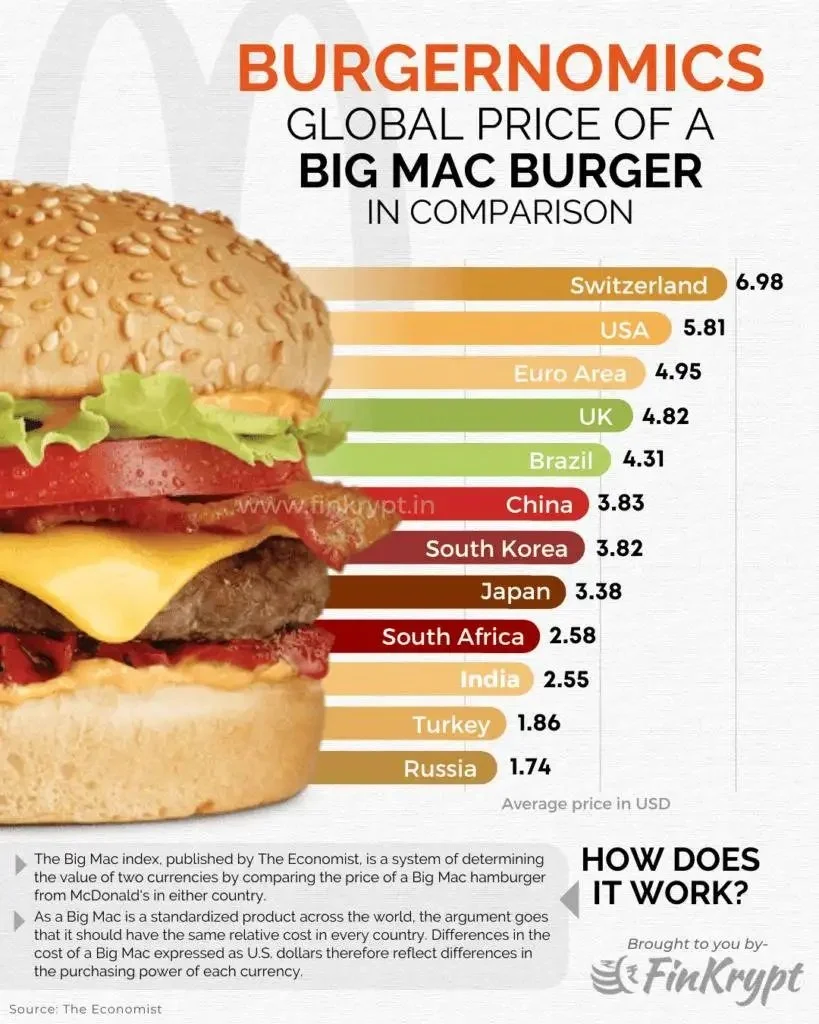
    Purchasing Power Parity (PPP) constitutes a foundational concept within mainstream international economics, asserting that, over the long term, real exchange rates will naturally adjust to equalize the purchasing power of currencies across nations. This suggests that the cost of an identical basket of goods should, in principle, be uniform globally once currency exchange rates are applied. This notion is frequently popularized through informal measures such as the Big Mac Index. PPP is conceptualized as a specific application of the Law of One Price (LOOP), which posits that, when abstracting from transactional frictions like transportation costs, tariffs, and taxes, any particular commodity traded or purchased should sell for a similar price regardless of its geographical location.

Aaaand, no. The Law of One Price says that a *traded* commodity should be at the same price everywhere, absent transport costs, tariffs and all the rest. Anything that’s not traded this will not be true of. For example, to use an example provided to us:

    For instance, if a Starbucks coffee is considerably more affordable in Tokyo than in Manhattan, Purchasing Power Parity (PPP) would indicate an undervalued Yen.

No, Starbucks coffee is not a tradeable item. Coffee beans are globally traded, yes, and coffee beans are the same price the world over — given transport costs, tariffs and so on. But the coffee bean is pennies on the dollar of a Starbucks coffee.

The use of the Big Mac in The Economist‘s popular version of PPP actually runs entirely the other way around. The note is that a Big Mac is made the same way around the world. But it’s always made of *local* ingredients, not internationally traded ones. Therefore we are not measuring whether tradeable goods are the same price in different places at all — we’re measuring what local goods cost in different places.

    Comparative advantage, whereby nations specialize in their most efficient productions for reciprocal benefit, is a myth. Absolute advantage reigns supreme.

Then there’s that as well. Which is to misunderstand comparative advantage as well. The insight is not about whether Britain makes cloth better than Portugal and then the same again with wine in reverse. Which is indeed absolute advantage. It’s about whether Britain makes cloth better than Britain makes wine, whether Portugal makes wine better than it does cloth. Each should do what they are *least bad at* and then share the increased production making both richer.

It’s also, once we move away from Ricardo, nothing to do with countries either. It’s something that applies to each and every individual. We should all do what we’re least bad at then swap the production. This does produce an interesting result for given how good, *ahem*, my economic writing is take a guess at how skilled I am at other ways of making a living? Quite.

So, you know, not getting PPP, LOOP nor comparative advantage — but still ending up calling for world government and that proper democratic control of the economy. Ah well, at least it’s fashionable even if incorrect.
D-Day’s Flat Pack Ports OR Lord HT Gets Cross with The Fat Electrician

HardThrasher
Published 13 Aug 2025

In which we use the ‪@the_fat_electrician‬ as an excuse to talk about the Mulberry Harbours, make a specific threat to a building in the United States and get to oogle at giant bits of floating concrete.

Primary Source – Codename Mulberry – Guy Hartcup, Pen & Sword Military. Kindle Edition 2014 (org. 1977)
(more…)

“Just war” theory and nuclear weapons practice

Filed under: History, Japan, Military, USA, Weapons, WW2 — Tags: , , , — Nicholas @ 03:00

On Substack, Nigel Biggar discusses the postwar argument about whether the use of nuclear weapons against Japan was justified or not:

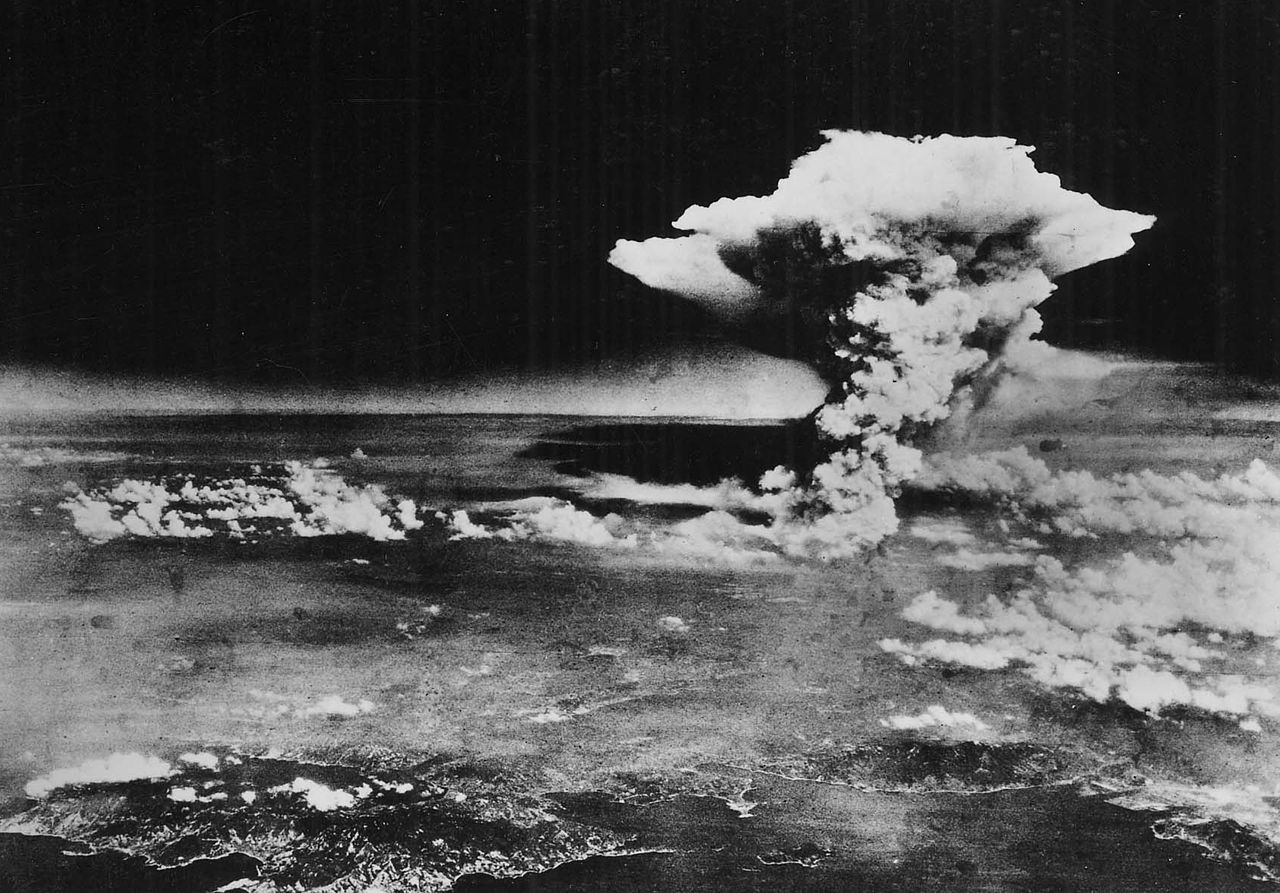
Atomic cloud over Hiroshima, taken from “Enola Gay” flying over Matsuyama, Shikoku, 6 August, 1945.
US Army Air Force photo via Wikimedia Commons.

For pacifists, Christian or otherwise, the answer is clear: since any deliberate killing is wrong, the dropping of atomic bombs on Hiroshima and Nagasaki on 6 and 9 August 1945 was wrong about two hundred thousand times over.

But that clear answer generates further questions whose answers aren’t so obvious. If killing is always wrong, then the United States should never have gone to war against Imperial Japan and therefore its ally, Hitler’s Germany. What, then, would have stopped the triumph of brutally racist Japanese imperialism in Asia and massively murderous Nazism in Europe? The noble witness of innocent non-violence?

Unfortunately, the historical evidence is that the kind of people who ran the slave-labour camps in Burma, and the likes of Dachau in Germany and Auschwitz in Poland, were not at all shamed by the face of vulnerable innocence; on the contrary, it excited their lust for domination and they fed upon it.

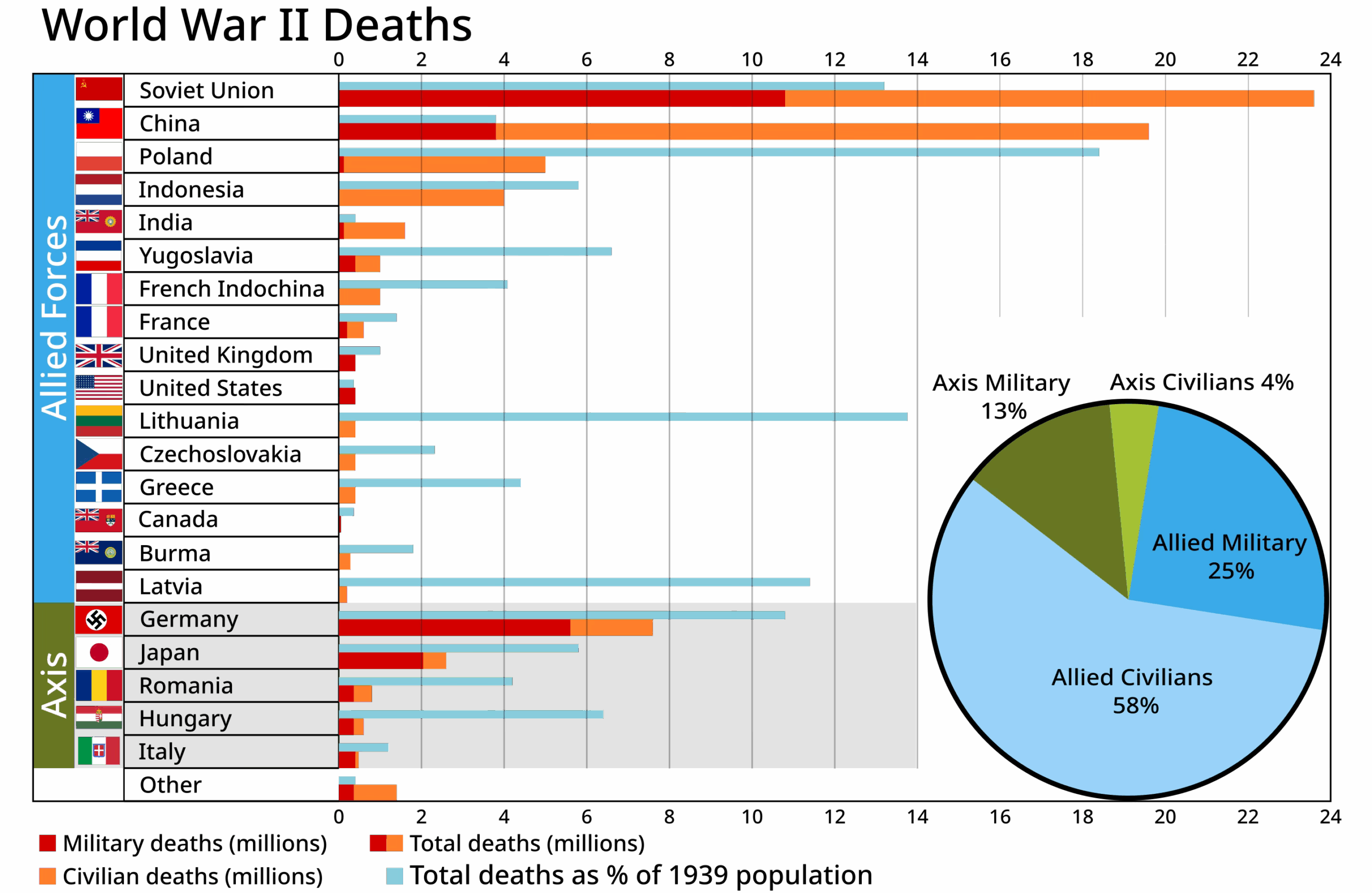
On the other hand, those who think that war can sometimes be justified, might judge that the mass killing of civilians by the atomic bombs was, simply by its massive extent, indiscriminate and therefore unjust. But there are two problems here. The first is that the vast majority of people, certainly in the UK and the USA, regard the war against Hitler and his allies as morally justified, notwithstanding the fact that that cost between 60 and 80 million deaths, well over half of them civilian.

Image credit – Wikipedia

And the second problem is that the ethical tradition of “just war” thinking doesn’t say that we may not kill civilians, even on a massive scale; it only says that we may not kill them intentionally. If a military objective can’t be achieved except by risking the possible or probable deaths of civilians, then it may still be attempted, provided that the objective is sufficiently important, militarily, and that all reasonable measures are taken to avoid or minimise the side-effect of civilian casualties. The reason for this permissiveness is that in most circumstances just war would be impossible to prosecute otherwise.

So, for the “just war” proponent, if the intention in dropping the atomic bombs on Japan was to destroy vital military or military-related targets, and if there was no more discriminate way of achieving that end, then the bombing was morally justified. It was deeply, deeply tragic—but nevertheless just.

“Sound of Silence” cover in Classical Latin (BARDCORE)

Filed under: History, Media — Tags: , , , — Nicholas @ 02:00

the_miracle_aligner
Published 29 Mar 2025

What Marc Anthony sang after he gave an epic speech at Caesar’s funeral.

One of my favorite songs and one I was supposed to upload on the Ides of March this year but got late. As punishment, I will do one for dearly departed Julius every year from now. RIP Caesar.
(more…)

QotD: It’s not hypocrisy when progressives do it …

Filed under: Humour, Politics, Quotations, USA — Tags: , , , — Nicholas @ 01:00

If you want to make a Liberal squirm, point out that their neighborhood is monochromatic. I forget who first said “the Left talks like MLK but lives like the KKK”, but we’ve all heard it. The first thing the yuppies do when the Missus fails the pregnancy test is call a realtor — they need a neighborhood with “good schools”. I knew an egghead who put one of those “Hate has no home here” signs outside his house. Some wit graffitied it with “and neither do black people”; I thought he was going to have an aneurysm. And so forth.

Severian, “Fade to Black”, Founding Questions, 2022-01-23.

Powered by WordPress



