
The Korean War by Indy Neidell
Published 12 Aug 2025UN Commander Matt Ridgway is extremely frustrated by the Communist delegation’s unyielding stance on the 38th Parallel at the Kaesong peace talks. Chinese violations of the neutral zone highlight the fact that the war still goes on, though, as do the preparations for a UN offensive soon to be launched, to really reignite the active war in a big way.
Chapters
00:00 Hook
00:50 Recap
01:15 Ridgway’s Frustration
05:01 Neutral Zone Violations
08:57 Van Fleet’s Plans
12:28 Conclusion
13:50 Call to Action
(more…)
August 13, 2025
The Korean War Week 60: Neutral Zone Violations and the 38th Parallel Standoff – August 12, 1951
Comments Off on The Korean War Week 60: Neutral Zone Violations and the 38th Parallel Standoff – August 12, 1951
“[A]ll those land acknowledgments weren’t just symbolic: they [were] advance notice”
In The Free Press, Rupa Subramanya discusses the — in my opinion, insane — court ruling in British Columbia that invalidated existing land titles in part of the Vancouver area, handing the titles to the properties over to the Cowichan First Nation:

A B.C. Supreme Court judge has granted several First Nations a portion of a 1,846-acre land claim on Lulu Island. B.C. Supreme Court
It turns out that all those land acknowledgments weren’t just symbolic. They may have been advance notice.
When Canada adopted its constitution in 1982, Prime Minister Pierre Trudeau slipped in a ticking time bomb: an explicit recognition of indigenous land rights without constitutional protection for property rights for other Canadians. That constitutional clause has fueled decades of lawsuits from First Nations — Canada’s indigenous people — asserting claims to huge portions of their ancestral territories.
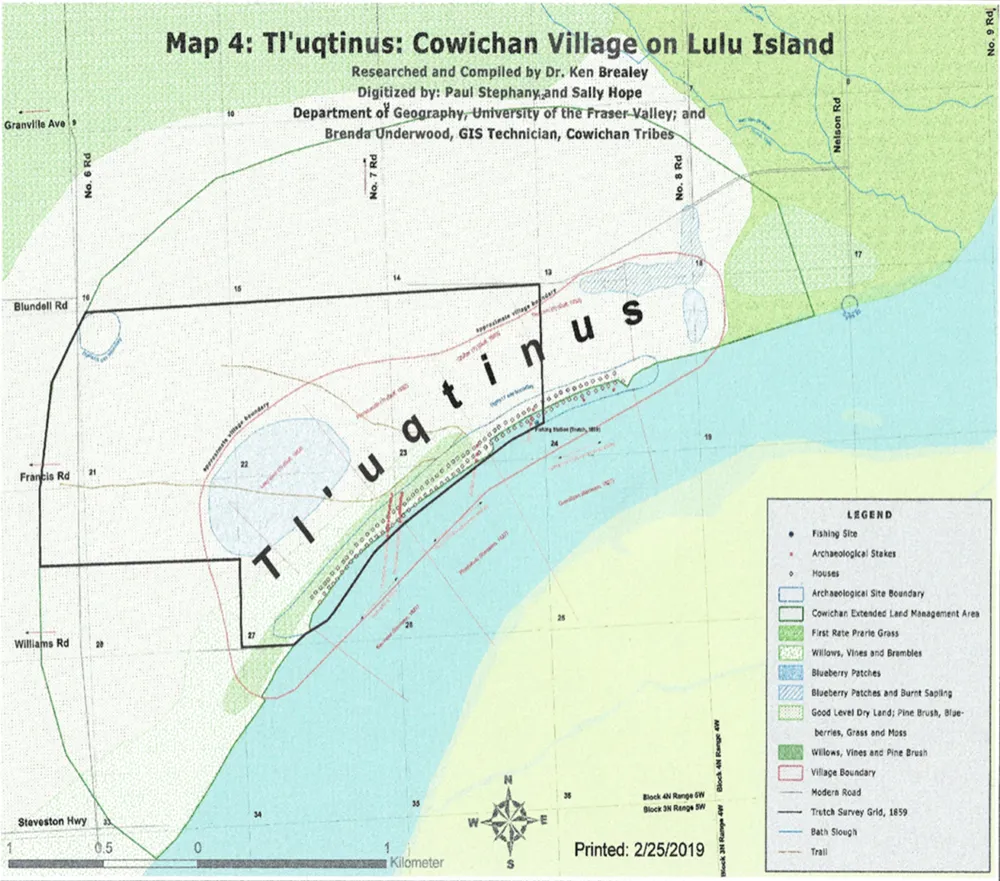
Last Thursday, the British Columbia Supreme Court ruled that the Cowichan Nation holds “Aboriginal title” to about 1,846 acres of land on the south shore of Lulu Island in Richmond, and constitutionally protected rights to fish in the south arm of the Fraser River.
This 275,000-word judgment doesn’t just affect government-owned lands. It also includes private property now owned by third parties. So if you’re a Canadian who is a property owner in British Columbia and not indigenous, your claim on what you think you own has just been superseded by indigenous claims, called a “senior” claim in legalese. Down the road, your land or house could be expropriated by the federal government and turned over to an indigenous group that claims ownership.
That has already happened in Ontario, where three northern Ontario First Nations claimed in a lawsuit last month that a 14-acre public park in Kenora called Anicinabe Park is actually unceded territory and should be returned.
“In constitutional terms, aboriginal rights trump private property rights,” Bruce Pardy, a professor of constitutional law at Queen’s University in Kingston, Ontario, told me. He pointed to last November’s ruling by a New Brunswick judge that the court might be in position to order the government to seize private property and turn it over to an indigenous group making a claim on it.
As Prime Minister Mark Carney tries to fast-track major infrastructure projects — roads, bridges, pipelines, power plants, and more — all part of his plan to boost Canada’s global competitiveness and reduce reliance on the U.S., some of those ambitions might be snarled by indigenous land claims that take years to resolve. The British Columbia case began in 2019 and is considered to be the longest trial in Canadian history.
The day before the Cowichan Nation ruling in British Columbia, a Yukon First Nation announced that it would oppose all new mining claims on its traditional territory while a regional land-use plan is developed. Yukon First Nations leaders said that new claims are “unwelcome” and “unlawful”, and that they plan to challenge the mining industry to protect the land from further industrial activity.
Stefan Labbé in BIV last week:
A B.C. court has handed the Cowichan Tribes and other First Nations title over a chunk of federal and city land in Richmond that for centuries was used as a winter fishing village, before colonial administrators evicted the people who lived there.
The landmark Aug. 7 ruling was handed down after more than 500 days of litigation before the B.C. Supreme Court.
It gives the Cowichan Tribes, the Stz’uminus First Nation, Penelakut Tribe, Halalt First Nation — as well as the Lyackson First Nation in a supporting role — Aboriginal title over the Tribes’ historic Tl’uqtinus village on the southeast side of Lulu Island.
The ruling also gives the First Nations fishing rights at the mouth of the Fraser River.
In a joint statement, the First Nation plaintiffs said: “We raise our hands to the generations of leaders” who fought for the return of the Tl’uqtinus village lands and their fishing rights in the Fraser River.
B.C. Supreme Court Justice Barbara Young suspended her decision for 18 months “to allow for an orderly transition of the lands” in keeping with the principle of reconciliation.
“Now that this multi-year journey has concluded, it is my sincere hope that the parties have the answers they need to return to negotiations and reconcile the outstanding issues,” she wrote.
Jamie Sarkonak in the National Post wrote on Monday:
This case of “land back” in action (Cowichan Tribes v. Canada) casts a shadow over the country’s property system. It jeopardizes the default means of owning land in Canada — the estate in fee simple, where owners have exclusive rights to sell land — wherever Aboriginal title is found to exist.
Aboriginal title is the right of an Indigenous group to use, control and reap benefits from the land. It’s granted to claimant groups that can prove they are descended from the sole occupants of an area at the time the British asserted sovereignty. Unlike regular fee simple ownership, it’s enshrined in Section 35 of the 1982 Constitution and impossible to sell to anyone but the Crown.
The Cowichan claim covered the site of their summer village near the mouth of the Fraser River, where they had established continuous, exclusive seasonal occupancy dating back to European contact in the 1790s.
In 1846, the British Crown asserted sovereignty over that land and the rest of what would become B.C. The following years would see property being surveyed and auctioned off to public and private buyers — but not the Cowichan summer village. Instead, it was set aside in 1860 and continued to be used as a settlement for the group. Colonial officials considered the possibility of making it into a reserve, and took initial steps to do so. After B.C. joined Canada in 1871, however, the summer village was carved into parcels and sold over the years until 1914. Purchasers included private parties (including “well-placed men” in the colony) and even the municipality itself; some of the land purchased privately would eventually be sold back to the Crown. Today, about half of these lots are held by public bodies, with the other half falling under private ownership.
A map shows the Cowichan title lands outlined in black. (B.C. Supreme Court) Photo by B.C. Supreme Court
The question before the B.C. Supreme Court was whether the taking of those village lands was legal to begin with. Justice Barbara Young (a Harper appointee, by the way) concluded it was not.
The Dispossessed: State Happens
Feral Historian
Published 21 Mar 2025Ursula K. le Guin’s The Dispossessed is one of the most in-depth examinations of how a large anarchist society might function, addressing both the problems it solves and those it creates for itself. It’s a must-read for anyone interested in the communist-leaning variants of anarchism in particular.
00:00 Intro
01:58 Anarres is not an Island
04:45 Shevek goes to Urras
07:00 Abolition of Property
08:30 Social Pressures and Pravic
12:30 Necessity and Ossification
14:45 Necessity of Conflict
15:45 Shevek’s Wild RideThis video is in part a companion to this one — Cloak of Anarchy : Gradations of Stat… from a few weeks ago. The original cut of that one had a brief mention of a couple details from The Dispossessed, but it really needed its own video.
Comments Off on The Dispossessed: State Happens
QotD: The New York Times and their 1619 project
In a NYT town hall recently leaked to the press, a reporter asked the executive editor, Dean Baquet, why the Times doesn’t integrate the message of the 1619 Project into every single subject the paper covers: “I’m wondering to what extent you think that the fact of racism and white supremacy being sort of the foundation of this country should play into our reporting … I just feel like racism is in everything. It should be considered in our science reporting, in our culture reporting, in our national reporting. And so, to me, it’s less about the individual instances of racism, and sort of how we’re thinking about racism and white supremacy as the foundation of all of the systems in the country.”
It’s a good point, isn’t it? If you don’t believe in a liberal view of the world, if you hold the doctrines of critical race theory, and believe that “all of the systems in the country” whatever they may be, are defined by a belief in the sub-humanity of black Americans, why isn’t every issue covered that way? Baquet had no answer to this contradiction, except to say that the 1619 Project was a good start: “One reason we all signed off on the 1619 Project and made it so ambitious and expansive was to teach our readers to think a little bit more like that”. In other words, the objective was to get liberal readers to think a little bit more like neo-Marxists.
The New York Times, by its executive editor’s own admission, is increasingly engaged in a project of reporting everything through the prism of white supremacy and critical race theory, in order to “teach” its readers to think in these crudely reductionist and racial terms. That’s why this issue wasn’t called, say, “special issue”, but a “project”. It’s as much activism as journalism. And that’s the reason I’m dwelling on this a few weeks later. I’m constantly told that critical race theory is secluded on college campuses, and has no impact outside of them … and yet the newspaper of record, in a dizzyingly short space of time, is now captive to it. Its magazine covers the legacy of slavery not with a variety of scholars, or a diversity of views, but with critical race theory, espoused almost exclusively by black writers, as its sole interpretative mechanism.
Don’t get me wrong. I think that view deserves to be heard. The idea that the core truth of human society is that it is composed of invisible systems of oppression based on race (sex, gender, etc.), and that liberal democracy is merely a mask to conceal this core truth, and that a liberal society must therefore be dismantled in order to secure racial/social justice is a legitimate worldview. (That view that “systems” determine human history and that the individual is a mere cog in those systems is what makes it neo-Marxist and anti-liberal.) But I sure don’t think it deserves to be incarnated as the only way to understand our collective history, let alone be presented as the authoritative truth, in a newspaper people rely on for some gesture toward objectivity.
Andrew Sullivan, “The New York Times Has Abandoned Liberalism for Activism”, New York, 2019-09-13.
Comments Off on QotD: The New York Times and their 1619 project


