On Substack, Fergus Mason explains why the British government got deep into a secretive program to bring thousands of former Afghan soldiers and their families to Britain:
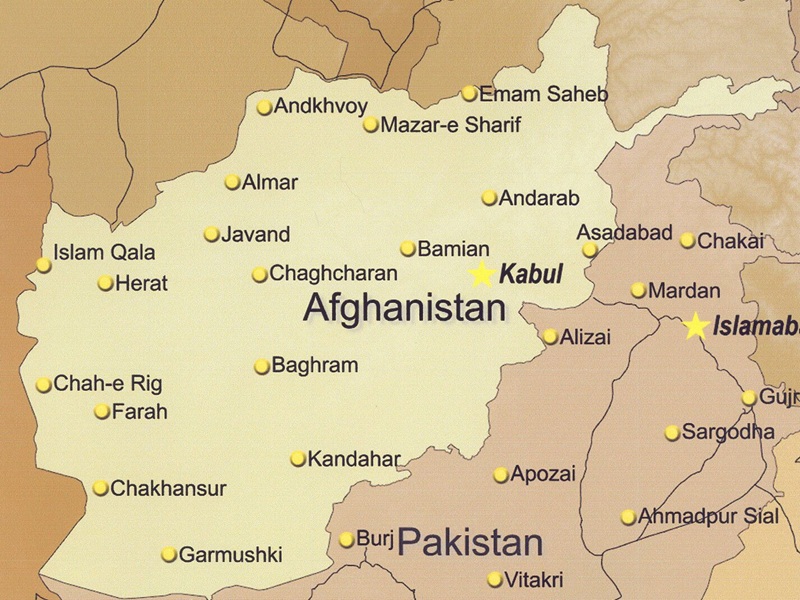
So here’s what we know so far. In February 2022 a Royal Marine officer, working for the Director of Special Forces, sent an email to several Afghans in Britain. These people were involved in the effort to rescue former interpreters and Afghan National Army special forces soldiers who were at risk of reprisals from the Taliban regime, and the Marine wanted to know whether some Afghans who claimed to be ex-special forces really were. The officer intended to attach a filtered list of around a hundred names from an Excel spreadsheet, but inadvertently attached the whole file — which contained around 25,000 names. One of the Afghans he sent the list to immediately passed it on to someone else – this time in Afghanistan. MoD sources are stressing that these were all trusted Afghans, but … well, we’ll get to that shortly.
And then nothing much happened for 18 months. The Taliban didn’t round up and shoot everyone on the list, even though they now claim to have had it since early 2022. But then, in August 2023, an Afghan man — a former soldier who had applied for asylum in Britain, but been rejected — popped up on Facebook. He promptly released part of the spreadsheet, then threatened to post all of it. At this point the government swung into action. First, it pressured Meta, which owns Facebook, to shut down the group the data was posted in and remove the user. Then the Ministry of Defence, under former defence secretary Ben Wallace, applied for a super-injunction to prevent the media from reporting anything about the leak, what the government planned to do about it, or what it was going to cost. It even banned anyone from revealing the existence of the injunction itself. That injunction was granted to Wallace’s successor, Grant Shapps, and the entire story was killed before it became public. The government was already drawing up a plan to bring tens of thousands more Afghans to Britain; the media and Parliament weren’t allowed to mention it; the British people, of course, were not to be allowed to know a thing. The degree of secrecy imposed was truly extraordinary.
And, over the last 18 months or so, the government has quietly been running a huge and very expensive operation to bring those identified as being at risk to Britain. From those listed on the spreadsheet, 23,900 former Afghan soldiers, policemen and intelligence officers were deemed to be in danger because of the leak. So, of course, were their families. How many people does the government plan to bring in under this scheme, in total? Nobody knows. Early estimates, according to court documents, were that 43,000 Afghans would be given asylum in Britain. Yesterday, officials insisted the real total was 6,900; even that dramatically lower number is a big addition to the 24,000 Afghans the government has admitted to bringing in under other, declared schemes. However, horrifyingly, last June three judges — Sir Geoffrey Vos, Lord Justice Singh and Lord Justice Warby — issued a written (but, of course, secret) ruling that up to a hundred thousand people could be at risk if the Taliban got their hands on the list.
Embarrassment for the British government, certainly, both for the initial cock-up and the ridiculous follow-up. It’s going to be expensive to resettle all those refugees and their often quite large families (guesstimates range from £850 million up to £6 billion), but not really a big deal, right? Well, about that …
I’ve already mentioned Afghan culture’s horrific misogyny. This leads to some truly dire attitudes towards women who don’t comply with Afghan society’s draconian rules of female behaviour (which boil down to having no rights and not being allowed to leave the house without a burqa and a male relative). One of the consequences of this is that Afghan men have unleashed a tidal wave of sexual assaults across Europe. At least one migration expert has noted that as well as their frequency, assaults by Afghans are remarkable for their brutality, audacity and often downright stupidity. Austrian political scientist Cheryl Benard wrote:
Can these men possibly expect that their attempts will be successful? Do they actually think they will be able to rape a woman on the main street of a town in the middle of the day? On a train filled with other passengers? In a frequented public park in the early afternoon? Are they incapable of logical thought — or is that not even their aim? Do they merely want to cause momentary female hysteria and touch some forbidden places of a stranger’s body? Is that so gratifying that it’s worth jeopardizing their future and being hauled off to jail by scornful and disgusted Europeans? What is going on here? And why, why, why the Afghans? According to Austrian police statistics, Syrian refugees cause fewer than 10 percent of sexual assault cases. Afghans, whose numbers are comparable, are responsible for a stunning half of all cases.
Type two words into Google — Afghane and Vergewaltigung — and a cornucopia of appalling incidents unfolds before you.
Incidentally, to all you lefties who’re undoubtedly sputtering with fury as you read this, don’t even think of writing Benard off as an anti-Afghan racist. Her husband is former US ambassador Zalmay Khalilzad, who is Afghan.
But surely, the “trusted” former Afghani soldiers, police and intelligence officers being brought in are bound to be much better able to adapt to British culture, right? Uh, well …
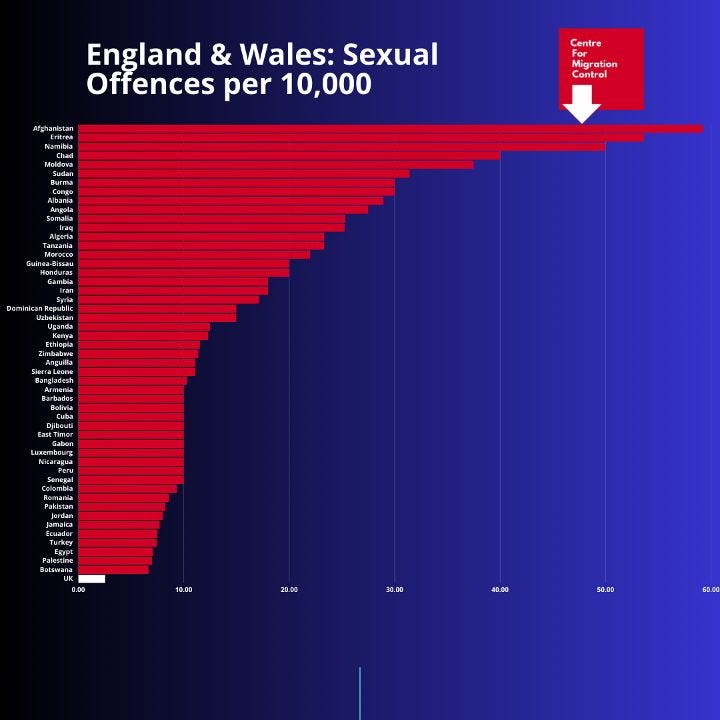
The government has been very reluctant to release — or even admit it possesses — statistics on the link between nationality and crime, but under pressure from independent MP Rupert Lowe it finally did so in March. This showed that among Afghans in Britain, 59 per 10,000 have been convicted of a sexual offence — 22.18 times higher than British men, at 2.66 per 10,000:
By the way, yes, I know the graph is from the Centre for Migration Control — but the data is from the Ministry of Justice and was obtained by a Freedom of Information request. I’ve checked the graph against the data, and it’s accurate.
[…]
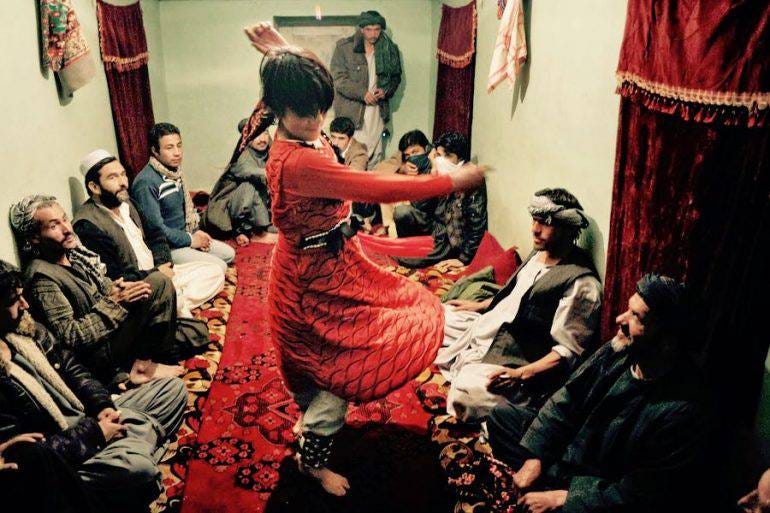
Does this photo of Afghan men watching a young boy dance give you the creeps? It should.
It’s not only women at risk, by the way. Afghan men aren’t averse to raping young boys, either. One of the most revolting aspects of Afghan culture — and that’s saying something — is the tradition of bacha bazi (Dari for “boy play”). Prepubescent boys are forced to dress up as girls then dance for, and “entertain”, men. This strain of paedophilia was common among anti-Taliban warlords and the Afghan security forces, particularly the police. The Taliban claim to be against the practice; their founder, the late Mullah Omar, actually was violently opposed to it. However, many prominent Taliban commanders also enjoy a spot of recreational pederasty.
Of course the obvious answer to this is “But most Afghan men aren’t rapists!” I agree; most of them aren’t. But an alarmingly high percentage of them are, and our governments clearly can’t keep the rapey ones out. The graph and its underlying statistics prove that beyond any possible doubt. And while it’s easy to downplay the statistics by saying it’s still “only” 77 sexual offences committed by Afghans over a two-year period, bear in mind that a) that’s 77 offences that wouldn’t have happened if we hadn’t let any Afghans in and b) this number is only convictions. In Britain just 3.1% of sexual offences reported to the police (around a third of which are rapes) lead to a conviction, which brings the potential number of Afghan suspects up to 2,484. The police estimate that only 10-15% of sexual offences are even reported; that could mean Afghans committed between 16,500 and 25,000 sexual offences across that same two-year period. Afghans would have to be bringing stupendous benefits to this country to make 25,000 sexual offences a worthwhile price to pay; indeed, many (emphatically including me) would argue that it wouldn’t be an acceptable price under any circumstances.
In Spiked, Tim Black on the government’s decision to hide everything for as long as they possibly could … for reasons:
Yet as catastrophic an error as this data leak was, the state has somehow managed to compound it with a series of decisions that made a terrible situation even worse. Successive Conservative and Labour governments effectively mounted a cover-up of both the data breach itself and the response. They slowly undertook a secret evacuation and relocation programme for the Afghans without telling even the Afghans affected about the data breach and the fact their lives were at risk. At the same time, they sought to hide all this from the British public, too, even while thousands of Afghan refugees were quietly being deposited in hotels and in military accommodation across the country. All with no explanation.
It is this de facto cover-up, this attempt on the part of ministers and senior officials to hide state errors and actions from public view, which is the most disturbing aspect of this whole sorry affair. They set about shielding a data breach followed by a costly, large-scale asylum scheme from any form of accountability, criticism or debate. And they did so by exploiting a legal tool that has never been used before by a British government – namely, the superinjunction.
This effective cover-up did not happen immediately. In fact, it wasn’t until early August 2023, a whole 18 months after the data breach took place, that the leak was finally brought to the attention of officials. A support worker responsible for settling Afghans in the UK emailed Luke Pollard, Labour MP for Plymouth, and James Heappey, the then Conservative defence minister, warning them that he’d seen the database circulating online. Days later, journalists also became aware of the leak. It was this that finally prompted the Ministry of Defence and the government to launch a covert mission, codenamed Operation Rubific, to shut down the leak and help Afghans put at risk get to the UK (after being vetted in Pakistan).
It was at this point that the authorities took the unprecedented step of applying for a superinjunction. This legal tool doesn’t only prevent journalists from reporting on the subject of the injunction. It also prevents anyone from acknowledging that the injunction even exists. Ministers argued that this extreme free-speech-defying measure was necessary to prevent the Taliban from becoming aware of the datasheet’s existence. Granted in September 2023, the superinjunction acted like a form of legal dark magic, rendering the data breach and the government response to it invisible. It insulated both from even the possibility of scrutiny.
Members of parliament could have still used their parliamentary privilege to speak up. But since all reporting had been prohibited, MPs found themselves in the same place as the wider public – in the dark. For nearly two years, then, we have all borne blind witness to the state’s conspiracy of silence. Until this week, that is, when defence secretary John Healey decided the superinjunction was no longer necessary.
It wasn’t just the British having issues with Afghan forces, as @InfantryDort recounts on the social media site formerly known as Twitter:
Among the Wildflowers @deaflibertarian
Did the high ranks really tell American soldiers to stand down and not interfere when children were being sexually assaulted in the Middle East region?TLDR, but you need to read it to get what I’m saying. I know it may be hard to understand how American Soldiers could witness horrors in Afghanistan and feel powerless to stop them. But let me try to explain. Fellow veterans, feel free to add on or correct me, because this rot ran deep.
1. We were forged to kill, then reprogrammed to hesitate. The warrior was replaced with a social worker in a helmet. Instead of rehearsing “react to contact,” we sat through PowerPoints on cultural sensitivity. Our edge dulled by doctrine that taught us empathy for the enemy and suspicion of ourselves.
2. We were ordered to practice “courageous restraint”. Sounds noble. It wasn’t. It meant ignoring your instincts. It meant second-guessing every shot, every step. The Army trained us to fight, then punished us for following that training. We were told killing the enemy might make things worse, as if leaving them alive made anything better.
3. Every success was credited to the Afghan army. Every failure pinned on us. We propped up a Potemkin military, full of cowards and thieves, and were ordered to salute the illusion. We whispered truths in smoke pits while speaking lies in briefings.
4. Under certain generals, aggressiveness was punished harshly. They’d clip the wings of the hawks and reward the peacocks. It’s like blaming a wolf for baring its teeth when surrounded by jackals.
5. “Green on Blue” attacks poisoned every partnership. The Taliban infiltrated Afghan ranks so deeply we stopped sleeping. Trust vanished. No one dared provoke them. Not over child rape, not over beatings, not over anything. Every Blue 1 report was a career landmine, so the truth stayed buried.This was the cocktail we drank every day:
• Restraint over reaction
• Illusion over integrity
• Shame over strengthWe were taught to see women as property, not to intervene. To accept children as sexual currency for Afghans, not to interfere. That the blame for every failure lay with us, not the corrupt warlords we empowered.
And was it non-consensual sexual currency? Because the culture was so backwards, we were told villagers would give their kids to powerful Afghans as tribute. And that the kids themselves understood the assignment. How f****d is that? How evil? How diametrically opposed to everything we believe?
And once you’re complicit in enough sin, it gets easier to stay silent. When you’ve spent years maintaining a lie, the truth becomes radioactive. Ripping off the bandage would mean admitting the whole war was infected.
We stood “shonna ba shonna” or shoulder to shoulder with some of the worst people humanity ever produced. And we called it partnership.
That’s how this happened.
A culture of confusion.
A doctrine of deceit.
A war that killed our ability to fight the very evil we were sent to destroy.There is a silver lining here. History has proven that our suspicions were right. And luckily, many of us are still in uniform or in charge of the DoD apparatus. We will NEVER let this happen again. And I will shout this from the rooftops to make sure that’s the case.
Infantry Dort, X.com, 2025-07-16.