
Quotulatiousness

June 17, 2025

BC is buying ferries from China … to spite Trump!

Filed under: Cancon, China, Government, Media, Politics — Tags: , , , — Nicholas @ 03:00

After all the “buy Canadian” blather of the last federal election campaign, it was only a matter of time before the feds or one of the provinces did something astoundingly out-of-step with the mantra. Smart money was always on Quebec being the first (because that often makes sense for internal provincial political reasons), but no, this time it’s British Columbia going a long way out of their way to not buy Canadian for a huge government purchase:
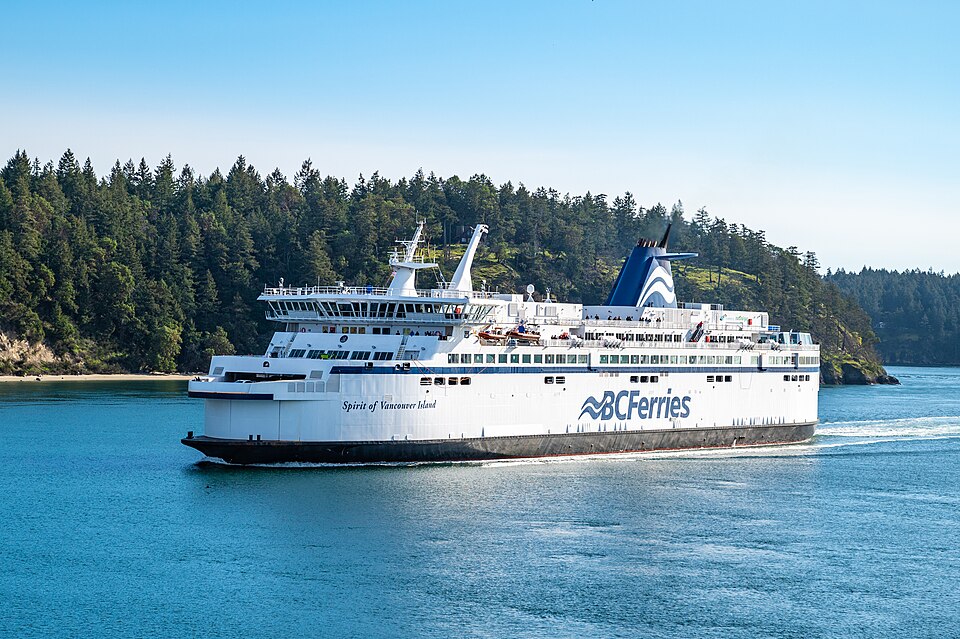
BC Ferries’ MV Spirit Of Vancouver Island between Galiano Island (Bluffs Park) and Mayne Island, en route from Tsawwassen to Swartz Bay, BC on April 6, 2022.
Photo by Gordon Leggett via Wikimedia Commons.

British Columbia’s transportation minister claimed Friday that buying new ferries from European shipyards would have cost roughly $1.2 billion more than buying them from a Chinese government-owned shipyard in Weihai, Shandong province, which is a city roughly the size of Montreal that I had never heard of until this week. China knows how to build cities. They burst into existence from nothing, like popcorn. China also knows how to build ships, and highways, and high-speed rail, and just about anything else you would care to name, better and more efficiently than the Canadian public service can realistically comprehend.

The four ships B.C. Ferries is fixing to replace, of 1960s and 1970s vintage, were built at Seaspan in North Vancouver (which is an active shipyard), at the Victoria Machinery Depot (which is no longer an active shipyard), and at the Burrard Dry Dock (which is also defunct). Canada’s shipyards, for better or worse — certainly for expensive! — are very busy building things for the navy.

B.C. Ferries has plenty of experience with foreign-built vessels. Its current fleet includes ships built in Romania, Poland, Germany and Greece. Other than the Baynes Sound cable ferry on Vancouver Island — which is not especially popular — the Crown corporation’s newest Canadian-built boat went into service in 1997. So “foreign” obviously isn’t the problem.

But China is China, and that’s legitimately another thing. China is not a Canadian ally. They try to screw with our democracy, and most other democracies by the sounds of it. And right now we are in a profoundly protectionist moment: Across the political spectrum, mostly because of President Donald Trump, “buy Canadian” is the only philosophy really on offer.

But does that make sense? We should pay over the odds for ferries … because of Trump? There wasn’t half of all this foofaraw when Marine Atlantic on the East Coast bought its newest ferry from Weihai. Since last year it has safely been shepherding Canadians between Nova Scotia and Newfoundland, without a whisper of controversy in the Rest of Canada.

I don’t quite get the Trump angle, which is perhaps why I’m more interested in Dean Broughton‘s take:

… I’m not just disappointed — I’m furious — about the NDP government’s decision to award the construction of four new BC Ferries vessels to a Chinese state-owned shipyard. This isn’t just outsourcing. It’s betrayal dressed up as budget management.

Back in 2021, the NDP government unveiled a “Made-in-B.C.” shipbuilding strategy with great fanfare. They formed a Shipbuilding Advisory Committee, posed for cameras, and promised to rebuild a long-neglected industry. It was supposed to be a turning point, a real investment in local jobs and industrial capacity.

Now, many of those same politicians have turned their backs on everything they claimed to support. Not only did they ship the contracts overseas, but, according to Eric McNeely, president of the BC Ferry and Marine Workers’ Union, they didn’t even give B.C. shipyards a fair shot. The procurement process was so rushed and restrictive that no local yard could realistically compete. They didn’t lose the bid — they were boxed out.

That’s not fiscal prudence. That’s political cowardice.

The hypocrisy is staggering. This is the same government that talks endlessly about investing in clean industry and supporting working families, and they just handed a massive public contract to a country with a well-documented record of environmental abuses and human rights violations.

They talk about reconciliation and sustainable development—and then funnel hundreds of millions to an authoritarian regime.

Worse still, they did this knowing full well that B.C.’s industrial base is already in decline.

We have so little left beyond resource extraction. Shipbuilding could have been part of our economic renewal. Instead, it’s another casualty of government optics and empty promises.

I remember my father’s outrage in 1990 when the federal government cancelled the Polar 8 icebreaker — a Canadian-built vessel meant to defend our Arctic sovereignty. That decision was dismissed as a “cost-saving measure” and today our claim to the North has never been weaker.

The BC Ferries decision reeks of the same short-sighted logic.

The Crewless Tank Experiment | Project Crazy Horse

Filed under: Britain, History, Military, Technology — Tags: , , , — Nicholas @ 02:00

The Tank Museum
Published 31 Jan 2025

This might just be one of the greatest missed opportunities in the history of tank development. Project Crazy Horse: a full-sized, crewless, remote-control tank – developed 35 years ago.

Being shot at is as unpleasant as it is dangerous. But in the 1980s, the Ministry of Defence needed to trial the cutting-edge TRIGAT missile system with a mobile target. The MOD approached the Royal Armament Research and Development Establishment (RARDE) with a unique challenge – design us a tank that can operate by remote control.

With a limited budget, the project team selected an old Mark I Chieftain as the test bed for their vehicle. Stripping out any unnecessary components and piecing together the needed parts from a range of tech, Crazy Horse was successfully trialed in 1988.

But despite the innovations of both the team and the technology, the project was shut down due to budget cuts and issues of unreliability. The team was reassigned, and Crazy Horse was sent to The Tank Museum. There is currently no such thing as an unmanned, remote controlled main battle tank. But 35 years ago, we came tantalisingly close.

00:00 | Introduction
00:39 | A Moving Target
03:00 | Less Than A Million Dollars?
04:40 | Previous Attempts
07:47 | Creating Crazy Horse
10:16 | A Stormer!
13:47 | Slow Death of Crazy Horse
18:23 | A Missed Opportunity?

In this film Chris Copson and Paul Famojuro explore the extraordinary story of Project Crazy Horse. This unique Chieftain target tank was developed in the 1980s, by an enthusiastic team that used their expertise to create the biggest remote-controlled tank in the world. Sadly, despite several glimmers of a resurrection, Crazy Horse would never see its full potential. Both Crazy Horse and its Stormer control vehicle were saved from scrap, and are now on display at The Tank Museum, where visitors can discover more about this revolutionary design.
(more…)

QotD: What is a “tank”?

Filed under: Britain, History, Military, Quotations, Weapons, WW1 — Tags: , , , , — Nicholas @ 01:00

… the tank was a direct response to the battlefield conditions of WWI, in particular the trench stalemate on the Western front. The idea of some kind of armored “land cruiser” (potentially armed with machine guns) had been floated before WWI but never seriously considered and developed on, but serious development only began in 1915 with the formation of the Landship Committee early that year. Famously, they needed a code-name for their planned vehicle and opted first for “water carrier” and then for “tank”, thus giving the tank its peculiar English name.

And we should stop to note that as with any question of definition, this one too is language-sensitive. The exact confines of a term vary from one language to another; kampfpanzer, for instance is not necessarily an exact synonym for “tank”.

In any event, the basic demands of early tanks were dictated by the realities of the Western Front: a tank needed to be able to resist small arms fire (particularly machine guns), deliver direct supporting fire itself, it needed to be able to move on the muddy, artillery-flattened ground and it needed to be able to cross a trench. This last requirement – the need to be able to both climb a parapet (usually c. 4ft) and then cross over an 8ft wide trench – was significant in the design of early tanks.

Those factors in turn dictated a lot of the design of early tanks. The armor demands of resisting small arms fire meant that the vehicle would be heavy (and indeed, as soon as tanks appeared amongst Allied troops, their German opponents began introducing more powerful bullets, like the K bullet and later the 13.2mm anti-tank round fired from the Mauser 1918 T-Gewehr). And here is the first advantage of tracks. The weight of a vehicle is distributed along all of the area of contact it has with the ground; with tires that area is limited to the bottom of the tire so the total area of ground contact is fairly low, which is fine for most vehicles.

But tanks are heavy. Really heavy. Even something like the Renault FT could mass around 7 tons and by later standards that would be classified as a tankette (a “mini-tank” as it were); by WWII, medium tanks often clocked in around 30 tons. If you put a vehicle like that on tires, you are going to create a LOT of pressure on those small points of contact. That might still be OK if you are just going to drive on roads and other firm surfaces which can take the pressure. But remember: tanks were designed for the Western Front, which looks like this.

Fortunately for the landship committee, this wasn’t a new problem: farming tractors were also heavy and also had to operate in churned up (in this case, plowed) soft soil; the heaviest of these vehicles had much the same problem and the solution was continuous tracks or “treads”. When kept properly tensioned – tune in, by the by, to Nicholas “The Chieftain” Moran’s YouTube for more than you ever want to know about track tension – the track distributes the weight of the tank across the entire section of the track touching the ground, which reduces the ground pressure at any given point, allowing a big heavy tank to roll over terrain where even a much lighter wheeled vehicle would get stuck.

This is one of those points where the functionality of a tank (what a tank does) has such a strong influence on design that the design implications of the functionality become part of the definition: a tank has to be heavily armored and has to be able to move off-road and as a result has to be tracked, not wheeled. One might be able to imagine some sort of exotic technology that might make it possible to do all of the things a tank does without tracks, but we don’t have that yet.

The other factor was fire. I’ve mentioned this before, but one of the significant background factors of WWI is that a lot of the belligerents misjudged the kind of artillery they’d need for a general European war. Not to get too deep into the weeds here, but most of the belligerents expected a relatively rapid war of maneuver and so thought that light, direct-fire artillery like the famed French ’75 (the Matériel de 75mm Mle 1897) would be the most useful. Those guns could be moved quickly and could deliver a lot of quick firepower on static or moving formations of enemy infantry in support of friendly infantry.

The problem is that in the conditions of trench warfare, those guns – as they were configured, at least – were far less useful. They were, first off, much shorter in range which meant they had to be brought dangerously far forward to do their direct fire role – often so far forward they could be engaged by enemy rifles and machine guns. This was compounded by the fact that direct fire at range was ineffective against trench works (which are dug down into the earth). But at the same time, the value of rapid firing (because these lighter guns could fire a lot faster than the heavy, indirect fire artillery) direct fire artillery remained high, if only you could get it to the fight.

This was also a problem a tank could solve: as a mobile, armored platform it could move a rapid-firing direct fire gun forward without immediately being knocked out by enemy small arms to support the infantry. There is, I should note, early complexity on this point, with both “male” (heavy direct fire cannon focused) and “female” (machine gun focused) tanks in WWI though in the end “hermaphrodite” designs with both capabilities (but much more focus on the main cannon) triumph, so that’s what we’ll focus on.

And that gets us the fundamental role structure for tanks: enough armor to resist enemy small arms (but with the understanding that some weapons will always be effective against the tank), enough mobility to cross the churned up battlefield and some direct fire capability to support the infantry crossing it at the same time.

Bret Devereaux, “Collections: When is a ‘Tank’ Not a Tank?”, A Collection of Unmitigated Pedantry, 2022-05-06.

Powered by WordPress


