
Colby Cosh considers the fate of a Japanese government minister who accidentally told the truth about a subject near and dear to Japanese consumers’ hearts (well, stomachs, actually):
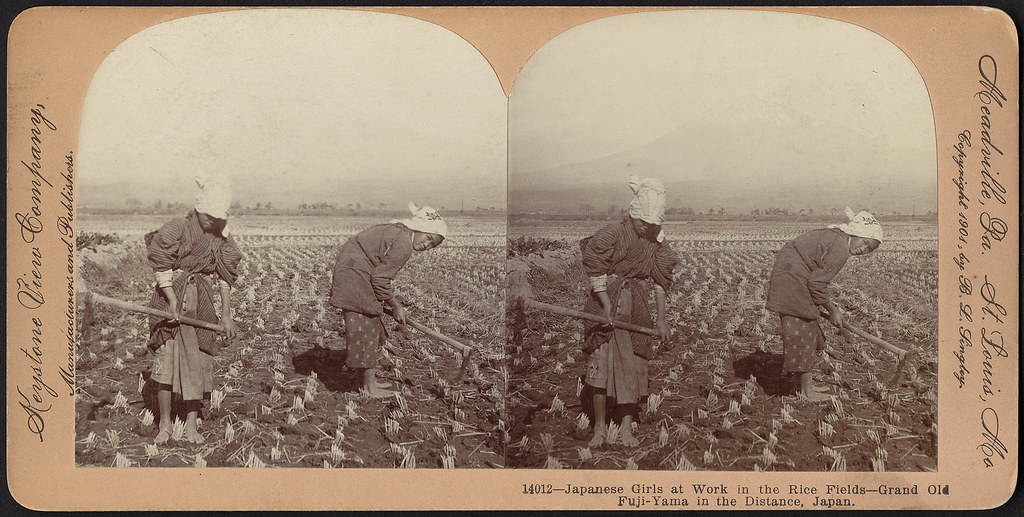
“Japanese Girls at Work in the Rice Fields – Grand Old Fuji-Yama in the Distance, Japan” by Boston Public Library is licensed under CC BY 2.0 
 .
.
I’m sure some of you saw Wednesday’s NP headline for an Associated Press wire story: “Japan’s agriculture minister resigns after saying he ‘never had to buy rice’” AP’s Mari Yamaguchi explained this international-news nugget. A cabinet minister in a shaky minority government made a flippant comment indicating that he was light-years out of touch with ordinary people facing high grocery costs in a developed country.
Taku Eto’s political survival thus became impossible within a matter of hours, and his prime minister hastily swapped a congenial young star into the agriculture portfolio. Japan is a constitutional monarchy with a system of parliamentary government more or less like ours, so there’s nothing incomprehensible about any of this to a Canadian …
… but, of course, one almost couldn’t help flashing back to our recent election campaign, wherein the prime minister had half-boasted to a Radio-Canada reporter that he doesn’t buy his own groceries and has no earthly idea how the stuff in his fridge gets there. It struck me at the time that this was a classic mistake for an electoral neophyte like Mark Carney. Fans of the legendary American columnist Michael Kinsley will surely think of it as a “Kinsley gaffe”, i.e., an obviously true statement that is nevertheless bound to get a politician in trouble.
[…]
Eto was talking about rice because the prices for it in Japan have gone through the roof, the clouds and the stratosphere. And rice plays a role in the Japanese culture and diet for which there is no analogue in omnivorous Canada. For precisely that reason, rice is supply-managed there in much the same way our dairy, eggs and poultry are — i.e., through confiscatory tariffs on foreign products, along with a mafia of politically powerful producer cooperatives who operate under supply quotas.
If you read Canadian news, you can recite the effects of this, whether or not you’re capable of finding Japan on a map of Japan. Their supply-management system is, like ours, a major headache for counterparties in trade negotiations. Their farmers, like Canada’s, are dwindling in number and aging out of the business. They are sometimes paid to destroy crops. Farm costs for machinery and supplies are subject to inflation. And sometimes the system for domestic demand forecasting blows a tire.
It’s a constant high-wire act for Japanese governments, who still have official responsibility for the national rice supply under wartime statute. If store-shelf prices get too high, and consumers start to make trouble, the cabinet must consider loosening tariff barriers and releasing rice from the national strategic reserve. The LDP ministry has done both these things in the face of hallucinatory prices, and so the farmers are now just as ticked off as the buying public.


