
TimeGhost History
Published 18 May 2025There seems to be an evolution, that may one day become a revolution, in popular music in the US. Songs with amplified electric guitars, wailing saxophones, and backbeat rhythms are being released more and more often, but it’s not just R&B or jump blues, this is a bit of a different style — a new style. And it’s spreading quickly thanks to a vinyl record revolution that’s also getting in gear. Looks like exciting times ahead for the youth of America, and maybe even the whole world.
(more…)
May 19, 2025
1949: What are those kids listening to? – W2W 29
Comments Off on 1949: What are those kids listening to? – W2W 29
The Roman Empire and climate change
Sebastian Wang considers “what we all know” about the rise and fall of the Roman Empire in the light of more recent research (not all of it politically motivated) into climate change:
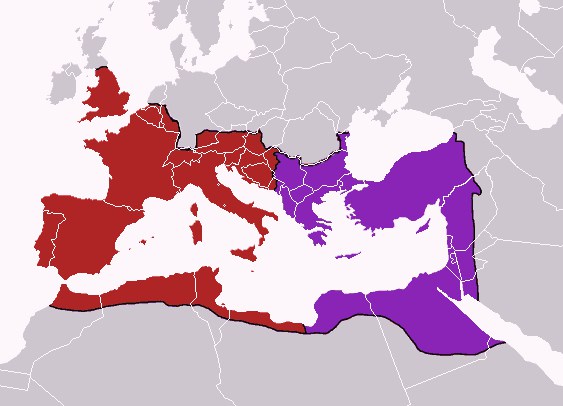
The approximate extent of the Roman empire circa 395AD.
Before we get into climate, and for those who tend to the wholly ignorant spectrum of my readers, we need a quick sketch of Roman history. The Empire officially began in 27 BC, when Octavian — better known as Augustus — became the first emperor. It ended in the west in AD 476, when the last western emperor was kicked out. As said, the eastern half, based in Constantinople, carried on for another thousand years.
Broadly, we can divide Roman history as follows:
- 27 BC – AD 180: The golden age. Augustus and his successors took over and further expanded a huge empire. There was peace (mostly), trade flourished, and cities grew. People call it the “Pax Romana“.
- AD 180 – 284: Everything starts to fall apart. This is called the Crisis of the Third Century. Civil wars, foreign invasions, plagues, and economic collapse all hit at once.
- AD 284 – 395: The empire pulls itself together. Emperors like Diocletian and Constantine bring in reforms. But the empire is now divided for administrative convenience — east and west.
- AD 395 – 476: The west goes under. It’s invaded. It’s conquered and broken up. Very quickly, it disappears. Though, once again, a parochial view of history, we call this the Fall of the Roman Empire.
The standard histories still blame bad rulers or too many wars. That’s fair enough. There were some very bad rulers, and the wars without number. But if you look at the climate data — tree rings, ice cores, sediment levels — you start to see another pattern underneath what may be called the political and economic superstructure of Roman history.
When Rome came to greatness, the climate was unusually good. From around 200 BC to AD 150, there was a long phase of stable, warm, and mostly wet conditions. Scientists call this the Roman Climate Optimum. In Egypt, the Nile flooded regularly and well. That meant lots of grain. In the Alps, glaciers shrank. In northern Europe, people were growing grapes in places too cold for vineyards today. In the Middle East, the Dead Sea stayed high, showing good rainfall.
This kind of weather made everything easier. Crops were reliable. Surpluses could be taxed. Cities could be fed. Roads and aqueducts could be built and maintained. And because the army was well supplied, the Empire was protected, and could even continue a modest expansion. But, as McCormick and his team point out, the high phase of Nile flooding correlates exactly with the high point of Roman prosperity — and once those floods became less predictable, problems followed.
The good times came to an end. By the mid-second century, a wave of volcanic eruptions thew great masses of dust into the atmosphere, blocking sunlight. Solar activity dropped. The climate became less stable. Then came the Antonine Plague in AD 166. It probably started in the east and spread quickly. Some think it was smallpox. Whatever it was in terms of microbiology, it was almost certainly brought on by changes in the climate. It may have killed a third of the Empire’s population.
Worse was coming. By AD 200, climate records show more erratic rainfall and cooling. In Gaul and the Balkans, harvests became less predictable. Glaciers began to advance again. Speleothem data from Austrian caves shows sharp shifts in rainfall patterns.
At the same time, the empire started to shake. Between 235 and 284, Rome had over twenty emperors. Most were generals who seized power, then got killed. Civil wars broke out. Trade declined. Foreign tribes pushed harder at the frontiers. Coin hoards — money buried for safety — increased in number. That’s usually a sign of fear and instability. Cities shrank. The economy shrivelled.
Was this all because of climate? No — not wholly. A good definition of historical crank is someone who tries to explain everything in terms of one cause or set of causes. But as McCormick et al. argue, bad weather made everything worse. It weakened agriculture, strained supplies, and made people more likely to panic or rebel. In a world without modern logistics, you couldn’t afford bad harvests two or three years in a row.
The empire buckled in the third century, but didn’t collapse. And its survival probably was an effect of human agency. A line of competent Emperors rose from the army and stabilised the frontiers. This line culminated in the reigns of Diocletian and Constantine, who restructured the Empire. They fixed taxes. They reorganised the army. Constantine built his new capital in the east. His successors found Constantinople safer and more strategically useful than Rome.
This being said, around AD 290, climate records suggest a small rebound. Warmer temperatures and better rainfall returned — especially in the east. That helped the eastern provinces recover faster. They had stronger governments and better infrastructure. But climate helped. Dead Sea levels remained relatively high, which meant steady rain in the Levant.
The west wasn’t so lucky. Italy and parts of Gaul stayed unstable. In Britain, pollen records show that farmland was being abandoned. The archaeology matches this, with fewer building projects and shrinking urban centres. The killing shock for the west came in the fifth century. In Central Asia, a long drought began around AD 370. Steppe tribes like the Huns were hit hard. They migrated west, pushing other tribes like the Goths ahead of them. In AD 376, the Goths crossed the Danube into Roman territory. Two years later, they crushed a Roman army at Adrianople. This all happened in the eastern half. But greater wealth and better leadership allowed the government in Constantinople to push the barbarians west. Over the next century, the western empire was hit again and again.
Meanwhile, the weather got worse. Europe cooled. Rainfall patterns shifted. Flooding and crop failures increased. Volcanic sulphur levels spike in the ice core record from Greenland.
Rome was sacked in AD 410. Again in 455. Finally, in 476, the last western emperor was deposed. That was it. The western Roman Empire was gone.
The east survived. But was hardly untroubled. In AD 536, a huge volcanic eruption darkened skies around the world. The sun barely shone. Crops failed. Famines spread.
A few years later, the Plague of Justinian broke out. It probably started in Egypt and spread through trade routes. Some say it killed half the population in affected areas.
Climate and disease worked together. Hunger weakened people. Infection finished them off. As McCormick et al. put it, the event of 536 and the plague that followed created one of the worst demographic shocks in recorded history.
Comments Off on The Roman Empire and climate change
Best of Cunk on Shakespeare – Part 1
Philomena Cunk
Published 20 Dec 2023Are you saying I’m a liar?
Sharing all things Cunk – a fictional character from Charlie Brooker’s Weekly Wipe, Cunk on Britain, Cunk on Shakespeare and Cunk on Earth – Portrayed by the incredible Diane Morgan.
Comments Off on Best of Cunk on Shakespeare – Part 1
QotD: Food for Medieval English peasants
The most common everyday sort of meal in wood-burning Britain was what we might call pottage or frumenty, a thick moist dish in which whole grains or pulses are brought to a boil and then simmered until as much liquid as possible has been absorbed. Think risotto but with less stirring. The simplest version was very simple indeed — wheat or barley or peas cooked in water with whatever fresh vegetables or herbs were available — but if you had the means you could add anything that was in season: meat, fish, butter or cheese, milk or cream, eggs, and even delicacies like sugar, almonds, or imported dried fruits.1 In fact most medieval dishes were thick and sticky, exactly the sort of thing I like to give my toddlers because it stays on even the most inexpertly wielded spoon, and they’re extremely well-adapted to cooking over wood. Just get your pot boiling over a big fire, then as the flames die down your dinner will simmer nicely. You’ll have to stir it, of course, to keep it from sticking to the pot, but you have to come back anyway to feed the fire. You can cook like this over coal, but it’s difficult: a coal fire stays hot much longer, so moderating the temperature of your frumenty requires constantly putting your pot on the grate and taking it off again. It’s far simpler to just add more liquid and let it all boil merrily away, with the added bonus that the wetter dish needs much less stirring to keep it from sticking. With the switch to coal, boiled dinners — soups, meats, puddings, and eventually potatoes — became the quintessentially English foods.2
Jane Psmith, “REVIEW: The Domestic Revolution by Ruth Goodman”, Mr. and Mrs. Psmith’s Bookshelf, 2023-05-22.
1. We’re used to thinking of plants as being seasonal, but until quite recently animal products were seasonal too: chickens won’t lay in the winter without artificial lighting, cows stop giving milk when their calves reach a certain age, and generally one would only slaughter an animal for its meat at the right time of year. Geese, for instance, were typically eaten either as a “green goose”, brought up on summer grasses and slaughtered as soon as it reached adult size around the middle of July, or a “stubble goose”, fattened again on what remained in the fields after harvest and eaten for Michaelmas (in late September). Feeding a goose all autumn and half the winter only to eat it for Christmas would have been silly.
2. It’s also typical of New England, which makes sense; the New Englanders by and large came from East Anglia, which is right on the Newcastle-London coal route and a region that adopted coal cookery relatively early.
Comments Off on QotD: Food for Medieval English peasants


