At Works in Progress, Agree Ahmed describes the conditions in northern Europe in the Middle Ages that helped create the Hanseatic League:
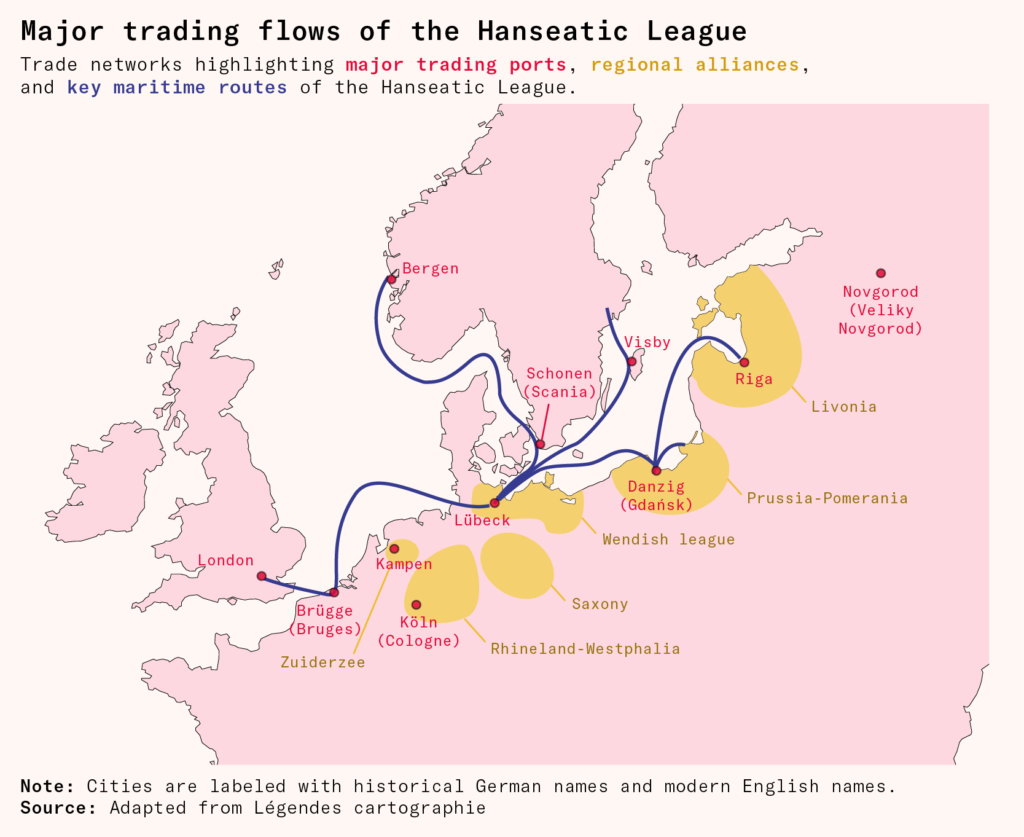
Today, we typically think of coalitions in the context of modern electoral politics. So it might be surprising that one of the greatest case studies in the history of coalitions is a community of medieval German merchants known as the Hansa.
Starting as individual traveling traders, the Hansa built up coalitions for collective bargaining, collective action, and collective security. Through this process, they formed Northern Europe’s first ever long-distance trade network.
Without corporate structures, they built supply chains that distributed goods between Northern Europe’s major ports, with capillaries that spread into each city’s hinterlands. Without formal territory, their laws governed trading hubs spanning thousands of miles, from London all the way to Western Russia. And, despite being composed of hundreds of member cities, the Hanseatic League had no head of state. Yet the Hansa still managed to sign treaty after treaty with foreign rulers and, a few times, even fought (and won!) wars.
[…]
Better climate, more arable land, and better farming techniques lifted Europe’s crop yields to above subsistence levels for the first time since the Roman period. After several centuries of decline, Europe’s population grew from 18 million in the 600s to over 70 million by the 1300s – nearly triple the population of the Roman period. The nutritional surplus allowed for Europe’s first significant artisan class since the Roman empire. Each town had common craftsmen like blacksmiths, leatherworkers, and carpenters. But local skills and resources allowed for the emergence of specialized crafts, which were unique to specific regions and could therefore be traded.
Tax-hungry lords across Europe began to set up permanent marketplaces for their growing communities. And so hundreds of towns formed in Europe, filled with workers who had flocked from countryside manors. These towns were the first substantial permanent markets in Northern Europe’s history.
As production accelerated, so did shipping. The warmer climate meant waterways in the North and Baltic Seas were navigable for longer stretches of the year. Meanwhile innovations in boatmaking dramatically improved shipping capacity. Excavations of the few surviving ships from this era show that, in the span of a few centuries, vessels tripled their average tonnage from 10 to 30 while dropping the number of rowers required by a factor of four.
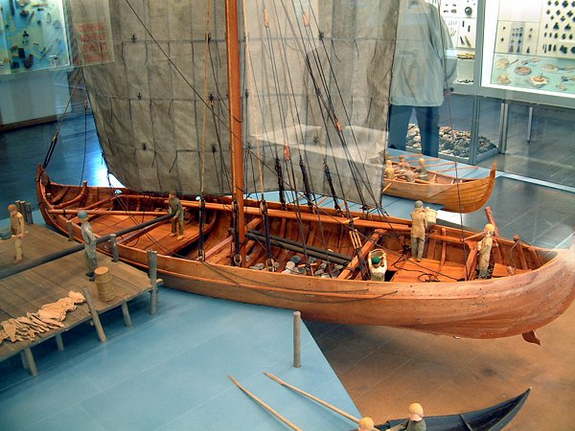
The breakthrough in tonnage starting in 900 can be credited to the knarr, a Viking-style ship that was shorter and wider than the longboat that preceded it, allowing it to load substantially more cargo with a smaller crew. Prior to the knarr, trade convoys had to carry cargo on longboats, which were agile but could only carry small fractions of what the knarr could.
A model knarr in the Hedeby Viking Museum in Germany.
Image Source: Europabild via Wikimedia.When Northern Europe’s first long-haul merchants set off on their voyages, they faced a world that had not yet been ordered for trade. Sailors had to worry about pirates in the Baltic and shipwrecks at icelocked winter ports.
Riverways gave merchants access to inland communities, where they could find products at lower prices to then sell for a profit in major port cities. But riverside towns were more interested in their own engineering projects or grinding their grain and so would block rivers with dams and water mills, and they would redirect water to irrigate fields.
And even if a river were clear of obstructive mills or dams, it might be heavily punctuated by toll stations. The Rhine River, a key shipping artery that connected inland Germany with the Baltic coast, had tolls approximately every five kilometers.
Under the laws of the Holy Roman Empire, the right to collect tolls on the Rhine could only be granted by the Emperor. But unauthorized tolling stations, or tolls levied in excess of what was authorized, were so rampant that the malpractice had a name: the lonia iniusta (Latin for “unjust tolls”). Some local authorities enforced toll collections along rivers by running chains from bank to bank, making it impossible for a boat to pass without paying. Others would patrol the river on their own boats and deny vessels passage until they paid up.
In the first four years of the Great Interregnum Period (1250–73), when the Empire had no emperor, the number of toll stations on the Rhine doubled to 20. This is the origin of the term “robber baron”: local barons, operating out of riverside castles, would set up illicit toll stations and demand significant shares of merchant cargo in order to pass.
The journey on land wasn’t much easier. Toll booths were similarly common. Nominally, these were to pay the landowner for the maintenance of the roads and bridges but in reality they were usually left dilapidated. Merchants voyaging on land had to load their wares on the backs of mules and horses (which were about a third the speed of ships). The narrow widths of medieval roads meant these caravans stretched out in long lines, leaving animals and cargo physically exposed. These vulnerable, slow moving, value-dense caravans attracted bandits who roamed the isolated roads between towns. It was nearly guaranteed a caravan would face an attempted robbery – either illegally by bandits or (somewhat) legally in the form of a toll shakedown – over the course of a sufficiently long trip.
As a matter of safety, Northern European merchants learned to move together in armed groups. These traveling merchant bands were called hansas, a Lower German word meaning “company” or “troop”. When a hansa formed for a trip, they elected an alderman (literally “elder man”) who would speak on behalf of the group to the various authorities – lords, princes, bishops, and other rulers – they might encounter along the way.
Once they completed the arduous journey, the merchants had to deal with the local governments of their destination cities, each of which had different and constantly changing laws. To protect the local merchants and craftsmen within their city walls from competition, princes might demand exorbitant taxes from foreign merchants or deny them access to the city altogether. Merchant bands had to negotiate collectively to secure the right to trade within each city in which they wished to conduct business. And if they made it into the city walls, they might not make it out: capricious lords might suddenly imprison foreign merchants (as happened to German merchants in England in 1468 and Novgorod in 1494), raid their offices, or seize their merchandise.
Local laws threatened foreign merchants more than they protected them. Most town courts, themselves newly formed, had minimal experience adjudicating long distance commercial disputes. When such disputes did arise, courts could take weeks or months to arbitrate them, and were heavily biased towards locals over foreign traders. Without sovereign states, merchants were left dealing with a fractured landscape of town courts, where each market had its own idiosyncratic laws. And because foreign traders could evade punishment by fleeing overseas, courts in England, France, Italy, and the Holy Roman Empire often collectively punished foreign merchant communities for the unpaid debts of their countrymen.
The lack of early medieval records makes it difficult to quantify just how much Northern European commerce grew as a result of continuous long distance trade. Before the late medieval period, Northern Europe’s archaeological record of trade shows just several dozen sites known as emporiums: small, temporary settlements outside of towns where foreign merchants traded with locals. But starting in the late medieval period (1300 to 1500), Lower German merchants began to change this.
H/T to Niccolo Soldo for the link.