
Quotulatiousness

May 8, 2025

Aftermath

Filed under: Books, Europe, Germany, History — Tags: , , , , , — Nicholas @ 09:19

I’ve read a few books on what happened in Europe after the surrender of Nazi Germany in May of 1945, but there is always more to learn about a continent-wide struggle to recover from a disaster of the magnitude of World War Two:
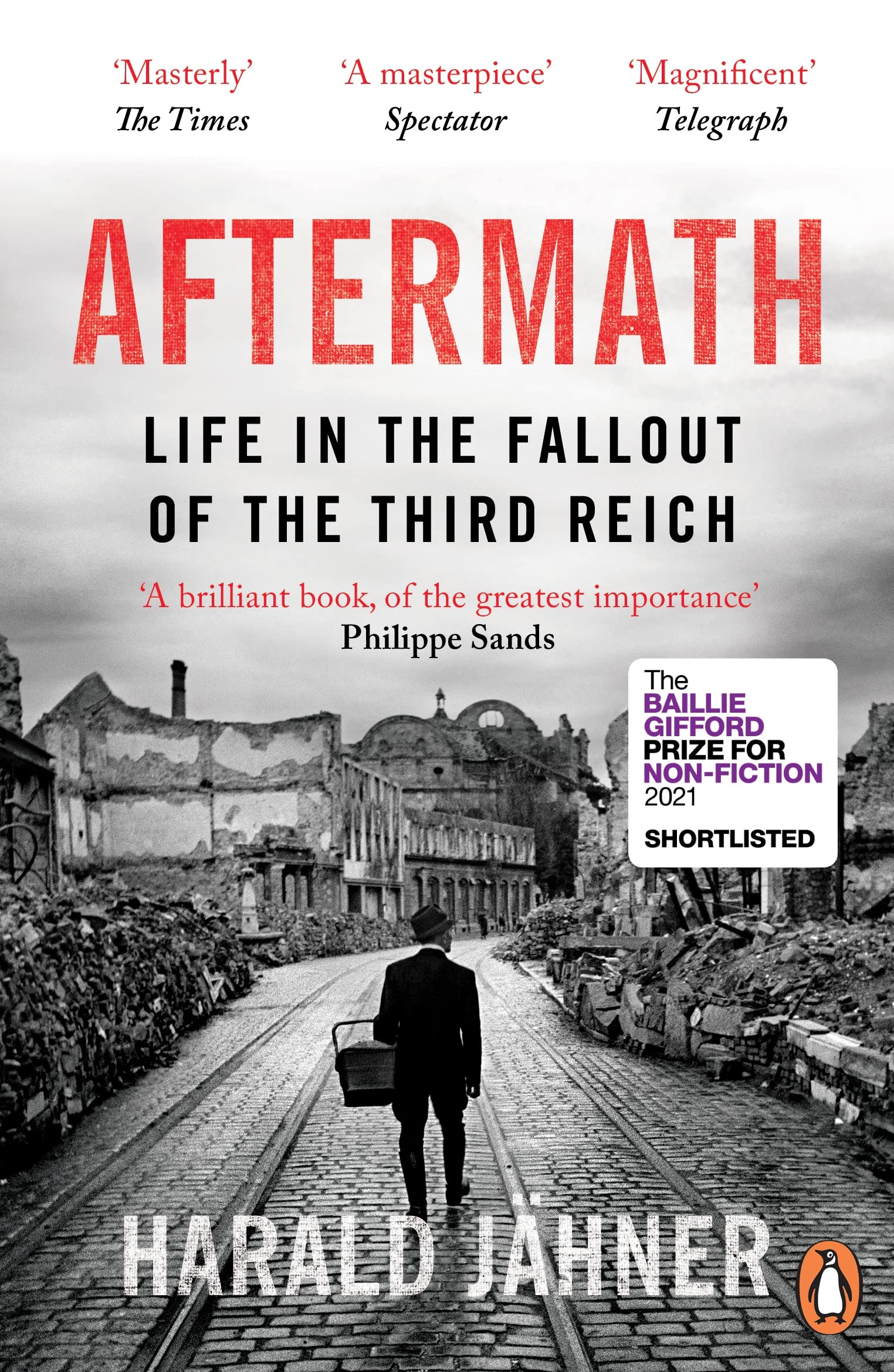
On a train journey earlier this year between Cologne and Berlin, I began to read Harald Jähner’s Aftermath, a fascinating account of the years when Germany emerged from the destruction and shame of the Third Reich.

The war ended 80 years ago today, and in the defeated nation the scenes were primeval and apocalyptic. In Berlin, journalist Ruth Andreas-Friedrich, along with a doctor, actor and musical conductor, discovered a white ox wandering through the streets and, after finding a Russian soldier to shoot it, found themselves suddenly surrounded by a ravenous mob. She recalled: “Suddenly, as if the underworld had been spying on them, a noisy crowd gathered around the dead ox. They crept from a hundred basements. Women, men, children. Were they lured by the smell of blood? Within minutes they were scrambling for meat.” The bourgeois of Middle Europe reduced to an animal state.

Germany was a pile of rubble; the ruins in the Reich‘s capital amounted to 55 million cubic metres, enough for a wall 30 metres wide and 5 metres high stretching all the way to Cologne. In West Berlin, for the next 22 years, up to 800 lorries a day unloaded so much rubble on the former Factory of Armaments Technology that it became known as Teufelsberg, or Devil’s Mountain. The last “rubble brigade” in Dresden only finished work in 1977.

Although Nazi party members were made to clear rubble as a punishment, the Germans hardly needed encouragement; on 23 April, the war not yet over, the municipal building of Mannheim had already declared WE ARE REBUILDING.

The communal process of clearing away seemed to serve a psychological function for a hungry, defeated people, and was encouraged by the new authorities — all the “heroic cinematic rhetoric” employed by the UFA film company of the Nazi regime now used to get the country clearing up. There was even a cinema genre called Trümmerfilm, rubble films, one — And The Heavens Above Us — ending with the Lord’s Prayer being recited among the ruins of Germany.

German POWs, “dispirited, disciplined and dutiful to the point of submissiveness”, made life easy for occupying soldiers while their former victims were far more troublesome. (Russian POWs in France caused such anarchy that they called in a Soviet liaison officer who selected ten at random and shot them, bringing the mob under control.) This led to a bizarre alliance between Allied and German law enforcement working hand-in-hand from the early days of the occupation, with joint raids and weapons searches on displaced persons from Poland and the Soviet Union, which the Poles and Russians “of course saw as an intolerable provocation”.

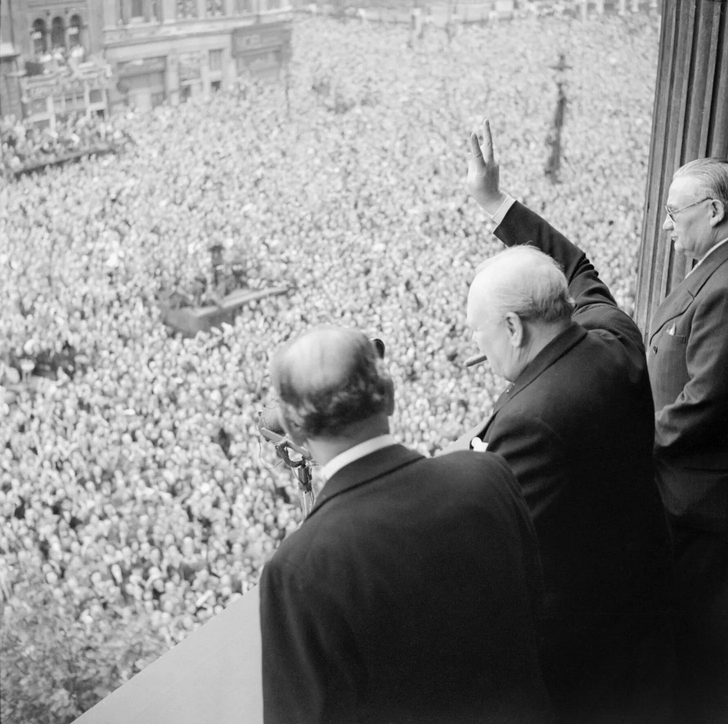
London cheered on May 8, 1945. In Berlin they searched for food and cleared rubble

In a strange irony, there was now a large-scale migration of Jews from Poland to Germany, fleeing fresh persecution despite the horror they had endured. Even here in a camp system under Allied control, there were anti-Semitic attacks from other survivors, so that Jews were eventually separated altogether following the conclusions of the Harrison Report. The Americans, in a likely first in European history, now made Jews an explicitly privileged group, with superior camp conditions.

The Polish Jews set up their own camp in the Munich district of Bogenhausen where locals were confused and disorientated by the new arrivals. These eastern Jews actually looked like the alien caricatures Nazi propaganda had bombarded them with, dressed in oriental clothes from the shtetl, totally unlike the assimilated German Jews they had grown up with. One local complained that “the Jews from the old days were really, how can I put it, very intelligent, polite and unusually friendly and elegant people. And of course the ones who turned up after the war included all sorts.” The Jews “from the old days” were “the good Jews”, he lamented.

Holocaust guilt was in the distant future for most, and newly re-established newspapers weren’t remotely shy about publishing anti-Semitic content. One printed a resident’s complaint about Polish Jews that “these were not people who had been persecuted” but “the sputum, the yeast and the scum of elements who were never deported but, to avoid regular work, came here from the eastern states, in many cases completely illegally, and are now spreading themselves raggedly about the place.”
Dambusters – Was It Worth It?

HardThrasher
Published 5 May 2025

The third and final part in a series on the Dambusters Raid; looking at the attacks themselves and their aftermath
(more…)

Ted Gioia is apparently “the guy you consult about the total collapse of everything

Filed under: Books, History, Media, USA — Tags: , , , , , — Nicholas @ 03:00

I’ve been reading Ted Gioia‘s work for a few years now, but I somehow failed to pick up on the fact that he’s some kind of Bond supervillain:

Many articles have been written about me over the years. But I’ve never been hit with an opening sentence like the one published on Monday by The Atlantic.

    Last year, I visited the music historian Ted Gioia to talk about the death of civilization.

Whoa! That makes me feel like a Bond villain.

I need some henchmen — any volunteers?

Ted appears to like the classic goon uniforms for his to-be-recruited legion of minions.

What an unexpected turnabout! For many years, I was known as an expert on music, especially jazz and blues.

But now I’ve taken on a new guise. I’m the guy you consult about the total collapse of everything.

I don’t sing the blues. I don’t write about the blues. I now deliver the blues.

I originally declined the interview request from The Atlantic. But their staff writer Spencer Kornhaber pushed back, insisting that I was an essential source for his article.

The subject was, he explained, a “pervasive suspicion that we’re in an era of cultural decline, especially in arts and entertainment”.

He said that I needed to be part of the story — because everybody saw me as the decline-of-culture guy.

This caught me surprise. But I thought it over. maybe this is why I don’t get invited to many parties anymore.

Dammit, Ted, we’re trying to have some fun here — and you keep droning on about the collapse of the Roman empire.

I eventually agreed to a phone conversation with Spencer, and that went well. And this led to him getting on a plane, and visiting me at home here in Austin.

To help him in his research, I laid out more than 40 books on a countertop in my library — these were essential works, I explained, for anyone studying social or cultural decline.

[At a future date, I will provide more details about these books, and share a reading list on — to quote The Atlantic — the “death of civilization”.]

But this begs the question: Is our culture really collapsing?

I spoke with Spencer for many hours about this subject. But only a few of my comments found their way into the finished article.

So today I’ll offer a fuller diagnosis for your benefit.

Augustus and the creation of the Principate – The Conquered and the Proud 13

Filed under: Europe, Government, History — Tags: , , , , , — Nicholas @ 02:00

Adrian Goldsworthy. Historian and Novelist
Published 11 Dec 2024

Continuing the series “The Conquered and the Proud”, this video looks at the political system created by Augustus — the Principate or rule of a princeps or “first”. We look at the twin elements of his formal power, the tribunician potestas and the maius imperium proconsulare. Next time we we look at Augustus, the provinces and imperial expansion.

QotD: Trade empires

Filed under: Economics, History, Military, Quotations — Tags: , , , , — Nicholas @ 01:00

The final (and possibly ultimate) sort of empire is the Trade Empire. These develop more because exploring traders have a need for safe bases and secure lines of communication to make their trade work. Theoretically trade empires could be land based (and both the American West and the Chinese spread down the Silk Road argue the case that they started as trade security rather than conquest … no matter how they finished). But in reality the main cause of and reason for trade empires is the development of water transport. Specifically ocean transport.

So let us consider the motives of Empire in a few cases.

The Phoenicians had a magnificent trade empire, though with a few elements we find familiar from the more recent Viking version, or indeed the Venetian “Republic” — namely a bit of raiding, and quite a bit of slave trading. All three broadened into a bit of conquest — Carthage, Normandy and the sack of Constantinople in the 4th Crusade come to mind — but all those offshoots were by-products of the original cultures, and none of them became the norm for the ongoing home culture (each of which faded away as circumstances changed and they failed to adapt). So we could say that they were essentially trading empires.

Greece and Carthage and Rome were also trade empires, initially letting their security concerns drag them into a bit of conquest on the side. The difference in their cases was that the conquest element became dominant and completely changed the “homeland”. The city states of Greece becoming the world-conquering hordes of Alexander, and completely undermining the vibrant city state cultures that had proceeded them. The Phoenician trading city of Carthage becoming an expansionary conquest state that eventually pushed Rome too hard. And Rome’s overseas campaigns in Spain and North Africa completely undermining the independent farmer/citizen/soldier class of the Roman Republic, and replacing them with a system of professional troops whose loyalty could only be bought by ever increasing conquests by the emperors.

Naturally every expansion eventually reaches limits, and the concern reverts to trying to secure what you have, and hold the outsiders further away. Which is why, amusingly, people like the Romans and the Chinese came through their expansionary conquest phase, and then found themselves back in the position of having to protect the fringes through deals with tribes that can be traded with/employed by/or paid tribute. Cue Attila the Hun and his ilk.

So empires on the way down may also be considered trade and security empires I suppose, though many still had a conquest impulse (for fame or fortune or simply to pay the defenders off) built in, or tried to act as if they were still conquering hordes. Cue Constantinople and Belisarius.

In fact most empires will go through a variety of stages, though I think it fair to say that most empires have a core purpose and attitude, no matter how they tinker at the edges to deal with specific circumstances.

Nigel Davies, “Types of Empires: Security, Conquest, and Trade”, rethinking history, 2020-05-02.

Powered by WordPress



