
The Korean War by Indy Neidell
Published 6 May 2025The Senate Hearings digging into Douglas MacArthur’s dismissal as UN forces commander begin this week, though they’ll likely continue for some time. Meanwhile in the field, the Chinese Spring Offensive that raged all last week continues, although it cannot reach Seoul, and by the end of the week the enemy seems to be withdrawing on all fronts.
(more…)
May 7, 2025
The Korean War Week 46 – The MacArthur Senate Hearings Begin – May 6, 1951
Comments Off on The Korean War Week 46 – The MacArthur Senate Hearings Begin – May 6, 1951
Ontario versus the courts
In general terms, you would expect the government — in this case the Ontario provincial government — to pass the laws and the courts — when called upon — to rule on their legality. We don’t expect courts to act as if they can overrule legislation passed by the government unless it clearly contravenes the Charter or goes beyond the powers assigned to that level of government. But Canadian courts seem to be choosing to expand their powers to curtail the actions of elected government more and more these days:
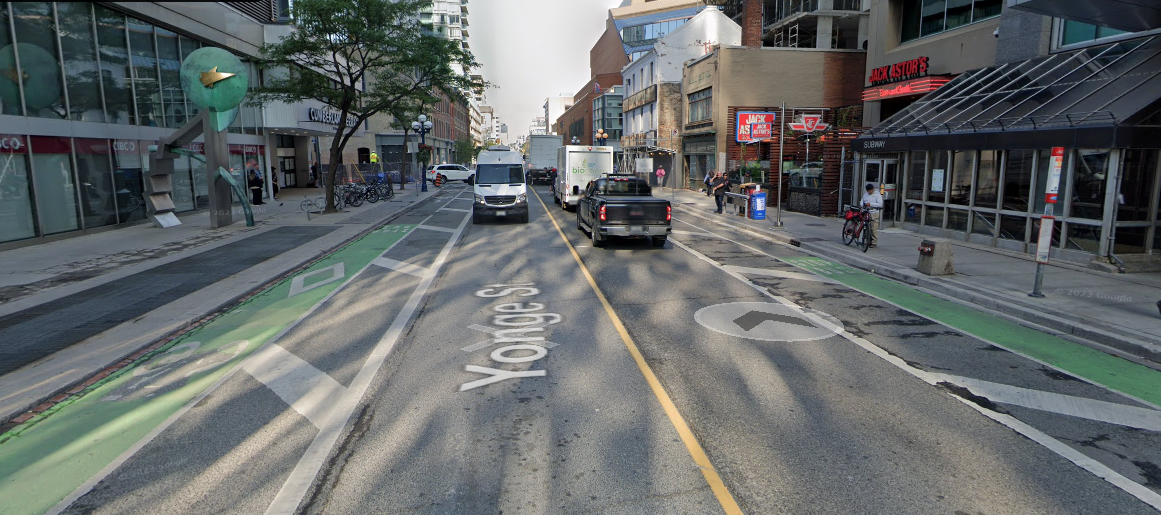
Bike lanes on Yonge Street north of Bloor Street in downtown Toronto.
Image from Google Street View
In the weeks of the election period, Canadian courts were busy preventing any legislation of controversy from taking effect — and they went relatively unnoticed. On March 28, the Ontario Superior Court of Justice blocked the Ontario government from banning supervised consumption sites near schools and daycares. It struck again on April 22, halting the Ontario government from removing Toronto’s bike lanes.
Days later, on April 24, the Quebec Superior Court cancelled the province’s planned mega-tuition hike for out-of-province students.
In the case of Toronto’s major bike lanes — on Bloor Street, Yonge Street and University Avenue — Ontario Premier Doug Ford had, in theory, all the power he needed to remove them. Municipalities are creatures of the province, and traffic regulation is also a provincial domain; thus, provincial legislatures can override just about anything that a city council does, especially if related to roads. So, in November, Ford legislated the removal of the lanes, which were previously constructed by city authorities (he was later re-elected premier, so clearly bike lane preservation wasn’t a priority for voters).
In December, cycling advocates launched a court challenge that, really, should have been laughed out of the room. They argued that the removal of bike lanes amounted to a violation of their Charter rights, specifically the Section 7 catch-all right to life, liberty and security.
It remains to be seen whether there is a Charter right that guarantees two per cent of the population the right to have specialty lanes built for their commuting pleasure — the trial process is still underway. In the meantime, Ontario’s Judge Paul Schabas, a Liberal appointee, has granted the cycling advocates an injunction to keep the lanes in place, because allowing their dismantling to go forward would impose an injunction-worthy risk of “irreparable harm” to Toronto’s cyclists.
“There is no evidence that the government has engaged in any planning as to how the bike lanes will be removed or what will replace them,” Schabas wrote in the decision. “The demolition and reconstruction will create its own impacts on traffic — both for cyclists and motor vehicles — and will likely result in considerable disturbance and congestion while that is taking place. Cyclists who continue to use these routes will be at risk of irreparable physical harm for which … the government will not provide any compensation in damages.”
And, just like that, a judge overruled a decision of the elected legislature, opting instead to take, temporarily, the zero-risk-tolerance advice of unelected government consultants. It’s at least good that Ford is appealing Schabas’ decision.
Comments Off on Ontario versus the courts
Boldly Bombing Bugger All – The Bomber War Episode 1
HardThrasher
Published 13 Oct 2023To see more on the Fairey Battle go here – The Fairey Battle – Light Bomber, Hea… also subscribe to Rex’s channel, he’s ace
Selected Online Resources
https://en.m.wikipedia.org/wiki/Point…
https://en.m.wikipedia.org/wiki/Butt_…
https://en.m.wikipedia.org/wiki/Area_…
https://en.m.wikipedia.org/wiki/Casab…
https://discovery.nationalarchives.go… – Western War Plan W5a and W6Selected Bibliography
America’s Pursuit of Precision Bombing 1910-1945 – McFarland et al.
Dresden – Sinclair McKay
Dresden; Tuesday … – Fredrick Taylor
Absolute War – The Firebombing of Tokyo – Chris Bellamy
Black Snow –
Bomber Command – Max Hastings
Bomber Command’s War Against Germany, An Official History – Nobel Franklin et al.
The Bomber Mafia – Malcolm Gladwell
Undaunted and Through Adversity (Vol 1 &2) – Ben Kite
United States Strategic Bombing Survey (European War) (USSBS) Sept 1945 – Var. – https://collections.nlm.nih.gov/catal…
America’s Pursuit of Precision Bombing 1910-1945, McFarland
Big Week – James Holland
Comments Off on Boldly Bombing Bugger All – The Bomber War Episode 1
QotD: China’s millennia-long struggles between farmers and nomads
Two centuries of émigré rule had changed the South forever, but the North had also changed, which brings me to the second great theme of Chinese history to emerge in this period: the polarity between settled farmer and nomadic barbarian. This has always been viewed as a sharp dichotomy in official imperial historiography, but as I discuss at length in my review of The Art of Not Being Governed, the reality was that it was always more of a spectrum. When times got tough, or when state capacity waned, formerly loyal peasants had a tendency to migrate to the peripheries and start lynching nosy census-takers. In fact, this probably accounts for many of the seemingly vast swings in population that China has had over the centuries.1
But this time it wasn’t just Chinese peasants moving around and changing the way they lived. For the first time in recorded history, the Chinese civilizational heartland of the Yellow River valley was invaded and occupied by a massive number of non-Chinese people. It’s an extremely sensitive and difficult to discuss topic in China, but there is genetic evidence of substantial steppe admixture in Northern Chinese lineages, and it seems likely that this is around when it kicked off. Meanwhile, remember that huge numbers of Northern Chinese were migrating to the South at around this time. Our best guess from both ancient DNA and linguistic2 evidence is that the modern Southern Chinese are pretty close to what the Northern Chinese were a couple thousand years ago, while the modern Northern Chinese have a good amount of Turkic and Mongolic ancestry.
The thing is you don’t even need to look at the genetics, it’s also quite apparent from the literary, artistic, and military record that over time a hybrid aristocracy emerged in the North with influences from both the old Chinese nobility and the invaders. The change is visible in everything from fighting style (suddenly Chinese armies are using cavalry), to fashion (pants!), to preferred hobbies (suddenly a lot more archery and falconry). It was this mixed-blood elite that finally reunified North and South China, and eventually gave rise to the glorious Tang dynasty.
This may have been the most shocking fact I learned from this book. I’d always thought of the Tang as the most quintessentially Chinese of all Chinese rulers (and moreover the real beginning of “modern” Chinese history). Chinese people tend to think that way too — “Tang” is a still-used archaic ethnonym for the Chinese ethnicity (the same way that it’s recently gotten trendy in the West to use a different archaic ethnonym, also the name of an ancient dynasty, “Han”).3 The idea that the Tang actually represented an intrusion of alien Turkic influences into Chinese society is not at all the mainstream view within China, but it’s pretty much the Western scholarly consensus, and Graff lays it out convincingly.
There’s a lot more to say about the great Tang, and this book has a lot of details on their expeditions past the Tarim Basin into Central Asia and their battles with Arab armies. But all of that is getting back into the well-covered part of Chinese history, the part that you can read about anywhere else. And I’ve gotten all the way to the end of this review while neglecting the most important part: were there preppers in the Jin dynasty, and if so how did they deal with the total breakdown of society followed by two centuries of anarchy?
Were there ever. While most of the country fell prey to bands of marauders and tribesmen who roamed the land committing unspeakable crimes, there were a few village headmen and petty aristocrats who constructed fortifications, stockpiled food and weaponry, and carved order out of chaos. There, in their redoubts, they kept the flame of civilization alive and sheltered their people against the long night. If you ever run into me at a party, there’s even odds I’ll quote this passage at you:
When his home was threatened by troops of one of the princely armies in 301, [Yu Gun, a minor official] led his kinsmen and other members of the community into the high country to the northwest. “In this high and dangerous defile, he blocked the footpaths, erected fortifications, planted [defensive] hedges, examined merit, made measurements, equalized labor and rest, shared possessions, repaired implements, measured strength and employed the able, making all things correspond to what they should.” On several occasions when bandits threatened his hilltop sanctuary, he was able to deter them simply by deploying his armed followers in orderly ranks.
There’s so much that’s beautiful in this passage, I feel like I could write an entire book about it. One thing I love is the way it embodies Joseph de Maistre’s aphorism that “contre-révolution ne sera point une révolution contraire, mais le contraire de la révolution.” Yu doesn’t just oppose strength with strength, he battles the insanity and entropic forces raging outside his walls by creating hierarchy, tranquility, and harmony within. His “armed followers in orderly ranks” are a military manifestation of the “making all things correspond to what they should” that preceded them. And there’s something very profound and very true in the image of the forces of disorder recoiling from his little island of civilization like a vampire faced with a crucifix.
John Psmith, “REVIEW: Medieval Chinese Warfare, 300-900 by David A. Graff”, Mr. and Mrs. Psmith’s Bookshelf, 2023-06-05.
1. Yes, alas, this means some of the death tolls parodied in the “Chinese history be like” meme are almost certainly exaggerations. When the census says 160 million one year and 120 million the next, it’s possible that a ton of people died, but it’s also possible that it just got a lot harder to take a census.
2. All the high mountains and sheltered valleys in Southern China mean it has massively greater linguistic diversity than the North, but many of those languages actually turn out on closer inspection to be snapshots of Northern Chinese languages at some much earlier point in history. It’s more evidence, consistent with the genetic evidence, that repeated waves of migrants have entered Southern China from the North, and then stayed fairly isolated.
3. The word in Chinese for overseas Chinatowns literally translates as something like “Tang people street”.
Comments Off on QotD: China’s millennia-long struggles between farmers and nomads


