
World War Two
Published 10 Feb 2022As the United Nations alliance, and the Resistance in occupied Europe increase their pressure on Nazi Germany, they continue to escalate their war on humanity. Meanwhile, in more and more parts of the world there is little to eat.
(more…)
February 11, 2022
Eat the Nazis, There’s Nothing Else – WAH 052 – February 1943, Pt. 1
Comments Off on Eat the Nazis, There’s Nothing Else – WAH 052 – February 1943, Pt. 1
Turn a Firewood Bowl on a Cheap Lathe
Rex Krueger
Published 9 Feb 2022Bowl turning basics with free green wood and a small import lathe.
More video and exclusive content: http://www.patreon.com/rexkrueger
Get the PDF of One Week to Woodturning (Revised Edition): https://tinyurl.com/rexkrueger
Kindle Version: https://amzn.to/3so6lu0
(more…)
Comments Off on Turn a Firewood Bowl on a Cheap Lathe
Ottawa in the year of the honk
At SDA, Kate shares part of an email she sent to a friend who works in the national media:

We watched pipelines get cancelled, LNG plants yanked, Caledonia thrown to the wolves — and Spendy McBlackface take a knee over some dead guy in Minneapolis.
Did the national media and professional left really think the business of bringing government and industry to a standstill would always remain the exclusive jurisdiction of Liberal rent-a-mobs?
And that’s the real problem, yes? There’s no one to call them off. Think about that. The professional protests of the left have structure, a chain of command and big money funders to direct them.
These protests don’t. They’re completely organic, which means they can spread and grow without the help of a Soros backed foundation. And it’s fucking glorious.
In The Line, Matt Gurney‘s latest update from Ottawa:
At the start of this week, I spent two days among the protesters in downtown Ottawa, wandering the lines of trucks on Wellington, on Kent, and the other roads all around Parliament Hill. I’ve tried to convey for readers what it’s like to be there — at least, what it’s been like for me to be there. This is a complicated protest and a complicated event. It has layers.
Are there good, frustrated people just trying to be heard in the crowd? Yes. Are there bad people in the crowd, including some who’ve waved hate symbols and harassed or attacked others? Yes. Are there people taking careful care of the roads, sweeping up trash and shovelling ice and snow off the sidewalk? Yes. Are there hard men milling about, keeping a wary eye on anyone who seems out of place? Yes. Is it a place where some people are having good-natured fun? Yes. Is it a place some other people would rightly be afraid to go? Yes. And so on.
But it’s even more complicated than it looks. And Ottawa Police Services chief Peter Sloly wants you to know that.
Sloly is in a tough spot. I don’t honestly know the backstory of the how and why the Ottawa protest was allowed to settle into the downtown core the way it did. It was obviously a massive intelligence and planning failure, but what kind of failure? And whose? Did they not have enough information? Bad information? Did they have good information that, for whatever reason, they didn’t accept or trust? That’s not the sort of thing you can discover wandering the site. But I can tell you that some of the protesters themselves are surprised by how easy it was for them to set up shop.
I have the terrible feeling, and I’ve spoken with five separate sources in government roles or in adjacent security positions who all confirmed this, that Sloly is one of the damn few people in Ottawa who understands the situation he’s in, and he’s trying to get everyone else to notice, or at least to catch up to his understanding. My sources, alas, seem to think that most others involved in decision-making are only just now starting to realize the enormity of the challenge in the capital. Sloly figured it out last week.
The chief is very political. I say that with no disrespect. Becoming the chief of a major police force isn’t something that happens because you catch the most bad guys. It happens because you’re good at working your way up through the power structures of a very particular institution. Sloly talks like a politician. But if you listen closely, and if you follow along across his briefings, you start to see a theme. From the moment he first mentioned that there might not be a policing solution to this protest, and hinted that we need the armed forces, he’s been signalling to the public that Ottawa, as a city, has lost control of itself. That’s a blunt description, but as I noted in a Twitter thread after a pretty remarkably stark Ottawa Police Services Board meeting on the weekend, Sloly was clear: the city needs to be rescued. It has lost control, it is outnumbered, and it cannot fix this problem with the resources on hand.
Comments Off on Ottawa in the year of the honk
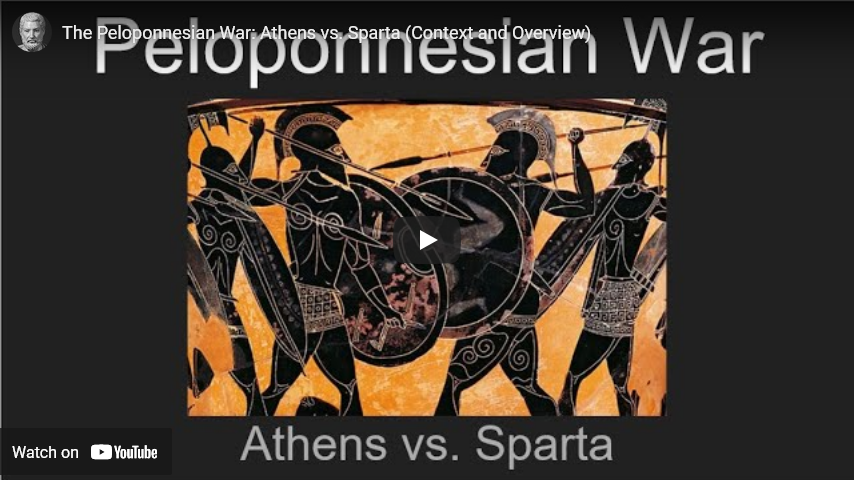
The Peloponnesian War: Athens vs. Sparta (Context and Overview)
Thersites the Historian
Published 28 Oct 2021In this lecture, I cover Greek history from 478-404 BCE with an emphasis on the Peloponnesian War. This is intended as a primer on the topic and I devote more time to establishing the context and causes of the war than I do going through the details of conflict itself.
Patreon link: https://www.patreon.com/thersites
PayPal link: paypal.me/thersites
Discord: https://discord.gg/QCaXXFr
Brave Browser: https://brave.com/noa557
Twitter link: https://twitter.com/ThersitesAthens
Minds.com link: https://www.minds.com/ThersitestheHis…
Steemit/dtube link: https://steemit.com/@thersites/feed
BitChute: https://www.bitchute.com/channel/jbyg…
Comments Off on The Peloponnesian War: Athens vs. Sparta (Context and Overview)
QotD: “By their proposals, shall ye know them”
Of politicians in power it might be said, “By their proposals, shall ye know them.” What they say they want to do is almost as significant as what they actually succeed in doing, for it offers an insight into their fundamental philosophy or state of mind. This is especially important, of course, when they seek to cling on to power by re-election or by some other means such as behind-the-scenes-influence.
That is why the proposal that the IRS should have access to the data of all bank accounts from which or into which more than $600 a year are paid (hardly a king’s ransom) is so important, despite the fact that it has not been enacted. The very fact that someone wanted to enact it, and thought it right that it should be enacted, is highly significant — and sinister — in itself, for the proposal demonstrates a totalitarian mindset.
The ostensible purpose of the proposal, of course, is the elimination of tax evasion. (Incidentally, I have noticed recently an increasing tendency, in the press and elsewhere, for the term tax avoidance to be used interchangeably with that of tax evasion, as if the difference between legality and illegality were of no real importance. This conflation is itself indicative of a totalitarian attitude, according to which a governmental end may be reached without the necessity for any law.)
The people who proposed that, in effect, every bank account should be routinely available for examination by the IRS, without any specific warrant for such an examination, thereby revealed that they thought that the gathering of tax so important that it superseded all other considerations.
Psalm 24 begins: “The earth is the Lord’s, and the fulness thereof, the world and they that dwell therein. For he hath founded it upon the seas, and established it upon the floods.”
A better version, according to the proposers, would be: Money is the government’s, and the fulness thereof, money and they that have any. For it hath founded it upon the printing press, and established it as legal tender.
I do not go as far as some economists of my acquaintance, who believe that tax evasion is a citizen’s civic duty: at least it is not in the circumstances prevailing in any western country, however unsatisfactory they may be. In my own case, I do not evade taxes and even my attempts to avoid them are rather feeble, for unfortunately there is so little at stake.
But I reject completely the idea that, morally, the first call on anyone’s money is the government’s, which in effect has the right to leave you pocket money by its grace and favor after you have paid your taxes at any rate that it likes. This is the very tyranny that the founders of America feared in majoritarian democracy, untempered by inalienable rights — inalienable even, or especially, by or to the government.
Theodore Dalrymple, “Monitoring Bank Accounts Would Make the People of the Government, Not the Government of the People”, The Iconoclast, 2021-11-01.
Comments Off on QotD: “By their proposals, shall ye know them”


