
The Tank Museum
Published on 31 Mar 2017The thirty-fourth Tank Chat, this time presented by Curator David Willey after some help from Eli. https://youtu.be/T33hp0J-LAw
Britain’s Main Battle Tank for twenty years, Chieftain was one of the first true Main Battle Tanks, designed to replace both medium and heavy tanks in front line service.
To find out more, buy the new Haynes Chieftain tank manual. https://www.myonlinebooking.co.uk/tan…
Support the work of The Tank Museum on Patreon: ► https://www.patreon.com/tankmuseum
Or donate http://tankmuseum.org/support-us/donate
August 13, 2018
Tank Chats #34 Chieftain | The Tank Museum
Comments Off on Tank Chats #34 Chieftain | The Tank Museum
August 12, 2018
Preseason game 1 – Minnesota 42, Denver 28
 The Minnesota Vikings visited Denver on Saturday evening for their first preseason game. If there was any buzz about a preseason match-up it was all about the quarterbacks: how would new Vikings QB Kirk Cousins and former QB Case Keenum match up against one another, oh, and two other Vikings QBs were with Denver at this point last year.
Cousins was only in for one series, throwing four passes for 42 yards capped off with a 1-yard touchdown pass to Stefon Diggs, after which Siemian took over at quarterback. Keenum didn’t have as good a night, recording two three-and-out series and not converting a first down.
Unlike previous years, I was able to watch the game (on a slight delay, apparently) because I’m trying DAZN this year, who offer all NFL games in their programming (we’re close to cutting the cord with our cable provider, at least for TV). The feed was the Denver home market team, so lots of information about various Bronco players and coaches, but little about the Vikings except Trevor Siemian and Kyle Sloter. Next week, the Vikings are playing at home, so I expect to have the Vikings commentary include relatively little about any Jacksonville players, unless they have a Minnesota connection of some kind.
At the Daily Norseman, Ted Glover provides his usual post-game Stock Market Report, including the “Buy or Sell” section:
Buy or Sell
Buy: The offensive line on the first drive. Riley Reiff only played one series but looked the best of everyone. I think Danny Isidora was the best of the rest, and as far as run blocking goes, the front five, to include Yukon Cornelius Edison, opened some gigantic holes for Murray, and established a great pocket for Cousins to set up and throw.
Sell: All the questions about the offensive line have been answered. After the first drive, the line had some ups and downs. Tom Compton, Isidora, Cornelius, Aviante Collins…they all made some great blocks, and they all had some bad whiffs. And as the Vikings went farther down the roster, the performance was decidedly worse. I think it’s fair to say that the first drive was very encouraging, but there’s also a fair amount of work to be done. I will say that assuming Pat Elflein and Mike Remmers come back, and they should, I’m feeling a lot less anxiety about this line than I was a couple days ago, all things considered.
Buy: Trevor Siemian had a good stat line. If you didn’t watch the game and just looked at the stat line you’d think ‘wow, what a good game’. SIemian went 11-17 for 165 yards, two touchdowns, and a pick. And based on that statline you’d think Siemian as QB2 was a foregone conclusion.
Sell: Trevor Siemian had a good game. All that said, I don’t believe he had a very good game. He had one really nice back shoulder throw to Coley, but of his 165 yards 91 were screens or dump offs to Roc Thomas (which, to be fair, were on two throws that both turned into touchdowns). The rest of his downfield throws were not accurate, and kind of all over the place. For example, his interception was on a throw to TE Tyler Conklin that was high and a bit behind him, and yes, it should have been caught. But it went off Conklin’s hands, and it became an easy pick. Yet, a good throw that hits Conklin in stride there, and it’s a huge gain.
Buy: Kyle Sloter for QB2. Sloter, on the other hand, looked really good. He went 9/11 for 69 (nice) yards, and a pretty back corner end zone throw to Beebe for a TD. He also had a nice bootleg TD run that put the game in ice late in the fourth quarter.
Sell: Kyle Sloter for QB2. Still it’s way too early to say Sloter should supplant Siemian as the primary backup. The overall accuracy was better, but the level of competition he was going against compared to Siemian wasn’t as good. It was encouraging, for sure, but I still think that Siemian till has the backup job…for now.
I fully endorse Ted’s comments on the QB2/3 battle: having watched the game, I thought Sloter was definitely the better of the two players, but the statistics seem to show Siemian had a much better game than I saw (proving that stats are not the whole story). Sloter looked much more comfortable in the pocket, while Siemian seemed very tentative and his throws were not as accurate as needed. If the Vikings end up keeping all three quarterbacks on the 53-man roster, I’d be okay with it (provided Siemian shows more consistency in the later games), but if the team only keeps two then I’d plump for Sloter to be the second stringer.
Sam Ekstrom at Zone Coverage had some observations on the game:
– Considering the lack of continuity of the first-team offensive line, the Vikings looked amazingly competent with their patchwork unit — really the only negative being a Cornelius Edison holding call. The group opened up 20 and 21-yard runs for Latavius Murray on consecutive snaps, Kirk Cousins went 5 for 5 through the air on his lone drive, and Stefon Diggs made three catches including a tight window grab along the sideline and a slant for the Vikings’ first touchdown. The chemistry between Cousins and Diggs isn’t all that shocking, but the offensive line’s work on that drive was.
[…]
– The Vikings got a good look at their trio of candidates for the third running back spot. Mack Brown, Mike Boone and Roc Thomas all had fairly pedestrian rushing totals, but it was Thomas who popped in the passing game with two touchdown catches from Siemian, one on a wheel route to give the Vikings a 14-0 lead, the second on a well-blocked screen for 78 yards to push Minnesota’s lead to 24-7. The touchdowns by Thomas will make highlight reels, but ultimately the battle will come down to consistency in the run game and pass protection ability. Boone had some trouble with blitz pickup and, at no fault of his own, got blown up beyond the line of scrimmage several times. Brown didn’t splash and wound up leaving the game with an injury. Round 1 goes to Thomas.
– Kyle Sloter is Mr. Preseason, right? No shocker that he delivered once again in his grudge match against the team that let him go last year. Sloter went 9 for 11 for 69 yards, a go-ahead passing touchdown to Chad Beebe and a game-icing rushing touchdown on a bootleg. One of his incompletions was nearly intercepted, but Sloter’s performance was largely impressive. His training camp hasn’t been the best, but Sloter’s first game action in a Vikings uniform didn’t disappoint.
Comments Off on Preseason game 1 – Minnesota 42, Denver 28
Misunderstanding what the trade deficit represents
In a post from last week, Tim Worstall explains why Donald Trump is wrong about the economic impact of a trade deficit:
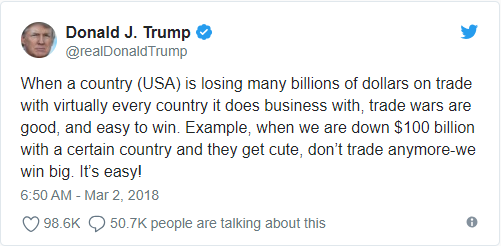
I should note here that I didn’t, because as a foreigner I can’t, support The Donald at the last election. But I didn’t support Hillary even more. So this is more about really, actually, insisting that Trump is wrong on trade issues rather than just the more general he’s wrong about everything common in the US press.
[…]
What Trump, DiMicco and Navarro are getting wrong is this, the GDP equation.
Y = C+I+G+(X-M)GDP is consumption plus investment plus government spending plus the trade balance – and minus it if there’s a trade deficit. So people look at this and think yep, if there’s a trade deficit than that makes Y, GDP, smaller!
But this is a mistake, an error. For, as the textbook immediately goes on to explain, what is it that we do with imports? Well, we either consume them, use them in investments or government buys them. So all imports are already in C and I and G. Meaning that if we don’t deduct them we’ll be double counting them. So, to avoid double counting we subtract them.
Trump and his advisers are simply wrong on this. The trade deficit doesn’t reduce the size of the economy. They’re getting it wrong simply because they’re not reading the second page of the explanation of the GDP equation.
1918 Flu Pandemic – The Forgotten Plague – Extra History – #6
Extra Credits
Published on 11 Aug 2018Why did everyone forget about the flu pandemic so fast? Partly because its effects were intermingled with the death and depression of World War I, and partly because we chose to forget.
Comments Off on 1918 Flu Pandemic – The Forgotten Plague – Extra History – #6
Public statuary … can we just get rid of the politicians?
In the wake of Victoria’s city council deciding to remove a statue of Sir John A. Macdonald, Colby Cosh suggests that we apply a broader brush to what is acceptable for public display and get rid of the rest of the politicians, too:
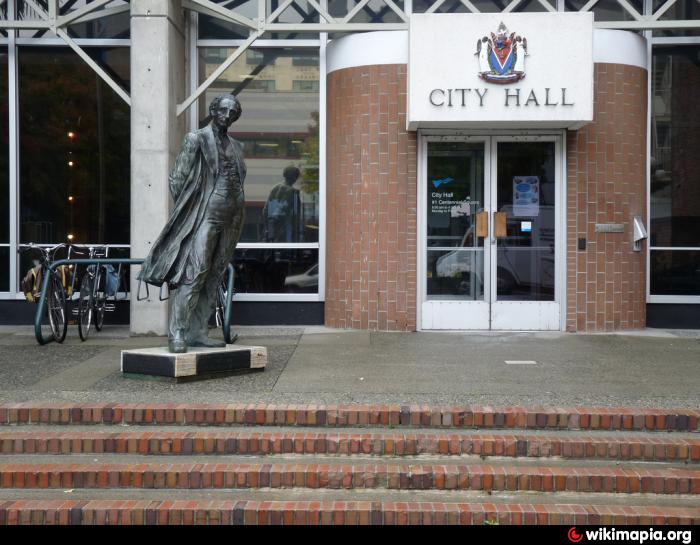
The mayor of Victoria, Lisa Helps, emphasized that the removal of the statue is “temporary,” promising to “find a way to recontextualize Macdonald in an appropriate way.” This suggests that the statue will find a home somewhere, perhaps even in its accustomed place, but will have to be accompanied by a sanitizing “This was a bad, racist guy despite having led the creation of our federation” text inscribed nearby.
All of this gives me a chance to rehearse my inconveniently unclassifiable views on the subject of revisionist iconoclasm in public settings. Part of me is sympathetic to the anti-revisionist case. Even if Victoria took a year with this decision, a year is not a long time to reconsider an act of commemoration that was intended to be permanent in the first place. Any one generation, let alone a small group within it, ought to be hesitant in removing public statuary — doubly so, perhaps, if you are doing it “temporarily” but without a deadline for its return. Putting objects of built heritage in storage is the easiest way for a government to demolish them, through neglect, on the sly.
With that said, I could be convinced to pick up a hammer if there is to be a general smashing of statues of politicians. No city or country really has a shortage of people to honour whose contribution to humanity is unambiguously and uncontentiously positive. Those who exercise political power, even in a democracy, rarely fall into this category. If we were building a country from scratch, I would suggest we start building statues to those who excel in the realm of pure thought — physics, math, music, scholarship — and work “down” through artisans, philanthropists, innovators and entrepreneurs.
Once we’re past the tradesmen who did good work and mentored the young, and we have made modest busts or reliefs of everyone who just worked to make a neighbourhood nicer or cleaner or safer, and we have put a few people on postage stamps just for contributing their own earnings or effort to any of the Corporal Works of Mercy, we can start with politicians of an especially noble and humane character who executed great necessary enterprises by means of law.
Politicians get big-ass statues because it is politicians who build statues: that’s all. The problem is that this encourages the dangerous habit of reverence for politicians, who, despite endless complaining about the thanklessness of their vocation, hardly go without social privileges or deference or celebration within their own lifetimes. In the case of statues or images of Sir John A. Macdonald, the veneration is all but explicit. The Old Chieftain represents the juvenile desire to have a George Washington-like national paterfamilias, to have a single founder to serve as the incarnation of our glorious state.
I am not a politician and I endorse this message. I’d be even more on board if we also chiselled off the names of politicians from schools, community centres, streets, and any other edifice built with taxpayer money.
Comments Off on Public statuary … can we just get rid of the politicians?
Garum, Rome’s Favorite Condiment (Ancient Cooking)
Invicta
Published on 12 Jul 2018As Rome’s military expanded the Empire’s territory it also expanded the kitchen pantry. Today we take a look at one of Rome’s favorite condiments, Garum fish sauce! Credit to: http://www.karwansaraypublishers.com/…
Support future documentaries:
Patreon: https://www.patreon.com/InvictaHistory
Facebook: https://www.facebook.com/InvictaHistory
Twitter: https://twitter.com/InvictaHistoryLiterary Sources
“Logistics of the Roman Army at War” by Jonathan P. Roth
“Garum, Rome’s Favorite Condiment” by Erich B. Anderson
(Ancient History Magazine Issue 8)
Comments Off on Garum, Rome’s Favorite Condiment (Ancient Cooking)
QotD: Journalism
Journalism is about covering important stories. With a pillow, until they stop moving.
David Burge (@iowahawkblog), Twitter, 2013-05-09.
Comments Off on QotD: Journalism
August 11, 2018
Post-coup Turkey – every move has served to increase Erdoğan’s hold on power
Austin Bay‘s recent essay for Strategika on the post-coup Turkish political situation and its NATO membership:
Ataturk bequeathed Turkey what his greatest biographer, Andrew Mango, called “the structure of a democracy, not of a dictatorship.” He authored an orientation, not an ideology, creating a political, social, and cultural process that he believed would eventually make Turkey capable of perpetual self‐modernization. Ataturk was a political giant and a superb military commander. Eighty years after his death he remains a cult historical and political figure.
President Erdogan is a canny politician and, to be fair, Turkey’s most significant political figure since Ataturk. The green-eyed monster feeds his inner fire; Recep knows he disappears in Kemal’s giant shadow. Not capable of displacing Ataturk the man, he has chosen to replace Ataturk’s state, first under the guise of extending democracy, now behind the façade of maintaining stability. Erdogan also intends to remain in office over twice as long as Ataturk. Turkey 2034 will be an Erdoganist political construct, not Kemalist.
That last paragraph sketches a novelistic interpretation of Erdoğan’s motives. It expands on the answer I gave at Hoover’s October 2017 Military History and Contemporary Conflict symposium after Barry Strauss asked me what I thought drove Erdoğan — the deep drive that might shed light on his long-term vision for Turkey and help us craft policy responses to his challenge.
Novelistic speculations have numerous weaknesses. However, over the decades Erdoğan has supplied plot points and psychologically-indicative dialog. We are able to assess action through time. Early in his career Erdoğan routinely employed Islamist poetry: “Democracy is merely a train that we ride until we reach our destination. Mosques are our military barracks. Minarets are our spears.” That poetry led to his arrest for sedition. After his release he renounced his piously seditious poetry, claiming his fundamentalist views had fundamentally altered. His sudden commitment to Turkish democracy energized his “moderate Islamist” Justice and Development Party’s (AKP) 2002 victory over a tired and corrupted Republican Peoples Party (CHP). In 2003 the AKP became Turkey’s governing party with Erdoğan serving as prime minister.
First he tested Kemal’s structure, then he began to dismantle it. Erdoğan purged the military of suspected political opponents. A cunning narrative camouflaged his operation. He claimed European Union accession rules demanded he strip the military of its political powers and make certain Kemalist military coups entered history’s dustbin. Sometime in 2008, as Erdoğan began pursuing the Ergenekon conspiracy of “secular fundamentalists” and other secret nationalist vigilante organizations, I finally realized whatever explanation du jour Erdoğan offered for his actions, the dismantling scheme always expanded his personal power and influence.
The bizarre July 2016 coup follows the same pattern. The Turkish people defeated the coup. Ironically, Erdoğan remains in office today because Turkish citizens (across Turkey’s complex political and ethnic spectrum) courageously defended their hard-won democracy — a democracy nine challenging decades in the making. In its aftermath, however, Erdogan used emergency powers to purge Gulenist Islamists and his political opponents. He dismantled elements of the democratic system that saved him and his government.
Comments Off on Post-coup Turkey – every move has served to increase Erdoğan’s hold on power
Sharpening Stone Shelves | Paul Sellers
Paul Sellers
Published on 10 Aug 2018These shelves keep Paul’s sharpening stones close at hand for convenience and separate them from the rest of his tools as they can get dirty. Follow along to fit solid useful shelves at the end of your bench.
More info on the Workbench can be downloaded here:
https://paulsellers.com/paul-sellers-…There is more discussion on these videos on Woodworking Masterclasses. You can sign up (for free) here: https://woodworkingmasterclasses.com/…
Music credit:
Henry Horrell (https://soundcloud.com/henry-horrell)For more information on these topics, see https://paulsellers.com or https://woodworkingmasterclasses.com
Comments Off on Sharpening Stone Shelves | Paul Sellers
Second-hand bookshops
An old Theodore Dalrymple article on the disappearing treasures (to some of us, anyway) of the second-hand book trade:
My love of money is so far unrequited, perhaps because I do not love it quite enough, which is to say to the exclusion of all other possible objects of adoration and devotion. Likewise I remain firm in my admiration of those who do not work exclusively or even principally for money; and among the latter must surely be English provincial sellers of second-hand books
Theirs is indeed a dying trade, and entering their shops – now, alas, fewer and fewer – one cannot help but wonder whether it ever truly lived. As long as I can remember, which is now quite a long time, they have been cold with a kind of irredeemable cold, an absence of warmth upon which no paraffin heater, no pre-war single bar electric heater (of the kind favoured by booksellers), no clement weather, can make the slightest impression. When you take a book from a shelf of one of these bookshops you get a puff of cold air in the face, as well as of dust, as if you had opened a mediaeval tomb complete with a curse against grave-robbers. One associates dust with dry heat, but this, at least where English provincial second-hand bookshops is concerned, is a mistake. They contrive to be cold, dusty and damp at the same time.
It is all the more remarkable, then, that in so materialistic an age as our own people can be found who not only spend, but want to spend, and cannot conceive of not spending, their working lives in such conditions, and all for little monetary reward. True, they are more or less protected by their avocation from the seamier and more violent side of modern society; burglars and armed robbers in even the worst areas for crime do not think to break into second-hand bookshops; and the comings and going of governments do not trouble them. Not for them, either, the shadow-boxing of modern party politics, in which one political mountebank sets himself up as the last bastion against the depredations of another, in truth not very dissimilar, mountebank. Rather they concern themselves with the eternal verities of light foxing, cocking, small tears to dust jackets, and the like. The worst that can happen to them is a gentle slide into insolvency as rents rise (all such shops are now found in the unlikeliest places because they can survive only where rents are low) and readers decline – both in number and in discrimination. For my money (of which, incidentally, they have taken a lot down the ages) they are the unsung heroes of our culture.
Their lives are precarious. For example, the other day I went into one such bookshop in the North of England, run by a husband and wife team, and bought for a sum that nowadays no one – no bourgeois that is – would hesitate to lay out for lunch, a slimmish volume published in 1857, that was in almost pristine condition. The lady was almost pathetically grateful: she said that by my single purchase I had paid half her rent for the day. I felt as if I had almost done a good deed.

Image via Google Maps street view
The majority of my own collection has been bought at used book shops, especially Gryphon Books in Port Hope and Willow Books and Books Galore in Port Perry. I haven’t been travelling much outside my immediate local area for the last several years, so Abebooks has been a very useful addition to my virtual book-buying range. I note, with mild sorrow, a few of my other favourite book shops have disappeared: especially the best military used book store in Ontario, Grenadier Books in Port Perry (moved to Montreal after the death of the founder), and the Book Vault in Stratford (the seasonal tourist traffic wasn’t enough to cope with rising rent).
Comments Off on Second-hand bookshops
Cobray Terminator at the Range: The Worst Shotgun Ever
Forgotten Weapons
Published on 21 Jul 2018http://www.patreon.com/ForgottenWeapons
Most of the guns made by Cobray are pretty awful, but one can at least understand the market they were made for. The Terminator is different, because it really is rather incomprehensible who would have actually thought that a single shot, open bolt 12 gauge shotgun with a terrible stock would be a good thing to spend money on. Really the only explanation I can come up with is that it looks industrial and mean, and I suppose some people would have bought it just for that.
Having taken one to the range now, my suspicions of its terribleness have been fully confirmed. It actually is painful to shoot, and the open bolt slamfire mechanism does a great job of magnifying the inevitable flinch it will give you. It’s clunky and annoying to reload, and also to unload after firing. I never did figure out why it was failing to fire so much for me, unless it was simply a short firing pin with deep-set primers. To be honest, I don’t really care. I’m just happy to be able to send it back to the generous (if perhaps sadistic) viewer who loaned it to me.
If you enjoy Forgotten Weapons, check out its sister channel, InRangeTV! http://www.youtube.com/InRangeTVShow
Comments Off on Cobray Terminator at the Range: The Worst Shotgun Ever
QotD: Reductio ad Hitlerum
The poverty of peoples’ collective memory and imagination is such that the first minute any politician strays from the path of universalism, commentators reach for the most shocking (and only) historical comparison they can think of.
Ed West, “It’s absurd to compare Amber Rudd’s immigration speech to Mein Kampf”, The Spectator, 2016-11-07.
Comments Off on QotD: Reductio ad Hitlerum
August 10, 2018
The tough part of selling a national carbon tax … is the “tax” part
As Colby Cosh points out, you can find all sorts of economists to explain why a properly constructed and applied carbon tax is the least harmful way to reduce carbon output, but Canadians typically focus on the “tax” part and not the claimed environmental efficiency benefits:
In yesterday’s Financial Post, the Calgary economist Jack Mintz asked the question “Why are carbon taxes so unpopular?”, pointing out that plenty of countries and jurisdictions have commitments to climate progress and energy efficiency but that few use this particular policy instrument. I guess Jack wouldn’t have had much of a column if he had just adopted the spirit of an auto mechanic explaining a breakdown to a naive car owner and jabbed directly at the problem. “See that word ‘taxes’? There’s your problem right there.”
And, truly, it is not quite as simple as that. But, as Mintz suggests, it is a big part of the difficulty. As a means of helping reduce carbon output, carbon taxes are competing with subsidies and regulations. Pervasive carbon taxes are, as a general principle, a less costly way of eliminating freely exhaled carbon, pound for pound or ton for ton.
If the tax is well designed, you are slapping a uniform unit price directly onto the thing you are trying to prevent; and you are leaving people and businesses to make decentralized judgments, based on their knowledge of their own circumstances, about whether to avoid the tax, and when, and how to do it. Even though the initial level of the tax must be something of a guess, you can adjust it by arbitrarily small increments until you have eliminated just as much carbon output as you wish to.
Economists will recognize that last paragraph as a grocery list of the relative advantages of carbon taxation. But voters are predisposed to hate taxes, and are very sensitive to their size and their side effects. They may not like government subsidies for windmills or carbon-capture schemes or certain species of light bulb either; but subsidies can usually be sold on the basis of local job creation or business incubation, and they can be — let’s face it, inevitably are — adjusted for maximum electoral benefit.
For my part, I don’t disbelieve the economists on the efficiency arguments … I just don’t trust the government to design and implement such a tax without rigging the system to benefit favoured corporations, regions, and donors.
Comments Off on The tough part of selling a national carbon tax … is the “tax” part
The Black Day Of The German Army – The Battle of Amiens I THE GREAT WAR Week 211
The Great War
Published on 9 Aug 2018Ludendorff and his generals didn’t think the Allies had it in them, but this week they attack with the might off several hundred tanks near Amiens, the Black Day of the German Army.
Comments Off on The Black Day Of The German Army – The Battle of Amiens I THE GREAT WAR Week 211


