
Quotulatiousness

March 3, 2017

The key difference between written and oral communication

Filed under: Media, Politics, USA — Tags: , , , , — Nicholas @ 05:00

Megan McArdle, discussing the uproar over the Attorney General Jeff Sessions “did he or didn’t he lie to congress” debate, took time to clarify why we don’t (and can’t) parse spoken communications in the same way we do with written work:

If you read the latter part of this exchange extremely strictly, chopping off the preamble, then you can argue that Sessions was technically untruthful. The problem is that this is not how verbal communication works. The left is attempting to hold the attorney general to a standard of precision that is appropriate for written communication, where we can reflect on preceding context and choose exactly the right word.

Oral language is much looser, because it’s real time. Real time means that we don’t have 20 minutes to puzzle over the exact phrasing that will best communicate our meaning. (For example: Reading this column aloud will take you perhaps five minutes. It took me nearly that many hours to write.) On the other hand, our audience is right there, and can ask for clarification if they are confused.1

Demanding extreme clarity from an oral exchange is unreasonable. Moreover, everyone understands that this is unreasonable — except, possibly, for the chattering classes, who spend their lives so thoroughly marinated in the written word that they come to think that the two spheres are supposed to be identical. Most ordinary people understand very well that there’s a big difference between talking and writing (which is why most people, even those who are dazzling in conversation, have a hard time producing fluid and lively prose).

That’s not to say that it’s wrong to investigate the Trump administration’s ties to Russia. Investigate away! If the Trump campaign knew about, or colluded with, the hack on the DNC, then Trump should be impeached. But at the moment, we have no evidence that Sessions committed a crime, much less attempted to cover it up. The court of public opinion is probably going to require somewhat better facts to convict.

    1. One reason that we writers spend so much time thinking about precise wording, and larding our prose with extra paragraphs meant to clarify exactly what we’re talking about, is that language is rife with ambiguity. This is why, at one time, Annapolis cadets were required to take a class in which they would write orders, and their fellow cadets would tear them apart looking for ways that a simple order could be misunderstood. It’s also one reason so many people get into so much trouble on Twitter: they write like they talk, but stripped of cues like context and facial expression, what they say is very easily taken the wrong way.


Conrad Loses His Job – Nivelle’s Coup I THE GREAT WAR Week 136

Filed under: Europe, France, Germany, History, Military, USA, WW1 — Tags: , , , — Nicholas @ 04:00

Published on 2 Mar 2017

The new Austro-Hungarian Kaiser is not happy about his Empire’s dependence on the German ally. And he is also not happy about their own military decisions and over the winter has worked to replace key positions with his own men. The last step in that process is convincing Conrad von Hötzendorf to take a position on the Italian Front. At the same time, French Commander Robert Nivelle is trying to get control over the British Armies on the Western Front and the Zimmermann Telegram is released to the press.

“Apollo 8 altered the self-perception of our species forever”

Filed under: History, Space, Technology, USA — Tags: , , , , , — Nicholas @ 03:00

Colby Cosh contrasts the insane bravado of John F. Kennedy’s moonshot announcement with the more recent insane bravado of Elon Musk and SpaceX:

SpaceX, the private rocketry company founded in 2002 by billionaire adventurer Elon Musk, says it is developing plans to fly two unnamed persons to the moon late in 2018. This announcement has created both skepticism and alarm. This is, I think, partly a matter of confusion about prepositions.

If I announced that, despite being Canada’s most sedentary citizen, I was going to Mount Everest next week, you would probably know better than to assume I was going UP the mountain. SpaceX’s proposal is to send a manned spacecraft beyond the moon. That’s the word they use in the SpaceX press release, and whoever chose it should get a big fat bonus. “Beyond” is an English word of unparalleled connotative power and romance.

But, of course, going beyond the moon — more prosaically, looping around it and coming back — is much, much simpler than landing ON it. It is probably not a fantastically difficult challenge, and the company’s zany-sounding timeline may be justified. (Mind you, this is not a prediction.)

Even if you are old enough to have followed the golden age of spaceflight as it happened, you may not understand or remember the half-insane ambition of John F. Kennedy’s original proposal to land men on the moon. For young and old, the moment that the Apollo 11 lunar module landed on the Sea of Tranquility tends to obscure everything else about the tale in retrospect. But no U.S. astronaut had orbited the Earth yet when JFK threw down the gauntlet. No spaceship had photographed, much less touched, the moon.

Taken by Apollo 8 crew member Bill Anders on December 24, 1968, at mission time 075:49:07 (16:40 UTC), while in orbit around the Moon, showing the Earth rising for the third time above the lunar horizon. The lunar horizon is approximately 780 kilometers from the spacecraft. Width of the photographed area at the lunar horizon is about 175 kilometers. The land mass visible just above the terminator line is west Africa. Note that this phenomenon is only visible to an observer in motion relative to the lunar surface. Because of the Moon’s synchronous rotation relative to the Earth (i.e., the same side of the Moon is always facing Earth), the Earth appears to be stationary (measured in anything less than a geological timescale) in the lunar “sky”. In order to observe the effect of Earth rising or setting over the Moon’s horizon, an observer must travel towards or away from the point on the lunar surface where the Earth is most directly overhead (centred in the sky). Otherwise, the Earth’s apparent motion/visible change will be limited to: 1. Growing larger/smaller as the orbital distance between the two bodies changes. 2. Slight apparent movement of the Earth due to the eccenticity of the Moon’s orbit, the effect being called libration. 3. Rotation of the Earth (the Moon’s rotation is synchronous relative to the Earth, the Earth’s rotation is not synchronous relative to the Moon). 4. Atmospheric & surface changes on Earth (i.e.: weather patterns, changing seasons, etc.).
NASA photo via Wikimedia.

Sharpening a Chisel with Paul Sellers

Filed under: Technology, Tools, Woodworking — Tags: , , , — Nicholas @ 02:00

Published on 27 Feb 2017

Chisels come from the manufacturer needing preparing or initialising as well sharpening. How do you check they are flat and get them sharp? Paul shows you the process he follows. This gets them to the level we need for crisp and accurate work.

For more information on these topics, see https://paulsellers.com or https://woodworkingmasterclasses.com

QotD: Is the Internet itself making us less tolerant and more prone to confirmation bias?

Filed under: Media, Quotations — Tags: , , , — Nicholas @ 01:00

I think it’s time to declare the internet a failure. At least with respect to its early promises of increased knowledge sharing and positive impact on collaboration.

Decentralization of media, Social media, has increased the rate in which misinformation is being transmitted. Once learned invalid information has to be unlearned and that is a much harder task than educating people with accurate information in the first place.

Social media also appears to have increased the rate that people cluster around misinformation and create specialized groups of individuals that aggressively seek to disseminate their ideas.

The asocial aspect of social media encourages individuals to behave in ways that they normally wouldn’t when face-to-face with people that don’t share their views. It has made intolerant people more belligerent and it has forced tolerant people to adopt less tolerant stances.

The trend seems to be to continue to partition people into increasingly specialized and narrowly focused groups. At the extreme we see individuals with highly individualized views agitating groups with more generally accepted views.

People have become more militant, intolerant, and unaccepting of society. The impact on society is a weakening of collaborative spirit, increased cynicism, and further increases to militancy.

In the mid-90s I was very excited at the opportunities collective information sharing could produce. We’ve realized some of those but I simply didn’t foresee the degradation of democratic values that reveal the best in the humanity.

Social media has increased the ability to create social anxiety by pouring misinformation into peoples’ lives with ideas that they are directly threatened or that there are limits to resources, ideas that are often mere fabrication.

Today we are bombarded daily with absurdity, aggression, fear mongering, and intolerance. It’s as if we unwound the clock a hundred years and abandoned the great freedom experiment. Only now the weapons to resolve differences of opinion are much more destructive.

Hard to be bullish on the consequences of increased nationalism around the globe.

The world does face some difficult issues we need to address but things are not nearly as bad as what has become status quo thinking.

Douglas Gunn, posting to Facebook, 2017-02-20.

March 2, 2017

Munchkin Shakespeare … I can’t believe this isn’t already a thing

Filed under: Gaming, Humour — Tags: — Nicholas @ 05:00

I don’t play games as often as I used to, but the Steve Jackson Games Munchkin series has always been a great source of party entertainment. I just discovered a Kickstarter campaign to produce a new one, called Munchkin Shakespeare, which will end just over a week from now. I know I have several quite serious Shakespeare fans among my readership, so I’d be remiss not to pimp this game to them:

They’ve more than met the initial goal, so the game will be produced, but the number and variety of stretch goals is yet to be fully completed.

Words & Numbers: The Problem with Alternative Facts

Filed under: Media, Politics, USA — Tags: , , , — Nicholas @ 04:00

Published on 1 Mar 2017

I this week’s episode, Antony & James talk about alternative facts and how false, partisan data skews important discussions about public policy.

Update: For some reason the original post link was taken private, so I’m reposting to the current version.

Possible end-game for the British nuclear deterrent

Filed under: Britain, Military, Russia, Technology, USA — Tags: , , , , — Nicholas @ 03:00

Charles Stross speculates on a few ways that Il Donalduce could trigger the end of Britain’s nuclear-armed ballistic missile submarines:

Working hypothesis #1: Donald Trump is an agent of influence of Moscow. Less alarmingly: Putin’s people have got blackmail material on the current President and this explains his willingness to pursue policies favourable to the Kremlin. Russian foreign policy is no longer ideologically dominated by communism, but focusses on narrow Russian interests as a regional hegemonic power and primary oil and gas exporter.

Clearly, it is not in Russia’s geopolitical interest to allow a small, belligerent neighbor to point strategic nuclear missiles at Moscow. But this neighbor’s nuclear capability has a single point of failure in the shape of the resupply arrangements under the 1958 UK-USA Agreement. Donald Trump has made no bones about his willingness to renegotiate existing treaties in the USA’s favor, and has indicated that he wants to modernise and expand the US strategic nuclear capability. Existing nuclear weapons modernization programs make the first goal pointless (thanks, Obama!) but he might plausibly try to withdraw British access to Trident D-5 in order to justify commissioning four new US Navy SSBNs to carry the same missiles and warheads.

(Yes, this would break the “special relationship” between the USA and the UK for good — but remember, this is Donald Trump we’re talking about: the original diplomatic bull in a china shop who decapitated the state department in his first month in office.)

Trump could present this as delivering on his promise to expand the US nuclear capability, while handing his buddy a gift-wrapped geopolitical easter egg.

Working hypothesis #2: Let us suppose that Donald Trump isn’t a Russian agent of influence. He might still withdraw, or threaten, British access to Trident as a negotiation lever in search of a better trade deal with the UK, when Theresa May or her successor comes cap-in-hand to Washington DC in the wake of Brexit. It’s a clear negative sum game for the British negotiating side — you can have a nuclear deterrent, or a slightly less unpalatable trade deal, but not both.

In this scenario, Trump wouldn’t be following any geopolitical agenda; he’d just be using the British Trident renewal program as a handy stick to beat an opponent with, because Trump doesn’t understand allies: he only understands supporters and enemies.

As for how fast the British Trident force might go away …

Missiles don’t have an indefinite shelf-life: they need regular servicing and maintenance. By abrogating the 1958 agreement, or banning Royal Navy warships from retrieving or delivering UGM-133s from the common stockpile at King’s Bay, POTUS could rely on the currently-loaded missiles becoming unreliable or unsafe to launch within a relatively short period of time — enough for trade negotiations, perhaps, but too short to design and procure even a temporary replacement. It’s unlikely that French M51 missiles could be carried aboard Dreadnought-class SSBNs without major design changes to the submarines, even if they were a politically viable replacement (which, in the wake of Brexit, they might well not be).

Catherine the Great – II: Not Quite Empress Yet – Extra History

Filed under: Europe, Germany, History, Russia — Tags: , — Nicholas @ 02:00

Published on 4 Feb 2017

Sophia’s excitement to meet her future husband deflated when she realized Peter III was a boor who cared nothing about Russia. By contrast, she threw herself into learning the culture with such vigor that she earned the love of the people. She was rechristened Catherine and married Peter… but when he became emperor, his mistakes and her popularity began to add up to a crisis situation.

QotD: Presidential derangement syndromes

Filed under: Media, Politics, Quotations, USA — Tags: , , , , , — Nicholas @ 01:00

In the 1990s, a serious malady appeared on the American public square in which citizens were driven over the edge by their antipathy for incumbent presidents. It came to be known as the “presidential-derangement syndrome” and over the course of the Bill Clinton, George W. Bush, and Barack Obama administrations its victims grew in number. But while it was a given that whoever won last November’s election would have one named after them, we really had no idea what we were in for once Donald Trump moved into the White House. As we’ve seen this past week, presidential paranoia has not only gone mainstream in terms of the public, it’s now found a home in the mainstream media.

Though it was limited at first to the fever swamps of American politics where some on the right first imagined that black helicopters were about to swoop in and steal their freedom or that the Clintons were operating a drug cartel, the derangement virus adapted to the changing political environment in the years that followed. Those deranged by Bush were less marginal than the Clinton victims but shared the belief that the 43rd president was somehow a front for a vast conspiracy and not only blamed him for “lying” the country into war but viewed the entire national-security response to 9/11 as a put-up job intended to mask the theft of liberty.

As awful as the Bush version was, the Obama-derangement syndrome was in many ways even worse as the 44th president’s citizenship was questioned along with his religious faith and anything else about him that anyone could think of. Though Obama’s liberal policies and power grabs were bad enough from a conservative point of view, some on the right preferred to instead spend their energy pondering the authenticity of his birth certificate (see Trump, Donald) or whether or not he was an Islamist mole. We can blame the Internet and the rise of social media for the more pervasive nature of Obama conspiracy theories but even that dispiriting spectacle may turn out to be insignificant when compared to the psychological torment Trump has inspired among not merely the far Left but also mainstream liberals.

Jonathan S. Tobin, “The Paranoid Style of Anti-Trump Politics”, National Review, 2017-02-12.

March 1, 2017

Vikings decline Adrian Peterson’s $18m option for 2017

Filed under: Football — Tags: , , — Nicholas @ 04:00

Adrian Peterson will officially become an unrestricted free agent on March 9th, after the Minnesota Vikings chose not to exercise a contact option for the 2017 season. Even if Peterson had played in every game for the last couple of seasons, his salary was way out of synch with the rest of the league, as this Pro Football Talk summary suggests (published before the Peterson announcement):
Under the 2011 CBA, the non-exclusive franchise tenders are determined based not on what any one player made in 2016 or will make in 2017, but on the five-year average of the percentage that the tenders for each position consume under the total cap. For running backs, the 2017 franchise tender will equate to 7.257 percent of the overall cap. At a salary cap of $165 million, that’s a tender of $11.9 million.

NFL Network has suggested that a decision by the Vikings to cut Adrian Peterson will cause that number to drop to $8 million. It won’t. Peterson’s $18 million cap number for 2017 is relevant only to the exclusive tag, which is based on the average of the five highest cap numbers at the position the coming year.

Via Spotrac.com, the five highest running back cap numbers for 2017 belong to Peterson, Bills running back LeSean McCoy ($8.875 million), Panthers running back Jonathan Stewart ($8.25 million), Texans running back Lamar Miller ($6.5 million), and Titans running back DeMarco Murray ($6.25 million). Even with Peterson’s $18 million, the next four drag the average down to $9.5 million If Peterson is cut, Chiefs running back Jamaal Charles replaced Peterson at No. 5, with a cap number of $6.187 million. That reduces the average to $7.2 million.

The best indication that Peterson was going to be overpaid this season is that removing his contract from the franchise tender calculation drops the league number from $11.9 million to only $7.2 million. There’s no doubt that Peterson has been a great running back for the Vikings, but his contributions had been in a steady decline since he won the league rushing title in 2015.

(more…)

The different “flavours” of propaganda

Filed under: China, Media, Politics, Russia, USA — Tags: , , , , — Nicholas @ 03:00

Cory Doctorow on the various types of propaganda in use around the world:

Jonathan Stray summarizes three different strains of propaganda, analyzing why they work, and suggesting counter-tactics: in Russia, it’s about flooding the channel with a mix of lies and truth, crowding out other stories; in China, it’s about suffocating arguments with happy-talk distractions, and for trolls like Milo Yiannopoulos, it’s weaponizing hate, outraging people so they spread your message to the small, diffused minority of broken people who welcome your message and would otherwise be uneconomical to reach.

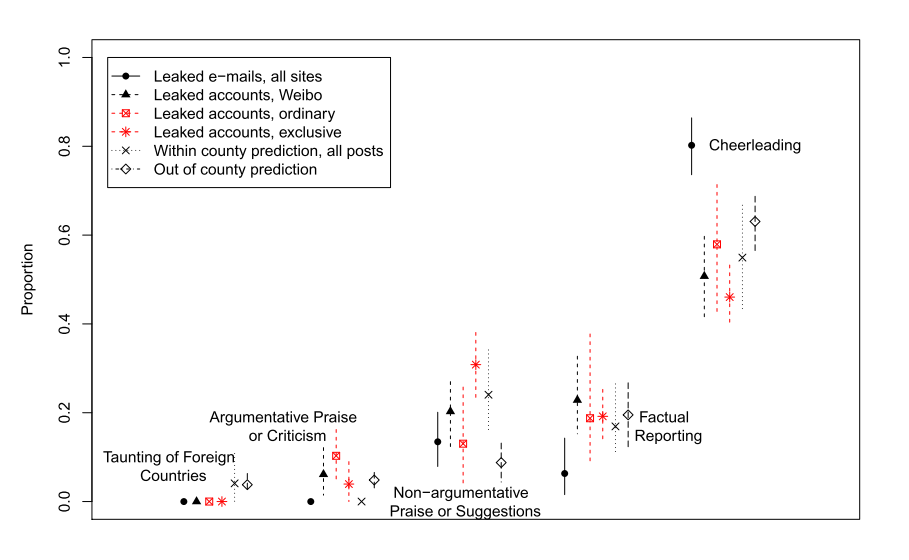
Stray cites some of the same sources I’ve written about here: Tucker Max’s analysis of Yiannopoulos’s weaponized hate and The Harvard Institute for Quantitative Science team’s first-of-its kind analysis of leaked messages directing the activities of the “50-cent army, which overwhelms online Chinese conversation with upbeat cheerleading (think of Animal Farm‘s sheep-bleating, or Nineteen Eighty-Four‘s quackspeak).

But I’d never encountered the work he references on Russian propaganda, by RAND scholar Christopher Paul, who calls Russian disinformation a “firehose of falsehood.” This tactic involves having huge numbers of channels at your disposal: fake and real social media accounts, tactical leaks to journalists, state media channels like RT, which are able to convey narrative at higher volume than the counternarrative, which becomes compelling just by dint of being everywhere (“quantity does indeed have a quality all its own”).

Mixing outright lies with a large dollop of truth is key to this tactic, as it surrounds the lies with a penumbra of truthfulness. This is a time-honored tactic, of course: think of the Christian Science Monitor‘s history of outstanding international coverage, accompanied by editorials about God’s ability to heal through prayer; or Voice of America‘s mixture of excellent reporting on (again) international politics and glaring silence on US crises (see also: Al Jazeera as a reliable source on everything except corruption in the UAE; the BBC World Service‘s top-notch journalism on everything except UK complicity in disasters like the Gulf War, etc).

In addition to this excellent taxonomy of propaganda, Stray proposes countermeasures for each strain: for Russia-style “firehoses of falsehood,” you have to reach the audience first with an alternative narrative; once the firehose is on, it’s too late. For Chinese quackspeak floods, you need “organized, visible resistance” in the streets. For pathetic attention-whores like Yiannopoulos, Stray says Tucker Max is right: you have to ignore him.

Yes Prime Minister – Bernard Woolley on defence capabilities

Filed under: Britain, Humour, Military — Tags: , , , — Nicholas @ 02:00

Uploaded on 20 Jul 2010

QotD: What we mean by “equality of the sexes”

Filed under: Politics, Quotations — Tags: , , , — Nicholas @ 01:00

The question of “sex-equality” is, like all questions affecting human relationships, delicate and complicated. It cannot be settled by loud slogans or hard-and-fast assertions like “a woman is as good as a man” — or “woman’s place is the home” — or “women ought not to take men’s jobs.” The minute one makes such assertions, one finds one has to qualify them. “A woman is as good as a man” is as meaningless as to say, “a Kaffir is as good as a Frenchman” or “a poet is as good as an engineer” or “an elephant is as good as a racehorse” — it means nothing whatever until you add: “at doing what?” In a religious sense, no doubt, the Kaffir is as valuable in the eyes of God as a Frenchman — but the average Kaffir is probably less skilled in literary criticism than the average Frenchman, and the average Frenchman less skilled than the average Kaffir in tracing the spoor of big game. There might be exceptions on either side: it is largely a matter of heredity and education. When we balance the poet against the engineer, we are faced with a fundamental difference of temperament — so that here our question is complicated by the enormous social problem whether poetry or engineering is “better” for the State, or for humanity in general. There may be people who would like a world that was all engineers or all poets — but most of us would like to have a certain number of each; though here again, we should all differ about the desirable proportion of engineering to poetry. The only proviso we should make is that people with dreaming and poetical temperaments should not entangle themselves in engines, and that mechanically-minded persons should not issue booklets of bad verse. When we come to the elephant and the racehorse, we come down to bed-rock physical differences — the elephant would make a poor showing in the Derby, and the unbeaten Eclipse himself would be speedily eclipsed by an elephant when it came to hauling logs.

That is so obvious that it hardly seems worth saying. But it is the mark of all movements, however well-intentioned, that their pioneers tend, by much lashing of themselves into excitement, to lose sight of the obvious. In reaction against the age-old slogan, “woman is the weaker vessel,” or the still more offensive, “woman is a divine creature,” we have, I think, allowed ourselves to drift into asserting that “a woman is as good as a man,” without always pausing to think what exactly we mean by that. What, I feel, we ought to mean is something so obvious that it is apt to escape attention altogether, viz: not that every woman is, in virtue of her sex, as strong, clever, artistic, level-headed, industrious and so forth as any man that can be mentioned; but, that a woman is just as much an ordinary human being as a man, with the same individual preferences, and with just as much right to the tastes and preferences of an individual. What is repugnant to every human being is to be reckoned always as a member of a class and not as an individual person.

Dorothy L. Sayers, “Are Women Human? Address Given to a Women’s Society”, 1938.

« Newer Posts

Powered by WordPress


