
Quotulatiousness

May 2, 2015

Minnesota Vikings 2015 draft – second day

Filed under: Football — Tags: , , — Nicholas @ 09:00

After the (total lack of) drama and suspense over the Vikings’ first round pick yesterday, I did the sensible thing and went out for the evening and paid minimal attention to day two of the draft. Since I don’t follow college football, I wasn’t likely to say whether any given player was a good or a bad pick and aside from checking to see what position the drafted player is projected to fill, I could follow with an occasional check of my Twitter feed.

With all the trades in previous drafts, the Vikings hadn’t actually drafted anyone in the second round for several years (not since 2011 when they drafted Kyle Rudolph), but this time they actually did use the 45th pick on UCLA linebacker Eric Kendricks, a former team-mate (and college room-mate) of last year’s first rounder Anthony Barr. Here’s 1500ESPN‘s Andrew Krammer on the pick:

Eric Kendricks draft card

The Vikings had offers to trade down from 45th overall, but general manager Rick Spielman said they weren’t expecting Kendricks to be there.

“He has the athletic skill set to be a three-down backer,” Spielman said. “We were surprised he fell to where we were at.

“And he says he can help Anthony Barr line up,” Spielman joked. “They said they had the ‘AB’ role when he was [at UCLA].”

Kendricks (6’0″, 230lbs) finished his four-year career with the Bruins totaling 480 combined tackles, 10 sacks, five interceptions and three forced fumbles. He was the NCAA’s 2014 Butkus Award winner.

The Vikings feel he can play either weak-side linebacker or the middle linebacker role for coach Mike Zimmer’s defense. Last year’s starter in the middle, Jasper Brinkley, left in free agency and signed with the Dallas Cowboys. Kendricks joins a linebacker corps comprised of Barr, Chad Greenway, Audie Cole, Gerald Hodges, Casey Matthews and others.

They spent one of 60 combine interviews with Kendricks in February and had heard enough to prioritize him atop their draft board.

After that pick, Spielman’s famous “Trader Rick” persona broke out in the Vikings war room and some wheeling and dealing took place. They swapped picks with Kansas City to move back four spots in the third round (with the Chiefs giving up a sixth-round pick, #193, in compensation). Then they moved back again in a trade with the Lions, going from #80 to #88 in the third round, acquiring the Lions’ fifth-round pick at #143.

After trading down twice for the extra picks, the Vikings chose LSU defensive end Danielle Hunter. Here’s ESPN‘s Ben Goessling on the pick:

Danielle Hunter draft card

It had been clear all offseason that the Vikings were looking for help at defensive end, and for the second year in a row, they took one in the third round. Hunter is an impressive athlete — a 6-foot-6, 240-pound end with 4.57 40 speed and 34½-inch arms. He didn’t put up the kind of sack numbers you’d expect in college and will have to figure out how to beat offensive tackles in the NFL. But after the Vikings missed out on signing Michael Johnson, they added the kind of lanky defensive end Mike Zimmer likes.

[…] Hunter had just 1½ sacks in 2014 at LSU, and after the Vikings took Scott Crichton last year, they could be looking at another end who could take some time to develop. Hunter came out a year early, and while Pro Football Focus ranked him second among draft-eligible edge rushers in run-stop percentage, he will have to get better at pressuring the quarterback. In any case, the Vikings will have to get something out of Crichton or Hunter this season to lighten the load for Everson Griffen and Brian Robison, who each logged more than 900 snaps last year.

The final rounds of the 2015 draft take place later today, with the Vikings holding six picks (for now, pending further wheeling and dealing by Rick Spielman):

  • Round 4 (110)
  • Round 5 (137) – (from Buccaneers through Bills)
  • Round 5 (143) – (from Lions)
  • Round 6 (193) – (from Chiefs)
  • Round 7 (228)
  • Round 7 (232) – (from 49ers through Dolphins)
“…every word she says is a lie, including ‘and’ and ‘the'”

Filed under: Books, History, USA — Tags: , , , — Nicholas @ 03:00

An older article from Lesley McDowell at The Independent, discussing the relationship between Lillian Hellman and Dashiell Hammett:

When Mary McCarthy said of Lillian Hellman, “every word she says is a lie, including ‘and’ and ‘the'”, a certain attitude was fostered. Not only to the celebrated playwright’s experiences in war-torn Spain during the 1930s or before the House Un-American Activities Committee during the 1950s, but also to her personal life. Hellmann, this attitude said, was a myth-maker of the worst kind. She couldn’t be trusted to tell the truth, not even about those she loved. So what if she wrote in her memoirs that crime writer Dashiell Hammett, with whom she lived on-and-off for 30 years, was the most important person in her life? “Did anyone ever see them together?” queried Gore Vidal.

Writers make myths out of people’s lives, especially their own. And when writers become embroiled with other writers, the opportunity increases ten-fold. It was to Hammett, the pulp magazine writer turned detective novelist, that she always owed a debt, Hellman insisted. The completion of her first play, The Children’s Hour, in 1934, just four years after they met at a Hollywood party, was all thanks to “help from Hammett.” She “worked better if Hammett was in the room.” Yet Hellman’s words about this crucial relationship have been doubted too. Perhaps it didn’t help that she wrote in her 1969 memoir, An Unfinished Woman, “what a word is truth. Slippery, tricky, unreliable. I tried in these books to tell the truth…I see now, in re-reading, that I kept much from myself, not always, but sometimes.”

Lillian Hellman was married to a writer, Arthur Kober, when they wound up in Hollywood in 1930. Kober had a script-writing job and Hellman was a script-reader. She was 25, bored in her five-year marriage and had writing ambitions. When she met Hammett at a party, he was 36 and famous, the bestselling author of Red Harvest and The Maltese Falcon. Different accounts of their first meeting don’t help Hellman’s case for truth-telling, but there is a nastier undercurrent to those who doubted Hellman’s version of the subsequent relationship.

Hammett was extremely handsome and rich, thanks to his books. Hellman was never a pretty girl, and had a forthright manner that scared people. Some doubted Hammett’s interest in her: why should such a successful writer take up with an unattractive nobody?

A revolutionary fix for California’s water problems – pricing

Filed under: Economics, Environment, USA — Tags: , — Nicholas @ 02:00

Last month, Megan McArdle pointed out that the state of California is reacting to the water shortages in one of the least effective ways by mandating rationing, rather than addressing the absurd under-pricing of the resource:

I’ve seen a lot of apocalyptic writing about California only having a year of water left (not true), and I’ve heard some idle talk about whether California can continue to grow. But California’s problem is not that it doesn’t have enough water to support its population. Rather, the problem is that its population uses more water than it has to. And the reason people do this is that water in California is seriously underpriced, as Marginal Revolution‘s Alex Tabarrok notes. While the new emergency rules do include provisions for local utilities to raise rates, that would still leave water in the state ludicrously mispriced. According to Tabarrok, the average household in San Diego pays less than 80 cents a day for the 150 gallons of water it uses. This is less than my two-person household pays for considerably less water usage, in an area where rainfall is so plentiful that the neighborhood next door to me has a recurrent flooding problem.

Artificially cheap water encourages people to install lush, green lawns that need lots of watering instead of native plants more appropriate to the local climate. It means they don’t even look for information about the water efficiency of their fixtures and appliances. They take long showers and let the tap run while they’re on the phone with Mom. In a thousand ways, it creates demand far in excess of supply.

Having artificially goosed demand, the government then tries to curb it by mandating efficiency levels and outlawing water-hogging landscaping. Unfortunately, this doesn’t work nearly as well as pricing water properly, then letting people figure out how they want to conserve it. For one thing, you can only affect large and visible targets, such as appliance manufacturers or lawns. For another, people will often try to evade your regulations — my low-flow showerhead came with handy instructions on how to remove the flow restrictor. And, perhaps most important, you limit the potential conservation to the caps. So people have an efficient dishwasher but don’t consider doing small loads by hand; they have a low-flow showerhead but don’t consider taking shorter showers. In short, no one is looking for ways to conserve more than whatever you’ve mandated. This may be enough to temporarily manage the current crisis, but it does nothing to set California’s water usage on a more sustainable path.

QotD: The nihilism of modern art

Filed under: Media, Quotations — Tags: , , , , — Nicholas @ 01:00

One of my earliest blog essays (Terror Becomes Bad Art) was about Luke Helder, the pipe-bombing “artist” who created a brief scare back in 2002. Arguably more disturbing than Helder’s “art” was the fact that he genuinely thought it was art, because none of the supposed artists or arts educators he was in contact with had ever taught him any better and his own talent was not sufficient to carry him beyond their limits.

I am not the first to observe that something deeply sick and dysfunctional happened to the relationship between art, popular culture, and technology during the crazy century we’ve just exited. Tom Wolfe made the point in The Painted Word and expanded on it in From Bauhaus To Our House. Frederick Turner expanded the indictment in a Wilson Quarterly essay on neoclassicism which, alas, seems not to be available on line.

If we judge by what the critical establishment promotes as “great art”, most of today’s artists are bad jokes. The road from Andy Warhol’s soup cans to Damien Hirst’s cows in formaldehyde has been neither pretty nor edifying. Most of “fine art” has become a moral, intellectual, and esthetic wasteland in which whatever was originally healthy in the early-modern impulse to break the boundaries of received forms has degraded into a kind of numbed-out nihilism.

[…]

To see these craft objects, unashamedly made for money (that’ll be $40 extra for molecular-surface etching, thank you), is to have your nose rubbed in the desperate poverty of most modern art, to be reminded of the vacuum at its core and the pathetic Luke Helders that the vacuum spawns. It’s a poverty of meaning, a parochialism that insists that the only interesting things in the universe are the artist’s own psychological and political quirks.

Bathsheba Grossman’s art reminds us that exploration of the narrow confines of an artist’s head is a poor substitute for artistic exploration of the universe. It reminds us that what the artist owes his audience is beauty and discovery and a sense of connection, not alienation and ugliness and neurosis and political ax-grinding.

Forgetting this value rotted the core out of the fine arts and literary fiction of the 20th century. We can hope, though, that artists like her and Arthur Ganson will show the way forward to remembering it. Only in that way will the unhealthy chasm between popular and fine art be healed, and fine art be restored to a healthy and organic relationship with culture as a whole.

Eric S. Raymond, “The Art of Science”, Armed and Dangerous, 2004-09-21.

May 1, 2015

Minnesota Vikings 2015 draft – first round

Filed under: Football — Tags: , , — Nicholas @ 07:00

Well, few saw this coming … that Minnesota would actually use the #11 pick rather than trading down. Pretty much everyone read “Trader” Rick Spielman’s last pre-draft press conference as a clear attempt to get any kind of trade offer for the #11 slot, but perhaps no other team was all that interested in moving up.

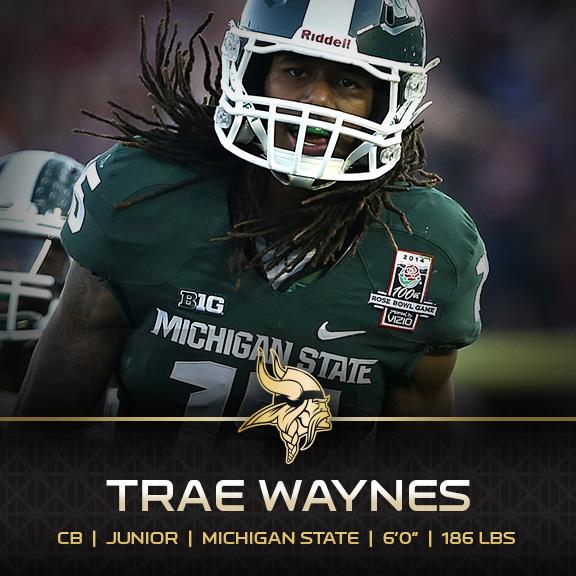
With their original pick, the Vikings selected Michigan State cornerback Trae Waynes. This is so boring: 90% of the mock drafts had this as the Vikings’ selection. Mr. Spielman, you’ve let us all down … where’s the drama? Where’s the suspense? Where’s the Earth-shattering Kaboom? How dare you do what everyone thought you’d do?

Trae Waynes-cb-Michigan State

Initially (never having watched any of his college games), I was enthusiastic about Waynes, but as the pre-draft process wore on, I started to think he wasn’t the best scheme fit (and Arif Hasan’s analysis added to the niggling doubts). When Rick Spielman came out to talk to the media about the team’s pick, he said there had been some offers to trade, but that they didn’t feel the trade value was worth it, as they had Waynes high on their board. Unless this is smoke-blowing, I tend to believe that coach Zimmer feels that Trae Waynes is the best choice for the Vikings’ secondary.

Here’s Arif’s immediate reaction to the pick at Bleacher Report:

Known for only giving up two touchdowns in the past two years, Waynes’ ability to protect against vertical threats is unparalleled in college. He should provide the Vikings with some protection against the deadly passing attacks of the NFC North, which features deep threats and quarterbacks who like to exploit them.

With Kevin White (Miami) in the division, it increases the importance of a player who can keep up with his speed and provide some protection over the top.

There are a number of concerns about Waynes going in, some of which match the issues that Xavier Rhodes had coming out of the draft, including a predilection for grabby play and issues with short-area quickness.

Known for his high character, Waynes puts in time in the film room and can read receivers well.

On the flip side of that is a limited ability to read offensive concepts, and he struggles with route combinations. For the most part, the quarters defense at Michigan State made it less important to do so, although that unique defense also raises questions about his capacity to cover interior routes.

The Sea Turns Red – Gallipoli Landings I THE GREAT WAR – Week 40

Filed under: Australia, Europe, History, Middle East, Military, WW1 — Tags: , , , , — Nicholas @ 04:00

Published on 30 Apr 2015

Completely underestimating the Ottoman army at the Dardanelles, the British commanders decide to let the ANZACs take the Gallipoli peninsular as a gateway to the Bosporus and Constantinople. After the landing in ANZAC Cove and on Z Beach one thing comes clear though: Mustafa Kemal and his troops will fight for every inch of this piece of rock.

Does anyone really know what’s happening in Alberta?

Filed under: Cancon, Politics — Tags: , , , , — Nicholas @ 03:00

The last provincial election in Alberta exposed the polling organizations’ flaws for all to see, and the self-destruction of the Wildrose party, followed almost immediately by the PC budget fiasco mean that nobody seems to have a clue what the voters will end up doing next week. Colby Cosh is right there with his finger on the political pulse, and even he’s not sure what to expect when the votes are counted:

Nobody trusts the polls. They are mostly being conducted by unfamiliar firms with no record of Alberta tea-leaf reading. But the signal that the New Democratic Party is close to a sweep in Edmonton is so strong that it cannot be ignored. Three different firms who polled the city on or about April 23 have the NDP at 56 per cent, 61 per cent and 54 per cent among decided voters.

There are many undecideds, and they may scooch toward the PCs. But … 54 per cent? 61 per cent? That is a lot of mileage to make up, even if the polls are badly out of whack. NDP Leader Rachel Notley was widely seen — right across the partisan spectrum — to have won the April 23 TV debate. Thomas Lukaszuk’s northwest Edmonton PC seat ought to be one of the safest in the city. When he endorsed the NDP’s corporate tax hike on April 21, contradicting his own party’s platform, it was a hint that internal Tory polls must look almost as bad as the published ones.

[…]

Notley will be the emerging star of the campaign even if she takes third place. During the TV debate she benefited from a tart exchange in which Premier Jim Prentice, trying to emphasize that Notley would raise provincial corporate tax rates by 20 per cent, quipped: “I know math is difficult.” He was trying to crack wise about the NDP making accounting mistakes in the original release of its budget plan. But the joke came off as “mansplaining,” which, for future readers, was a borderline capital crime in 2015.

Notley was also ready with a counter to Prentice’s actual debating point, insisting that the NDP’s fast correction of its error was an example of transparency and accountability. She also got off the best joke of the night: after Prentice mixed it up a little with Wildrose Leader Brian Jean, she told the premier: “That’s not the way to talk to a donor!” This was a cheeky reminder that Jean’s Fort McMurray-based company had donated $10,000 to Prentice’s 2014 leadership campaign.

Statistical myths in California’s water shortage

Filed under: Bureaucracy, Economics, Environment, Media, USA — Tags: , , — Nicholas @ 02:00

Devin Nunes debunks the common claim that California’s farmers use “80 percent” of the available water in the state:

As the San Joaquin Valley undergoes its third decade of government-induced water shortages, the media suddenly took notice of the California water crisis after Governor Jerry Brown announced statewide water restrictions. In much of the coverage, supposedly powerful farmers were blamed for contributing to the problem by using too much water.

“Agriculture consumes a staggering 80 percent of California’s developed water, even as it accounts for only 2 percent of the state’s gross domestic product,” exclaimed Daily Beast writer Mark Hertsgaard in a piece titled “How Growers Gamed California’s Drought.” That 80-percent statistic was repeated in a Sacramento Bee article titled, “California agriculture, largely spared in new water restrictions, wields huge clout,” and in an ABC News article titled “California’s Drought Plan Mostly Lays Off Agriculture, Oil Industries.” Likewise, the New York Times dutifully reported, “The [State Water Resources Control Board] signaled that it was also about to further restrict water supplies to the agriculture industry, which consumes 80 percent of the water used in the state.”

This is a textbook example of how the media perpetuates a false narrative based on a phony statistic. Farmers do not use 80 percent of California’s water. In reality, 50 percent of the water that is captured by the state’s dams, reservoirs, aqueducts, and other infrastructure is diverted for environmental causes. Farmers, in fact, use 40 percent of the water supply. Environmentalists have manufactured the 80 percent statistic by deliberately excluding environmental diversions from their calculations. Furthermore, in many years there are additional millions of acre-feet of water that are simply flushed into the ocean due to a lack of storage capacity — a situation partly explained by environmental groups’ opposition to new water-storage projects.

QotD: Military decorations and military men

Filed under: Humour, Military, Quotations, USA, WW1 — Tags: , — Nicholas @ 01:00

Anno 1865. I look out of my window and observe an officer of the United States Army passing down the street. Anno 1922. Like General Grant, he is without a sword. Like General Grant, he wears a sort of soldier’s blouse for a coat. Like General Grant, he employs shoulder straps to indicate to the army who he is. But there is something more. On the left breast of this officer, apparently a major, there blazes so brilliant a mass of color that, as the sun strikes it and the flash bangs my eyes, I wink, catch my breath and sneeze. There are two long strips, each starting at the sternum and disappearing into the shadows of the axillia — every hue in the rainbow, the spectroscope, the kaleidoscope — imperial purples, sforzando reds, wild Irish greens, romantic blues, loud yellows and oranges, rich maroons, sentimental pinks, all the half-tones from ultra-violet to infra-red, all the vibrations from the impalpable to the unendurable. A gallant Soldat, indeed! How he would shame a circus ticketwagon if he wore all the medals and badges, the stars and crosses, the pendants and lavallieres, that go with those ribbons! … I glance at his sleeves. A simple golden stripe on the one — six months beyond the raging main. None on the other — the Kaiser’s cannon missed him.

Just what all these ribbons signify I am sure I don’t know; probably they belong to campaign medals and tell the tale of butcheries in foreign and domestic parts — mountains of dead Filipinos, Mexicans, Haitians, Dominicans, West Virginia miners, perhaps even Prussians. But in addition to campaign medals and the Distinguished Service Medal there are now certainly enough foreign orders in the United States to give a distinct brilliance to the national scene, viewed, say, from Mars. The Frederician tradition, borrowed by the ragged Continentals and embodied in Article I, Section 9, of the Constitution, lasted until 1918, and then suddenly blew up; to mention it to-day is a sort of indecorum, and to-morrow, no doubt, will be a species of treason. Down with Frederick; up with John Philip Sousa! Imagine what General Pershing would look like at a state banquet of his favorite American order, the Benevolent and Protective one of Elks, in all the Byzantine splendor of his casket of ribbons, badges, stars, garters, sunbursts and cockades — the lordly Bath of the grateful motherland, with its somewhat disconcerting “Ich dien“; the gorgeous tricolor baldrics, sashes and festoons of the Legion d’Honneur; the grand cross of SS. Maurizio e Lazzaro of Italy; the sinister Danilo of Montenegro, with its cabalistic monogram of Danilo I and its sinister hieroglyphics; the breastplate of the Paulownia of Japan, with its rising sun of thirty-two white rays, its blood-red heart, its background of green leaves and its white ribbon edged with red; the mystical St. Saviour of Greece, with its Greek motto and its brilliantly enameled figure of Christ; above all, the Croix de Guerre of Czecho-Slovakia, a new one and hence not listed in the books, but surely no shrinking violet! Alas, Pershing was on the wrong side — that is, for one with a fancy for gauds of that sort. The most blinding of all known orders is the Medijie of Turkey, which not only entitles the holder to four wives, but also absolutely requires him to wear a red fez and a frozen star covering his whole facade. I was offered this order by Turkish spies during the war, and it wabbled me a good deal. The Alexander of Bulgaria is almost as seductive. The badge consists of an eight-pointed white cross, with crossed swords between the arms and a red Bulgarian lion over the swords. The motto is “Za Chrabrost!” Then there are the Prussian orders — the Red and Black Eagles, the Pour le Merite, the Prussian Crown, the Hohenzollern and the rest. And the Golden Fleece of Austria — the noblest of them all. Think of the Golden Fleece on a man born in Linn County, Missouri! … I begin to doubt that the General would have got it, even supposing him to have taken the other side. The Japs, I note, gave him only the grand cordon of the Paulownia, and the Belgians and Montenegrins were similarly cautious. There are higher classes. The highest of the Paulownia is only for princes, which is to say, only for non-Missourians.

H.L. Mencken, “Star-spangled Men”, Prejudices, Third Series, 1922.

« Newer Posts

Powered by WordPress


