
March 22, 2015
QotD: Conveying useful information
I wish to be equally frank with the reader of this book. I wish here conscientiously to let forth its shortcomings. I wish no one to read this book under a misapprehension.
There will be no useful information in this book.
Anyone who should think that with the aid of this book he would be able to make a tour through Germany and the Black Forest would probably lose himself before he got to the Nore. That, at all events, would be the best thing that could happen to him. The farther away from home he got, the greater only would be his difficulties.
I do not regard the conveyance of useful information as my forte. This belief was not inborn with me; it has been driven home upon me by experience.
In my early journalistic days, I served upon a paper, the forerunner of many very popular periodicals of the present day. Our boast was that we combined instruction with amusement; as to what should be regarded as affording amusement and what instruction, the reader judged for himself. We gave advice to people about to marry — long, earnest advice that would, had they followed it, have made our circle of readers the envy of the whole married world. We told our subscribers how to make fortunes by keeping rabbits, giving facts and figures. The thing that must have surprised them was that we ourselves did not give up journalism and start rabbit-farming. Often and often have I proved conclusively from authoritative sources how a man starting a rabbit farm with twelve selected rabbits and a little judgment must, at the end of three years, be in receipt of an income of two thousand a year, rising rapidly; he simply could not help himself. He might not want the money. He might not know what to do with it when he had it. But there it was for him. I have never met a rabbit farmer myself worth two thousand a year, though I have known many start with the twelve necessary, assorted rabbits. Something has always gone wrong somewhere; maybe the continued atmosphere of a rabbit farm saps the judgment.
We told our readers how many bald-headed men there were in Iceland, and for all we knew our figures may have been correct; how many red herrings placed tail to mouth it would take to reach from London to Rome, which must have been useful to anyone desirous of laying down a line of red herrings from London to Rome, enabling him to order in the right quantity at the beginning; how many words the average woman spoke in a day; and other such like items of information calculated to make them wise and great beyond the readers of other journals.
Jerome K. Jerome, Three Men on the Bummel, 1914.
March 21, 2015
Who was Sappho?
In the New Yorker, Daniel Mendelsohn discusses our evolving views of the poet Sappho:
One day not long after New Year’s, 2012, an antiquities collector approached an eminent Oxford scholar for his opinion about some brownish, tattered scraps of writing. The collector’s identity has never been revealed, but the scholar was Dirk Obbink, a MacArthur-winning classicist whose specialty is the study of texts written on papyrus — the material, made of plant fibres, that was the paper of the ancient world. When pieced together, the scraps that the collector showed Obbink formed a fragment about seven inches long and four inches wide: a little larger than a woman’s hand. Densely covered with lines of black Greek characters, they had been extracted from a piece of desiccated cartonnage, a papier-mâché-like plaster that the Egyptians and Greeks used for everything from mummy cases to bookbindings. After acquiring the cartonnage at a Christie’s auction, the collector soaked it in a warm water solution to free up the precious bits of papyrus.
Judging from the style of the handwriting, Obbink estimated that it dated to around 200 A.D. But, as he looked at the curious pattern of the lines — repeated sequences of three long lines followed by a short fourth — he saw that the text, a poem whose beginning had disappeared but of which five stanzas were still intact, had to be older.
Much older: about a thousand years more ancient than the papyrus itself. The dialect, diction, and metre of these Greek verses were all typical of the work of Sappho, the seventh-century-B.C. lyric genius whose sometimes playful, sometimes anguished songs about her susceptibility to the graces of younger women bequeathed us the adjectives “sapphic” and “lesbian” (from the island of Lesbos, where she lived). The four-line stanzas were in fact part of a schema she is said to have invented, called the “sapphic stanza.” To clinch the identification, two names mentioned in the poem were ones that several ancient sources attribute to Sappho’s brothers. The text is now known as the “Brothers Poem.”
Remarkably enough, this was the second major Sappho find in a decade: another nearly complete poem, about the deprivations of old age, came to light in 2004. The new additions to the extant corpus of antiquity’s greatest female artist were reported in papers around the world, leaving scholars gratified and a bit dazzled. “Papyrological finds,” as one classicist put it, “ordinarily do not make international headlines.”
But then Sappho is no ordinary poet. For the better part of three millennia, she has been the subject of furious controversies — about her work, her family life, and, above all, her sexuality. In antiquity, literary critics praised her “sublime” style, even as comic playwrights ridiculed her allegedly loose morals. Legend has it that the early Church burned her works. (“A sex-crazed whore who sings of her own wantonness,” one theologian wrote, just as a scribe was meticulously copying out the lines that Obbink deciphered.) A millennium passed, and Byzantine grammarians were regretting that so little of her poetry had survived. Seven centuries later, Victorian scholars were doing their best to explain away her erotic predilections, while their literary contemporaries, the Decadents and the Aesthetes, seized on her verses for inspiration. Even today, experts can’t agree on whether the poems were performed in private or in public, by soloists or by choruses, or, indeed, whether they were meant to celebrate or to subvert the conventions of love and marriage. The last is a particularly loaded issue, given that, for many readers and scholars, Sappho has been a feminist heroine or a gay role model, or both. “As far as I knew, there was only me and a woman called Sappho,” the critic Judith Butler once remarked.
British journalist mourns the loss of innocence in model railway layouts
From the tone of Mr. Simkins’ “shocked-and-horrified” tone, I can only assume he’s been in a coma since roughly 1967:
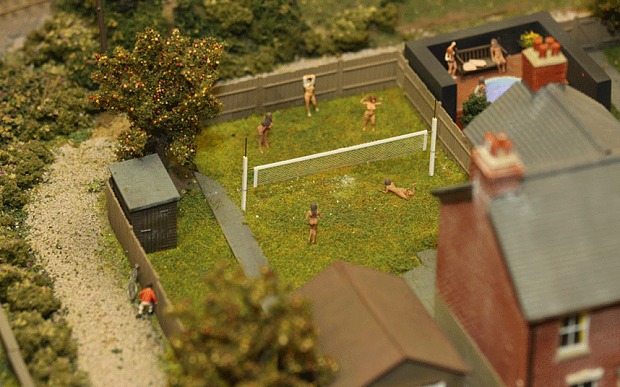
I’d always considered the world of model railways to be the last surviving example of a rose-tinted Britain that no longer exists. Enthusiasts of this quaint and captivating hobby invariably seem to use 1950 as their cultural template when designing their layouts.
In the real world it may all be Pendolino trains, gleaming concourses in steel and glass, and rail replacement bus services; but in model railwayland you’d always find puffing steam trains barrelling along in front of an idealised balsawood countryside that was never far from Adlestrop.
And therein, of course, lay their charm. Whenever I visited an exhibition I always revelled in the tiny trackside details as much as the engines themselves: the miniature sheep, the artificial grass, the miniature coal lorries waiting at the level crossing, and the old-fashioned station platforms.
Best of all, I loved the human figurines awaiting the arrival of the train they’re destined never to board. In the world of model railwayland, fashion as well as technology seemed to have stopped around the end of rationing, with each tiny passenger clad in pleated skirts or duffel coats.
But now an enterprising model railway emporium in Devon is set to shatter this cosy fictional world. Buffers of Axminster is selling a new range of steamy miniature figurines to reflect the laid-back (literally in some cases) attitudes and cultural mores of modern Britain.
They may be new to Mr. Simkins, but scale figures of nudes have been available as long as I can remember (although North American ads for them had to be careful not to expose too much scale detail, for fear of offending the postal authorities…)
H/T to Elizabeth for the link.
I know several people who’d want one of these
Want a new exotic toy to show off to your buddies after you say “Here, hold my beer”? How about a personal flamethrower?



QotD: The modern snob
Walking through Amsterdam recently, a paradox that I had long noticed in an inchoate way formulated itself clearly in my mind. It was this: A century ago, there would have been one clothes shop for every hundred well-dressed people. Nowadays there is one well-dressed person (if that) for every hundred clothes shops. What accounts for this strange reversal of ratios?
Beyond the fact that clothes are now mass-produced rather than made individually, there is an act of will involved. Practically everyone now dresses not merely in a casual way, but with studied slovenliness for fear of being thought elegant, as elegance is a metonym for undemocratic sentiment or belief. You can dress as expensively as you like, indeed expensive scruffiness is a form of chic, but on no account must you dress with taste and discrimination. To do so might be to draw hostile attention to yourself. Who on Earth do you think you are to dress like that?
[…]
Modern scruffiness, then, is a manifestation of egotism. Outside one of the shops in Amsterdam was a large plasma screen showing models wearing the kind of clothes to be had within. They were precisely the insolently ragged clothes that the great majority of people in the street were wearing anyway. This was a form of flattery of the public, for it implied that its members had nothing to aspire to in the matter of dress higher than that which they themselves were already wearing — that in the matter of appearance they had already reached acme of the possible.
There was yet more. The models, in their T-shirts, baseball caps, sneakers, and so forth, as uniform as any army, walked with the kind of vulpine lope that one associates with the less law-abiding young males of the American ghettoes. But even more striking was the expression on their faces, which were cachectic in the case of the women, androgynous in the case of men: a fixed, determined, humorless stare that indicated a hatred of the world and all that was in it, including their fellow-beings. If one saw such a person at a social event, one would go to some effort to avoid or to flee or not to talk to him or her. The models’ faces were vacantly earnest, as if they wished for annihilation of everything around them for some personal reason, no doubt trifling.
This is the first age in which people do not dress to please others, but dress to displease others, to make sure that everyone knows that I’m not going to make any effort just for you. And this, no doubt, is because I am as good as anyone in the world, bar none: His Majesty, myself. And what starts out as an attitude becomes an unexamined and ingrained habit.
Theodore Dalrymple, “Slobbery as Snobbery”, Taki’s Magazine, 2014-06-15.
March 20, 2015
A Slice of The Pie – Splitting Up The Middle East I THE GREAT WAR Week 34
Published on 19 Mar 2015
Even though the Entente offensive near Constantinople didn’t really take off yet, the allied powers were already dreaming about splitting up the Ottoman Empire between themselves – and even promised territory to other nations. In the meantime, Austria-Hungary started its third offensive in the Carpathians to free the besieged army in Galicia.
Epigenetic researchers – “We can double the size of these bugs!” Everyone else – “No, thanks. We’re good.”
Science can be a great source of fascinating experiments. Doubling the size of insects is perhaps not the best way to advertise your particular speciality, however:

Researchers have changed the size of a handful of Florida ants by chemically modifying their DNA, rather than by changing its encoded information. The work is the latest advance from a field known as epigenetics and may help explain how the insects — despite their high degree of genetic similarity — grow into the different varieties of workers needed in a colony.
This discovery “takes the field leaps and bounds forward,” says entomologist Andrew Suarez of the University of Illinois, Urbana-Champaign, who wasn’t connected to the study. “It’s providing a better understanding of how genes interact with the environment to generate diversity.”
Ant nests have division of labor down pat. The queen spends her time pumping out eggs, and the workers, which are genetically similar sisters, perform all the other jobs necessary to keep the colony thriving, such as tending the young, gathering food, and excavating tunnels. Workers in many ant species specialize even further, forming so-called subcastes that look different and have different roles. In Florida carpenter ants (Camponotus floridanus), for example, workers tend to fall into two groups. Minor workers, which can be less than 6 mm long, rear the young and forage for food. Major workers, which can be almost twice as long, use their large jaws to protect the colony from predators.
A team from McGill University in Montreal, Canada, suspected that the mechanism involves DNA methylation: the addition of a chemical to DNA. Genome sequencing and other methods suggest that these physical differences don’t usually stem from genetic differences between individual ants. Instead, environmental factors help push workers to become majors or minors — specifically, the amount of food and coddling that young ants receive. But just how do these factors change the size of ants?
A new 12-step program … to turn yourself into a wine snob
Carolyn Evans-Hammond on the fastest way to become the person everyone else in the restaurant (or at the party) just despises:
- When tasting a wine over $50, always use the phrase, “excellent value.”
- Make sexual allusions to describe wine, especially when talking to a member of the opposite gender. Tight, muscular, voluptuous, hard, long. You get the idea. Best done while making soft moans before and after the sentiment.
- When at a restaurant, grill the wine waiter about the wines. Ask how a certain bottle is “showing”, whether it’s fruit forward or restrained, and whether the Champagne on the list has undergone malolactic fermentation.
- Bring a bottle of wine to a party already decanted, and tell the host you’d like it poured at a precise temperature.
QotD: Power in sexual relationships
The reproductive instinct (sex instinct) and the nurturing instinct (caring for the brood) are social drives, as we have said, in contrast to the instinct of self-preservation, which focuses on one’s own person, while the two first-named, focusing on another person, make us dependent upon that person and vice versa. The reproductive instinct and the nurturing instinct, therefore, are the key to power and powerlessness.
Power consists in making oneself the goal of another person’s social instincts, without seeking to satisfy one’s own social instincts through him. The other then does everything one asks. Powerlessness consists in wanting or having to satisfy one’s social instincts through another person whose social instincts one has not succeeded in concentrating on oneself — one then does everything the other asks. According to whether one has made someone dependent upon oneself for the satisfaction of one or both instincts, one controls that person partially or wholly, has partial or absolute power over him. (We are referring to biologically determined power; psychologically conditioned power will be dealt with later on.)
To know which of two people has the upper hand, then, one merely needs to know which member of the couple is in a position to manipulate the sex or nurturing instinct of the other. The same is true for the relationship between groups, classes, races, religious communities, generations and clans. It is whichever has the leverage, the favorable starting point or whatever it takes to concentrate the other’s social instincts upon himself, while remaining emotionally uncommitted. Since the most important social instincts involve sex or nurturing the brood, sex and parentage are the basic areas in which the question of power arises. Real power over another person — paradoxical as it may sound — is held by protégés and sex objects only. There is also the kind of power that depends on force, or physical strength. Where there is superior force, I serve under constraint; where there is power, I serve willingly. An adult of my own sex, a social class, an alien race, a political body can at most force me to submit i.e. only by superior physical pressure. But real power is held by whomever I want or need to satisfy my basic social instincts, even if that person is incomparably weaker than I am — I would be bound to do willingly whatever he/she asks. To rule effectively, it is power we need; force is second rate by comparison and far from equally compelling.
Esther Vilar, The Polygamous Sex, 1976.
March 19, 2015
The latest snowstorm in the Maritimes may have been the proverbial straw
If the reports from Nova Scotia are typical, the new ice age may have already started in the Maritime provinces:
7 snowblowers were tragically killed in a driveway avalanche today in Snowva Snowtia. #truetalesfromthewhitedepths
— Hunter (@HuntersInsight) March 18, 2015
Woke up to over 3 feet of snow. Then I shot myself. #truetalesfromthewhitedepths
— Hunter (@HuntersInsight) March 18, 2015
"I think the raccoons got into the compost?" "No the paper was buried in the snow and the snowblower ate it." #truetalesfromthewhitedepths
— Hunter (@HuntersInsight) March 18, 2015
Only traffic I saw while outside: Plow and snowmobile. #truetalesfromthewhitedepths
— Hunter (@HuntersInsight) March 18, 2015
iT'S STILL SNOWING BY THE WAY.
— Hunter (@HuntersInsight) March 18, 2015
The snow is higher than the snowblower feed, and the banks are higher than the snowblower can blow. #truetalesfromthewhitedepths
— Hunter (@HuntersInsight) March 18, 2015
In other news they've decided to change the provinces name to Snowva Snowtia because at this point… just why the fuck not. Just fuck. Fuck
— Hunter (@HuntersInsight) March 18, 2015
Thirty years on, what was the impact of the Miners’ strike in Britain?
Frank Furedi points out six ways that Britain’s political scene has changed as a result of the year-long miners’ strike:
To defeat the National Union of Miners, UK prime minister Margaret Thatcher and her Conservative government had to use almost every available resource, including the mass mobilisation of the police. The Miners’ Strike became the defining event of British politics in the 1980s. And in retrospect, it’s clear that it was the last class-focused dispute of its kind.
Over the past three decades, the political climate, culture and institutions that served as the background for the Miners’ Strike have fundamentally altered. Here are six things that changed enormously in the wake of that industrial conflict.
1) The defeat of the Miners’ Strike signalled the end of the era of militant trade unions
[…]
2) The demise of the British labour movement was paralleled by the decline of the left
The Labour Party has survived the post-1985 tumult, yes, but only by reinventing itself as the party of the middle-class, public-sector professional. Thanks to the vagaries of the electoral system, Labour can still have MPs in many of its traditional working-class seats. The decline of labourism also coincided with the implosion of the Stalinist communist movement and the collapse of the Soviet Union.
[…]
3) Paradoxically, the demise of the left has not benefited the right
Thatcherism, which was very much the dominant force during the Miners’ Strike, has lost its authority. Today’s so-called Conservatives regard Thatcher as an embarrassment and self-consciously distance themselves from her legacy. So defensive is the right today that it continually protests that it is no longer a ‘toxic brand’.
There’s a deep-seated problem with how we measure the so-called “standard of living”
My family are tired of hearing me say any variation on the expression “the past is a foreign country”, but I ring the changes on that phrase because it at least frames some of the problem we have in trying to comprehend just how much life has changed even within living memory, never mind more than a couple of generations ago. At the Cato Institute, Megan McArdle tries to avoid saying exactly those words, but the sense is still very much the same:
The generation that fought the Civil War paid an incredible price: one in four soldiers never returned home, and one in thirteen of those who did were missing one or more limbs. Were they better off than their parents’ generation? What about the generation that lived through the Great Depression, many of whom graduated into World War II? Does a new refrigerator and a Chevrolet in the driveway make up for decades and lives lost to the march of history? Or for the rapid increase in crime and civic disorder that marked the postwar boom? Then again, what about African Americans, who saw massive improvements in both their personal liberty and their personal income?
We should never pooh-pooh economic progress. As P.J. O’Rourke once remarked, I have one word for people who think that we live in a degenerate era fallen from a blessed past full of bounty and ease, and that word is “dentistry.” On the other hand, we should not reduce standard of living to (appropriately inflation adjusted) GDP numbers either. Living standards are complicated, and the tools we have to measure what is happening to them are almost absurdly crude. I certainly won’t achieve a satisfying measure in this brief essay. But we can, I think, begin to sketch the major ways in which things are better and worse for this generation. Hopefully we can also zero in on what makes the current era feel so deprived, and our distribution of income so worrisome.
My grandfather worked as a grocery boy until he was 26 years old. He married my grandmother on Thanksgiving because that was the only day he could get off. Their honeymoon consisted of a weekend visiting relatives , during which they shared their nuptial bed with their host’s toddler. They came home to a room in his parents’ house—for which they paid monthly rent. Every time I hear that marriage is collapsing because the economy is so bad, I think of their story.
By the standards of today, my grandparents were living in wrenching poverty. Some of this, of course, involves technologies that didn’t exist—as a young couple in the 1930s my grandparents had less access to health care than the most neglected homeless person in modern America, simply because most of the treatments we now have had not yet been invented. That is not the whole story, however. Many of the things we now have already existed; my grandparents simply couldn’t afford them. With some exceptions, such as microwave ovens and computers, most of the modern miracles that transformed 20th century domestic life already existed in some form by 1939. But they were out of the financial reach of most people.
If America today discovered a young couple where the husband had to drop out of high school to help his father clean tons of unsold, rotted produce out of their farm’s silos, and now worked a low-wage, low-skilled job, was living in a single room with no central heating and a single bathroom to share for two families, who had no refrigerator and scrubbed their clothes by hand in a washtub, who had serious conversations in low voices over whether they should replace or mend torn clothes, who had to share a single elderly vehicle or make the eight-mile walk to town … that family would be the subject of a three-part Pulitzer prize winning series on Poverty in America.
But in their time and place, my grandparents were a boring bourgeois couple, struggling to make ends meet as everyone did, but never missing a meal or a Sunday at church. They were excited about the indoor plumbing and electricity which had just been installed on his parents’ farm, and they were not too young to marvel at their amazing good fortune in owning an automobile. In some sense they were incredibly deprived, but there are millions of people in America today who are incomparably better off materially, and yet whose lives strike us (and them) as somehow objectively more difficult.
I know it’s been cold around here this winter …
… but I hadn’t heard that Hell had actually frozen over. Because that’d be the only possible explanation for a headline like this one:
Is Scarborough, Ontario the dining capital of the world?
Wednesday night I was taken on a restaurant tour of Scarborough — four different places — plus rolls from a Sri Lankan locale, consumed in the office of the Dean of UT Scarborough and with the assistance of Peter Loewen.
After that eating, and lots of driving around and looking, I concluded Scarborough is the best ethnic food suburb I have seen in my life, ever, and by an order of magnitude. I hope you all have the chance to visit Scarborough, Ontario.
Update, 20 March: The Toronto Star‘s Lauren Pelley reports on Tyler Cowen’s recent visit to Scarborough and his discovery of the area’s impressive range of high quality ethnic food.
Over the phone from his office at George Mason University in Virginia, Cowen noted that people in Toronto seem to perceive the new, hip restaurants to be elsewhere. “But it seems to me, you don’t come close to this part of town,” he said.
Rick Halpern, dean of UTSC and Cowen’s tour guide last Wednesday, agreed that most people are fixated on the downtown core. “No one goes east of the DVP,” he lamented.
Cowen’s post is making the rounds online, and sparking discussion on blogs and Reddit. Scarborough is “a foodie’s best kept secret,” as one commenter put it, though it’s no secret to locals.
“I would say that people who are into food, and who have a car, explore Scarborough and other suburbs,” said Jennifer Bain, the Star’s food editor, who has highlighted many of the area’s offerings over the years — including Uighur fare from Scarborough’s Chinese Muslim community, sweets from local Filipino bakeries, and the global flavours of Hakka Chinese food, to name a few.
Getting to know the “the cocaine of Chardonnay”
At Wine Folly, Morgan Harris talks about the original home of Chardonnay:
For winemakers, white Burgundy may just be the Helen of Troy of Chardonnay because nearly everyone who’s ever made Chardonnay has looked towards white Burgundy as the golden standard. All in all, white Burgundy is just Chardonnay, but the region is also the origin place of the variety, which is by the way, the world’s most planted white grape. In Burgundy, the combination of climate, land and tradition produce a wine that is coveted by many and never precisely replicated anywhere else.
Once you’re hooked on white Burgundy, there’s no going back. White Burgundy is the crack cocaine of Chardonnay. Sommeliers and retailers who sell white Burgundy sound like drug dealers: “Just try some, you’ll love it…”
Now that you’ve had a proper introduction, let’s get started exploring the region and the wine. While people have dedicated their lives to understanding the region, anyone can be learn how buy and appreciate white Burgundy.
Broadly, white Burgundy can be found in four production areas within Burgundy. Each area has a different terroirs and characteristics and thus, different flavor profiles:
- Bourgogne Blanc ($$$): unoaked simple wines with mineral and apple notes
- Chablis ($$$$): unoaked wines that are zippy and lean with lime-like mineral flavors
- Mâconnais ($$$): usually unoaked wines with melon and starfruit notes
- Côte de Beaune ($$$$$): typically oak-aged wines with rich fleshy melon and starfruit flavors and undertones of truffle and hazelnut
($) $5–10; ($$) $10–15; ($$$) $15–20; ($$$$) $20–30; ($$$$$) $30+;
NOTE: There are a few wines from outlier regions within Burgundy not included in this guide.

Click to see full-sized map
I’m a fan of oaked chardonnay … I don’t particularly like unoaked chardonnay, but add that hit of oak and it’s a wonderful experience. The best white Burgundy I’ve ever had was a Chassagne-Montrachet, but I rarely risk buying French wines these days due to the sometimes chancy relationship between the price at the LCBO and the actual quality of the wine.


