
BBC Archive
Published 17 Jun 2023Russian moon landings, week long traffic jams, a workforce replaced by automation and above all, too much leisure time!
These are just some of the bold predictions made in Don Haworth’s 1963 BBC “mockumentary” Time on Our Hands – a remarkable film which projects the viewer a quarter of a century into the future.
Imagine how the futuristic inhabitants of 1988 — a society freed from the shackles of endless hard work — might reflect on the way people live and work in 1963. Its aim is to look back at the extraordinary, almost unbelievable, events of the intervening 25 years — referred to as “the years of the transformation”.
“This Buoyant programme could be repeated a dozen times and still intrigue, delight and disturb me”
Dennis Potter, Daily Herald TV critic, 1963This footage is compiled of excerpts from Time On Our Hands, a faux-documentary film by Don Haworth.
Originally broadcast 19 March, 1963.
June 19, 2023
1963: Mockumentary Predicts The Future of 1988 | Time On Our Hands | Past Predictions | BBC
June 16, 2023
Blackadder at 40
Ed West remembers his first encounter with the brilliant, devious, and hilarious Edmund Blackadder:
What do these famous figures from British history all have in common? Elizabeth I, George III, George IV, Victoria and Albert, the Duke of Wellington, Dr Samuel Johnson, Sir Walter Raleigh, Sir Douglas Haig, Richard III, er Richard IV, William Pitt the Younger, William Pitt the Even Younger …
They’re all, of course, characters in the greatest tale of our island story, a giant rollercoaster of a comedy in four sizzling chapters, one that was first shown 40 years ago today.
New British stamps issued on the 40th anniversary of the BBC comedy series Blackadder
I was probably always going to love history — my dad was obsessed with it — but Blackadder helped imprint the idea that the past can be one great black comedy. History is funny because people’s behaviour is often quite irrational, or spiteful, or motivated by petty reasons that contrast with their high-minded principles — and no doubt we will seem the same to future generations, too.
That was the whole idea behind Blackadder because, as creator Richard Curtis points out in a documentary screened tonight on Gold, he’s “a modern person in the stupidity of ancient times”.
Yet when the idea was first proposed by Curtis and Rowan Atkinson, they were advised that there are two sitcom premises that can never work — shows set in heaven and hell, or those in historical settings. And Blackadder was lucky to survive its first season.
Atkinson and Curtis had met at Oxford, going on to work together on Not the Nine O’Clock News, where they’d met producer John Lloyd. The two men were inspired by Fawlty Towers, but were also determined to avoid any comparison with John Cleese and Connie Booth’s great creation, so decided on a setting as far removed from a south coast hotel as possible.
Aired on 15 June, 1983, The Black Adder was quite lavish. There were location shots in places like Alnwick Castle and huge amounts spent on costumes and horses. Curtis says that one of the hats Atkinson wore was worth more than he was paid for writing the episode. It featured such big names as Brian Blessed and Peter Cook, the godfather of alternative comedy whose presence granted the show its place in the apostolic succession. But, while the first series has its moments, it was flawed; the original Blackadder was a weasel-like and pathetic figure, and less clever than his sidekick Baldrick. The comedy didn’t exactly work.
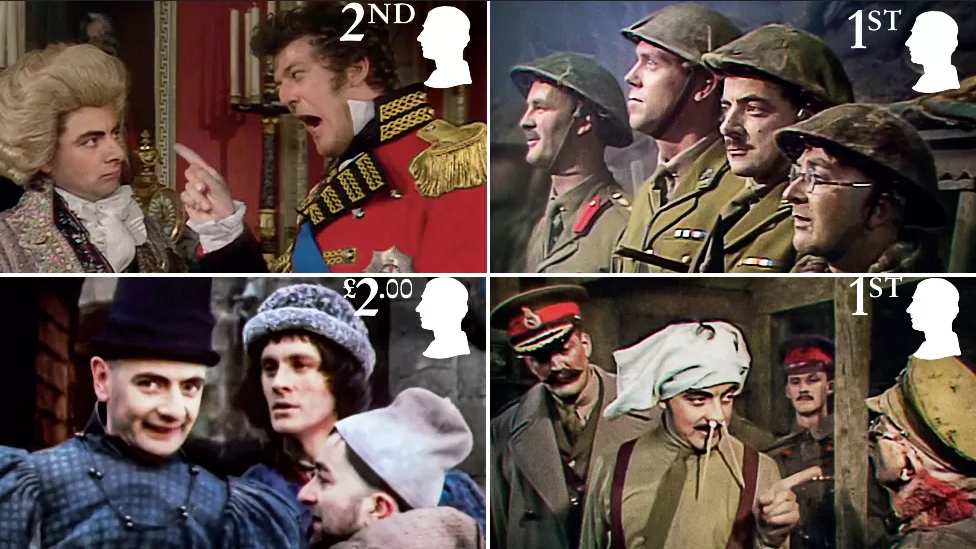
I was fortunate enough to encounter the second series, set in Elizabethan England, before I saw any of the first series. The original has its funny moments, but Ed is quite correct that it’s less than the sum of its parts. Brian Blessed steals every scene he’s in (as always), and Peter Cook’s portrayal of Richard III is great. The rest … is kinda funny if you know a bit of the history. Thankfully, there was more to come.
Blackadder II aired at the start of January 1986, and had a much smaller budget and a simpler set up — and it was far, far funnier, the protagonist no longer a conniving weasel but a court sycophant with Baldrick and Percy as comedy punchbags.
“Well, it is said, Percy, that civilised man seeks out good and intelligent company, so that through learned discourse he may rise above the savage and closer to God. Personally, however, I like to start the day with a total dickhead to remind me I’m best.”
(Fans of comedy shows who quote the lines endlessly can become quite tedious but, well, tough.)
Or: “The eyes are open, the mouth moves, but Mr. Brain has long since departed, hasn’t he, Percy?”
Towards Baldrick he is somewhat more indulgent, telling him that “Thinking is so important“.
“I’ve been in your service since I was two and a half my Lord,” his dogsbody protests upon being thrown out: “Well that is why I am so utterly sick of the sight of you.”
Elton also thought the medieval era to be too squalid and wanted Season 2 set in the “sexier” Elizabethan era (and indeed Edmund’s outfit is rather sexy, as Percy might put it).
June 13, 2023
Why The Far Side is a masterclass in storytelling
The Gaze
Published 26 Dec 2019The Far Side by Gary Larson is one of the best and most praised cartoons in history. But what makes The Far Side so good? What is the legacy of Gary Larson? And most importantly: what can we learn from The Far Side?
0:00 Pixar and Storytelling
1:22 How Gary Larson tells a story
2:42 The Far Side facts and figures
3:22 The level of detail in The Far Side
4:04 Telling a story with one image and a punchline
5:09 What is The Far Side about?
7:11 Gary Larson and naturalism
7:40 Controversy over The Far Side
8:10 The legacy of The Far Side
9:00 Conclusion
(more…)
May 12, 2023
TL;DR Edition Of All 66 Books Of The Bible
The Babylon Bee
Published 3 Feb 2023With The TL;DR Edition of the Bible, you can forget about reading through the Bible in a year — now you can read through the Bible in about five minutes!
(more…)
May 8, 2023
Father Ted as Ireland’s answer to Fawlty Towers
Conor Fitzgerald on the tragically short run of the classic Irish comedy Father Ted:
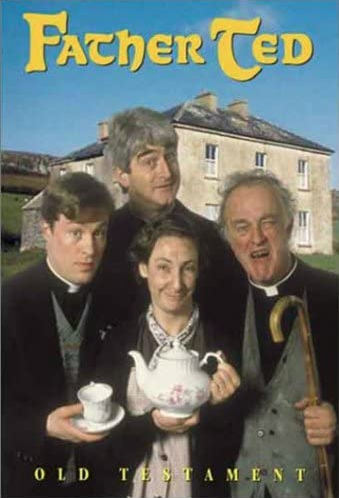
Fondly remembered and occasionally quoted, Father Ted has its place in the broad canon of the British sitcom. But in Ireland, even 25 years since its finale, it has always been so much more. Its status is closer to Fawlty Towers in England or Cheers in the United States: the national sitcom, a piece of light entertainment that nevertheless Says Something Meaningful About Us.
Not only was Father Ted one of the few successful TV representations of Ireland, it was made during Ireland’s version of the Swinging Sixties, our flux decade of the Nineties. The accelerating collapse of the Church and the exposure of longstanding political corruption coincided with the dawn of the Celtic Tiger years, lending peripheral Ireland a sense of self-conscious modernity. It was a unique national turning point, where our 19th-century past seemed to co-exist with our 21st-century future. In reflecting this upheaval, Father Ted has become not just a social historical document, but a portent of where Ireland stands today.
It’s not the sort of thing that national epics are normally made of. The programme is about three Catholic Priests — Fathers Ted Crilly, Dougal McGuire, and Jack Hackett — on Craggy Island, a remote settlement off the west coast of Ireland. All three priests have been exiled to this purgatory by the terrifying Bishop Len Brennan (their misdemeanours are never referred to directly, but Ted often makes oblique reference to the fact that “the funds were only resting in my account”). Most episodes revolve around an absurdist version of Church life, Ted’s schemes to escape the island and their interactions with the island’s townsfolk.
Rarely for domestic Irish TV, it was a sitcom written by Irish people and it was set within a central Irish institution, the Catholic Church. And the dearth of representations of Irish people in entertainment meant it crystallised many Irish archetypes for the first time. Ireland itself hadn’t always been a welcoming place for satirists. Ted star Dermot Morgan knew this well — his major project before Ted had been a political comedy radio show named Scrap Saturday, which upset all the wrong people, and was eventually cancelled amid allegations of political interference.
Unlike Scrap Saturday, Ted never sought to be political or self-consciously “relevant”. But Craggy Island is a capsule of Irish life at this time of major social change — not least for gender relations and the Church. Take one married couple, John and Mary, who own the corner shop on Craggy Island. They contrive to show a winsome, loving front to the priest whenever they encounter him, but turn to violent bickering once his back is turned. At one point, Mary tries to drown John in a bucket of water; at another, Father Ted comes into the shop and finds John has locked Mary in a cupboard. When he leaves, they’re arguing over a shotgun.
This peck-and-scratch marriage is still funny, but in 2023 the laughter it provokes is nervous. It’s a product of an Irish society still processing the reality of divorce, only legalised by a referendum in Ireland in 1995, the same year Ted first aired. Though it was not uncommon at that time for people to separate, the divorce campaign had been ugly and emotional. One billboard for No bore the slogan “Hello divorce, goodbye daddy”. The referendum was passed by the tiny margin of 9,000 votes.
Divorce was only one step in the very gradual withering of religious power in Ireland — far more gradual than the rest of Europe. Remember that abortion was only legalised in Ireland five years ago. When Ted was broadcast, the Church was formally still one of the central pillars of Irish life, but its authority rang hollow. Priests often felt like administrators of a vanished country. And on remote Craggy, Ted, Dougal and Jack mirror this directly. All good sitcoms feature characters who are trapped, but Ted is doubly so: first on his island; and second in an institution people are coming to see as irrelevant. He is still an essential member of the community, more than just a ceremonial functionary for weddings and funerals. But it’s just not clear what the essential thing he does is anymore, beyond being a common reference point that deserves token respect.
May 1, 2023
Doctor Sketchy and the Strange Case of the Syndrome of Doom
Lindybeige
Published 24 Jan 2023I teamed up with the highly-skilled Alasdair Beckett-King and together we threw together this sketch. Can you tell that he went to film school?
(more…)
April 20, 2023
When You Get Distracted Easily
It’s a Southern Thing
Published 19 Jan 2021Just keep nodding and try to hang in there.
(more…)
April 1, 2023
“The Spaghetti Harvest” (1957) | Panorama | Classic BBC clips | BBC Archive
BBC Archive
Published 31 Mar 2022Panorama reports from Switzerland, where the combination of a mild winter and the virtual disappearance of pests like the spaghetti weevil, has resulted in a bumper spaghetti crop.
This clip is believed to be one of the first televised April Fools pranks – the original fake news, if you will. The narrator of the film is the highly respected journalist Richard Dimbleby. Back in 1957, some viewers failed to see the funny side and criticised the BBC for airing the spoof news item on what is supposed to be a serious factual programme. Others, however, were so intrigued that they wrote in to the BBC asking where they could purchase their very own spaghetti bush.
Originally broadcast 1 April, 1957.
(more…)
March 10, 2023
Having solved all other problems, Congress now investigates … (checks notes) … the Protestant Reformation
Chris Bray respectfully outlines some of the questions the honourable Congressmen Congresspersons Congressentities Representatives would be likely to pose to the witnesses:
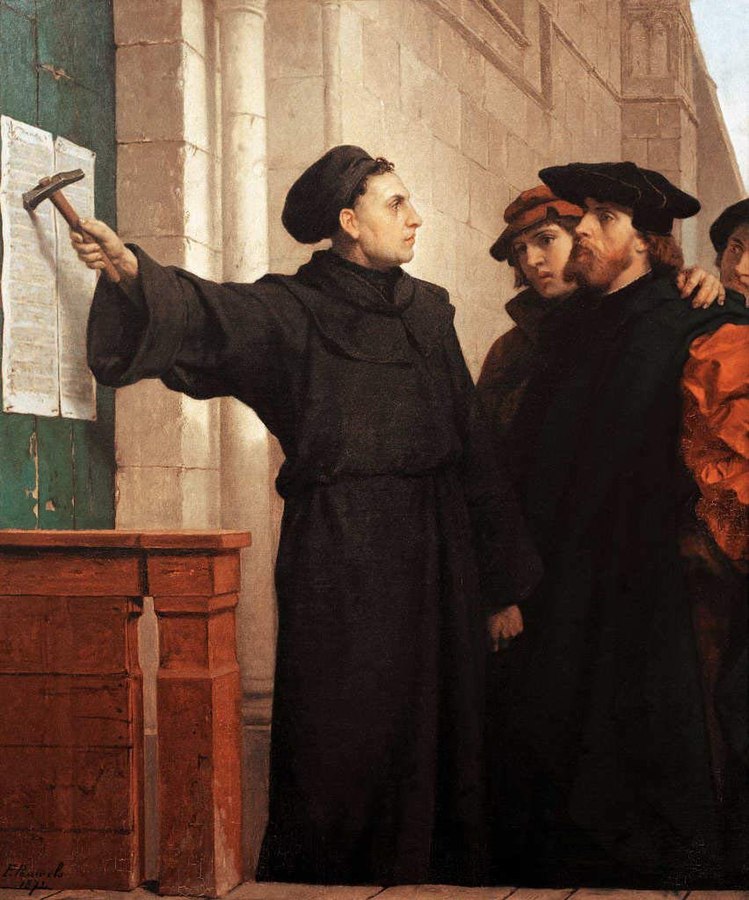
Martin Luther nails his 95 theses to the door of All Saints Church in Wittenberg, 1517.
Painting by Ferdinand Pauwels (1830-1904) via Wikimedia Commons.
1.) Mr. Luther, you — sorry, having trouble with my reading glasses. It says here you … mailed 95 feces to a door? Do you feel that it was appropriate to put something like that in the mail?
2.) Mr. Calvin, sir, you have raised numerous objections to the elevation of the host. Shouldn’t you be equally concerned about the elevation of the hostess? Don’t you feel that gendered terms are problematic?
3.) For all the witnesses, I’m told you wish to choose your own pastures. Isn’t that a question best left to the farmers?
4.) Gentlemen, you apparently propose to dissolve the monasteries. But most of them are, in my understanding, made out of big rocks, with very solid walls. Wouldn’t that take a prohibitive amount of acid to dissolve those? Have you done an EIR?
5.) I must very candidly inform the witnesses that I cannot agree to your premise, and I frankly find it absurd to say that faith alone is the cause of salivation. Do you have credentials in the science of digestion?
March 6, 2023
QotD: The pastries of the wider paradonut family
When people say “I’d like a donut”, #Science indicates that Actually, they don’t want a donut at all. They say donut, but they really mean a pastry from the paradonut family.
Exhibit A: The Coffee Roll — Phasers on Star Trek have three settings: Stun, Kill, and Coffee Roll.
Exhibit B: The Eclair — From the French for “lightning”, the eclair was invented by a psychiatrist as a delicious alternative to electroshock therapy for schizophrenics. Because when you’re eating an eclair, you can’t deny the marvelous cream-filled reality you’re actually present in.
Exhibit C: The Cheese Danish — Cheese Danishes have a mix of flavors and textures that make them, in scientific terms, “a gang-bang for your face”.
Exhibit D: The Bear Claw — The bear claw is the ugly, bewarted King Pimp of the pastry shop window, with a dozen smaller, more effeminate donuts it’s turned into its sad little bitches and tricks following behind it.
Exhibit E: The Apple Fritter — The so-called “Emperor of Pastries” makes your stupid little glazed donut look sad and weak like Barack Obama’s gay arms.
Exhibit F: The Cinnamon Bun — Cinnamon Buns have been proven to be responsible for America’s obesity epidemic and diabetic crisis, and also totally worth it.
Bonus: Worst Donuts
1. Jelly Donuts — Jelly donuts are always what’s left after people eat the real donuts. Jelly donuts are consolation prizes for losers who came late. They taste like failure for a reason. If you’re eating a jelly donut, that’s because you’re not a competitor and you don’t have any friends to set aside a good donut for you.
2. Plain Donuts — Plain donuts are also called “not donuts” or “ring-shaped bread”. Plain donuts were invented for parents who don’t love their children. They are also sometimes put out as bait for poisoning rats, though they have a 75% failure rate. Rats don’t like them either. Sometimes a poisoned plain donut will be found intact, with a dead rat next to it — rats will lick the poison off the plain donut while avoiding the plain donut itself. According to Leviticus, you are supposed to pay the dowry of an ugly woman in plain donuts.
3. Powdered Sugar Donuts — Powdered sugar donuts are made primarily by mental degenerates employed by donut shops as charity hires. They are sometimes called “Retard Donuts”. To compare powdered sugar donuts to the Holocaust would be to trivialize the horror of powdered sugar donuts.
Ace, “Science Proves That The Best Donuts Are Actually Non-Donuts”, Ace of Spades H.Q., 2017-06-17.
March 5, 2023
“Natural Woman” – classic hit song or hate crime in progress?
Janice Fiamengo on the hoax “cancellation” attempt on the late Aretha Franklin’s hit song:
For at least a few hours, it looked as if the 1960s soul classic “(You Make Me Feel Like a) Natural Woman“, memorably performed by Aretha Franklin, was imperiled by woke attack. Various conservative and right-wing media reported in late January that a trans awareness group was demanding via Twitter that the song be canceled because of its exclusionary emphasis on “natural” womanhood. It was dutifully noted that this was the latest salvo in the trans “assault on women”, and a women’s activist was reported as saying, “I don’t think many women really know how much we’re hated”.
It turned out that the complaint about “Natural Woman”, which received well over one million views and provoked thousands of responses, had been made by a parody account. Aretha Franklin was safe — at least for now. But commentary on the song has a surprising history, as we’ll see, that complicates the standard claims about the trans erasure of women.
The Twitter account at the center of the faux controversy was TCMA, the Trans Cultural Mindfulness Alliance, which began tweeting in January of 2023 to highlight the lunatic fringe of trans advocacy. Many of the tweets by TCMA exaggerate actual trans activist positions so adroitly that even on a second or third reading, they seem plausible. On January 20, for example, TCMA tweeted that “Many children learn gender from their pets”, and advised parents that “Just because you bring home a ‘gendered’ pet, allow your child to choose the gender of the pet — don’t assign it one ‘at will’.”
A day later, TCMA tweeted that it would be petitioning the Norwegian government “to no longer include gender on birth certificates” and it condemned media, in another tweet, for emphasizing child abuse by same-sex couples while failing to cover the “wonton abuse” (steamed or deep fried?!) in the church.
The purpose of the account seems fairly clear: to show how dogmatic statements by activists are often hard to tell apart from parodies of the same. Something strange is going on when people in positions of cultural power not infrequently express themselves in a manner indistinguishable from parody.

February 14, 2023
Valentine’s Day Brownies – You Suck at Cooking (episode 57)
You Suck At Cooking
Published 13 Feb 2017
(more…)
December 28, 2022
Useful Beer Reviews: Newcastle Brown Ale
Jago Hazzard
Published 12 Jun 2019Today, an old favourite – Newcastle Brown Ale.
DISCLAIMER: Contains rambling that may bear no resemblance to reality.
December 24, 2022
QotD: Auberon Waugh on Christmas shopping
Auberon Waugh, Diary, 1975-12-18.
December 19, 2022
Christmas Crack – You Suck at Cooking (episode 54)
You Suck At Cooking
Published 22 Dec 2016To make the Christmas crack:
1. Combine equal parts of butter and brown sugar (1 cup of each works) and heat in a sauce pan until it turns into sauce in the pan.
2. Line a baking sheet with foil then with graham crackers. Break them up to make them fit along the edges.
3. Once the butter and sugar become a thickish sauce, pour it all over.
4. Bake in in the oven for a couple minutes until it starts to bubble but not for too long.
5. Cover with chocolate chips … you can put that back in the oven for a minute or just wait a minute and start spreading them around as they melt until it’s a full layer. Use just over 1 cup.
6. Throw on whatever toppings you want; almonds, pepperoni, whatever.
7. Wait a few hours for it to harden or throw it in the fridge or the freezer.I personally like keeping it frozen and eating it that way. But I am not you and you may have different temperature preferences. It’s hard for me to tell at this point, but if you message me on snapchat perhaps we can discuss this more thoroughly. Or perhaps not. I’m sorta moody that way.
(more…)


