
Most men get over the strippers-and-sports-cars overreaction pretty quickly, generally to be replaced by a new outlook on life. The guys who have come through the midlife crisis are generally a lot better people — more focused, more outgoing, far less materialistic — because they’ve taken up, however briefly, the perspective of Eternity. If you’re religious, you wonder if you’ll merit heaven. If you’re not, you wonder how you’ll be remembered. Either way, you start thinking about the kind of world you want to leave behind you, and what you’re going to do to achieve it with whatever time is left to you.
Which is why I’ve found the COVID overreaction so bizarre. Realizing your own mortality changes things. You can always tell, for instance, when it has happened to a younger person — when they come home, combat vets often act like middle-aged men going through a midlife crisis. Readjustment to civilian life is hard. Read the great war narratives, and it’s clear that none of them ever really “got over it”. Robert Graves and Ernst Junger, for instance, both lived to ripe old ages (90 and 103, respectively), and were titans in fields far removed from battle … and yet, the war WAS their lives, in some way we who haven’t been through it will never understand, and it comes through in every line they wrote.
If the Covidians were really freaking out about COVID, then, I’d expect one of two broad types of reaction: Either party-hearty midlife crisis mode, or a new determination to get on with whatever’s left of life. Obviously neither of those are true, and I just can’t grasp it — these might be your last few weeks on Earth, and that’s how you’re going to spend them? Sitting in your apartment like a sheep, wearing a mask and eating takeout, glued to a computer screen?
If you want a measure of just how feminized our society has become, there you go. Call this misogyny if you must, but it’s an easily observed fact of human nature — indeed, it has been observed, in every time, place, and culture of which we have knowledge — that post-menopausal women go a bit batty. Though a man might know for certain that he dies tomorrow, he can still keep plugging away today, because he’s programmed to find real meaning in his “work” — we are, after all, running our snazzy new mental software over kludgy old caveman hardware.
Women aren’t like that. They have one “job”, just one, and when they can’t do it anymore, they get weird. In much the same way high-end sports cars would cease to exist if middle aged men ceased to exist, so there are entire aspects of culture that don’t make sense in any other way except: These are channels for the energies of post-menopausal, and therefore surplus-to-requirements, women. You could go so far as to say that pretty much everything we call culture — traditions, history, customs — exist for that reason. Women go from being the bearers, to being the custodians, of the tribe’s future.
Severian, “Life’s Back Nine”, Rotten Chestnuts, 2021-05-11.
April 17, 2024
QotD: The mid-life crisis, male and female versions
November 18, 2023
“René Girard’s famous book I See Satan Fall Like Lightning isn’t directly about Barack Obama being the Antichrist”
At Astral Codex Ten, Scott Alexander reviews I See Satan Fall Like Lightning by René Girard:
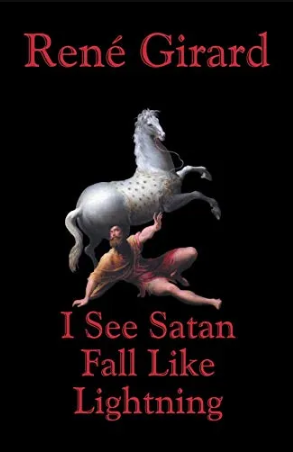
The phrase “I see Satan fall like lightning” comes from Luke 10:18. I’d previously encountered it on insane right-wing conspiracy theory websites. You can rephrase it as “I see Satan descend to earth in the form of lightning”. But “lightning” in Hebrew is barak. So the Bible says Satan will descend to Earth in the form of Barak. Seems like a relevant Bible verse for insane right-wing conspiracy theorists!
Philosopher / theologian Rene Girard’s famous book I See Satan Fall Like Lightning isn’t directly about Barack Obama being the Antichrist. It’s an ambitious theory-of-everything for anthropology, mythography, and the Judeo-Christian religion. After solving all of those venerable fields, it will, sort of, loop back to Barack Obama being the Antichrist. But it’ll do it in such an intellectual and polymathic Continental philosophy way that can’t even get mad.
Girard’s starting point is the similarity between Bible stories and pagan myths. You’ve heard about this before — dying-and-resurrecting gods, that sort of thing. You might expect Girard, a good Catholic, to reject these similarities. He doesn’t. He says they’re real and important. Pagan myths resemble the Bible because they’re both describing the same psychosocial process. The myths are distorted propaganda supporting the process, and the Bible is a clear-eyed description of the process which reveals it to be evil. Just as worshipful Soviet hagiographies of Stalin and sober historical analyses of Stalin will have many similarities (since they’re both describing Stalin), so there will be unavoidable resonances between myth and the Bible.
Girard calls this process “the single-victim process” or “Satan”. It goes like this:
- Most (all?) human desire is mimetic, ie based on copying other people’s desires. The Bible warns against coveting your neighbor’s stuff, because it knows people’s natural tendencies run that direction. It’s not that your neighbor has particularly good stuff. It’s that you want it because it’s your neighbor’s. Think of two children playing in a room full of toys. One child picks up Toy #368 and starts playing with it. Then the other child tries to take it, ignoring all the hundreds of other toys available. It’s valuable because someone else wants it.
- As with the two children, conflict is inevitable. As the mimetic process intensifies, everyone goes from complicated individuals with individual wants, to copies of their neighbors (ie their desires copy their neighbors’ desires, and they become the sort of people who would have those desires). Alliances form and dissipate. There is a war of all against all. The social fabric starts to collapse.
- Instead of letting the social fabric collapse, everyone suddenly turns their ire on one person, the victim. Maybe this person is a foreigner, or a contrarian, or just ugly. The transition from individuals to a mob reaches a crescendo. The mob, with one will, murders the victim (or maybe just exiles them).
- Then everything is kind of okay! The murder relieves the built-up tension. People feel like they can have their own desires again, and stop coveting their neighbors’ stuff quite so hard, at least for a while. Society does not collapse. If there was no civilization before, maybe people take advantage of this period of relative peace to found civilization.
- (Optional step 5) Seems pretty impressive that killing one victim could cause all this peace and civilization! The former mob declares their victim to be a god. Killing the god was the necessary prerequisite to civilization. Now the god probably reigns in heaven or something. Maybe they die and resurrect every year. Whatever.
- Rinse and repeat.
Girard is against this process. Not just because it involves violent mobs lynching innocent people (although it does), but because that step perpetuates the whole cycle: people greedily desiring whatever their neighbors have, people hating their neighbors, internecine war of all against all. He dubs the process Satan, based partly on the original Hebrew meaning of Satan as “prosecutor”. Satan is the force that tells people that the victim is guilty and deserves to be lynched.
(and did you know that Paraclete, the Greek word for the Holy Spirit, originally meant “defense attorney”? The Paraclete is the force that — no, we’ll get to that later).
Are all myths and Bible stories really about this process? Girard says yes. For example, consider the myth of Oedipus. Around the end, Thebes is stricken by plague (Girard says plagues should usually be interpreted metaphorically as social plagues, ie discord). Everyone goes to the oracle and asks for a solution. The oracle says that someone has killed his father and married his mother, and the plague won’t end until that person is removed. It is revealed that Oedipus is the culprit. The mob expels Oedipus from the city, and the plague ends.
Okay, that’s one myth. Are there others?
September 27, 2023
QotD: Geeks and hackers
Thus, one doesn’t expect a “gaming geek” or a “computer geek” or a “physics geek” to actually produce games or software or original physics – but a “computer hacker” is expected to produce software, or (less commonly) hardware customizations or homebrewing. I cannot attest to the use of the terms “gaming hacker” or “physics hacker”, but I am as certain as of what I had for breakfast that computer hackers would expect a person so labeled to originate games or physics rather than merely being a connoisseur of such things.
One thing that makes this distinction interesting is that it’s a recently-evolved one. When I first edited the Jargon File in 1990, “geek” was just beginning a long march towards respectability. It’s from a Germanic root meaning “fool” or “idiot” and for a long time was associated with the sort of carnival freak-show performer who bit the heads off chickens. Over the next ten years it became steadily more widely and positively self-applied by people with “non-mainstream” interests, especially those centered around computers or gaming or science fiction. From the self-application of “geek” by those people it spread to elsewhere in science and engineering, and now even more widely; my wife the attorney and costume historian now uses the terms “law geek” and “costume geek” and is understood by her peers, but it would have been quite unlikely and a faux pas for her to have done that before the last few years.
Because I remembered the pre-1990 history, I resisted calling myself a “geek” for a long time, but I stopped around 2005-2006 – after most other techies, but before it became a term my wife’s non-techie peers used politely. The sting has been drawn from the word. And it’s useful when I want to emphasize what I have in common with have in common with other geeks, rather than pointing at the more restricted category of “hacker”. All hackers are, almost by definition, geeks – but the reverse is not true.
The word “hacker”, of course, has long been something of a cultural football. Part of the rise of “geek” in the 1990s was probably due to hackers deciding they couldn’t fight journalistic corruption of the term to refer to computer criminals – crackers. But the tremendous growth and increase in prestige of the hacker culture since 1997, consequent on the success of the open-source movement, has given the hackers a stronger position from which to assert and reclaim that label from abuse than they had before. I track this from the reactions I get when I explain it to journalists – rather more positive, and much more willing to accept a hacker-lexicographer’s authority to pronounce on the matter, than in the early to mid-1990s when I was first doing that gig.
Eric S. Raymond, “Geeks, hackers, nerds, and crackers: on language boundaries”, Armed and Dangerous, 2011-01-09.
January 31, 2023
QotD: Religious rituals
We tend to have an almost anthropological view of rituals, even ones we still practice: we see them in terms of their social function or psychological impact. Frank Herbert’s Children of Dune (the Sci-fi miniseries; I can’t find the quote in the text, but then it’s a lot of text) put it wonderfully, “Ritual is the whip by which men are enlightened.” That is, ritual’s primary effect is the change that takes place in our minds, rather than in the spiritual world. This is the same line of thinking whereby a Church service is justified because it “creates a sense of community” or “brings believers together”. We view rituals often like plays or concerts, experiences without any broader consequences beyond the experience of participation or viewing itself.
This is not how polytheism (ancient or modern) works (indeed, it is not how most modern Christianity works: the sacraments are supposed to be spiritually effective; that is, if properly carried out, they do things beyond just making us feel better. You can see this articulated clearly in some traditional prayers, like the Prayer of Humble Access or Luther’s Flood Prayer).
Instead, religious rituals are meant to have (and will have, so the believer believes, if everything is done properly) real effects in both the spiritual world and the physical world. That is, your ritual will first effect a change in the god (making them better disposed to you) and second that will effect a change in the physical world we inhabit (as the god’s power is deployed in your favor).
But to reiterate, because this is key: the purpose of ritual (in ancient, polytheistic religious systems) is to produce a concrete, earthly result. It is not to improve our mood or morals, but to make crops grow, rain fall, armies win battles, business deals turn out well, ships sail, winds blow. While some rituals in these religions do concern themselves with the afterlife or other seemingly purely spiritual concerns (the lines between earthly and spiritual in those cases are – as we’ll see, somewhat blurrier in these religions than we often think them to be now), the great majority of rituals are squarely focused on what is happening around us, and are performed because they do something.
This is the practical side of practical knowledge; the ritual in polytheistic religion does not (usually) alter you in some way – it alters the world (spiritual and physical) around you in some way. Consequently, ritual is employed as a tool – this problem is solved by a wrench, that problem by a hammer, and this other problem by a ritual. Some rituals are preventative maintenance (say, we regularly observe this ritual so this god is always well disposed to us, so that they do X, Y, and Z on the regular), others are a response to crisis, but they are all tools to shape the world (again, physical and spiritual) around us. If a ritual carries a moral duty, it is only because (we’ll get to this a bit more later) other people in your community are counting on you to do it; it is a moral duty the same way that, as an accountant, not embezzling money is a moral duty. Failure lets other people (not yourself and not even really the gods) down.
Bret Devereaux, “Collections: Practical Polytheism, Part II: Practice”, A Collection of Unmitigated Pedantry, 2019-11-01.
November 7, 2022
“We are the descendants of good team players”
Rob Henderson considers the Male-Warrior hypothesis:

The male-warrior hypothesis has two components:
- Within a same-sex human peer group, conflict between individuals is equally prevalent for both sexes, with overt physical conflict more common among males
- Males are more likely to reduce conflict within their group if they find themselves competing against an outgroup
The idea is that, compared with all-female groups, all-male groups will (on average) display an equal or greater amount of aggression and hostility toward one another. But when they are up against another group in a competitive situation, cooperation increases within male groups and remains the same among female groups.
Rivalries with other human groups in the ancestral environment in competition for resources and reproductive partners shaped human psychology to make distinctions between us and them. Mathematical modeling of human evolution suggests that human cooperation is a consequence of competition.
Humans who did not make this distinction — those who were unwilling to support their group to prevail against other groups — did not survive. We are the descendants of good team players.
It used to be accepted as a given that males were more aggressive toward one another than females. This is because researchers often used measures of overt aggression. For instance, researchers would observe kids at a playground and record the number of physical altercations that occurred and compare how they differed by sex. Unsurprisingly, boys push each other around and get into fights more than girls.
But when researchers expanded their definition of aggression to include verbal aggression and indirect aggression (rumor spreading, gossiping, ostracism, and friendship termination) they found that girls score higher on indirect aggression and no sex differences in verbal aggression.
The most common reasons people give for their most recent act of aggression are threats to social status and reputational concerns.
Intergroup conflict has been a fixture throughout human history. Anthropological and archaeological accounts indicate conflict, competition, antagonism, and aggression both within and between groups. But violence is at its most intense between groups.
A cross-cultural study of 31 hunter-gatherer societies found that 64 percent engaged in warfare once every 2 years.
Men are the primary participants in such conflicts. Human males across societies are responsible for 90 percent of the murders and make up about 80 percent of the victims.
The evolution of coalitional aggression has produced different psychological mechanisms in men and women.
Just as with direct versus indirect aggression, though, homicide might be easier to observe and track with men. When a man beats another man to death, it is clear what has happened. Female murder might be less visible and less traceable.
Here’s an example.
There’s a superb book called Yanoama: The Story of Helena Valero. It’s a biography of a Spanish girl abducted by the Kohorochiwetari, an indigenous Amazonian tribe. She recounts the frequent conflicts between different communities in the Amazon. After decades of living in various indigenous Amazonian communities, Valero manages to leave and describes her experiences to an Italian biologist, who published the book in 1965.
In the book, Helena Valero describes arriving in a new tribe. Some other girls were suspicious of her. One girl gives Valero a folded packet of leaves containing a foul-smelling substance. She tells Valero that it’s a snack, but that if she doesn’t like it she can give it to someone else. Valero finds the smell repulsive and sets it aside. Later, a small child picks up the leaf packet, takes a bite, and falls deathly ill. The child tells everyone that he got the leaf packet from Valero. The entire community accuses Valero of trying to poison the child, and banishes her from the tribe, with some firing arrows at her as she runs deep into the forest.
The girl who gave Valero the poisonous leaf packet formed a win-win strategy in her quest to eliminate her rival:
- Valero eats the leaf packet and dies
- Or she gives it to someone else who dies and she is blamed for it, followed by being ostracized or killed by the community
This is some high-level indirect aggression. Few men would ever think that far ahead (supervillains in movies notwithstanding). For most men, upon seeing a newcomer they view as a potential rival, they would just physically challenge him. Or kill him in his sleep or something, and that would be that.
Point is, this girl would have been responsible for Valero’s demise had she died. But no one would have known. If a man in the tribe, enraged at the death of the small child, had killed Valero, then he would be recorded as her killer. Or if Valero had been mauled by a jaguar while fleeing, then her death wouldn’t have been considered a murder.
Interestingly, the book implies that Valero was viewed as relatively attractive by the men, which likely means the girl who attempted to poison her was also relatively attractive (because she viewed her as a rival). Studies demonstrate that among adolescent girls, greater attractiveness is associated with greater use of aggressive tactics (both direct and indirect) against their rivals.
June 18, 2022
QotD: Celebrities “came up out of the lagoon and helped themselves to all the culture they could find. They just ate everything.”
Well, actually, I’m asking.
Are celebrities one of the reasons our culture is now so chaotic and unstable?
There is a strong case for “yes”.
For starters, celebrities have many flaws.
They can be self centered, as when Madonna was asked to celebrate Aretha Franklin. She referenced herself more than 50 times, and Ms. Franklin 4 times.
They can be naive, as when Gal Gadot lead a sing-along with fellow celebrities from the comfort and protection of their beautiful homes. She now agrees this was “in poor taste”.
Celebrities are not durable. That’s our our fault. We raise them up and we strike them down. And because we have the attention span of a French monarch, their moment in the spot light is fleeting. But it means our relationship with them is often fleeting.
Celebrities are vulnerable. Being a celebrity is incredibly perilous. Living in the very thin air up there, no mortal should wish for this. So celebrities suffer. They have break downs. They slide into drug dependency and bad relationships. At this point it is hard for them to be exemplars. Unless of course we are struggling too.
But here’s the key reason to treat celebrities as a culture problem.
In the course of the 20th century, celebrities ate their way through Western society, consuming or discrediting any and every elite that dared compete with them.
In this period, people still cared about scientists and other experts. They saw editors, publishers, judges, and professors as figures of authority. They admired and sought to emulate people of exalted social standing. They looked to religious leaders to address the big issues of the day. Artists, a few of them, were consulted. Designers, some of them, were gods.
This is mostly gone. Celebrities brought them low. It’s not clear that they meant to. It’s more likely that the simply won the popularity contest of contemporary culture.
We could choose between (nearly) dead white males, cranky, pipe smoking, vest wearing, utterly pompous creatures who would occasionally stoop to correct us. Or we could go with the effortlessly charismatic, blindingly beautiful, funny, endearing, eager-to-please people. I mean just look at the people in the “selfie” above. You can’t help but be wowed. Game, set and match to the movie star.
Celebrities remind me of the Rem Koolhaas library in Seattle.
This never fails to make me think of a mechanical monster that’s just crawled out of Seattle’s Elliot Bay and climbed the hill looking for lunch.
That’s what celebrities did. They came up out of the lagoon and helped themselves to all the culture they could find. They just ate everything.
It started with children’s books. They had to write em. Then it was lines of perfume and clothing. They had to design em. Then of course it was politics. How could we possibly do without em? Most of the people running for office in the US are now strikingly attractive. Some of them could actually be part-time models. This is the celebrity effect.
But here’s the other reason that the celebrity influence might be a cause of our instability. It is that they have colonized our young. There are lots of ways of making this argument, but I think “exhibit A” is probably TikTok. This platform matters because it mints celebrity. And that matters because a fifteen year old typically believes he or she matters in exact proportion to his or her fame.
Grant McCracken, “Culture Problem: celebrities”, Future Watch: an anthropological pov, 2022-03-17.
January 12, 2022
“You feel instantly at home when you arrive in Kenya because Kenya was once everyone’s home!”
When I was in middle school, my favourite teacher was a huge fan of the Leakey family’s discoveries in central Africa, and took every opportunity to show us films on the latest hominid remains uncovered (and by “latest”, it usually meant several years old, as 16mm films distributed through the county school system were rarely all that “new”). I assume she was a frustrated anthropologist herself, honestly, although I found her to be a very good teacher even if she’d “settled” for teaching as a career. In The Iconoclast, Geoffrey Clarfield remembers the late Richard Leakey, “the last Victorian scientist”, who died earlier this month in Kenya:

Richard Leakey at the WTTC Global Summit 2015.
Detail of original photo by the World Travel & Tourism Council via Wikimedia Commons.
Kenyan paleoanthropologist Richard Leakey died on January 2nd at age 77, following an extraordinary career devoted to the scientific exploration of human origins. Richard was once my boss. And although we never became friends, I came to know him fairly well.
He died peacefully in his house overlooking Kenya’s Great Rift Valley, where he’d made his most notable discoveries, and which occupied his imagination from an early age until his final days. It was fitting that he was buried beside his home, amid the same terrain from which he’d dug up humanity’s long-buried early ancestors. As I once heard him say to a group of visitors, “You feel instantly at home when you arrive in Kenya because Kenya was once everyone’s home!” (Essayists are supposed to shun exclamation marks, but this was simply the way the man spoke.)
To an outsider, Richard’s work history may appear to comprise a series of disconnected, sometimes testosterone-driven adventures. By turns, he was a wildlife trapper and animal trader, safari guide, bush pilot, gifted (albeit informally trained) fossil hunter, archaeological excavator, scientific autodidact, museum and civil-service administrator, member of parliament, opposition leader, cabinet minister, conservation activist, Kenyan patriot, fundraiser, public speaker, and prolific writer. The public knew him best as a television and film presenter. But those who knew him privately will also remember him as an enthusiastic team leader and mentor of young talent.
In my case, he helped advance my own project to train young Kenyan researchers to record and document traditional music in the northern part of their country, the Turkana District in particular. When I’d raised funds for this initiative, he brought it under the auspices of the National Museums of Kenya (NMK), of which he was then director.
While he may have seemed like something of an (enormously) overachieving dilettante to some, there was in fact a unity to his life and work. The times being what they are, many will focus on the fact that he was a white man taking a prominent role in a largely black country. But in truth, he likely attracted more scrutiny for being a fervent admirer of Charles Darwin, and a secular atheist, in a religious part of the world. He once published his own edited and illustrated version of Origin of Species, which I read when I was working for him, and his contributions to that volume gave me insight into what I believe was his fundamentally edifying professional motivation. I still have it on my shelf.
Richard emphasized that humankind had evolved in the Great Rift Valley, and from there had spread “out of Africa”, as the saying goes. He also believed that a previously underestimated factor in human evolution had been our species’ relationship to evolving biodiversity and prehistoric climate fluctuation — “paleoenvironments” as they came to be called.
June 2, 2021
QotD: The evolution of theory-of-mind
All this seems so obvious to most people that it sounds like common sense rather than theory. It isn’t; it has to be learned. Very young children don’t start out with theory of mind. They can’t separate themselves from their emotions; it’s not natural for them to say “I’m really angry now, but that’s just a thing I’m feeling, I don’t actually hate you”. It’s not even clear to them that people’s minds contain different things; children are famously unable to figure out that a playmate who has different evidence than they do may draw different conclusions.
And the learning isn’t just a process of passively sitting back observing your own mind until you figure out how it works. You learn it from your parents. Parents are always telling their kids that “I think this” and “What do you think?” and “You look sad” and “It makes me feel sad when you do that”. Eventually it all sinks in. Kids learn their parent’s theory-of-mind the same way they learn their parents’ language or religion.
When in human history did theory-of-mind first arise? It couldn’t have been a single invention – more like a gradual process of refinement. “The unconscious” only really entered our theory-of-mind with Freud. Statements like “my abuse gave me a lot of baggage that I’m still working through” involves a theory-of-mind that would have been incomprehensible a few centuries ago. It’s like “I’m clicking on an icon with my mouse” – every individual word would have made sense, but the gestalt would be nonsensical.
Still, everyone always assumes that the absolute basics – mind as a metaphorical space containing beliefs and emotions, people having thoughts and making decisions – must go back so far that their origins are lost in the mists of time, attributable only to nameless ape-men.
Scott Alexander, “Book Review: Origin Of Consciousness In The Breakdown Of The Bicameral Mind”, Slate Star Codex, 2020-06-01.
June 1, 2021
QotD: The evolutionary origin of male aggressiveness
Were we humans the entirely separate creations, quite unlike mere animals, that old-school Christians used to say we were, then for our minds to be entirely different from those of animals might make more sense. As it is, given that we are products of the same evolutionary process that made all the others animals, the “blank slate” notion of the human mind makes no sense at all.
One thing I did — not “learn” exactly — but hear for the first time from a scientist of human evolution, concerned the aggressiveness of the human male. Many human masculine characteristics have evolved not so much because human females like them, but more because other human males are intimidated by them. Males who defeat other males in competition achieve high status, and high status and the resources that accompany it are what human females especially like, rather than necessarily liking the particular characteristics that achieve that high status. Male aggressive characteristics are, metaphorically speaking, deer antlers more than they are peacock tails. They are at least as much for making human males into top dogs, so to speak, as they are for directly impressing the ladies. I can’t help noticing that some human females are impressed, directly, by male aggression. They like to watch men fighting, for instance. But others are very put off by such behaviour, and especially, of course, if it is ever directed against them.
Brian Micklethwait, “What Steve Stewart-Williams said”, Brian Micklethwait’s New Blog, 2021-02-26.
January 27, 2021
Australia’s aboriginal people
On Australia Day, which progressives want to rename as “Invasion Day”, a look at the aboriginal culture(s) who had inhabited the continent for thousands of years before contact with Europeans:
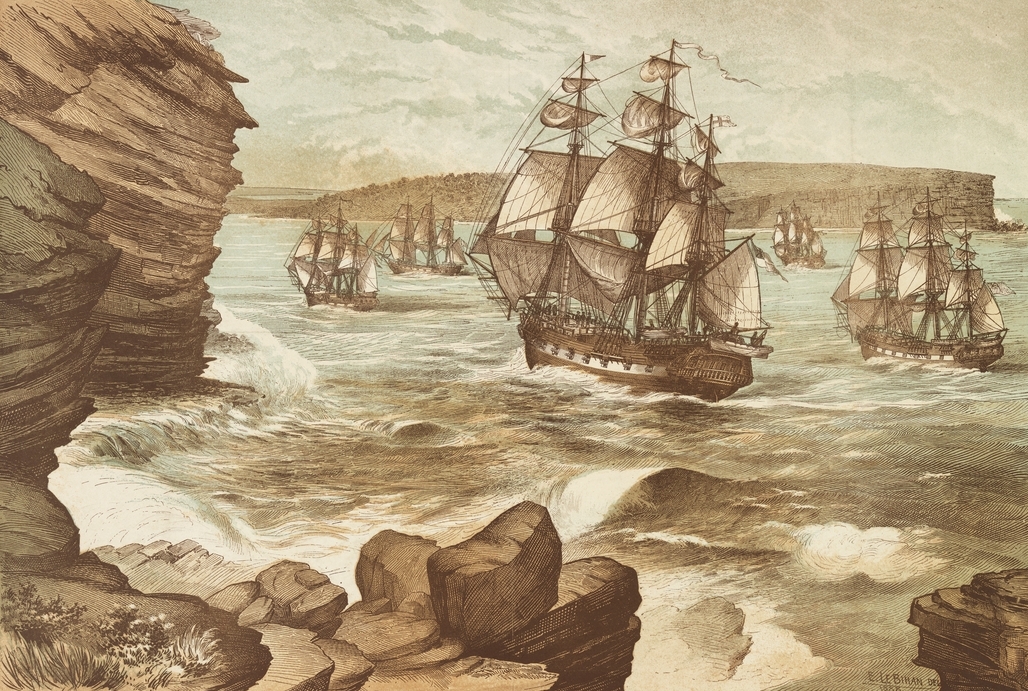
Colour lithograph of the First Fleet entering Port Jackson on January 26 1788, drawn in 1888.
Original by E. Le Bihan via Wikimedia Commons.
Liam Hemsworth and others are spruiking nonsense which is also being taught to school children as they protest against “invasion day”:
We are spiritually and culturally connected to this country.
This country was criss-crossed by generations of brilliant Nations.
Aboriginal and Torres Strait Islander people were Australia’s first explorers, first navigators, first engineers, first farmers, first botanists, first scientists, first diplomats, first astronomers and first artists.
Australia has the world’s oldest oral stories. The First Peoples engraved the world’s first maps, made the earliest paintings of ceremony and invented unique technologies. We built and engineered structures – structures on Earth – predating well-known sites such as the Egyptian Pyramids and Stonehenge.
Our adaptation and intimate knowledge of Country enabled us to endure climate change, catastrophic droughts and rising sea levels.
Always Was, Always Will Be. acknowledges that hundreds of Nations and our cultures covered this continent. All were managing the land – the biggest estate on earth – to sustainably provide for their future.This statement is a work of poorly written fiction. All humans are descended from ancestors that roamed Africa. At some stage – perhaps 50,000 to 60,000 years ago according to archaeological records – some Homo Sapiens (so far as we know, Homo Erectus do not appear to have migrated to the land mass now know as Australia) moved to this continent during the Pleistocene (ice age) when sea levels were much lower allowing transit without seafaring. Later the ice age abated, ice melted and the Australian continent became separate and its inhabitants isolated.
In Jared Diamond’s book Guns, Germs and Steel – the Fates of Human Societies, he argues that circumstances (pressure on resources etc) lead to innovations and changes to society. On Australia he wrote:
Australia is the sole continent where, in modern times, all native peoples still lived without any of the hallmarks of so-called civilization – without farming, herding, metal, bows and arrows, substantial buildings, settled villages, writing, chiefdoms or states. Instead Australian Aborigines were nomadic or semi-nomadic hunter-gatherers, organised into bands, living in temporary shelters or huts and still dependent on stone-tools. – (p. 297).
Compared with Native Australians, New Guineans rate as culturally “advanced” … most New Guineans … were farmers and swineherds. They lived in settled villages and were organised politically into tribes rather than as bands. All New Guineans had bows and arrows, and many used pottery. – (p. 297-8).
While New Guinea … developed both animal husbandry and agriculture, … Australia … developed neither. – (p. 308).
Isolated from other populations, and lacking little in the way of resources, Australia’s first inhabitants were not pressured into changing their ways of life and remained essentially hunter gatherers and nomadic societies. I make no judgement on whether this is good or bad, merely that despite the lack of competition over resources, life wasn’t always rosy and violence and skirmishes, murder and rape occurred as much among those humans as it did elsewhere.
It was inevitable that this isolation would not persist – it is perhaps surprising that it persisted as long as it did. But contact with other humans was inevitable and the outcome of that contact would be widely varying depending on whether the contact was made by the Portuguese, Spanish, Dutch, Chinese, British or others. The fact that Australia became a British colony is probably the best of the many alternatives that could have sprung from colonialisation. And we are all affected, mostly positively, by that contact – there would be few Aboriginal Australians (perhaps none) who today could say that they have no ancestry at all from settlers who arrived after 1787. We are all of mixed blood and we all descend from those original Homo Sapiens who evolved in Africa. It is time to talk about unity rather than division.
August 27, 2020
Margaret Murray’s highly influential The Witch-Cult in Western Europe
In First Things, Francis Young discusses the impact Murray’s work had when it was published in the 1920s:
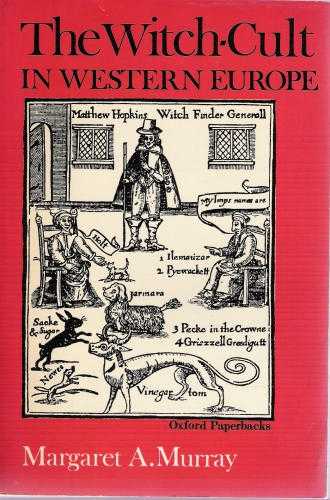
Just under a century ago, in 1921, one of the strangest books ever to be published by Oxford University Press appeared in print: The Witch-Cult in Western Europe by Margaret Alice Murray. By today’s academic standards — in fact, even by the standards of the 1920s — Murray’s book was filled with transparent flaws in methodology and research. Furthermore, the book’s author (a leading Egyptologist) was not qualified to write it. The few scholars then working on the history of European witchcraft dismissed Murray’s contribution. Yet in spite of this, The Witch-Cult in Western Europe became an instant hit and captured the imaginations of readers. Within three decades, the book had not only profoundly influenced cultural understandings of witchcraft, but also directly led to the rise of neopaganism and the foundation of a new religion, Wicca, that today has millions of adherents throughout the world.
Margaret Alice Murray (1863–1963) was born and brought up in British India — an upbringing that, as with so many Anglo-Indians of the nineteenth century, may have opened her mind to interests beyond Victorian culture. Determined to pursue a career of her own at a time when opportunities for women were limited, Murray tried out both nursing and social work before entering the progressive University College London in 1894, where she studied Egyptology under W. Flinders Petrie. Murray rapidly rose through the academic ranks, and by 1914, she was effectively running the Egyptology department. Her impressive achievements in advancing knowledge of ancient Egypt and higher education for women have, however, been largely overshadowed by her decision to take a detour into writing about European witchcraft.
In The Witch-Cult in Western Europe, Murray seized on some unusual testimonies in 16th-century Scottish witch trials to elaborate a radical theory: She claimed that what medieval and early modern people called witchcraft was, in fact, the last traces of a pagan fertility cult that originated in the Neolithic period. The witch trials of the 15th–17th centuries represented Christianity’s last attempt to stamp out this cult, which was practiced in secret covens (groups of thirteen people) who worshipped a horned god (who was mistaken for the devil). Knowledge of this cult was passed through families or, occasionally, to new initiates, but kept secret from the outside world.
Murray’s use of a single set of problematic sources from one country (Scotland) to argue that a previously unnoticed religion had existed since prehistory failed to meet basic historiographical and anthropological standards of research. She was given to making huge conceptual leaps on the basis of contentious interpretations of meager evidence. Using a small range of hostile trial records designed to discredit women accused of witchcraft (along with testimonies extracted under torture), Murray reconstructed what she believed were real religious practices lurking behind the demonological construct of the Witches’ Sabbath. In so doing, she brought together traditions of interpretation honed by the anthropologist Sir James Frazer (1854–1941), the author of The Golden Bough, and the French historian Jules Michelet (1798-1874). Murray followed Michelet in arguing that those accused of witchcraft were not the innocent victims of trumped-up charges, but were in fact adherents of a subversive cult; and she followed Frazer in her belief that prehistoric religious beliefs, associated with fertility, had survived into recent times.
August 18, 2020
QotD: Stigma
But in fact there is almost a law of conservation of stigma that operates in human societies, such that if it does not attach to one thing, it will attach to another. No doubt there is more stigma in shame societies than in guilt societies, but even in the latter everyone, except perhaps the most psychopathic of psychopaths, is afraid of being shown up in some respect or another.
Stigma begins early in life and children are much guided or influenced in their conduct by the fear of it. A teacher told me the following story. A child of about seven or eight came crying to her one day because another child had called him names.
“What did he say?” she asked.
“He called me a virgin.”
“What is a virgin?” asked the teacher,
“I don’t know,” said the boy. “But I know it’s something horrible.”
Stigma is a kind of shorthand to indicate what we detest. Anyone who pretends that he never stigmatises is probably lying, or perhaps I should say not telling the truth, since not every untruth that emerges from the human mouth is a lie. There are people who can contradict themselves without disbelieving in the law of non-contradiction, and therefore people who can genuinely despise people who pass moral judgment on others.
What would living completely without stigma and stigmatisation mean? Surely that there was nothing that we or anyone else could do to make people think badly of us. One of the reasons — I don’t say the only one — that I don’t steal is that I don’t want to be stigmatised as a thief. One sin doesn’t define a person’s character, however, so that when we stigmatise we must be careful to be just and proportionate. If we called everyone a liar who had told a lie, then we should all be liars (quite apart from the fact that it is sometimes virtuous to tell a lie). We call a liar someone who habitually lies, so that untruthfulness is a central part of his character.
Stigma is one of those many things that is neither good nor bad in itself, and depends for its social beneficence or maleficence on what it attaches to and how strongly. In the company of rogues or scoundrels, one can be stigmatised for honesty. Many a cruel act has been performed to avoid the stigma of being too cowardly to be cruel.
Theodore Dalrymple, “The Situational Nature of Scorn and Stigma”, New English Review, 2020-04-28.
July 7, 2020
QotD: The first invasion of Britain
Since then, 90 percent of subsequent skeletons in England reflect the DNA of the steppe invaders.
What happened to most of England’s earlier inhabitants? One of the less violent scenarios is that the steppe migrants introduced bubonic plague.
In general, “migration” and “mixture” tend in Reich’s book to serve as euphemisms for genocide of the native males and rape of the native females. Reich lists numerous examples from around the world where genetic data show that newcomers enslaved or murdered the local men and turned their women into concubines.
Fortunately, for the past 4,500 years, “ancient Britons harbored a blend of ancestries very similar to that of present-day Britons.” The Roman conquest didn’t leave much of a genetic mark, and the later Anglo-Saxon, Danish, and Norman invaders were genetically similar enough to earlier Britons that geneticists have only recently begun to disentangle them.
After 1066, the island race enjoyed a long halcyon era without new invaders raping and pillaging. But all good things evidently have to come to an end. As Benjamin Schwarz has pointed out, “In fact, Britain today receives more immigrants in a single year than it did in the entire period from 1066 to 1950.”
Steve Sailer, “Reich’s Laboratory”, Taki’s Magazine, 2018-03-28.
June 21, 2020
QotD: “[T]he fascinating modern science of high-tech grave robbing”
As Fitzgerald’s friend Hemingway ended The Sun Also Rises, “Isn’t it pretty to think so?”
But now the brilliant Harvard geneticist David Reich has published a bombshell scientific book, Who We Are and How We Got Here: Ancient DNA and the New Science of the Human Past, whose revelations would have been found congenial by a smarter version of Buchanan (such as Fitzgerald himself).
Despite Reich’s occasional need to stop his otherwise lucid narrative to spew irrational rage against his fellow race-science heretics such as James D. Watson, the genome expert conclusively demolishes the post-Boasian anthropologists’ conventional wisdom.
[…]
Reich learned the fascinating modern science of high-tech grave robbing from Svante Pääbo. This Swedish biologist invented the techniques for extracting from ancient skeletons their DNA. (Interestingly, the 1990 Native American Graves Protection and Repatriation Act makes it hard to get hold of ancient American Indian skeletons, but other races’ ancestors appear to be fair game.)
Reich applied to Pääbo’s breakthrough the traditional American knack for vast industrial scale. Assisted by English code-cracker Nick Patterson’s innovations in extracting meaning from bits and pieces of ancient genomes, Reich’s factory-like lab at the Broad Institute has been churning out a tsunami of papers on fascinating questions of prehistory.
Steve Sailer, “Reich’s Laboratory”, Taki’s Magazine, 2018-03-28.
May 19, 2020
QotD: Amour-propre
Really there is nothing new under the sun, and the concept comes much earlier from Saint Augustine of Hippo who in his City of God calls it in Latin, amor sui, and puts it about the centre of his review of human tawdriness. That, in turn, is how it came to Pascal: via the French Augustinians, with whom Pascal was in thick, about the time he was writing his Lettres provinciales. One might add, contre Rousseau (and perhaps with Joseph de Maistre) that it goes back farther, to Adam and Eve.
Ye devill appeals to Eve’s amour-propre. She then appeals to Adam’s. That’s how this whole wretched mess got started. Note that this couple predeceased all Rousseau’s noble savages, and that the field anthropologists have since discovered that the primitive tribal types are a lot like us. Which is to say, bad, in many colourful ways, and quite invariably self-regarding.
David Warren, “Amour-propre”, Essays in Idleness, 2016-06-01.


