Quotulatiousness

April 5, 2021

The 1919 Red Scare – the craziest year in American history

The Cynical Historian
Published 19 May 2016

Many people have heard of the first Red Scare, but we should look at the year of 1919 more thoroughly. It’s probably the craziest one in American history.

Ann Hagedorn, Savage Peace: Hope and Fear in America, 1919 (New York: Simon & Schuster Paperbacks, 2007). https://amzn.to/2NHIcaT
————————————————————
contribute to my Patreon:
https://www.patreon.com/CynicalHistorian

LET’S CONNECT:
https://twitter.com/Cynical_History
————————————————————
wiki:
The First Red Scare was a period during the early 20th-century history of the United States marked by a widespread fear of Bolshevism and anarchism, due to real and imagined events; real events included those such as the Russian Revolution. At its height in 1919–1920, concerns over the effects of radical political agitation in American society and the alleged spread of communism and anarchism in the American labor movement fueled a general sense of paranoia.

The Scare had its origins in the hyper-nationalism of World War I as well as the Russian Revolution. At the war’s end, following the October Revolution, American authorities saw the threat of Communist revolution in the actions of organized labor, including such disparate cases as the Seattle General Strike and the Boston Police Strike and then in the bombing campaign directed by anarchist groups at political and business leaders. Fueled by labor unrest and the anarchist bombings, and then spurred on by United States Attorney General A. Mitchell Palmer’s attempt to suppress radical organizations, it was characterized by exaggerated rhetoric, illegal search and seizures, unwarranted arrests and detentions, and the deportation of several hundred suspected radicals and anarchists. In addition, the growing anti-immigration nativism movement among Americans viewed increasing immigration from Southern Europe and Eastern Europe as a threat to American political and social stability.

Bolshevism and the threat of a Communist-inspired revolution in the U.S. became the overriding explanation for challenges to the social order, even such largely unrelated events as incidents of interracial violence. Fear of radicalism was used to explain the suppression of freedom of expression in form of display of certain flags and banners. The First Red Scare effectively ended in mid-1920, after Attorney General Palmer forecast a massive radical uprising on May Day and the day passed without incident.
————————————————————
Hashtags: #History #1919 #RedScare #SpanishFlu #Bolshevism #BlackSox #strikes #WoodrowWilson #LeagueOfNations #prohibition #suffrage

[Note: this was filmed in 2016 … I think 2020 has now taken the mantle of “craziest year”. Unless 2021 doubles down all the weirdness of 2020.]
August 14, 2020

“The End of the War to End All Wars” – The Great War – Sabaton History 080 [Official]

Filed under: Europe, History, Media, Military, USA, WW1 — Tags: , , , , , — Nicholas @ 04:00

Sabaton History
Published 13 Aug 2020

November 11, 1918. The end of the Great War. A war that was also dubbed “the war to end all wars”. And many truly wished that the war’s countless horrors, which had caused the terrible deaths of millions of soldiers and civilians, and had left so many of its survivors crippled and scarred for the rest of their lives, would never repeat themselves. But could this truly be the war that ended the need for war? Was there a solution that promised everlasting peace? Could war even be outlawed? Or was mankind doomed to repeat itself?

Support Sabaton History on Patreon: https://www.patreon.com/sabatonhistory

Listen to The Great War (where “The End of the War to End All Wars” is featured): https://music.sabaton.net/TheGreatWar

Watch the Official Lyric Video of The End of the War to End All Wars here: https://www.youtube.com/watch?v=oXnnb…

Listen to Sabaton on Spotify: http://smarturl.it/SabatonSpotify
Official Sabaton Merchandise Shop: http://bit.ly/SabatonOfficialShop

Hosted by: Indy Neidell
Written by: Markus Linke and Indy Neidell
Directed by: Astrid Deinhard and Wieke Kapteijns
Produced by: Pär Sundström, Astrid Deinhard and Spartacus Olsson
Creative Producer: Joram Appel
Community Manager: Maria Kyhle
Executive Producers: Pär Sundström, Joakim Broden, Tomas Sunmo, Indy Neidell, Astrid Deinhard, and Spartacus Olsson
Post-Production Director: Wieke Kapteijns
Edited by: Karolina Dołęga
Sound Editing by: Marek Kaminski
Maps by: Eastory – https://www.youtube.com/c/eastory
Archive by: Reuters/Screenocean https://www.screenocean.com
Music by Sabaton

Sources:
Icons from The Noun Project by: Vectors Point, Locad, Gan Khoon Lay, RF_Design & banjirolove
National Archives NARA
Library of Congress
Bundesarchiv
Bibliothèque nationale de France
Library of Scotland
Imperial War Museums:Q 43463, Q5733, HU 105641, Q 12363, HU 105641, Q 3117,Q 5733, Q 56637, IWM Q 10378, Q 3117,Q 86635, Q 23760, HU 110852, Q 7815, PST5277,
Archives of New Zealand
TRAJAN 117 from Wikimedia
Srg36 from Wikimedia
F l a n k e r from Wikimedia
Guilherme Paula from Wikimedia
Narodowe Archiwum Cyfrowe

An OnLion Entertainment GmbH and Raging Beaver Publishing AB co-Production.

May 30, 2020

The Spanish Flu Influenza Pandemic 1918 – 1920 I THE GREAT WAR 1920

The Great War
Published 29 May 2020

Sign up for Curiosity Stream and get Nebula bundled in: https://curiositystream.com/thegreatwar

It was far deadlier than even the global war that had preceded it: The Influenza pandemic or Spanish Flu that hit the world between 1918 and 1920 in multiple waves.

» SUPPORT THE CHANNEL
Patreon: https://www.patreon.com/thegreatwar
Merchandise: https://shop.spreadshirt.de/thegreatwar/

» SOURCES
Barry, John M. The Great Influenza: The Story of the Deadliest Pandemic in History, (New York : Penguin Books, 2018)
Byerly, Carol R. ‘The U.S. Military and the Influenza Pandemic of 1918–1919’ Public Health Reports; 125 Supplement 3 (Apr. 2010)
Crosby, Alfred W, America’s forgotten pandemic : the influenza of 1918, (Cambridge : Cambridge University Press, 2003)
Hoover, Irwin Hood, Forty-two years in the White House, (New York : Houghton Mifflin Co., 1934)
Killingray, David & Phillips, Howard, (eds.) The Spanish Influenza Pandemic of 1918-19: New Perspectives, (London : Routledge, 2011)
Johnson, NP & Mueller J, ‘Updating the accounts: global mortality of the 1918-1920 “Spanish” influenza pandemic’ Bulletin of the History of Medicine. 76(1) (Spring 2002)
Dock, Lavinia et al., History of American Red Cross Nursing (1922)
Macdonald L. The Roses of No Man’s Land. (London : Penguin Books, 1993)
Robertson, John Dill, ‘Spanish Influenza — The Flu’ The Public Health Journal Vol. 9, No. 10 (Oct 1918)
Rosner, David, ‘”Spanish flu, or whatever it is…”: The paradox of public health in a time of crisis’ Public Health Reports, 125 Supplement 3, (Apr. 2010)
Stanford University, ‘The Influenza Pandemic of 1918’ https://virus.stanford.edu/uda/
“Surgeon General’s Advice to Avoid Influenza”: Washington Evening Star, (Sept. 22, 1918)
Wever, Peter C & van Bergen, Leo, ‘Death from 1918 pandemic influenza during the First World War: a perspective from personal and anecdotal evidence’ Influenza Other Respiratory Viruses, 8(5), (Sept 2014)
https://www.lefigaro.fr/livres/2008/1…

» SOCIAL MEDIA
Instagram: https://instagram.com/the_great_war
Twitter: https://twitter.com/WW1_Series
Reddit: https://reddit.com/r/TheGreatWarChannel

»CREDITS
Presented by: Jesse Alexander
Written by: Jesse Alexander
Director: Toni Steller & Florian Wittig
Director of Photography: Toni Steller
Sound: Toni Steller
Editing: Toni Steller
Mixing, Mastering & Sound Design: http://above-zero.com
Maps: Daniel Kogosov (https://www.patreon.com/Zalezsky)
Research by: Jesse Alexander
Fact checking: Florian Wittig

Channel Design: Alexander Clark
Original Logo: David van Stephold

A Mediakraft Networks Original Channel

Contains licensed material by getty images
All rights reserved – Real Time History GmbH 2020

April 20, 2020

Understanding the Lost Cause Myth

Filed under: History, Politics, USA — Tags: , , , , — Nicholas @ 04:00

The Cynical Historian
Published 16 Apr 2020

The Lost Cause Myth has changed American history. Though it is a hateful ideology today, to ignore it is to give it power. We must understand the myth in order to defeat it.
————————————————————
Connected videos [see YouTube description for linked videos to parts of this discussion]
————————————————————
See pinned comment and its replies for references, notes, responses, and errata
————————————————————
Support the channel through PATREON:
https://www.patreon.com/CynicalHistorian

LET’S CONNECT:
Discord: https://discord.gg/Ukthk4U
Twitter: https://twitter.com/Cynical_History
Subreddit: https://www.reddit.com/r/CynicalHistory/
————————————————————
Wiki: The Lost Cause of the Confederacy, or simply the Lost Cause, is an American pseudo-historical, negationist ideology which holds the view that the cause of the Confederacy during the American Civil War was a just and heroic one. The ideology endorses the supposed virtues of the antebellum South, viewing the war as a struggle which was primarily waged in order to save the Southern way of life, or to defend “states’ rights”, in the face of overwhelming “Northern aggression.” At the same time, the Lost Cause minimizes or completely denies the central role of slavery in the buildup to and outbreak of the war.

Particularly intense periods of Lost Cause activity occurred around the time of World War I, as the last Confederate veterans began to die out and a push was made to preserve their memories, and they also occurred during the Civil Rights Movement of the 1950s and 1960s, in reaction to growing public support for racial equality. Through activities such as building prominent Confederate monuments and writing school history textbooks, they sought to ensure that future generations of Southern whites would know about the South’s “true” reasons for fighting the war, and support white supremacist policies, such as Jim Crow laws. In this manner, white supremacy is a characteristic of the Lost Cause narrative.

The Lost Cause narratives typically portray the Confederacy’s cause as a noble one and they also portray its leaders as exemplars of old-fashioned chivalry, who were defeated by the Union armies through numerical and industrial force that overwhelmed the South’s superior military skill and courage. Proponents of the Lost Cause movement also condemned the Reconstruction that followed the Civil War, claiming that it had been a deliberate attempt by Northern politicians and speculators to keep the South down. The Lost Cause theme has also evolved into a major element in defining gender roles in the white South, in terms of preserving family honor and chivalrous traditions. The Lost Cause has inspired numerous Southern memorials and religious attitudes.
————————————————————
Hashtags: #history #LostCause #Mythology

April 12, 2020

The Failed Start Of The League of Nations I THE GREAT WAR 1920

Filed under: Europe, History, Military, USA, WW1 — Tags: , , , , — Nicholas @ 04:00

The Great War
Published 10 Apr 2020

Sign up for Curiosity Stream and Nebula – and get 40% off annual plans right now: https://curiositystream.com/thegreatwar

The League of Nations was US President Woodrow Wilson’s tool for a new and peaceful world after the war of 1914-1918 — and the US should have been their most important member. But the United States never joined and today the League of Nations is often seen as a failure. Was it doomed from the start?

» SUPPORT THE CHANNEL
Patreon: https://www.patreon.com/thegreatwar
Merchandise: https://shop.spreadshirt.de/thegreatwar/

» SOURCES
“The Treaty of Peace with Germany (The Treaty of Versailles),” June 28, 1919, United States Statutes at Large, art. 1-440.

Walters, F.P. A History of the League of Nations. (Oxford, UK: Oxford University Press, 1952)

Link, Arthur et al., eds., The Papers of Woodrow Wilson, vol. 45 (1984)

Ray S. Baker and William E. Dodd, eds, The Public Papers of Woodrow Wilson: Authorized Edition, Vol. 1, (New York, 1924)

Matz, Nele, “Civilization and the Mandate System under the League of Nations as Origin of Trusteeship” in von Bogdandy, A and Wolfrum, R (eds.), Max Planck Yearbook of United Nations Law, Volume 9, 2005

Braumoeller, Bear F. “The Myth of American Isolationism”, Foreign Policy Analysis Vol. 6, No. 4 (OCTOBER 2010), pp. 349-371

“March 19, 1920: Senate Rejects Treaty of Versailles for Second and Final Time” New York Times, https://learning.blogs.nytimes.com/20… /march-19-1920-senate- rejects-treaty-of-versailles-for-second-and-final-time/

Egerton, George W, “The Lloyd George Government and the Creation of the League of Nations”, The American Historical Review, Vol. 79, No. 2 (Apr., 1974), pp. 419-444

Burkman, Thomas W. “Japan and the League of Nations: AN ASIAN POWER ENCOUNTERS THE ‘EUROPEAN CLUB'”, World Affairs, Vol. 158, No. 1, Woodrow Wilson and the League of Nations: Part Two (SUMMER 1995), pp. 45-57

Rappart, William E. “Small States in the League of Nations”, Political Science Quarterly Vol. 49, No. 4 (Dec., 1934), pp. 544-575

Cox, James Middleston, Journey Through My Years, (Simon & Schuster: New York, 1946)

“THE BRITISH EMPIRE, THE LEAGUE OF NATIONS, AND THE UNITED STATES”, Advocate of Peace through Justice, Vol. 82, No. 7 (JULY, 1920), pp. 229-231

Dorsey, Leeroy G, “Woodrow Wilson’s Fight for the League of Nations: A Reexamination”, Rhetoric and Public Affairs, Vol. 2, No. 1 (Spring 1999), pp. 107-135

“The Covenant of the League of Nations” AVALON PROJECT, Yale Law School, https://avalon.law.yale.edu/20th_cent…

“Woodrow Wilson’s 14 Points”, AVALON PROJECT, Yale Law School, https://avalon.law.yale.edu/20th_cent…

Riddell, George Allardice, The Riddell diaries, 1908-1923, (London ; Dover, N.H. : Athlone Press, 1986)

» SOCIAL MEDIA
Instagram: https://instagram.com/the_great_war
Twitter: https://twitter.com/WW1_Series
Reddit: https://reddit.com/r/TheGreatWarChannel

»CREDITS
Presented by: Jesse Alexander
Written by: Mark Newton, Jesse Alexander
Director: Toni Steller & Florian Wittig
Director of Photography: Toni Steller
Sound: Toni Steller
Editing: Toni Steller
Mixing, Mastering & Sound Design: http://above-zero.com
Maps: Daniel Kogosov (https://www.patreon.com/Zalezsky)
Research by: Jesse Alexander
Fact checking: Florian Wittig

Channel Design: Alexander Clark
Original Logo: David van Stephold

A Mediakraft Networks Original Channel

Contains licensed material by getty images
All rights reserved – Real Time History GmbH 2020

April 1, 2020

Woodrow Wilson (pt.2) | Historians Who Changed History

The Cynical Historian
Published 8 Feb 2018

This is the second part of a 2 part episode. The first covered Woodrow Wilson from his early years to the 1912 election. This episode is covering his presidency. I highly recommend you go see the previous one, because I’m going to refer to stuff in it a lot here.

They only allow 5 cards, so here are all the previous episodes referenced:
Wilson Part 1: https://youtu.be/Hm0Gzz53YJo
Birth of a Nation: https://youtu.be/zzsvOBjRXew
Philippine Insurrection: https://youtu.be/mmYk0xxjDDA
WWI causes: https://youtu.be/NTrk7XktTrc
WWI effects: https://youtu.be/G3vKUgoTghg
Border Wars: https://youtu.be/qs4Lp39Y8W8
Russian Intervention: https://youtu.be/1mC1bmzbgxY
1919 Red Scare: https://youtu.be/S4Pi2nYcYNw
————————————————————
[Full references in the YouTube description]

Support the channel through Patreon:
https://www.patreon.com/CynicalHistorian
or pick up some merchandise at SpreadShirt:
https://shop.spreadshirt.com/cynicalh…

LET’S CONNECT:
https://twitter.com/Cynical_History
————————————————————
Wiki:
The presidency of Woodrow Wilson began on March 4, 1913 at noon when Woodrow Wilson was inaugurated as President of the United States, and ended on March 4, 1921. Wilson, a Democrat, took office as the 28th United States president after winning the 1912 presidential election, gaining a large majority in the Electoral College and a 42 percent plurality of the popular vote in a four–candidate field. Four years later, in 1916, Wilson defeated Republican Charles Evans Hughes by nearly 600,000 votes in the popular vote and secured a narrow majority in the Electoral College by winning several swing states with razor-thin margins. He was the first Southerner elected as president since Zachary Taylor in 1848, and the first Democratic president to win re-election since Andrew Jackson in 1832.
————————————————————
Hashtags: #History #WoodrowWilson #PresidentWilson #KKK #BirthOfANation #Segregation #JimCrow #Wilsonianism #Interventionism #EspionageAct #SeditionAct

March 28, 2020

Woodrow Wilson (pt.1) | Historians Who Changed History

Filed under: History, Politics, USA — Tags: , , , , , — Nicholas @ 02:00

The Cynical Historian
Published 28 Dec 2017

Time to finally tell you why I’ve used Woodrow Wilson as a bit of a rhetorical punching bag. This is part 1 of a 2 part series. This part will cover his life and scholarship before the presidency. It’s going to be quite a trip. [References on YouTube description]

————————————————————

Support the channel through Patreon:
https://www.patreon.com/CynicalHistorian

LET’S CONNECT:
https://twitter.com/Cynical_History
————————————————————
Wiki:
Thomas Woodrow Wilson (December 28, 1856 – February 3, 1924) was an American statesman and academic who served as the 28th President of the United States from 1913 to 1921. A member of the Democratic Party, Wilson served as the President of Princeton University from 1902 to 1910 and then ran and was elected as a progressive Democrat to the office of Governor of New Jersey. Wilson’s victory in the 1912 presidential election made him the first Southerner elected to the presidency since Zachary Taylor in 1848. He also led the United States during World War I, establishing an activist foreign policy known as “Wilsonianism.” He was a major leader at the Paris [Versailles] Peace Conference in 1919, where he championed the proposed League of Nations. However, he was unable to obtain Senate approval for U.S. membership. After he suffered debilitating strokes in September 1919, his wife and staff members handled most of his presidential duties.
————————————————————
Hashtags: #History #WoodrowWilson #LostCause #historians #Princeton #biography

March 10, 2020

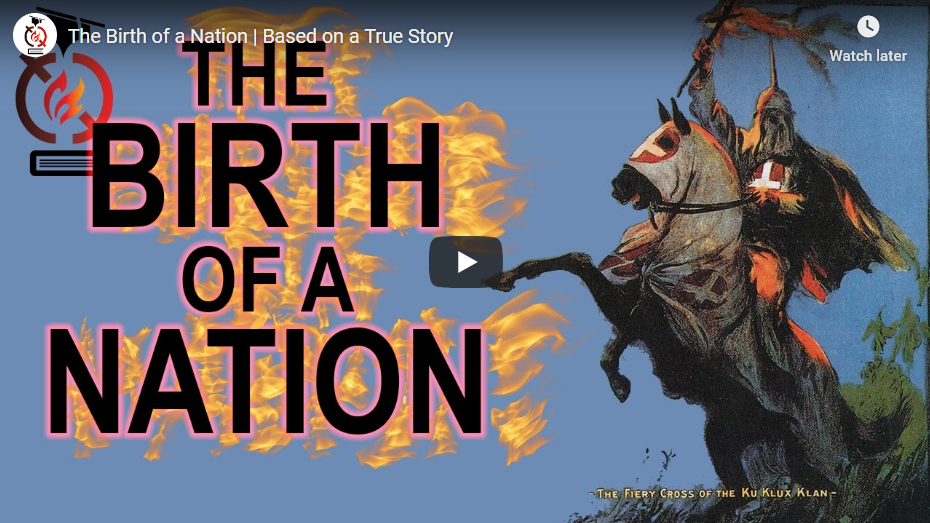
The Birth of a Nation | Based on a True Story

Filed under: History, Media, USA — Tags: , , , , , , — Nicholas @ 02:00

The Cynical Historian
Published 7 Oct 2016

The Birth of a Nation was the first major motion picture success, and because of its historical inaccuracy, the Ku Klux Klan was revived for another round of terror. This is the worst case of a “Based on a True Story” film. So today is a prime time to go into why it was so bad, and get some President Wilson bashing in.

Through YouTube’s cowardice, this video has been demonetized.
————————————————————
references:
Blee, Kathleen M. Women of the Klan: Racism and Gender in the 1920s. Berkeley: University of California Press, 1991. https://amzn.to/2NzeHbl

http://www.npr.org/sections/codeswitc…

https://en.wikipedia.org/wiki/The_Bir…
https://en.wikipedia.org/wiki/The_Cla…
https://en.wikipedia.org/wiki/Ku_Klux…
https://en.wikipedia.org/wiki/Reconst…
https://en.wikipedia.org/wiki/Woodrow…
https://en.wikipedia.org/wiki/1804_Ha…
https://en.wikipedia.org/wiki/Nat_Tur…
————————————————————
contribute to my Patreon:
https://www.patreon.com/CynicalHistorian

LET’S CONNECT:
https://twitter.com/Cynical_History
—————————————–
Wiki:
The Birth of a Nation (originally called The Clansman) is a 1915 American silent epic drama film directed and co-produced by D. W. Griffith and starring Lillian Gish. The screenplay is adapted from the novel and play The Clansman, both by Thomas Dixon Jr. Griffith co-wrote the screenplay (with Frank E. Woods), and co-produced the film (with Harry Aitken). It was released on February 8, 1915.

Three hours long, the film was originally presented in two parts separated by an intermission; it was the first 12-reel film in America. The film chronicles the relationship of two families in the American Civil War and Reconstruction era over the course of several years: the pro-Union Northern Stonemans and the pro-Confederacy Southern Camerons. The assassination of President Abraham Lincoln by John Wilkes Booth is dramatized.

The film was a commercial success, though it was highly controversial for its portrayal of black men (many played by white actors in blackface) as unintelligent and sexually aggressive towards white women, and the portrayal of the Ku Klux Klan (KKK) (whose original founding is dramatized) as a heroic force. There were widespread African-American protests against The Birth of a Nation, such as in Boston, while thousands of white Bostonians flocked to see the film. The NAACP spearheaded an unsuccessful campaign to ban the film. Griffith’s indignation at efforts to censor or ban the film motivated him to produce Intolerance the following year.

The film’s release is also credited as being one of the events that inspired the formation of the “second era” Ku Klux Klan at Stone Mountain, Georgia, in the same year. The Birth of a Nation, along with the trial and lynching of Leo Frank for the 1913 murder of Mary Phagan in Atlanta, was used as a recruiting tool for the KKK. Under President Woodrow Wilson, it was the first American motion picture to be screened at the White House.

Griffith’s innovative techniques and storytelling power have made The Birth of a Nation one of the landmarks of film history. In 1992, the United States Library of Congress deemed the film “culturally, historically, or aesthetically significant” and selected it for preservation in the National Film Registry.
————————————————————
Hashtags: #History #BirthOfANation #KKK #Review #BasedOnATrueStory #WoodrowWilson #DWGriffith

January 12, 2020

QotD: Progressive snobbery is part of the kink

Filed under: Government, Media, Politics, Quotations, USA — Tags: , , , , , — Nicholas @ 01:00

Do they really hate ordinary people that much?

Yes, they do. For liberals, the distinction between the “dumb masses” and their enlightened selves renders life meaningful. Disdain for ordinary folks is not just an ancillary trait of liberalism. It is fundamental to the its nature.

At its heart, liberalism is a gnostic religion, and the essence of that religion is the believer’s faith that he possesses the means of changing the world for the better. The belief that the world must be changed requires there to be a mass of individuals whose lives are in need of change. Following this logic, it is the liberal, not those deplorables in need of change, who knows what must be changed. For liberals, there must be a mass of people in need of this knowledge for life to make sense.

Above all, liberalism is a hubristic faith. Its followers share the fatal flaw of pride in their own intellectual capacity. This is why liberalism appeals so strongly to those in the knowledge trades: teachers, journalists, writers, psychologists, and social workers. The sense of “knowing more than others” is its strongest attraction – particularly to the young, who otherwise know so little. Liberalism confers, or seems to confer, almost immediate power and authority to those who embrace it.

The left’s obsession with superior knowledge runs through its entire history. As Woodrow Wilson remarked, the “instrument” of political science “is insight. A nice understanding of subtle, unformulated conditions.” Lyndon B. Johnson thought “a president’s hardest task” is “to know what is right.” And the most hubristic of all is Obama’s “We are the ones we’ve been waiting for.” Yes, we are wonderfully bright, and we’ve been waiting eons for ourselves to appear.

Jeffrey Folks, “Leftists versus the People”, American Thinker, 2018-02-24.

December 21, 2019

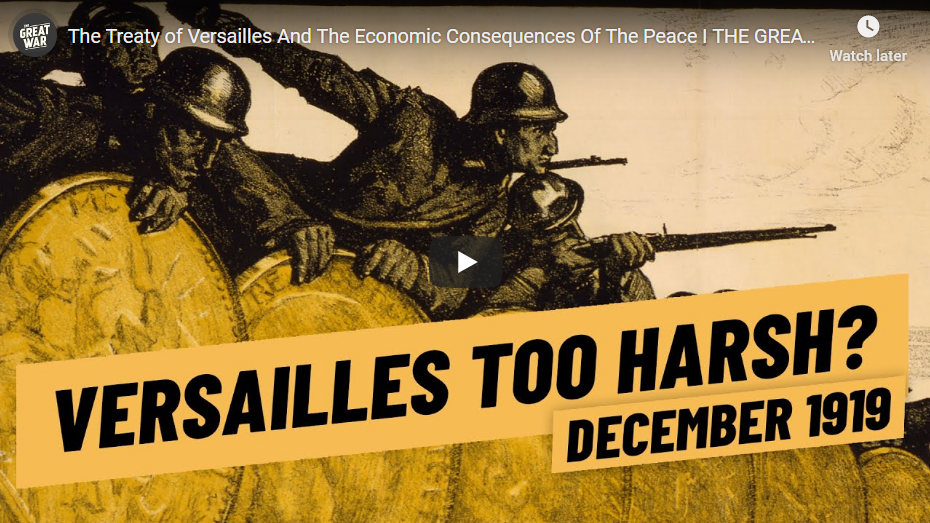
The Treaty of Versailles And The Economic Consequences Of The Peace I THE GREAT WAR 1919

Filed under: Books, Economics, Germany, History, USA, WW1 — Tags: , , , , , , — Nicholas @ 06:00

The Great War
Published 19 Dec 2019

Help The Great War and keep it free for everyone: https://patreon.com/thegreatwar

John Maynard Keynes was an economist and part of the Paris Peace Conference in 1919. He had high hopes for a new post-war order but when he realized what Georges Clemenceau, David Lloyd-George and Woodrow Wilson were planning, he resigned from the conference. And then wrote a book about it: The Economic Consequences of the Peace became a bestseller and is one of the best known critiques of the Versailles Treaty.

» SUPPORT THE CHANNEL
Patreon: https://www.patreon.com/thegreatwar
Merchandise: https://shop.spreadshirt.de/thegreatwar/

» SOURCES
Demps, Lorenz and Materna, Ingo (eds.). Geschichte Berlins von den Anfängen bis 1945. Berlin, 1987.
Eichengreen, Barry. Golden Fetters. The Gold Standard and the Great Depression 1919-1939. New York 1995.
Horn. Britain, France and the Financing of the First World War, 2002.
Hudson, Michael. Trade, Development, and Foreign Debt: Volume 2. Pluto Press, London, 1992.
Hudson, Michael. Superimperialism: The Origins and Fundamentals of U.S. World Dominance. Pluto Press, London 2003.
Keynes, John Maynard. The Economic Consequences of the Peace. Harcourt, Brace and Howe, New York, 1919.
Kinzer, Stephen. The True Flag: Theodore Roosevelt, Mark Twain, and the Birth of American Empire. St. Martin’s Griffin, 2018
Shirer, The Rise and Fall of the Third Reich. 1960.
Skidelsky, Robert. John Maynard Keynes, 1883-1946: Economist, Philosopher, Statesman. Penguin Books, New York, New York, 2003.
Skidelsky, Robert. John Maynard Keynes Volume I — Hopes Betrayed. Penguin Books, New York, 1983.

»CREDITS
Presented by: Jesse Alexander
Written by: Mark Newton
Director: Toni Steller & Florian Wittig
Director of Photography: Toni Steller
Sound: Toni Steller
Editing: Toni Steller
Mixing, Mastering & Sound Design: http://above-zero.com
Maps: Daniel Kogosov (https://www.patreon.com/Zalezsky)
Research by: Jesse Alexander
Fact checking: Florian Wittig

Channel Design: Alexander Clark
Original Logo: David van Stephold

A Mediakraft Networks Original Channel

Contains licensed material by getty images
All rights reserved – Real Time History GmbH 2019

December 10, 2019

In praise of Warren Gamaliel Harding

Filed under: History, Politics, USA — Tags: , , , , — Nicholas @ 03:00

At Essays in Idleness, David Warren says nice things about an American president who rarely gets any love from historians:

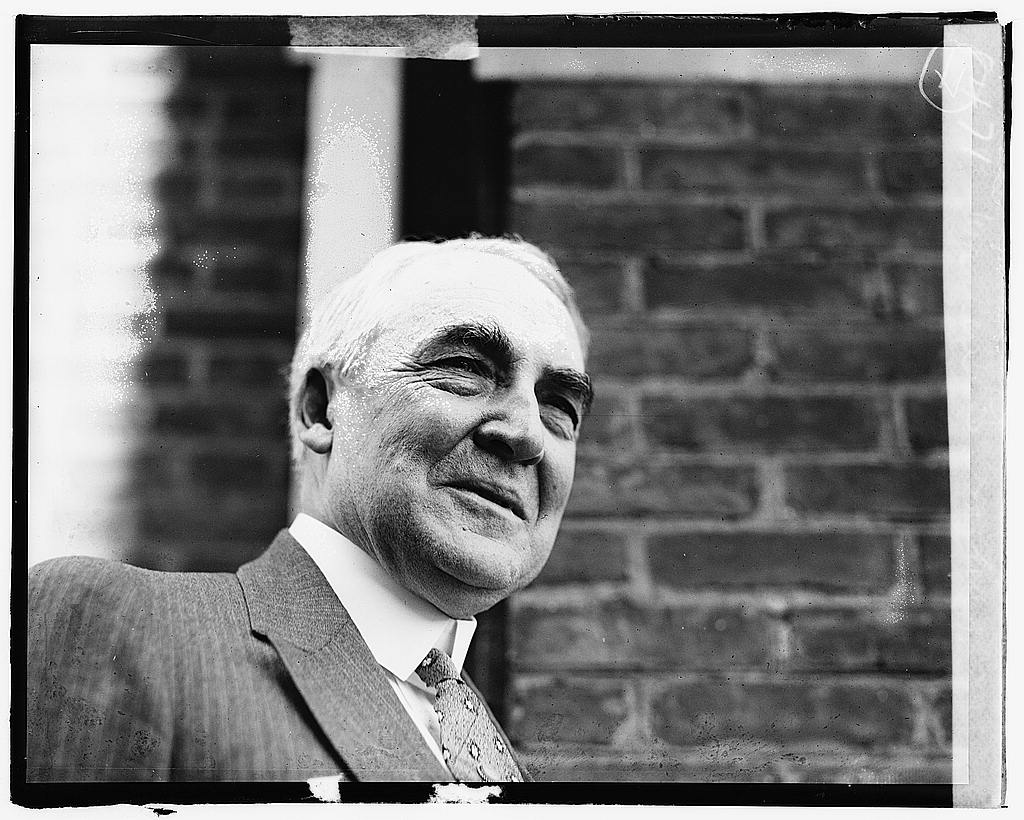
Warren G. Harding, 14 June 1920.
Library of Congress control number 2016828156

Like most politicians, W. G. Harding was only semi-literate, yet well above the average. The Ivy League types are still querying his use of “normalcy,” which the Natted States president used during his election campaign of 1920. Harding himself ranks low in the polls of “Great American Presidents,” though he was quite popular until his death. That mistake, committed after a heart attack in San Francisco, anno 1923, was the first of several. It was discovered that his administration had been rather corrupt, and himself guilty of an adultery. One might say he was “impeached,” posthumously. Today, they impeach Republican presidents for breathing.

Warren Gamaliel Harding is naturally among my favourite presidents. This has something to do with his “return to normalcy.” For the better part of a decade, his countrymen had suffered under the ministrations of progressive Democrats, such as the unspeakable Woodrow Wilson, and from such foreign entanglements as the First World War. The federal budget was being blown to heck, and society was on the verge of the Jazz Age.

Harding, who stayed home in Marion, Ohio, for most of his presidential campaign — rather than “pressing the flesh” and risking the influenza — won by a landslide, promising: “Not heroics, but healing; … not revolution, but restoration; not agitation, but adjustment; not surgery, but serenity; not the dramatic, but the dispassionate; not experiment, but equipoise; not submergence in internationality, but sustainment in triumphant nationality.”

Oh yes and, “not nostrums, but normalcy.”

The quote, which I have filched from the Wicked Paedia, is semi-literate throughout. Harding was a man who had an unhealthy relationship with a dictionary, and to his other sins, we must add an addiction to semi-colons. Still, “The Peeple” could guess what he meant. He wanted America to move backwards. He thought the whole country should forget about recent lunatic adventures, and return to her wonted calm.

Al Stewart wrote a song called “Warren Harding” (lyrics here):

June 30, 2019

Woodrow Wilson and the Versailles Treaty

Filed under: Europe, History, Politics, USA, WW1 — Tags: , , , , — Nicholas @ 05:00

Michael Filozof on the hundred-year anniversary of the Treaty of Versailles and the American President who had so much to do with the casting of the treaty:

Eight months after committing troops to war, Wilson cobbled together a list of progressive war aims in his Fourteen Points. They demanded an end to secret deals (i.e., the Treaty of London and the Sykes-Picot Agreement); “ethnic self-determination” for Poland and Austro-Hungarian territories that would soon become Yugoslavia and Czechoslovakia; “a free, open-minded, and absolutely impartial adjustment of all colonial claims,” and finally, a collective security organization, the League of Nations, which would be formed by a “covenant” (using the biblical term for a pact with God Himself) to maintain peace and territorial security of all nations.

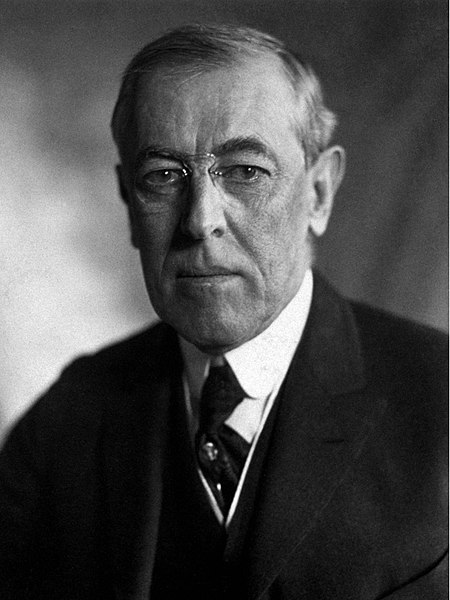
Woodrow Wilson, 1919
Photo via Wikimedia Commons.

Upon reading the Fourteen Points, French prime minister George “the Tiger” Clemenceau is said to have sniggered, “God gave us only ten.”

In 1919, Wilson became the first sitting president to venture overseas, practically abandoning his domestic duties and spending six months at the Paris Peace Conference personally negotiating the Treaty of Versailles. He was joined by “The Inquiry,” a group of over 100 academics and professors who surely knew how to fix the world and usher in Wilson’s global utopia.

Initially, Wilson and his Fourteen Points were wildly popular. He was greeted as if he were a latter-day rock star in France and Italy. Delegations from ethnic groups around the world came to Paris to beg Wilson for “self-determination.” (His French and British counterparts, Clemenceau and David Lloyd George, sneered that Wilson “thought he was Jesus Christ.”)

But they were soon to be disappointed. Wilson’s aims were so grandiose that they could not possibly be fulfilled. Italians, who had switched sides in the war to gain territory on the Dalmatian coast, became disillusioned when Wilson refused to accede to Italian demands. The negotiators did create Poland, Czechoslovakia, and Yugoslavia, but all three were destined to become communist dictatorships, and the latter two failed to outlast the twentieth century.

Worst of all was Wilson’s hypocrisy when it came to dealing with Germany. Wilson had railed against German imperialism, but turned a blind eye to the biggest empire at the Conference: Great Britain. A pro-British bigot, Wilson was contemptuous of Irish demands for self-determination and had been disgusted by the Easter Rising of 1916. Wilson granted Britain and France Ottoman territories they had secretly agreed to divvy up in the Sykes-Picot agreement — not as “colonies,” but under the guise of League of Nations “mandates.” He willingly partitioned Germany into two non-contiguous territories, separated by the Polish Corridor, and placed millions of ethnic Germans in the newly created nation of Czechoslovakia and the Free City of Danzig.

On a slightly lighter note, Al Stewart’s “A League of Notions” does a wonderful job of capturing the machinations at Versailles:

May 29, 2019

US Soldiers Fighting in Russia – The End of the “Polar Bear Expedition” I THE GREAT WAR May 1919

Filed under: History, Military, Russia, USA, WW1 — Tags: , , , , — Nicholas @ 06:00

The Great War
Published on 28 May 2019

The so called Allied intervention into the Russian Civil War suffered from no clear operational goals and mandate and when US President Woodrow Wilson pulled out the American soldiers that were fighting in Northern Russia in May 1919, the operation suffered another setback. Public pressure against US foreign intervention was increasing now that Germany had been beaten and many people didn’t understand what American soldiers were doing in Russia anyway. At the same time Winston Churchill and his supporters maintained that it was vital to defeat the Bolsheviks in Russia once and for all.

» SUPPORT THE CHANNEL
Patreon: https://www.patreon.com/thegreatwar
Merchandise: https://shop.spreadshirt.de/thegreatwar/

» SOURCES
Crownover, Roger. The United States Intervention in North Russia, 1918-1919: The Polar Bear Odyssey. Edwin Mellen Press, 2001.

Wright, Damien. Churchill’s Secret War With Lenin: British and Commonwealth Military Intervention in the Russian Civil War, 1918-20, Helion and Company, 2017

Long, John W. “American Intervention in Russia: the North Russian Expedition, 1918-1919,” in Arthur Dudden, ed. American empire in the Pacific: from trade to strategic balance 1700 – 1922 (Aldershot: Ashgate, 2004): 321-344.

Mawdsley Evan. The Russian Civil War, Pegasus Books, 2019

Moore, Joel. The History of the American Expedition Fighting the Bolsheviki Campaigning in North Russia 1918-1919 (1920)

»CREDITS
Presented by: Jesse Alexander
Written by: Jesse Alexander
Director: Toni Steller & Florian Wittig
Director of Photography: Toni Steller
Sound: Toni Steller
Editing: Toni Steller
Mixing, Mastering & Sound Design: http://above-zero.com
Motion Design: Christian Graef – GRAEFX
Maps: Daniel Kogosov (https://www.patreon.com/Zalezsky)
Research by: Jesse Alexander
Fact checking: Florian Wittig

Channel Design: Alexander Clark
Original Logo: David van Stephold

A Mediakraft Networks Original Channel

Contains licensed material by getty images
All rights reserved – Real Time History GmbH 2019

January 4, 2019

The US Turns Away from the World to Prohibition and Crime I Between 2 Wars I 1921 Part 1 of 2

TimeGhost History
Published on 3 Jan 2019

After an unpopular war and facing unrest at home, the US returns to isolationism after half a century of gradually opening up to the world. On the home front, prohibition gives rise to more problems of the very kinds it meant to solve; crime and debauchery, and one the biggest crooks is in the White House.

Join us on Patreon: https://www.patreon.com/TimeGhostHistory

Hosted by: Indy Neidell
Directed by: Spartacus Olsson
Written by: Spartacus Olsson and Rune Væver Hartvig
Produced by: Astrid Deinhard
Executive Producers: Bodo Rittenauer, Astrid Deinhard, Indy Neidell, Spartacus Olsson
Edited by Wieke Kapteijns

Thumbnail depicts US President Warren G. Harding as in his official presidential portrait.

Video Archive by Screenocean/Reuters http://www.screenocean.com

A TimeGhost chronological documentary produced by OnLion Entertainment GmbH

From the comments:

Now… before all you modern liberals and modern conservatives get your panties in a bunch; listen carefully to what Indy says in this video this is not about right or left wing politics in the modern sense, and this video is not about 2018 any parallels you infer to today will by force be way, way off the mark, the world of the 1920s was a very different place. If you have the desire to draw parallels to today we can’t stop you (we disagree on principle, but hey), in any case we’re not telling this part of American history for that reason, this is just the way it happened and we have to cover these events and movements to understand yet another little piece of the puzzle that was laid as the foundation for World War Two.

December 17, 2018

QotD: Woodrow Wilson’s repressive regime

Filed under: History, Liberty, Quotations, USA, WW1 — Tags: , , , , — Nicholas @ 01:00

Not surprisingly, such intellectual kindling was easy to ignite when World War I broke out. The philosopher John Dewey, New Republic founder Herbert Croly, and countless other progressive intellectuals welcomed what Mr. Dewey dubbed “the social possibilities of war.” The war provided an opportunity to force Americans to, as journalist Frederick Lewis Allen put it, “lay by our good-natured individualism and march in step.” Or as another progressive put it, “Laissez faire is dead. Long live social control.”

With the intellectuals on their side, Wilson recruited journalist George Creel to become a propaganda minister as head of the newly formed Committee on Public Information (CPI).

Mr. Creel declared that it was his mission to inflame the American public into “one white-hot mass” under the banner of “100 percent Americanism.” Fear was a vital tool, he argued, “an important element to be bred in the civilian population.”

The CPI printed millions of posters, buttons, pamphlets, that did just that. A typical poster for Liberty Bonds cautioned, “I am Public Opinion. All men fear me!… [I]f you have the money to buy and do not buy, I will make this No Man’s Land for you!” One of Creel’s greatest ideas – an instance of “viral marketing” before its time – was the creation of an army of about 75,000 “Four Minute Men.” Each was equipped and trained by the CPI to deliver a four-minute speech at town meetings, in restaurants, in theaters – anyplace they could get an audience – to spread the word that the “very future of democracy” was at stake. In 1917-18 alone, some 7,555,190 speeches were delivered in 5,200 communities. These speeches celebrated Wilson as a larger-than-life leader and the Germans as less-than-human Huns.

Meanwhile, the CPI released a string of propaganda films with such titles as The Kaiser, The Beast of Berlin, and The Prussian Cur. Remember when French fries became “freedom fries” in the run-up to the Iraq war? Thanks in part to the CPI, sauerkraut become “victory cabbage.”

Under the Espionage Act of 1917 and the Sedition Act of 1918, Wilson’s administration shut down newspapers and magazines at an astounding pace. Indeed, any criticism of the government, even in your own home, could earn you a prison sentence. One man was brought to trial for explaining in his own home why he didn’t want to buy Liberty Bonds.

The Wilson administration sanctioned what could be called an American fascisti, the American Protective League. The APL – a quarter million strong at its height, with offices in 600 cities – carried government-issued badges while beating up dissidents and protesters and conducting warrantless searches and interrogations. Even after the war, Wilson refused to release the last of America’s political prisoners, leaving it to subsequent Republican administrations to free the anti-war Socialist Eugene V. Debs and others.

Jonah Goldberg, “You want a more ‘progressive’ America? Careful what you wish for: Voters should remember what happened under Woodrow Wilson”, Christian Science Monitor, 2008-02-05.

« Newer PostsOlder Posts »

Powered by WordPress