
Taking a wild-ass guess (because that’s the best I can do), I imagine any Intelligence Service is going to bat below the Mendoza Line, because the Enemy gets a vote, too — when his best and brightest are doing their best to fool your guys, it’s certain your guys are going to get fooled a lot.
There’s also another version of the Historian’s Fallacy in play with Intelligence work:
The historian’s fallacy is an informal fallacy that occurs when one assumes that decision makers of the past viewed events from the same perspective and having the same information as those subsequently analyzing the decision. It is not to be confused with presentism, a similar but distinct mode of historical analysis in which present-day ideas (such as moral standards) are projected into the past. The idea was first articulated by British literary critic Matthew Arnold in 1880 and later named and defined by American historian David Hackett Fischer in 1970.
Things that seem obvious in retrospect weren’t at the time. That’s the “formal” Historian’s Fallacy, if you like. But there’s another one, that we could call the “Narrative Fallacy” or the “Assumed Rationality Fallacy” or something (I stink at titles). Historians are, or at least should be, acutely sensitive to the danger of seeing patterns that aren’t really there (in a very real sense, “conspiracy theorists” e.g. McGowan are just Historians manqué. Coincidences are coincidental, and without training and practice and — crucially — an experienced hand to smack you upside the head for going farther than the available sources allow, it’s easy to run wild with them. So-and-So knew Joe Blow … yes, but that does not automatically mean that So-and-So conspired with Joe Blow).
Compounding it further: It’s indeed rational to assume rationality on your enemies’ part, so some catastrophic intelligence “failures” have come because analysts were unwilling to acknowledge that the enemy was, in fact, making a mistake. It’s a bit pricey, but I highly recommend James Wirtz’s The Tet Offensive: Intelligence Failure in War (here’s a preview page of a review at JSTOR, which points to a trade journal, American Intelligence Journal. Wirtz is a professor at the Naval Postgraduate School; I bet his book rattled a lot of cages that needed rattling). Breaking it out a bit further, and these categories are mine, not Wirtz’s:
In the case of Tet, there was top-level structural “failure” that hardly deserves the term “failure” — the NVA’s intelligence boys were no fools; they were bright guys doing their damnedest to put one over on the American intelligence crew, and they had some success at it. That’s only “failure” in the sense that in binary system, a win for them is a loss for you — you “failed” to win the game against a highly skilled, highly motivated opponent. The Americans didn’t fail to recognize that The Enemy Gets a Vote; they just didn’t realize how he’d voted.
But there was what I’ll call “Narrative” failure, and that’s all on the Americans. They seem to have decided that the North Vietnamese were not only losing the war, but knew themselves to be losing the war. So what the North Vietnamese saw as merely “the next phase of the plan”, the Americans saw as “increasing desperation”. Which led to other Narrative Failures. I might be misremembering the details, so check me on this, but I believe that the Americans were correct despite themselves about the attack on the big Marine base at Khe Sanh — it was indeed a diversion. But the Americans somehow concluded that it was a diversionary attack, specifically a “spoiling attack”, on something the NVA shouldn’t have known about in the first place — a top secret operation called “Muscle Shoals” (in Wiki under Operation Igloo White).
In reality, the Khe Sanh attack was a diversion against the main Tet operation, and it worked so well that it took a week or more, IIRC, for Westmoreland to come around. He insisted on interpreting the Tet “uprising” as yet a further diversion — a diversion in support of what he assumed was the main NVA operation, the attack on Khe Sanh!
Those are Narrative Failures. Twitter didn’t exist then, but we could nowadays profitably call them “Twitter Failures”. Whatcha gonna believe, your own lying eyes or the blue checkmarks in the Pocket Moloch?
All of which was aided and abetted by the third kind of failure, that “Assumed Rationality” failure. One CIA analyst, Joseph Hovey, not only predicted the Tet Offensive, but got large parts of it exactly right. But Hovey had a hard time believing his own analysis, because its central assumption was that the North Vietnamese were, in fact, making a mistake. The North Vietnamese did not, in fact, have the forces in place to do what they wanted to do. They were suffering a catastrophic Narrative Failure of their own, one endemic (it seems reasonable to say) to Communist regimes — since political officers are highly encouraged to submit exaggerated reports of unit strength and morale (and often lethally discouraged from reporting the opposite), the NVA thought they had far more, and far better prepared, forces than they actually did.
In an Alanis-level irony, US military intelligence had a better idea of the NVA’s strength than the boys in Hanoi did. (They confirmed this, in fact, when they nabbed a high-level NVA defector, who only “rallied” because the formation he was sent south to lead didn’t actually exist!). When faced with the possible conclusion that the Enemy is about to make a big mistake, it’s only rational to assume that something else is going on. Hovey knew that, of course, and that’s one of the main reasons his analysis went nowhere — being a conscientious professional, he noted at the outset that his analysis was premised on the NVA setting up to make a big mistake, which seemed extremely unlikely.
Given all that, if I had to guess, I’d bet that the KGB had a similar record, if the truth is ever known, because they had similar problems. They had a different, more systematic kind of Narrative Failure, I’d imagine — “Marxism-Leninism” vs. “bow-tied Ivy Leaguers running around cosplaying Lawrence of Indochina” — but it probably all washed out in the end. It’d be extremely interesting to hear about the Vietnam War from the KGB’s side …
Severian, “Friday Mailbag”, Founding Questions, 2023-04-15.
July 8, 2025
June 26, 2025
QotD: Credentialism versus meritocracy
Harvard’s motto is “Veritas” — truth — but it ought to be “ludificationes pertinet“, which the internet informs me is how you say “delusions of competence” in Latin. I meant it when I said that the “Ministry of Talent”, as these jerkoffs unironically called themselves, actually had some serious brainpower and real accomplishments … but the Peter Principle is also true, and though they had some real brains and actual accomplishments, neither their brains nor their accomplishments at Harvard translated to anything out in the real world, any more than some Late Republic social climber’s “experience” as curule aedile translated to anything real in their world.
Just as the Roman Senate had no idea how to deal with a Julius Caesar, then, despite it all, so no American “leader” had any idea how to deal with a guy like Ho Chi Minh, even though he, like Caesar, had always been perfectly open and forthright about what he was doing and why. It never occurred to “the best and brightest” to even ask the question “What does Ho Chi Minh want?”, because after all, Ho Chi Minh wasn’t a Harvard man.
And all this was 60 years ago. These days, the AINO cursus honorum is so widespread that every kid who manages to fill out a college app has a resume that would give McGeorge Bundy an erection lasting more than four hours. You’ll have to trust me on this, I guess, but I wouldn’t be surprised to learn that Flyover State — which is respectable but rinky-dink; the kind of outfit where you see their team losing a late December bowl game and you think “Gosh, I guess that state has a third college in it” — had several hundred student organizations …
… all of which seem to exist for no other reason than to have “officers”, to which these little social climbers can be “elected”, the better to pad their law, med, and grad school apps. By the end of my career, probably 3/4 of the students who ever sent me an email had an auto-signature on it, and that auto-signature was longer than my entire CV. President of this, Vice-Treasurer of that, Assistant Grand Poobah (junior grade) of the other thing. Grandpa Simpson was a piker compared to these kids:
I’m an Elk, a Mason, a Communist. I’m the president of the Gay and Lesbian Alliance for some reason. Ah, here it is. The Stonecutters!
Instead of giving potential movers and shakers some practical experience, our modern cursus honorum casts the widest possible net for sociopathy. McGeorge Bundy is your absolute best case scenario. He wasn’t actively evil; he was just a goofy egghead who thought he was way smarter and more accomplished than he actually was, because he’d never been in a position to find out otherwise. (An anecdote that tells you everything you need to know, courtesy of Wikipedia: “When applying to Yale, Bundy wrote on the entrance exam ‘This question is silly. If I were giving the test, this is the question I would ask, and this is my answer.’ Despite this, he was still admitted to Yale as he was awarded a perfect score on his entrance exam”).
Think about that the next time you go to the doctor. Even if your MD — or, much more likely these days, PA — isn’t a prize graduate of Bollywood Upstairs Medical College, xzhey most likely spent xzheyr college years as an Elk, a Mason, a Communist …
Your worst case scenario is, of course, another Caesar. A fake and gay one, it goes without saying — this being Clown World — but a fake and gay Caesar can still do tremendous damage, because they’re the worst of both worlds: Bundy-level goofs, and angry ethnic sociopaths with huge chips on their shoulders. These are the kids who have been “team leads” doing “original research” since about age 12. Not only have they never failed, they’ve never been exposed to the merest hint of the possibility of failure. All their “success” is theirs by right. They have Caesar’s vaulting ambition, his utter disregard for tradition, his absolute cutthroat ruthlessness … and none of his experience, to say nothing of his competence.
Severian, “Cursus Honorum”, Founding Questions, 2021-12-27.
May 15, 2025
Inventing “American Bushido“
Secretary of Defense Rock identifies where this new military cult came from:
In the decades since the end of the Cold War, the United States military has undergone a cultural transformation — not merely in terms of technology, doctrine, or geopolitical posture, but in its self-conception. What has emerged is a new martial identity, one that fuses an idealized warrior code with fetishized notions of lethality and tactical superiority. This identity, what might be termed an “American Bushido“, is not merely a rhetorical or symbolic phenomenon. It is an ideological formation with material consequences for how wars are planned, how personnel are trained and selected, and how national security strategy is interpreted through the narrow prism of combat prowess. At its core, this American Bushido enshrines tactical skill and lethal capacity as ends in themselves, rather than as tools in service of coherent political objectives. But has also branched out more broadly into American society in unhealthy ways, corroding civic culture. This elevation of the warrior ethos risks distorting strategic judgment, encouraging a professional military caste isolated from civilian oversight, and glorifying violence as the central expression of national power at home and abroad.
The concept of Bushido, the feudal Japanese code of honor among the samurai, was historically a synthesis of martial discipline, spiritual rectitude, and absolute loyalty.1 In the twentieth century, however, Imperial Japan weaponized Bushido as state propaganda stripping it of nuance and repurposing it to justify fanatical nationalism, unquestioning obedience, and mass sacrifice in the service of empire leaving a trail of destruction and war crimes that rivaled Nazi Germany in World War II.2 On the tactical level, that meant banzai charges into machine gun fire and kamikaze missions that turned pilots into human-guided cruise missiles. On the strategic level, that meant one decisive battle that would single-handedly win the war in an era of mass mobilization. In the American context, however, Bushido has been appropriated and reimagined as a branding tool and cultural phenomenon: a way to market military service as a modern warrior whose path translates to all walks of life, stripped of its philosophical depth but saturated with over-the-top aggression.
[…]
In this context, the move toward an AVF, formalized by President Nixon in 1973 and championed by the Gates Commission in 1970, was seen as a political necessity and a strategic recalibration.3 The commission drew a sharp analogy between military service and public infrastructure, framing the draft as a form of taxation in service of national needs. As they put it, “It can expropriate the required tools and compel construction men and others to work until the job is finished or it can purchase the goods and manpower necessary to complete the job.”4 In this view, conscription was not a moral aberration but a practical mechanism through which the state could marshal resources, including human labor, to fulfill collective obligations.5 But this collective obligation had been pushed to the brink, and an all-volunteer force offered a path to professionalize the force, improve quality and morale, and insulate the military from the social upheavals tearing through the nation. Voluntarism was framed as a means of restoring legitimacy and operational effectiveness, ensuring that those who served did so by choice, not coercion. In many ways, voluntarism was a return to the American tradition but did so embracing the concept of the professional soldier and not the citizen soldier. While this shift solved many short-term problems, it also began a long-term process of separating the military from the broader public, contributing to the rise of a distinct warrior class and the cultural isolation of the armed forces from civilian society.
The development of the AVF worked about as one could expect through the 1980s, eventually culminating in the 100-hour war in the Persian Gulf, a campaign that showcased overwhelming American technological and tactical superiority with just 63 American dead.6 In the aftermath, President George H. W. Bush famously proclaimed, “By God, we’ve kicked the Vietnam syndrome once and for all!“7 But while the battlefield triumph seemed to bury the ghosts of Vietnam, the underlying mentality never truly died; it was only displaced. What had definitively died was the draft, and with it, the citizen-soldier model that had once anchored the American military to broader society. In its place emerged an increasingly professionalized force, insulated from the public and shaped by the lessons and traumas of a war that continued to cast a long shadow over American strategy, civil-military relations, and the political appetite for sustained conflict.
GWOT has accelerated American Bushido
The U.S. military’s post-9/11 transformation unwittingly accelerated this. Terms like “warfighter”, “operator”, and “lethality” replaced earlier bureaucratic or strategic vocabulary. Secretary of Defense Jim Mattis, nicknamed “Mad Dog” and revered for his battle-hardened persona, became the symbolic vanguard of this transformation. Phrases such as “unleash lethality” began appearing in speeches, documents, and strategic vision statements.8 Underlying all of this was a single premise: that the decisive instrument of American power was the warrior, and that the ultimate measure of military effectiveness is the capacity to kill.9
There is no doubt that tactical excellence is a prerequisite for military success, and nobody has done it better than the modern American military. But the rise of American Bushido has elevated tactical proficiency to the level of doctrine itself, often at the expense of strategic clarity. This phenomenon is not unique to the U.S., but it is particularly acute within a military-industrial ecosystem flush with funding, prestige, and cultural deference. The result has been a proliferation of elite units, special operations forces, and kinetic capabilities, often deployed with great fanfare but little discernible strategic gain, as given by the recent two-billion-dollar campaign attempting to pound the Houthis into submission in Yemen from the air.
[…]
Even still, it’s a bizarre framing because there never was a “warrior ethos” in the American tradition to nostalgically return to, at least not in the mythologized sense currently being invoked. The foundational ideal of national defense was not the professional warrior, but the citizen-soldier: an ordinary individual who took up arms out of civic duty, served for a finite period, and then returned to civilian life. Soldiering, in this tradition, was a temporary obligation, not a permanent identity. It was a job — necessary and honorable, but not meant to confer moral superiority or define a lifelong caste. Only a small number of officers and NCOs were considered to be professionals who led a variety of militia and volunteers in American conflicts.
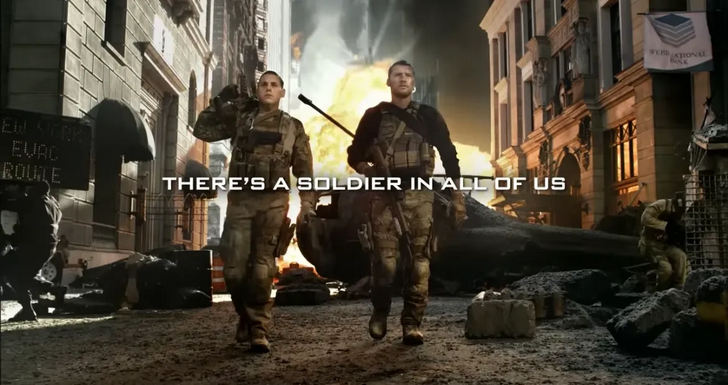
One might mistake the famous Call of Duty tagline “there’s a soldier in all of us”, as a manifestation of American Bushido. But in truth, it gestures toward the opposite. The commercial depicts ordinary people stepping briefly into a role demanded by extraordinary circumstances, the very ethos of the citizen-soldier tradition. However stylized or commercialized, the message remains: soldiering is not a sacred vocation reserved for an elite few, but a responsibility that can emerge from within the ordinary citizen. In that sense, there is a soldier in all of us.
1. See Inazō Nitobe, Bushido: The Soul of Japan (1900), Cameron Hurst, “Death, Honor, and Loyalty: The Bushidō Ideal”. Philosophy East and West 40, no. 4 (1990): 511–27. Tasuke Kawakami, “BUSHIDŌ IN ITS FORMATIVE PERIOD”. The Annals of the Hitotsubashi Academy 3, no. 1 (1952): 65–83, Karl F. Friday, “Bushidō or Bull? A Medieval Historian’s Perspective on the Imperial Army and the Japanese Warrior Tradition”. The History Teacher 27, no. 3 (1994): 339–49, and Stephen Turnbull, The Samurai and the Sacred (Osprey Publishing: Oxford, 1999).
2. For Bushido in the Imperial Japanese context, see John W. Dower, War Without Mercy: Race & Power in the Pacific War (Pantheon Books: New York, 1986), Edward J. Drea, Japan’s Imperial Army: Its Rise and Fall (University Press of Kansas: Lawrence, 2016, S. C. M. Paine, The Japanese Empire: Grand Strategy from the Meiji Restoration to the Pacific War (Cambridge University Press: Cambridge, 2017) The Wars for Asia, 1911–1949, (Cambridge University Press: Cambridge, 2012), and Robert Edgerton, Warriors Of The Rising Sun: A History Of The Japanese Military (Basic Books: New York, 1999).
3. Thomas S. Gates, The Report of the President’s Commission on an All-Volunteer Armed Force (Washington, DC: U.S. Government Printing Office, 1970).
4. Ibid., 23.
5. Milton Friedman, the 1976 Nobel Prize-winning economist, played a pivotal role on the Commission, where his influential intellectual arguments helped overcome the significant institutional resistance.
6. For scholarship on the military’s post-Vietnam recovery and AVF transition, see James F. Dunnigan, Raymond M. Macedonia, Getting It Right: American Military Reforms After Vietnam to the Gulf War and Beyond (William Morrow & Co: New York, 1993) and Suzanne C. Nielsen Lieutenant Colonel, An Army Transformed: The U.S. Army’s Post-Vietnam Recovery and the Dynamics of Change in Military Organizations (US Army War College Press: Carlisle, 2010).
7. Quoted from Maureen Dowd, “After the War: White House Memo; War Introduces a Tougher Bush to Nation”, New York Times, March 2, 1991.
8. U.S. Department of Defense, Summary of the 2018 National Defense Strategy of the United States of America (Washington, DC: DoD, 2018), 1.
9. The emphasis on the warrior ethos was set in motion in part because the events of March 23, 2003, when an 18-vehicle convoy from the 507th Maintenance Company took a wrong turn and was ambushed by insurgents in Nasiriyah, southern Iraq. See Vernon Loeb, “Army Plans Steps to Heighten ‘Warrior Ethos'”, Washington Post, September 8, 2003.
April 14, 2025
Huế: Battle for the Heart of Vietnam
Army University Press
Published 22 Nov 2024The Battle of Huế is known for urban combat, destruction, and anguish. The city of Huế mattered to all the combatant forces. The city and its people paid the price. Interviews with noted subject matter experts Drs. Pierre Asselin, Gregory Daddis, James Willbanks, and Cpt. Wyatt Harper are augmented with archival audio and film, and detailed maps. This documentary places the Battle of Huế within the context of Hanoi’s 1968 Tet Offensive. How North Vietnam, South Vietnam, and the United States perceived the Vietnam War in 1967 and 1968 are central to this documentary. Covered are the key moments of the battle — including the People’s Armed Forces of Vietnam (PAVN) and People’s Liberation Armed Forces (PLAF) planning and assault on Hue. The responses of the Army of the Republic of Vietnam (ARVN), Vietnam Marine Corps (VNMC), the United States Marine Corps (USMC), and the U.S. Army (USA) are addressed to offer insight into an informative example of urban warfare.
0:02:39 – Why the Tet Offensive
0:10:53 – Why Huế
0:15:53 – Military Decision Making Process | Doctrine
0:26:51 – Warfighting Function | Doctrine
0:27:59 – Paralysis by analysis | Doctrine
0:33:15 – Courses of action | Doctrine
0:38:22 – Weather and operations | Doctrine
0:40:52 – Huế Massacre
0:41:18 – My Lai
0:46:05 – Huế and Modern Warfare
QotD: Pax Americana replaces Pax Britannica
The British government spent most of the next century being dragged – reluctantly – into being arbitrators of conflicts they wanted nothing to do with. Finishing with being stuck with the Great War, and then responsibility for some of the most hopeless basket-case states handed over to “Mandate Powers” by the Versailles peace … as one British minister presciently pointed out, no one wanted Palestine, and it would be nothing but a disaster for whoever gets stuck with it … (Fortunately for the US, their Congress repudiated Wilson’s ridiculous League of Nations before the plan to lumber the US with the Mandate for places like Georgia – the Russian bit on the Black Sea that is! – could be put through.)
It is unsurprising that the British taxpayer spent the next 50 years trying to get out of international police-keeping obligations. With the sole exception of reluctantly agreeing to fight against the expansionary dictatorships in World War Two, British taxpayers voted for disarmament and de-colonisation whenever they could. (Abandoning some states – particularly in Africa – that might eventually have developed into safe and secure states, way before they were ready for independence … much to the cost of world peace and security since …)
The United States has had a similar experience more recently. Having inherited responsibility for maybe 50 years of the “Pax Americana” by the simple expedient of being the strongest economy standing after the Second World War. (Their only potential rival being the British Commonwealth of Nations — who between them had 5 of the next 10 biggest and healthiest post-war economies — being more than happy to let the dumb Americans have a go at being world policemen for a time, and see how they liked being blamed by everyone else for absolutely everything.)
The Americans discovered pretty quickly that the things they had been complaining about the British doing for the last 200 years were exactly what they had now signed up for, and finding even quicker that their taxpayers simply weren’t willing to carry the can, and take the blame, for very long at all.
Arguably the US’s fun with being world policeman was already pretty much over after Korea, and certainly after Vietnam. It is notable that the first Gulf War was NOT paid for by the US taxpayer … the US troops turned up but only if Saudi Arabia and Europe paid for them to do so (and preferably with a British Division on one flank, Australian warships on the other, and NATO fighters overhead …) none of this “we will carry the can and our taxpayers will just cope” crap for post-Vietnam American taxpayers.
Nigel Davies, “Types of Empires: Security, Conquest, and Trade”, rethinking history, 2020-05-02.
March 3, 2025
Europe’s Imperial Giants: On the Brink of Collapse? – W2W 09 Q4 1946
TimeGhost History
Published 2 Mar 2025In 1946, Britain, France, and the Netherlands fight to regain control over shattered colonies — from Indonesia’s revolt to Vietnam’s war with France. Meanwhile, the U.S. and USSR maneuver to shape these emerging nations for their own global interests. Will independence spark true liberation, or will it simply swap one master for another?
(more…)
February 17, 2025
France Starts the Vietnam War – W2W 005
TimeGhost History
Published 16 Feb 2025In 1946, tensions in Indochina explode into full-scale war. As France struggles to reclaim its empire, Ho Chi Minh’s Viet Minh fight for independence, setting the stage for a brutal conflict that will shape the next three decades. With international powers pulling the strings, Vietnam becomes the first battleground of the post-war era’s colonial struggles.
(more…)
January 9, 2025
Forgotten Armies of the Vietnam War: Australia, Korea, China, USSR
NR: Sorry about this … RTH must have taken this video down at some point between me scheduling it to appear and today.
Real Time History
Published 16 Aug 2024The Vietnam War is mainly remembered as a conflict between the Vietnamese and the United States. But both sides received direct and indirect support from other countries.
(more…)
December 3, 2024
Evolution of Airborne Armour
The Tank Museum
Published Jul 19, 2024Lightly armed airborne troops are at a huge disadvantage when faced with regular troops with heavy weapons and armour. In World War II this led to huge losses for paratroops on Crete and at Arnhem. Since then, many attempts have been made to level the playing field, to give airborne soldiers a fighting chance.
From the Hamilcar gliders of World War II to the C17 Globemaster, we look at how to make a tank fly.
00:00 | Intro
00:47 | The Origins of Airbourne Operations
02:34 | Gliders
07:20 | A Tank Light Enough to Fly?
09:02 | Success & Failure
14:24 | Post-War Solutions
17:41 | Better Aircraft – Better Tanks?
20:15 | Strategic Deployment
21:39 | ConclusionThis video features archive footage courtesy of British Pathé. This video features imagery courtesy of http://www.hamilcar.co.uk/
#tankmuseum
November 9, 2024
History of SAW (Squad Automatic Weapon) use in the US Army
Forgotten Weapons
Published Jul 26, 2024The first squad automatic weapon used by the US Army was the French Mle 1915 Chauchat, which was the primary LMG or automatic rifle for troops in the American Expeditionary Force in World War One. At that time, the Chauchat was a company-level weapon assigned where the company commander thought best. In World War Two, the Chauchat had been replaced by the BAR, and one BAR gunner was in each 12-man rifle platoon. The BAR was treated like a heavy rifle though, and not like a support weapon as light machine guns were in most other armies.
After Korea the value of the BAR was given more consideration and two were put in each squad instead of one, but the M14 replaced the BAR before it could gain any greater doctrinal importance. The M14 was intended to basically go back to the World War Two notion of every man equipped with a very capable individual weapon, and the squad having excellent flexibility and mobility by not being burdened with a supporting machine gun. The M60 machine guns were once again treated as higher-level weapons, to be attached to rifle squads as needed.
After Vietnam, experiments with different unit organization — and with the Stoner 63 machine guns — led to the decision that a machine gun needed to be incorporated into the rifle squad. This led to the request for what became the M249 Squad Automatic Weapon, and its adoption in the 1980s. At last, the American rifle squad included an organic supporting machine gun.
Today, the USMC is once again going back to the earlier model with every rifleman carrying the same weapon, now an M27 Individual Automatic Rifle. The Army may also change its organizational structure with the new XM7 and XM250 rifle and machine gun, but only time will tell …
(more…)
October 24, 2024
Did the Media Lose the Vietnam War?
Real Time History
Published Jun 21, 2024In late April 1975, dramatic images from Saigon are beamed across the world. North Vietnamese troops proclaimed final victory. Just how did the US lose the Vietnam War?
(more…)
September 10, 2024
Why the US Left Vietnam
Real Time History
Published Apr 19, 2024With violent anti-war protests at home and discipline problems on US bases, President Nixon promises to withdraw American troops from the Vietnam War, but that doesn’t mean an end to the fighting. As US troop numbers drop, the war expands across borders and in the air as more weapons are pumped into the South.
(more…)
September 3, 2024
The End of World War Two – WW2 – Week 314B – September 2, 1945
World War Two
Published 2 Sep 2024The Japanese sign the official document of surrender and the Second World War is over. There are still some Japanese garrisons yet to surrender, but they begin doing so one after the other. However, war is not over — and there is serious foreboding for future events in places like Vietnam and China — where Mao Zedong is meeting with Chiang Kai-Shek, even as Josef Stalin lurks in the background to secure Soviet interests no matter which Chinese regime comes out on top.
00:00 Intro
00:59 Vietnam Declares Independence
04:04 The Importance Of Manchuria
06:28 Japan’s Surrender
11:22 The Final Surrenders
13:18 Casualties
15:50 The End
(more…)
September 2, 2024
QotD: Yes, yes, but does it work in theory?
I told y’all a while back about a friend of mine in grad school, who did his dissertation on an aspect of the Vietnam War. I’m making some of this up, of course, to protect various anonymities, but it’s at least as “fake but accurate” as the Rather Memo. Anyway, he had a long section on how Colonel So-and-So’s actions while attached to MACV-SOG only made sense in the light of his belief that his ARVN counterpart, Maj. Long Duc Dong, was a Communist infiltrator.
To my buddy, this appeared to be a completely unproblematic assertion. After all, he had reams of paperwork from Col. So-and-So, asserting his categorical belief that Long Duc Dong was a communist. Please note that it was absolutely irrelevant, for dissertation purposes, if Long Duc Dong actually was a Communist. It only matters that Col. So-and-So thought he was, and acted accordingly — which was a 100% true fact, about as “proven” as anything gets in the Liberal Arts. It’s actually extremely rare in the History Biz to find someone saying something like “I, Colonel So-and-So, believe X, with all my heart and soul, and I’m staking my entire professional reputation, not to mention the very lives of my soldiers, on this belief,” but that’s what my buddy had.
One particular prof on my buddy’s defense committee had a problem with this section. Oh, the evidence was fine, and the conclusions reasonable, and well written, and all that jazz. It was just that my buddy didn’t have enough Theory. That’s how it came back through the mark-up process: “Needs more Theory”.
This is where you need to understand academia’s weird argot, as it’s a window into the Smart People’s world. Normal folks would be scratching their heads at this point. Didn’t my buddy already have a theory, a really robust one? “Col. So-and-So only did thus-and-such because he thought Long Duc Dong was a Communist.” My buddy unearthed literal reams of evidence pointing to exactly that. QED, time to move on dot org …
… but that’s not how “Theory” works in academia. I’ve been very careful to capitalize it, because to them, it’s nothing so grubby as “a hypothesis which can be verified or rejected on the basis of evidence”. No, “Theory” is that highfalutin’ Frog shit. What my buddy really needed was an analysis of Long Duc Dong’s subalternity (or “subalterity”, despite years in grad school I’m still not sure which one is “correct”) vis a vis Col. So-and-So, an examination of the colonial and postcolonial discourses of power between the two of them, a long explication of the Colonel’s hegemony and Dong’s resistance. In other words, a shitload of buzzwords, simply for the sake of having buzzwords.1
That‘s how Smart People operate. The real world of actions and consequences, real people doing real things, is completely irrelevant. If you can’t fit it into Gayatri Spivak’s work on “strategic essentialism”, it doesn’t matter.
That’s why Smart People’s decisions seem so randomly stupid, yet planned, simultaneously. They’re not interested in examining actual facts in the real world. Most of the time, they’re not dealing with what we’d recognize to be “facts” at all. Regarding Long Duc Dong’s “subalternity”, or “subalterity”, or whatever, normal people’s normal response is: Who gives a shit? He himself surely didn’t, not having his PhD in Grievance Studies, and neither did Col. So-and-So. Those dumbasses, being so very very NOT-Smart, were only concerned with irrelevancies like “staying alive” and “winning the war”.
But to the Smart, Long Duc Dong’s subalternity (or whatever) isn’t just a real thing, it’s the only thing. When they’re forced to confront actual facts in the real world, they will put all their mental energy into shoehorning those facts into their paradigm, their “Theory”. Hence, Afghanistan. Did the Totally Legit Joe administration really believe that handing a list of our people to the Taliban was a good idea? Did they really think the Taliban would help them get to the airport, rather than marking them down on their rapidly-growing kill list?
You’re damn right they did. Despite all evidence, despite all reason, because the Afghans are “the subaltern” in the Smart People’s Theory — they have to act in thus-and-such way, because Postcolonial Theory insists they can do no other.
Really. I know it’s mind-boggling, but it’s nonetheless true.
Severian, “Mail”, Rotten Chestnuts, 2021-08-27.
1. After talking my buddy down from the ledge — he had, after all, spent years on this, including several trips to frickin’ Hanoi — we got blind drunk together and had great fun writing the “Theory” section of that chapter. My friends, you’ve never seen such incomprehensible polysyllabic buffoonery. The Postmodern Essay Generator itself couldn’t have done better. To this day I have no idea what any of that shit meant — not one word — but it sailed through committee, and my buddy now has tenure at Big State. When he went to publish his diss as his first book, even the editors — no mean SJWs themselves — confessed to being baffled by it, and suggested taking it out.
September 1, 2024
Can Chiang and Mao Unite China? – WW2 – Week 314 – August 31, 1945
World War Two
Published 31 Aug 2024Mao Zedong takes his first ever journey by plane to go and meet with Chiang Kai-Shek. They begin what will be several weeks of talks and negotiations. However, Chiang is not aware that Josef Stalin is lurking in the background. And the Soviet Red Army is lurking in Manchuria, having defeated the Japanese there, and are giving tacit support to the Chinese Communists, whose power base is very strong in the north. As for Japan, a motley collection of Allied fleets arrives in Tokyo Bay, for Japan’s surrender document is to be officially signed two days from now.
(more…)


