Quotulatiousness

November 3, 2011

So who did write Shakespeare’s plays?

Filed under: Britain, History, Media — Tags: , , — Nicholas @ 09:23

Jonathan Kay tackles the crank-infested ground of Shakespeare’s works:

‘There are three infallible signs of the crank,” Catholic intellectual Joseph Bottum has written. “The first is that he has a theory about the Jews. The second is that he has a theory about money. And the third is that he has a theory about Shakespeare.”

Very true. Take, for instance, Ignatius Donnelly, perhaps the greatest crank in American history. In the late 19th century, Donnelly wrote books such as Ragnarok, which argued that Atlantis was destroyed by a passing comet and that the contours of our Earth were formed by splatterings of extraterrestrial “gravel.” He also believed the secret identity of the Great Bard could be discovered by counting and multiplying all the different words in his plays. In his crank manifesto, The Great Cryptogram, he claimed to have discovered a secret cipher that proved Francis Bacon was the true author.

[. . .]

And then there was Sigmund Freud, one of the small handful of thinkers whose influence on Western culture arguably can be said to stand alongside Shakespeare’s.

For Freud, it all began in 1898, when a Danish literary critic named George Brandes published a book outlining the connections between Shakespeare’s life and literary works. Hamlet, for instance, was said to grow out of Shakespeare’s grief for his own father’s passing in 1601. Freud became fascinated by this theory at a critical point in his life — his own father had died in 1896. And he incorporated the notion into The Interpretation of Dreams, in which Freud argued that Hamlet “is rooted in the same soil as Oedipus Rex”

Of course, all the back-and-forth among the Marlovians, Baconians, Oxfordians, and Stratfordians misses the point completely: the plays were clearly not written by William Shakespeare, but by a different chap of the same name.

December 4, 2010

QotD: “Every futuristic vision that starts with a clean slate has a genocide or an apocalypse lurking in it”

Filed under: Media, Quotations — Tags: , , , , , , — Nicholas @ 10:11

Here’s a clip of HG Wells in 1943 predicting the demise of the newspaper, as people abandon print journalism in favor of using their telephones for up-to-the-minute news.

In one way, it’s very prescient — “using the telephone to get the news” isn’t so far off from what we do on the web today. But in another way, it’s exactly wrong (after all, it’s been nearly 70 years and there are still newspapers), And it’s wrong in a way that futurists are often wrong: it assumes a clean break with history and the positive extinction of the past. It predicts an information landscape that is reminiscent of the Radiant Garden Cities that Jane Jacobs railed against: a “modern” city that could only be built by bulldozing the entire city that stood before it and building something new on the clean field that remained. Every futuristic vision that starts with a clean slate has a genocide or an apocalypse lurking in it. Real new cities are build through, within, around, and alongside of the old cities. They evolve.

As Bruce Sterling says, “The future composts the past.” What happened to newspapers is what happened to the stage when films were invented: all the stuff that formerly had to be on the stage but was better suited to the new screen gradually migrated off-stage and onto the screen (and when TV was invented, all the “little-screen” stories that had been shoehorned onto the big screen moved to the boob-tube; the same thing is happening with YouTube and TV today). Just as Twitter is siphoning off all the stuff we used to put on blogs that really wanted to be a tweet.

Cory Doctorow, “Newspapers are dead as mutton – HG Wells, 1943 (No, they’re not)”, BoingBoing, 2010-12-03

October 30, 2010

Shakespeare in the original pronunciation

Filed under: Britain, History, Media — Tags: , , — Nicholas @ 10:18

It doesn’t sound much like your traditional Shakespeare production does it?

Like an archeologist reconstructing the fossilized skeleton of an ancient species, a University of Kansas theatre professor has pieced together the bones of a form of English that has never been heard in North America in modern times — the original pronunciation of Shakespeare.

Thanks to the work of Paul Meier, audiences can get a sense of what it might have been like to eavesdrop on opening night of “Hamlet” or “Romeo and Juliet” at the Globe Theater in London or to listen in on a shipboard conversation on the Mayflower as it approaches the shores of the New World.

“What did English sound like back then?” Meier said. “Was it posh or down to earth? Was it anything like today’s British or American English? Would we understand it?”

H/T to A Blog About History for the link.

July 26, 2010

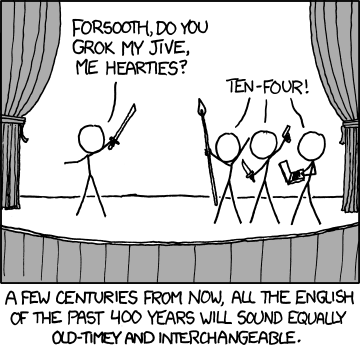
Verily, it is to LOL, forsooth!

Filed under: History, Humour — Tags: , , , , — Nicholas @ 18:30

Period Speech

April 12, 2010

Updating Romeo & Juliet for the YouTube/Twitter generation

Filed under: Media, Technology — Tags: , , — Nicholas @ 09:03

The Guardian looks at a new Royal Shakespeare Company production of Romeo and Juliet:

But soft! What tweet through yonder iPhone breaks? It is the east, and @julietcap16 is the sun.

Actually, Juliet Capulet is probably offline at the moment: being only 16, she has to go to school even on her birthday, where to her indignation Twitter is banned. She’ll be back. And there’s a big party planned tonight that could change all their lives: does any of this sound at all familiar?

The Royal Shakespeare Company today joined with the cross-platform production firm Mudlark and Channel 4’s digital investment fund, 4iP, to launch Such Tweet Sorrow, a drama in real time and 4,000 tweets, very roughly based on Shakespeare’s Romeo and Juliet.

The Bard of Avon’s 1597 tragedy of flirty, street-fighting teenagers disastrously caught up in the double trauma of real love and their parents’ murderous small-town rivalries is already one of the most adapted of his works. It has been continuously reinvented as an opera, a ballet, a musical, a lesbian love story, a geriatric love story and even an ice show.

This time, Juliet is the daughter of a successful property developer. Her mother died in a car driven by the artist Montague; her father will no longer tolerate any of his works in the house, much less his son. Her brother Tybalt is well on his way to being expelled from his latest boarding school, and their older sister Jess, nicknamed Nurse, keeps well out of the way of their new stepmother.

I’m usually pretty conservative about “re-imagining” Shakespeare, but this sounds like an interesting performance.

Update, 13 April: Full story so far here.

November 4, 2009

Transsexual Jesus

Filed under: Britain, Religion — Tags: , , , , , — Nicholas @ 13:53

A play in Glasgow is — all together now — “not intended to incite or offend anyone of any belief system”. In spite of that, some Christians are offended:

About 300 protesters held a candlelit protest outside a Glasgow theatre over the staging of a play which portrays Jesus as a transsexual.

The protest was held outside the Tron Theatre, where Jesus, Queen of Heaven — in which Christ is a transsexual woman — is being staged.

It is part of the Glasgay! arts festival, a celebration of Scotland’s gay, bi-sexual and transsexual culture.

Festival organisers said it had not intended to incite or offend anyone.

Of course, given the parlous state of Christianity in Britain, maybe they really did think that nobody would be offended. Portraying the founder of a different religion in this way might spark a bit more than protest.

August 15, 2009

Would-be assassins

Filed under: History, USA — Tags: , , , — Nicholas @ 10:42

In honour of this news item, I felt it appropriate to buy this (actually, I downloaded it from iTunes).

I always thought it’d have been more appropriate if she’d tried to do this at the Lincoln Centre, just for the symmetry . . .

(more…)

« Newer Posts

Powered by WordPress