Quotulatiousness

July 18, 2022

QotD: The basis of belief in pre-modern polytheistic societies

Filed under: History, Quotations, Religion — Tags: , , , , — Nicholas @ 01:00

For the Roman (or most any ancient polytheist) there is never much question of if the gods exist. True atheism was extremely rare in the pre-modern world – the closest ancient philosophy gets to is Epicureanism, which posits that the gods absolutely do exist, but they simply do not care about you (the fancy theological term here is immanence (the state of being manifest in the material world). Epicureans believed the gods existed, but were not immanent, that they did not care about and were little involved with the daily functioning of the world we inhabit). But the existence of the gods was self-evident in the natural phenomena of the world. Belief was never at issue.

(This is, as an aside, much the world-view we might expect from a universe – as is often the case in speculative fiction or high fantasy – where divine beings are not merely immanent, but obviously so, intervening in major, visibly supernatural ways. The point at which this or that supernatural, divine being brings someone back to life, grants them eternal youth or makes swords light on fire ought to be a pretty substantial theological awakening for everyone there. Even for other polytheists, such displays demand the institution of cult and ritual.)

This, of course, loops back to one of my favorite points about history: it is generally safe to assume that people in the past believed their own religion. Which is to say that polytheists genuinely believe there are many gods and that those gods have power over their lives, and act accordingly.

In many ways, polytheistic religions, both ancient and modern (by modern polytheisms, I mean long-standing traditional religious structures like Hinduism and Shinto, rather than various “New Age” or “Neo-pagan” systems, which often do not follow these principles), fall out quite logically from this conclusion. If the world is full of gods who possess great power, then it is necessary to be on their good side – quite regardless of it they are morally good, have appropriate life philosophies, or anything else. After all, such powerful beings can do you or your community great good or great harm, so it is necessary to be in their good graces or at the very least to not anger them.

Consequently, it does not matter if you do not particularly like one god or other. The Greeks quite clearly did not like Ares (the Romans were much more comfortable with Mars), but that doesn’t mean he stopped being powerful and thus needing to be appeased.

So if these polytheistic religions are about knowledge, then what do you need to know? There are two big things: first you need to know what gods exist who pertain to you, and second you need to know what those gods want.

Two things I want to pull out here. First: the exact nature and qualities of the gods do not really matter, because remember, the goal is practical results. Crops need to grow, ships need to sail, rain needs to fall and the precise length of Zeus’ beard is profoundly unimportant to those objectives, but getting Zeus to bring storms at the right times is indispensable. The nature of the gods largely does not matterwhat matters is what you need to do to keep them happy.

Second, you may be saying – you keep ramming home the idea that you have to cultivate all of the gods – what is this “pertaining to you” business? What I mean by this is that while the polytheist typically accepts the existence of vast numbers of gods (often vast beyond counting), typically only a subset of those gods might be immediately relevant. Some gods are tied to specific places, or specific families, or jobs, or problems – if you don’t live in that place, belong to that family, hold that job, etc., then you don’t need to develop a relationship with that god.

Nevertheless, everyone typically needs to develop a relationship with the big gods – the sort whose name you know from a high school or college class – that control big parts of life we all share, along with a bunch of smaller gods which pertain to smaller parts of our lives or perhaps only to select groups of people (we’ll talk more about these “little” gods later in this series, because they are fascinating).

Bret Devereaux, “Collections: Practical Polytheism, Part I: Knowledge”, A Collection of Unmitigated Pedantry, 2019-10-25.

May 23, 2022

QotD: The adoption of Astrology by the Greeks and Romans

Perhaps the most influential form of divination to arrive in the Roman world from the East was astrology. Systems for divining the will of the gods and the course of the future emerged in both Egypt and Mesopotamia c. 2000 B.C. and were thus both very ancient when Alexander the Great conquered both in the late fourth century. From there, astrology, practiced by professional experts, moved into the Greek and then Roman world, though Roman elites were often deeply ambivalent about this foreign method of divination; both Cato and Cicero express doubts (of course, the Roman practice of haruspicy was also foreign in that it was Etruscan, but this adoption had been sanctified by long use in Roman tradition and was thus mostly beyond reproach). Nevertheless, it is clear that this form of divination become common, with the writer, geographer and astronomer Ptolemy (c. 100-170 A.D.) even producing a long explication of the practice of astrology in his Tetrabiblos.

This portability is not restricted merely to divination. Herodotus’ suspicion that quite a bit of Greek religion might have come from somewhere else has merit, though Anatolia, not Egypt, appears to be the main source (see: M.L. West, The East Face of Helicon (1999); and for the person already writing this comment, yes I am aware of Bernal’s Black Athena and no I am not convinced, nor are many specialists in the field). The Romans were open about importing gods from Greece and make a clear distinction between gods worshiped in traditional Roman manner and those imported from Greece (a quite small number) and thus whose rituals followed ritus graecus – rituals in Greek fashion.

In other cases, the foreign practice was modified to fit the culture it arrived in. The Romans adopted the cult of Cybele, an Anatolian goddess, during the dark days of the Second Punic War (the Senate made that decision based on a consultation with the Sibylline books, a written source of oracular prophecy we can talk about another day). Cybele was called Magna Mater (“Great Mother”) in Rome, and it seems made some modifications to her rituals, in particular possibly limiting the role of the Galli (eunuch priests) whose rituals and style seemed decidedly “unRoman” (though I should note that the scholarship here is contested and the issue and evidence complex).

The normal technical term for this kind of religious borrowing is syncretism, and it is a sort of interweaving of religious traditions that polytheisms both ancient and modern are exceptionally capable of. It is simply not hard to add one more god or one more ritual into a religious system that already assumes the existence of innumerable gods.

Bret Devereaux, “Collections: Practical Polytheism, Part III: Polling the Gods”, A Collection of Unmitigated Pedantry, 2019-11-08.

April 6, 2022

QotD: Haruspicy and Augury in Roman religious observances

Filed under: Europe, History, Quotations, Religion — Tags: , , , — Nicholas @ 01:00

Perhaps the most important form of divination in Rome was haruspicy (which spell-check insists is not a word, but is). Performed by a haruspex, haruspicy was the art of determining the will of the gods by examining the entrails of animals – particularly sacrificed animals and most commonly (but not exclusively) the liver. The most common thing haruspicy might tell you is if the sacrifice was accepted: a malformed or otherwise ill-omened liver might indicate that the ritual had failed and that the god had refused the sacrifice.

Remember that the do ut des system is essentially one of bargaining with the gods, and the god you are bargaining with always has the option of simply refusing the bargain. This might mean some failure in the mechanics of the ritual (necessitating it be performed again), or that the god had been offended in some way, but it might also mean something more. A lot of sacrificial rituals were done at the outset of important tasks – before battles, political events, etc. What the god might be telling you then with a failed sacrifice is “DO NOT PROCEED”.

The practitioner is given a bit of wiggle room on how to interrupt a failed sacrifice in this way: it might mean “don’t attack at all”, but it might also mean “don’t attack now”. Roman generals, ready to attack, might repeat the same ritual over and over again, like a runner at the start of a race waiting for the “go” signal.

But more information was potentially available, because the exact nature of the liver and its quality might signal more things. In Rome, it was understood that the very best knowledge in this regard came from the Etruscans (an example of how antiquity lends credibility to ritual – Etruscan religion was old even to the Romans, and thus had acquired a strong reputation). The reading of a liver could be complex: we find “liver models” from both Italy and the Near East with guidance on how to interpret different parts of the liver of a sacrificed animal. This could be fairly specific: famously, it was haruspex who warned Caesar about the danger of the Ides of March (Seut. Caes. 81.2).

Another key system for divining the will of the gods in Rome was augury, the reading of the flights of birds (mostly, there are actually other categories of auspicia); doing so is called taking the auspices, and the men who do so are the augurs. Augurs were particularly important in political matters, taking the auspices for elections and the like. Unfavorable auspices could invalidate even a consular election: the gods get a vote too.

Bret Devereaux, “Collections: Practical Polytheism, Part III: Polling the Gods”, A Collection of Unmitigated Pedantry, 2019-11-08.

January 8, 2022

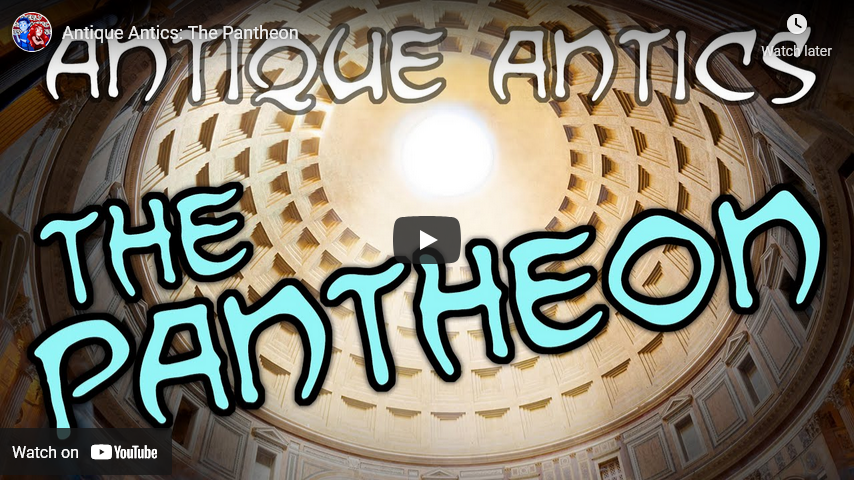
Antique Antics: The Pantheon

Overly Sarcastic Productions
Published 7 Jan 2022

It’s a good dome, simple as that.

SOURCES & Further Reading: The Great Courses lectures: “The Most Celebrated Edifice – The Pantheon” from Understanding Greek and Roman Technology by Stephen Ressler, and “Roman Art and Architecture” from The Roman Empire: From Augustus to The Fall of Rome by Gregory Aldrete. “The Pantheon” by Chris Legare via ATouchOfRome https://www.atouchofrome.com/the_pant…. Additionally, I have a university degree in Classical Studies.

Our content is intended for teenage audiences and up.

PATREON: https://www.Patreon.com/OSP

PODCAST: https://overlysarcasticpodcast.transi…

DISCORD: https://discord.gg/osp

MERCH LINKS: http://rdbl.co/osp

OUR WEBSITE: https://www.OverlySarcasticProductions.com
Find us on Twitter https://www.Twitter.com/OSPYouTube
Find us on Reddit https://www.Reddit.com/r/OSP/

December 18, 2021

Saturnalia

Filed under: Europe, History, Religion — Tags: , , , , , — Nicholas @ 02:00

Historia Civilis
Published 17 Dec 2016

Io, Saturnalia!

Patreon | http://historiacivilis.com/patreon
Donate | http://historiacivilis.com/donate
Merch | http://historiacivilis.com/merch
Mailing List | http://historiacivilis.com/mailinglist
Twitter | http://historiacivilis.com/twitter
Website | http://historiacivilis.com

Music is:
“I //\\ I,” by Discount Fireworks

December 24, 2020

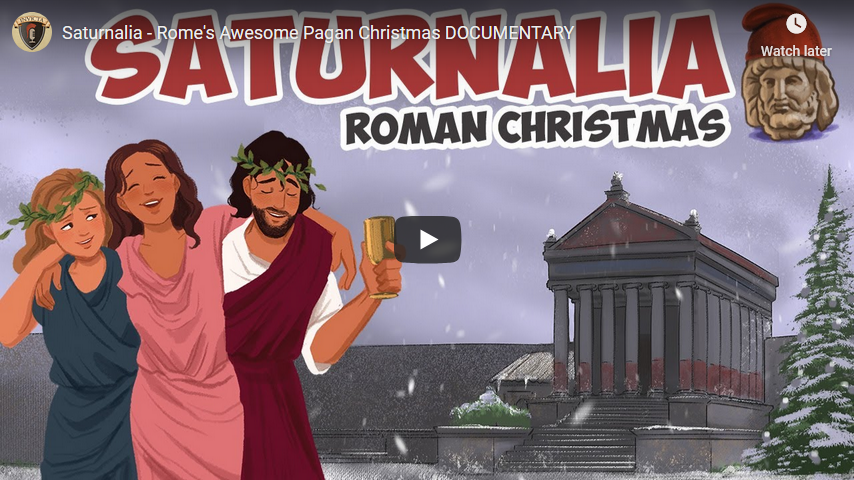
Saturnalia – Rome’s Awesome Pagan Christmas

Filed under: Europe, History, Religion — Tags: , , , , , — Nicholas @ 04:00

Invicta
Published 23 Dec 2020

Celebrate an awesome pagan Christmas with the Roman Saturnalia! The first 100 people to go to https://www.blinkist.com/invicta are going to get unlimited access for 1 week to try it out. You’ll also get 25% off if you want the full membership.

In this history documentary we cover a very special Roman Holiday, the Saturnalia. It was a hugely popular winter festival which dominated the ancient world and in many ways created the Christmas that we celebrate today!

We begin the episode with a discussion about the origins of Saturnalia as a harvest festival. In these early years it was celebrated whenever the last of the crops was brought with a special thanks being offered to the God of harvest, Saturn. The Romans did so at the temple of Saturn by offering a procession of bulls and hosting a grand feast. Over the years however the traditions would grow by importing Greek customs, pinning the date to December 17th and extending the holiday to a full week!

We then cover the history of Saturnalia at its full glory by recreating the experience. This begins with the traditional parade and feast on the first day after which all work was banned. The following days were filled with endless parties and feasts. These featured all kinds of familiar staples of Christmas like gift giving, hat wearing, and singing. However there were many more, wilder traditions as well. IO SATURNALIA!!!

We finally conclude with the rise of Christianity and the history of Christmas which coopted this popular pagan holiday. Stay tuned for more How They Did It episodes on the history of daily life in the past.

Bibliography and Suggested Reading:
Daily Life in the Roman City by Gregory Aldrete
Popular Culture in Ancient Rome by Jerry Toner
As the Romans Did by Jo-Ann Shelton
Festivals and Ceremonies of the Roman Republic by H. H. Scullard
The Roman Community at Table During the Principate by John Donahue

#Saturnalia
#Rome
#History

February 15, 2020

Lupercalia

Filed under: Europe, History, Religion — Tags: , , , , , — Nicholas @ 02:00

Historia Civilis
Published 4 Sep 2014

Patreon: https://www.patreon.com/HistoriaCivilis
Website: https://www.historiacivilis.com
Twitter: https://twitter.com/HistoriaCivilis

Plus a bonus video with a Julius Caesar connection:

October 8, 2015

QotD: The religious life of the early Roman Empire

Filed under: Greece, History, Quotations, Religion — Tags: , , , , — Nicholas @ 01:00

The policy of the emperors and the senate, as far as it concerned religion, was happily seconded by the reflections of the enlightened, and by the habits of the superstitious, part of their subjects. The various modes of worship, which prevailed in the Roman world, were all considered by the people, as equally true; by the philosopher, as equally false; and by the magistrate, as equally useful. And thus toleration produced not only mutual indulgence, but even religious concord.

The superstition of the people was not imbittered by any mixture of theological rancor; nor was it confined by the chains of any speculative system. The devout polytheist, though fondly attached to his national rites, admitted with implicit faith the different religions of the earth. Fear, gratitude, and curiosity, a dream or an omen, a singular disorder, or a distant journey, perpetually disposed him to multiply the articles of his belief, and to enlarge the list of his protectors. The thin texture of the Pagan mythology was interwoven with various but not discordant materials. As soon as it was allowed that sages and heroes, who had lived or who had died for the benefit of their country, were exalted to a state of power and immortality, it was universally confessed, that they deserved, if not the adoration, at least the reverence, of all mankind. The deities of a thousand groves and a thousand streams possessed, in peace, their local and respective influence; nor could the Romans who deprecated the wrath of the Tiber, deride the Egyptian who presented his offering to the beneficent genius of the Nile. The visible powers of nature, the planets, and the elements were the same throughout the universe. The invisible governors of the moral world were inevitably cast in a similar mould of fiction and allegory. Every virtue, and even vice, acquired its divine representative; every art and profession its patron, whose attributes, in the most distant ages and countries, were uniformly derived from the character of their peculiar votaries. A republic of gods of such opposite tempers and interests required, in every system, the moderating hand of a supreme magistrate, who, by the progress of knowledge and flattery, was gradually invested with the sublime perfections of an Eternal Parent, and an Omnipotent Monarch. Such was the mild spirit of antiquity, that the nations were less attentive to the difference, than to the resemblance, of their religious worship. The Greek, the Roman, and the Barbarian, as they met before their respective altars, easily persuaded themselves, that under various names, and with various ceremonies, they adored the same deities. The elegant mythology of Homer gave a beautiful, and almost a regular form, to the polytheism of the ancient world.

The philosophers of Greece deduced their morals from the nature of man, rather than from that of God. They meditated, however, on the Divine Nature, as a very curious and important speculation; and in the profound inquiry, they displayed the strength and weakness of the human understanding. Of the four most celebrated schools, the Stoics and the Platonists endeavored to reconcile the jarring interests of reason and piety. They have left us the most sublime proofs of the existence and perfections of the first cause; but, as it was impossible for them to conceive the creation of matter, the workman in the Stoic philosophy was not sufficiently distinguished from the work; whilst, on the contrary, the spiritual God of Plato and his disciples resembled an idea, rather than a substance. The opinions of the Academics and Epicureans were of a less religious cast; but whilst the modest science of the former induced them to doubt, the positive ignorance of the latter urged them to deny, the providence of a Supreme Ruler. The spirit of inquiry, prompted by emulation, and supported by freedom, had divided the public teachers of philosophy into a variety of contending sects; but the ingenious youth, who, from every part, resorted to Athens, and the other seats of learning in the Roman empire, were alike instructed in every school to reject and to despise the religion of the multitude. How, indeed, was it possible that a philosopher should accept, as divine truths, the idle tales of the poets, and the incoherent traditions of antiquity; or that he should adore, as gods, those imperfect beings whom he must have despised, as men? Against such unworthy adversaries, Cicero condescended to employ the arms of reason and eloquence; but the satire of Lucian was a much more adequate, as well as more efficacious, weapon. We may be well assured, that a writer, conversant with the world, would never have ventured to expose the gods of his country to public ridicule, had they not already been the objects of secret contempt among the polished and enlightened orders of society.

Edward Gibbon, “Chapter II: The Internal Prosperity In The Age Of The Antonines — Part I”, History of the Decline and Fall of the Roman Empire, 1782.

« Newer Posts

Powered by WordPress