
Scenic Routes to the Past
Published 3 Oct 2025The Agora was the political and economic heart of ancient Athens. This tour explores its long history and evocative ruins.
Chapters
0:00 Introduction
0:47 Bouleuterion
1:44 Tholos
2:22 Monument of the Eponymous Heroes
2:56 Temple of Hephaestus
5:28 The Hellenistic Agora
6:16 Stoa of Attalos
6:57 Augustus and the Agora
8:06 Odeon of Agrippa
9:26 Herulian Wall
10:56 Overview
February 1, 2026
The Agora of Athens | A Historical Tour
Comments Off on The Agora of Athens | A Historical Tour
January 1, 2026
The consuls and the start of a Roman year
Adrian Goldsworthy. Historian and Novelist
Published 1 Jan 2025For New Year’s day, we look at how the year started for the Romans, when from 153 BC onwards, the new consuls assumed office. There were rituals, sacrifices and ceremony, and then the start of the political year.
To round off, some thoughts on what is planned for the year to come on this channel.
Oh yes, and for chickens read geese!
Comments Off on The consuls and the start of a Roman year
October 23, 2025
QotD: The importance of ancestor veneration to pre-Christian cultures
John: The claim that the fundamental religion of the Greco-Roman world was ancestor veneration, and that everything else was incidental to or derivative from that, is so interesting. I’m not conversant enough with the ancient sources to know whether Fustel de Coulanges is overstating this part, but if you imagine that he’s correct, a lot of other things click into place. For instance, he does a good job showing why it leads pretty quickly to extreme patrilineality, much as it did in the one society that arguably placed even more of an emphasis on ancestor veneration — Ancient China.
And like in China, what develops out of this is an entire domestic religion, or rather a million distinct domestic religions, each with its own secret rites. In China there were numerous attempts over the millennia to standardize a notion of “correct ritual”, none of which really succeeded, until the one-two punch of communism and capitalism swept away that entire cultural universe. But for thousands of years, every family (defined as a male lineage) maintained its own doctrine, its own historical records, its own gods and hymns and holy sites. It’s this fact that makes marriage so momentous. The book has a wonderfully romantic passage about this:
Two families live side by side; but they have different gods. In one, a young daughter takes a part, from her infancy, in the religion of her father; she invokes his sacred fire; every day she offers it libations. She surrounds it with flowers and garlands on festal days. She asks its protection, and returns thanks for its favors. This paternal fire is her god. Let a young man of the neighboring family ask her in marriage, and something more is at stake than to pass from one house to the other.
She must abandon the paternal fire, and henceforth invoke that of the husband. She must abandon her religion, practice other rites, and pronounce other prayers. She must give up the god of her infancy, and put herself under the protection of a god whom she knows not. Let her not hope to remain faithful to the one while honoring the other; for in this religion it is an immutable principle that the same person cannot invoke two sacred fires or two series of ancestors. “From the hour of marriage,” says one of the ancients, “the wife has no longer anything in common with the religion of her fathers; she sacrifices at the hearth of her husband.”
Marriage is, therefore, a grave step for the young girl, and not less grave for the husband; for this religion requires that one shall have been born near the sacred fire, in order to have the right to sacrifice to it. And yet he is now about to bring a stranger to this hearth; with her he will perform the mysterious ceremonies of his worship; he will reveal the rites and formulas which are the patrimony of his family. There is nothing more precious than this heritage; these gods, these rites, these hymns which he has received from his fathers, are what protect him in this life, and promise him riches, happiness, and virtue. And yet, instead of keeping to himself this tutelary power, as the savage keeps his idol or his amulet, he is going to admit a woman to share it with him.
Naturally this reminded me of the Serbs. Whereas most practitioners of traditional Christianity have individual patron saints, Serbs de-emphasize this and instead have shared patrons for their entire “clan” (defined as a male lineage). Instead of the name day celebrations common across Eastern Europe, they instead have an annual slava, a religious feast commemorating the family patron, shared by the entire male lineage. Only men may perform the ritual of the slava, unmarried women share in the slava of their father. Upon marriage, a woman loses the heavenly patronage of her father’s clan, and adopts that of her husband, and henceforward participates in their rituals instead. It’s … eerily similar to the story Fustel de Coulanges tells. Can this really be a coincidence, or have the Serbs managed to hold onto an ancient proto-Indo-European practice?1 I tend towards the latter explanation, since that would be the most Serbian thing ever.
But I’m more interested in what all this means for us today, because with the exception of maybe a few aristocratic families, this highly self-conscious effort to build familial culture and maintain familial distinctiveness is almost totally absent in the Western world. But it’s not that hard! I said before that the patrilineal domestic worship of ancient China was annihilated in the 20th century, but perhaps that isn’t quite as true as it might at first appear. I know plenty of Chinese people with the ability to return to their ancestral village and consult a book that records the names and deeds of their male-lineage ancestors going back thousands of years. These aren’t aristocrats,2 these are normal people, because this is just what normal people do. And I also know Chinese people named according to generation poems written centuries ago, which is a level of connection with and submission to the authority of one’s ancestors that seems completely at odds with the otherwise quite deracinated and atomized nature of contemporary Chinese society.
Perhaps this is why I have an instinctive negative reaction when I encounter married couples who don’t share a name. I don’t much care whether it’s the wife who takes the husband’s name or the husband who takes the wife’s, or even both of them switching to something they just made up (yeah, I’m a lib).3 But it just seems obvious to me on a pre-rational level that a husband and a wife are a team of secret agents, a conspiracy of two against the world, the cofounders of a tiny nation, the leaders of an insurrection. Members of secret societies need codenames and special handshakes and passwords and stuff, keeping separate names feels like the opposite — a timorous refusal to go all-in.
And yet, literally the entire architecture of modern culture and society4 is designed to brainwash us into valuing our individual “autonomy” too much to discover the joy that comes from pushing all your chips into the pot. Is there any hope of being able to swim upstream on this one? What tricks can we steal from weak-chinned Habsburgs and the Chinese urban bourgeoisie?
Jane: I have a friend whose great-grandmother was one of four sisters, and to this day their descendants (five generations’ worth by now!) get together every year for a reunion with scavenger hunts and other competitions color-coded by which branch they’re from. Ever since I heard this story, one of my goals as a mother has been to make the kind of family where my grandchildren’s grandchildren will actually know each other, so I’ve thought a lot about how to do that.
On an individual level, you can get pretty far just by caring. People — children especially, but people more generally — long to know who they are and where they came from. In a world where they don’t get much of that, it doesn’t take many stories about family history and trips “home” to inculcate a sense a “fromness”: some place, some people.5 Our kids have this, I think, and it’s almost entirely a function of (1) their one great-grandparent who really cared and (2) the ancestral village of that branch of the family, which they’ve grown up visiting every year. Nothing builds familial distinctiveness like praying at the graves of your ancestors! But that doesn’t scale, because we’re a Nation of Immigrants(TM) and we mostly don’t have ancestral villages. (The closest I get is Brooklyn, a borough I have never even visited.) And even for the fraction of Americans whose ancestors were here before 1790 (or 1850, or whatever point you choose as the moment just before urbanization and technological innovation began to really dislocate us), the connection to people and place grows yearly more strained.
For the highly mobile professional-managerial class, moving for that new job, it’s even worse. You and I live where we live not because we like it particularly, or because we have roots here, but because it’s what made sense for work. And though we sometimes idly talk about moving somewhere with better weather and more landscape (not even a prettier landscape, just, you know, more), I don’t think any of the places we’d consider have a sufficiently diverse economic base that I’d bet on them being able to support four households worth of our children and grandchildren. We often think of living in your hometown in order to stay connected to your family as a sacrifice that children make — hanging out a shingle in the third largest town in Nebraska rather than heading to New York for Biglaw or something like that — but I increasingly see giving your children a hometown they can reasonably stay in as a sacrifice that we can make as parents.
Fustel de Coulanges has this beautiful, poetic passage about the relationship between the individual and the family:
To form an idea of inheritance among the ancients, we must not figure to ourselves a fortune which passes from the hands of one to those of another. The fortune is immovable, like the hearth, and the tomb to which it is attached. It is the man who passes away. It is the man who, as the family unrolls its generations, arrives at his house appointed to continue the worship, and to take care of the domain.
I love this as a metaphor. It’s generational thinking on steroids: it’s not just “plant trees for your grandchildren to enjoy”, it’s “don’t sell the timberland to pay your bills because it’s your grandchildren’s patrimony”. And there’s something to it, especially when the woods are inherited, because it’s your duty to pass along what was passed down to you. You should be bound by the past, you should be part of something greater than yourself, because the “authentic you” is an incoherent half-formed ball of mutually contradictory desires and lizard-brain instinct. It’s the job of your family and your culture (but I repeat myself) to mold “you” into something real, like the medieval bestiaries though mother bears did to their cubs. But take it literally, as Fustel de Coulanges insists the ancients did, and it feels too much like playing Crusader Kings for me to be entirely comfortable. Yeah, this time my player heir is lazy and gluttonous, but his son looks like he’s shaping up okay, maybe we’ll go after Mecklenburg in thirty years or so. The actual individual is basically incidental to the process. And the entire ancient city is built of this!
The book describes how several families (and it’s worth noting that this includes their slaves and clients; the family here is the gens, which only aristocrats have) come together to form a φρᾱτρῐ́ᾱ or curia, modeled exactly after the family worship with a heroic ancestor, sacred hearth, and cult festivals. Then later several phratries form a tribe, again with a god and rites and patterns of initiation, and then the tribes found a city, each nested intact within the next level up, so that the city isn’t just a conglomeration of people living in the same place, it’s a cult of initiates who are called citizens. And, as in the family, the individual is really only notable as the part of this vast diachronic entity that’s currently capable of walking around and performing the rites. The ancient citizen is the complete opposite of the autonomous, actualized agent our society valorizes, which makes it a useful corrective to our excesses. That image of the family unrolling, of the living man as the one tiny part that’s presently above ground, is something we deracinated moderns would do well to guard in our hearts. But that doesn’t make it true.
Almost by accident, in showing us what inheritance and family meant for the ancient world, Fustel de Coulanges illustrates why Christianity is such a revolutionary doctrine. For the ancients, the son and heir is the one who will next hold the priesthood in the cult of his sacred ancestor. In Christ, we are each adopted into sonship, each made the heir of the Creator of all things, “no more a servant, but a son; and if a son, then an heir of God through Christ”.
Jane and John Psmith, “JOINT REVIEW: The Ancient City, by Numa Denis Fustel de Coulanges”, Mr. and Mrs. Psmith’s Bookshelf, 2023-02-20.
- Speaking of ancient proto-Indo-European practices, his descriptions of the earliest Greek and Roman marriage ceremonies are also fascinating. They incorporate a stylized version of something very reminiscent of Central Asian bride kidnapping! I like to think this is also a holdover of some unfathomably old custom, rather than convergent evolution.
- IMO China never really regained a true aristocracy after Mongol rule and the upheavals preceding the establishment of the Ming dynasty.
- The trouble with hyphenation is, what do you do the following generation? I know people are bad at thinking about the future, but come on, you just have to imagine this happening one more time. In fact, the brutally patrilineal Greeks and Romans and Chinese were more advanced than us in recognizing a simple truth about exponential growth. Your ancestors grow like 2^N, which means their contribution gets diluted like 1/(2^N), unless you pick an arbitrary rule and stick with it.
- With the exception of the Crazy Rich Asians movie. Maybe the Chinese taking over Hollywood will slowly purge the toxins from our society. Lol. Lmao.
- Sometimes, as with the Habsburgs, it becomes cringe.
Comments Off on QotD: The importance of ancestor veneration to pre-Christian cultures
August 19, 2025
Roman Hellenism
In his post “A Pagan Confession“, Fortissax provides an explanation of Roman Hellenism, the most widespread religious system in Europe before Christianity:
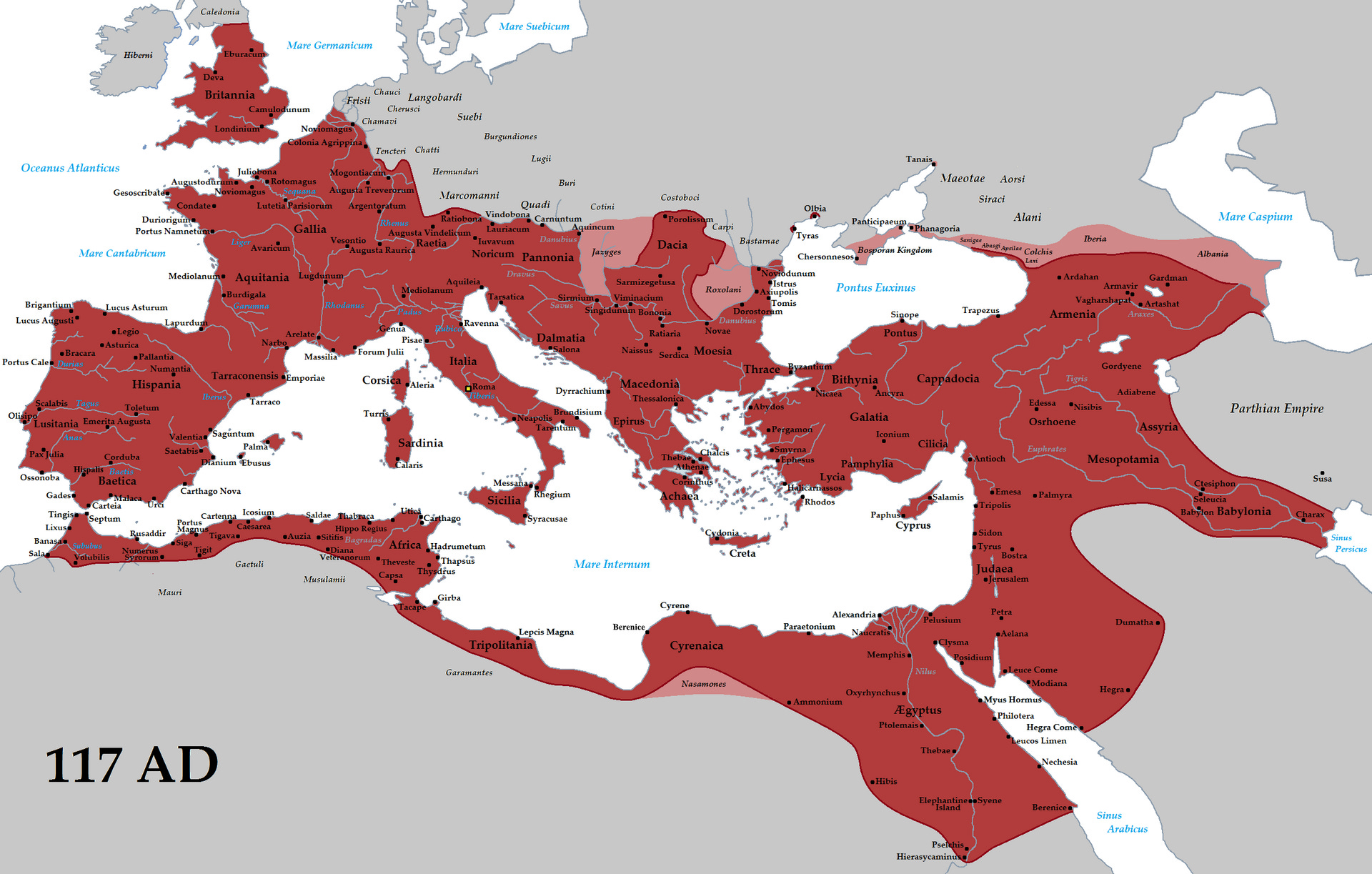
The Roman Empire at its maximum extent
The closest term that would describe me is “Roman Hellenist”.
Roman Hellenism was the largest religion in the Western world prior to the rise of Christianity. It was followed from Britain to Greece, from Spain to Romania, and was the first civilization-wide faith for Europeans.
At its height under the Roman Empire, Hellenism was a vast and adaptable religious tradition that united Greek mythology, Roman state religion and cults, household rites, and philosophical schools into a coherent spiritual world. As the organized state religion, the Dii Consentes were worshipped in every corner of the empire under both Latin and Greek names. Jupiter, Mars, Venus, Apollo, Minerva, and others were honoured through public festivals, imperial temples, military devotions, and local folk religion. This civic devotion was shaped by writers such as Cicero, Livy, and Plutarch, who emphasized the importance of piety, order, and divine ancestry.
Hellenism offered more than just myth or folklore. It provided a structured understanding of the cosmos, where the gods represented natural and moral forces, and where religion was interwoven with daily life, civic duty, and personal virtue. Mystery cults such as those of Dionysus and the Eleusinian rites offered deeper initiatory experiences, described by authors like Herodotus and Euripides. Philosophers such as Plato, Plotinus, Porphyry, Iamblichus, Proclus, Damascius, and Hierocles were considered divinely inspired and were often trained by the augurs, or in the College of Pontiffs, established in 400 B.C., and the inspiration for the College of Cardinals. These were priests within the state religion.
They built the theology of the faith. These philosophers were not monotheists or atheists, but pagans, and their theology came from Hellenism. Ordinary people prayed, sacrificed, and kept sacred fires at home. This marks the distinction between the folk religion of the everyman and the theological work of the priestly and philosophical elite, though they formed a whole, similar to Christian folk religion compared to the sophistication of the clergy. Hellenism in the Roman world was participation in a divine order that shaped identity, politics, culture, and destiny.
It had a core, but it was a dynamic tapestry. It often accommodated or incorporated local and regional gods of subject peoples throughout the empire, including other Europeans. It was normal to find shrines or temples dedicated to syncretic deities where Roman and provincial traditions were blended. This reflected a deeper truth shared by many Indo-European peoples. Across vast distances, from the Celts and Germans to the Greeks and Romans, there was a common spiritual grammar. Their gods often held similar roles, attributes, and origins. Rather than destroy or suppress local belief, Roman Hellenism often absorbed and integrated it within a universal metaphysical framework, though one without too strict of a dogma, which allowed spiritual continuity across cultures.
The Romans referred to this process as interpretatio graeca, the identification of foreign gods with Greek ones, and interpretatio romana, the application of Roman names and attributes. In Gaul and Germania, local deities such as Lugh or Wodan were equated with Hermes or Mercury. Camulos and Tyr equated with Mars, Taranis with Jupiter through interpretatio gallica and interpretatio germanica.
These interpretive traditions allowed theological bridges across linguistic and ethnic boundaries, fostering religious continuity and civic unity. Writers like Varro, Tacitus, and Strabo observed this continuity, noting that while names and symbols differed, the gods themselves were one in essence. This interpretive unity was ritualized practically in temple, altar, hymn, and law.
This faith, was shaped by the Iliad and the Aeneid, the rituals of Rome and the hymns of Orpheus, the Chaldean Oracles, the laws of the Twelve Tables and the meditations of Aurelius. It spoke through the Sibyl and the Stoic, the philosopher and the priest, the hearth and the polis. It is the soul of the West in its first religious form, a religion of cosmic order, virtue, memory, and return. Its path leads from the One to the many, and back again through sacrifice, contemplation, and union.
To be a Hellenist, in this fuller sense, is to honour the gods as real beings and divine intelligences who participate in the life of the soul and the order of the cosmos. It is to seek harmony with this order through philosophy, ritual, moral striving, and ancestral memory. It is a way of life, rooted in reason and reverence.
Comments Off on Roman Hellenism
June 29, 2025
QotD: People in the past believed their own religion
It is an old mistake – Polybius makes it of the Romans, writing in c. 150 BC. Polybius notes that Roman religion was “distinctly superior” for maintaining the cohesion of the Roman state, but that “they (= the ruling class) have adopted this course for the sake of the common people” (Plb. 6.56.6-8), by which he means for the sake of the “fickle multitude” which must be “held in invisible terrors and pageantry”. Polybius, I should note, immediately contradicts himself – one benefit of this religion, he says, is that Roman magistrates (read: elite Senators) do not steal from the public treasury even when they are not watched, which would seem to imply that even many very elite Romans believed their own religion (also, irony alert: those famously incorruptible Romans …). Poor men, after all, are not elected to watch the treasury.
Fortunately, Polybius is not our only source on Roman culture, so it is possible to say – and I want to be clear here – Polybius is wrong (on this point at least). Roman elites took their religion very seriously. There are exceptions, of course – Julius Caesar was an Epicurean philosophically, although this does not seem to have altogether disrupted his performance of the duties of Rome’s highest priesthood (he was Pontifex Maximus). Nevertheless, such philosophically minded men were generally regarded with scorn by even the Roman elites (Cicero heaps such scorn on Cato in the Pro Murena in what were clearly intended as friendly “ribbing” before a mostly elite audience), who nevertheless greatly valued religious character (in contrast, Cicero is quick to accuse his hated enemy Catiline of irreligion before the Senate). Roman leaders vowed temples and sacrifices in duress, and built and gave them in victory. Lavish dedications to the gods from all levels of Roman society confirm the overall picture: the Romans believed their religion. Yes, even the elite Romans (there is, I should note, some complicated in that elites tended to separate what they viewed as religion from common “superstition”, but that’s a topic for another day.) And, if anything, the evidence for elite “buy-in” to Medieval religion is far more voluminous.
Yet none of the main characters of Game of Thrones, apart from perhaps Catelyn Stark, is devoted to their region’s traditional religion in any private sense. I cannot recall at any point any character protesting an action on account of religion – no marches held up by high holy days (a regular occurrence in ancient and medieval literature), no groups, individuals or places religiously exempt from violence. The Faith has certain rules about sexuality, but they’re rules that are not only flouted privately by individuals in the show, but also quite publicly by the last ruling dynasty for centuries.
Moreover, none of the ruling characters seem to have any religious functions – or if they do, they simply ignore them most of the time. Keep in mind, these people believe that their gods – be it the Seven or the Old Gods – are powerful divine beings who are directly and immediately interested in the world and who act on that interest. Keeping such beings happy is vitally important – it is not an afterthought. No society, so far as I can tell, has ever believed there is enough gold or enough armies to save you if you have enraged the gods. There is simply no off-setting an angry divinity (and before the smart guy asks, “what about a favorable divinity?” the Greeks had an answer for that – go read Euripides’ Hippolytus. It ends badly for the mortals).
The lack of religious duties or functions for characters who are kings is particularly surprising. Kingship has three core roles in almost all human cultures where the institution appears: kings are 1) chief judge, 2) chief general, and 3) chief priest. That third role appears more or less prominently in almost all societies. In ancient Egypt and (at times) in Mesopotamia, kings were held to literally be either earthly incarnations of major gods or minor gods in their own right. Roman Emperors held the office of Pontifex Maximus, and took over as the chief priest of the state, before becoming gods on their deaths. The Chinese emperor was the “Son of Heaven” and was tasked with maintaining the right relationship with the divine (the “mandate of heaven”). The emperors of Japan are purported to be direct descendants of the goddess Amaterasu (and they have a family tree to back it up).
The relationship between medieval kings and the Church was more complicated, because of the existence of a clear religious head (the Pope) outside of secular authority, but medieval kingship retained a strong sense of religious purpose. Coronation rituals often involved the clergy and were essentially religious rituals, because kingly power was still thought to be bestowed by God. Kings, in turn, had a special role in keeping their kingdom in right relationship with the divine, both through just rule (which included protecting the Church) and through the performance of religious rituals. Those rituals, of course, worked both ways: both believed to be religious efficacious (as in they helped bring about God’s good favor), but also valuable tools of building royal legitimacy (hat tip to my colleague Elizabeth Hassler’s excellent dissertation on the topic of holy kingship). In some places (England and France most notably), kings were thought holy enough to be able to heal certain diseases miraculously by touch – a king who couldn’t was clearly insufficiently pious.
Bret Devereaux, “New Acquisitions: How It Wasn’t: Game of Thrones and the Middle Ages, Part II”, A Collection of Unmitigated Pedantry, 2019-06-04.
Comments Off on QotD: People in the past believed their own religion
October 24, 2024
QotD: From the OG Pontifex Maximus to the Pope
The Protestants might be happy to hear Misanthrope claim this would make you sick, because they’d correctly state that absolutely none of this is in the Bible. The entire liturgical structure of the Catholic Church is pagan, an inherited but corrupted structure from classical antiquity. Thus, a great majority of historic Christianity is syncretic. You might even say haphazardly pagan. The very idea of a high priest who would oversee the spiritual and religious duties is copped by the Pope’s role in Catholicism. The vestments worn by Catholic clergy, the use of incense (especially frankincense, the main herb used by invocations in Hellenism), chants, the sanctification of holy spaces, and the very architecture of Catholic cathedrals are derived from religious practices of pagan Rome. Let’s not get into art. The processions, the veneration of saints (akin to the Roman household gods or Lares), ancestor worship (which Catholics pretend they don’t do), and the hierarchical structure all reflect a continuity from Rome’s Hellenic pagan past. The Catholic Church’s liturgy, with its detailed rituals and sacraments is a direct continuation of the Greco-Roman pagan way of embedding religious practice into every aspect of public and private life. The transformation of its pantheon of gods into a multitude of saints, each with specific roles and domains is indistinguishable from how they interacted with their deities.
Fortissax, “Spiteful Mutant Christians”, Fortissax is Typing, 2024-07-19.
[NR: Glossary links added.]
Comments Off on QotD: From the OG Pontifex Maximus to the Pope
August 13, 2024
QotD: The weird world of the Iliad
Homer (“Homer“) presents the gods as having unified identities, desires, and attributes, which of course you have to have in order to have any kind of coherent story but which is not at all the way the Greeks understood their gods before him (or even mostly after). The Greeks didn’t have a priestly caste with hereditary knowledge, or Vedas, or anything like that, so their religion is even more chaotic than most primitive religions. “The god” is a combination of the local cult with its rituals, the name, the myths, and the cultic image, and these could (and often did) spread separately from one another. The goddess with attributes reminiscent of the ancient Near Eastern “Potnia Theron” figure is Hera, Artemis, Aphrodite, Demeter, or Athena, depending on where you are. Aphrodite is born from the severed testicles of Ouranos but is also the daughter of Zeus and Dione. “Zeus” is the god worshipped with human sacrifice on an ash altar at Mt. Lykaion but also the god of the Bouphonia but also a chthonic snake deity. Eventually these all get linked together, much later, primarily by Homer and Hesiod, but even after the stories are codified — okay, this is the king of the gods, he’s got these kids and this shrewish wife, he’s mostly a weather deity — the ritual substrate remains. We still murder the ox and then try the axe for the crime, which has absolutely nothing to do with celestial kingship but it’s what you do. If you’re Athenian. Somewhere else they do something completely different.
I also really enjoyed this book, and I think for similar reasons to you. Because you’re right, at the end of the classical world it wasn’t just the philosophers. One major theme in Athenian drama is the conscious attempt to impose rationality/democracy/citizenship/freedom (all tied together in the Greek imagination) in place of the bloody, chthonic, archaic world of heredity.1 It’s an attempt at a transition, and one which gets a lot of attention I think in part because people read the Enlightenment back into it. But my favorite part of the The Ancient City is Fustel de Coulanges’s exploration of the other end of the process: where did all the weird inherited ritual came from in the first place?!
The short version of the answer is “the heroön“. Or as he puts it: “According to the oldest belief of the Italians and Greeks, the soul did not go into a foreign world to pass its second existence; it remained near men, and continued to live underground.” Everything else follows from here: the tomb is required to confine the dead man, the burial rituals are to please him and bind him to the place, the grave goods and regular libations are for his use, and he is the object of prayers. Fustel de Coulanges is incredibly well-read (that one sentence I quoted above cites Cicero’s Tusculan Disputations, “sub terra censebant reliquam vitam agi mortuorum“, plus Euripides’ Alcestis and Hecuba), and he references plenty of Vedic and later Hindu texts and practices too. I also immediately thought of the Rus’ funeral described by ibn Fadlan and retold in every single book about the Vikings, in which, after all the exciting sex and human sacrifice is over, the dead man’s nearest kinsman circles the funerary ship naked with his face carefully averted from it and his free hand covering his anus. This seems like precautions: there’s something in the ship-pyre that might be able, until the rites are completed, to get out.2 And obviously we now recognize tombs and burial as being very important to the common ancestors of the classical and Vedic worlds — from Marija Gimbutas’s kurgan hypothesis to the identification of the Proto-Indo-Europeans with the Yamnaya culture (Ямная = pit, as in pit-grave) — their funerary practices have always been core to how we understand them. But I’m really curious how any of this would have worked, practically, for pastoral nomads! Fustel de Coulanges makes it sound like you have your ancestor’s tomb in your back yard, more or less, which obviously isn’t entirely accurate when you’re rolling around the steppe in your wagon.
I’d also be interested to see an archeological perspective on his next section, about the sacred hearth. This is the precursor of Vesta/Hestia and also Vedic Agni, the reconstructed *H₁n̥gʷnis (fire as animating entity and active force) as opposed to *péh₂ur (fire as naturally occurring substance). I looked back through my copy of The Wheel, the Horse, and Language and (aside from a passing suggestion that the hearth-spirit’s genderswap might be due to the western Yamnaya’s generally having more female-inclusive ritual practices, possibly from the influence of the neighboring Tripolye culture), I didn’t find anything. I suppose this makes sense — you can’t really differentiate between the material remains of a ritual hearth and a “we’re cold and hungry” hearth, especially if people are also cooking on the ritual hearth so there’s not a clear division anyway. But if anyone has done it I’d like to see.
I don’t know enough of the historiography to know whether Fustel de Coulanges was saying something novel or contentious in the mid-19th century, but he seems to be basically in line with more recent scholarship even if he’s not trendy. But The Ancient City can be read as a work of political philosophy as well as ancient history!
Jane and John Psmith, “JOINT REVIEW: The Ancient City, by Numa Denis Fustel de Coulanges”, Mr. and Mrs. Psmith’s Bookshelf, 2023-02-20.
1. And of course that tension is extra intriguing because the dramas are always performed at one of these inherited rituals, in this case the city-wide Great Dionysia festival, although it was a relatively late addition to the ritual calendar. Incidentally it’s way less bizarre than the Attic “rustic” Dionysia which is all goat sacrifices and phallus processions. (There’s also the Agrionia in Boeotia which is about dissolution and inversion and nighttime madness, and another example of “the god” being a rather fluid concept.)
2. Neil Price, in his excellent Children of Ash and Elm, says that the archaeological evidence seems to confirm this:
“Most of the objects [in the Oseberg ship burial] were deposited with great care and attention, but at the very end most of the larger wooden items — the wagons, sleds, and so on — were literally thrown onto the foredeck, beautiful things just heaved over the side from ground level and being damaged in the process. The accessible end of the burial chamber was then sealed shut by hammering planks across the open gable, but using any old piece of wood that seems to have been at hand. The planks were just laid across at random — anything to fill the opening into the chamber where the dead lay. The nails were hammered in so fast one can see where the workers missed, denting the wood and bending or breaking off the nail heads.”
Comments Off on QotD: The weird world of the Iliad
March 22, 2024
Rome conquered Greece … militarily, anyway
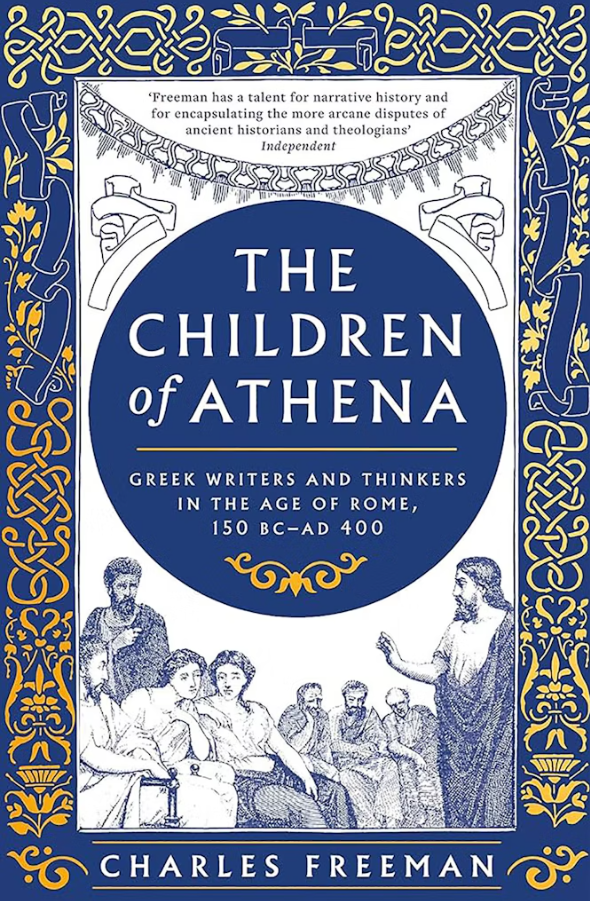
In The Critic, Gavin McCormick reviews Charles Freeman’s new book The Children of Athena: Greek writers and thinkers in the age of Rome, 150BC – 400AD:
“To a wise man,” said the first-century wonderworker Apollonius of Tyana, “everywhere is Greece.” That is to say, Greece is not a mere place, but a special state of mind. For Apollonius, on his extensive travels around the Greco-Roman world, the purported truth of this maxim is seldom open to doubt.
The author of Apollonius’s colourful biography, Philostratus, depicts his hero as not just a philosopher but also an impossibly accomplished champion of culture — a confounder of logic and expectations who could vanish in plain sight, now fascinating Roman emperors and foreign sages, now inspiring whole towns into acts of celebration and renewal. The guiding ideology that drove this hero is a heady mix of philosophy, religion, magic and political insouciance — or, to give it another name, Hellenism.
In the context of the third-century world, where Christianity was an increasingly noteworthy presence in the towns and cities of the Roman empire, pagans such as Philostratus were keen to highlight what their own tradition had to offer.
In fact, he seems almost to present his hero as a pagan rival to Jesus. And, in turn, Apollonius — in his successful renewal of the shrines and local cults of Hellas — seems to hint at what Philostratus would like to see happen in his own contemporary context.
Despite living under Rome, Apollonius (and Philostratus) wants to celebrate an emphatically Greek form of culture. The celebration of Greek culture in the Roman world was, of course, nothing new, and it was something the Romans themselves had long enjoyed.
Alongside their admiration for Greek literature, philosophy, art and architecture, there was the successful movement known as the “Second Sophistic” — whose parade of Greek-speaking intellectuals left a heavy imprint on the public life of the High Roman Empire.
But it is striking nonetheless that the virtues of Hellas — not Rome itself — were what many educated citizens of the empire turned to when they thought of cultural renewal. Indeed his was precisely the route taken later in the fourth century by the last pagan emperor of Rome, himself a champion of all things Greek, Julian the so-called Apostate.
Charles Freeman’s latest book, Children of Athena, is a highly readable tour through the lives and accomplishments of some of the great exponents of Greek culture under Rome. He introduces readers to a bracingly varied and energetic cast of characters — the geographers, doctors, polymaths, botanists, satirists, and orators are just part of the repertoire. In an early chapter, we meet the brilliant Greek historian Polybius, who wrote in the tradition of Herodotus and Thucydides, while training his sights on the rise of Rome in his own time.
Comments Off on Rome conquered Greece … militarily, anyway
June 20, 2023
QotD: When kings and emperors become gods
Divine rulership was not universal however – it was subject to cultural context. In Egypt, the Pharaoh was the Living Horus, a physical incarnation of the divine; when he died he became Osiris, the ruler over the underworld. The mystery of the duality whereby a Pharaoh was both a specific person (and might be a different person in the future) but also the same god each time seems to owe something to the multipart Egyptian conception of the soul. Naram-Sin, an Akkadian King (2254-2218 B.C.) represents himself as divine (shown by his having horns) on his victory stele; future kings of Akkad followed suit in claiming a form of divinity, albeit a lesser one than the big-time great gods.
But in Mesopotamia, the rulers of Akkad were the exception; other Mesopotamian kings (Sumerian, Babylonian, etc) did not claim to be gods – even very great kings (at least while alive – declaring a legendary ruler a god is rather more like a divine founder figure). Hammurabi (king of Babylon, c.1810-c.1750 B.C.) is shown in his royal artwork very much a man – albeit one who receives his mandate to rule from the gods Shamash and Marduk. Crucially, and I want to stress this, the Achaemenid kings of Persia were not considered gods (except inasmuch as some of them also occupied the position of Pharaoh of Egypt; it’s not clear how seriously they took this – less seriously than Alexander and Ptolemy, quite clearly). The assumption that the Persians practiced a divine kingship is mostly a product of Greek misunderstandings of Persian court ritual, magnified in the popular culture by centuries of using the Persian “other” as a mirror and (usually false) contrast for European cultures.
But the practice that my students often find most confusing is that of the Roman emperors. To be clear, Roman emperors were not divinized while they were alive. Augustus had his adoptive father, Julius Caesar divinized (this practice would repeat for future emperors divinizing their predecessors), but not himself; the emperor Vespasian, on his deathbed, famously made fun of this by declaring as a joke, “Alas! I think I’m becoming a god” (Suet. Vesp. 23.4). And yet, at the same time, outside of Rome, even Augustus – the first emperor – received cult and divine honors, either to his person or to his genius (remember, that’s not how smart he is, but the divine spirit that protects him and his family).
I think it is common for us, sitting outside of these systems, to view this sort of two-step dance, “I’m not a god, but you can give me divine honors in the provinces and call me a god, just don’t do it too loudly” as fundamentally cynical – and to some degree it might have been; Augustus was capable of immense cynicism. But I think it is possible to view this relationship outside of that cynicism through the lens of the ideas and rules we’ve laid out.
Bret Devereaux, “Collections: Practical Polytheism, Part IV: Little Gods and Big People”, A Collection of Unmitigated Pedantry, 2019-11-15.
Comments Off on QotD: When kings and emperors become gods
June 8, 2023
QotD: Heroes, demi-gods and gods in the ancient Greek world
These figures – complete with tales of being swept up into divinity while still alive or at the moment of their death – are in some way atypical of hero worship in the Greek world. More typical is a figure like Achilles, who very definitely was mortal and very definitely died and whose spirit is very much in the Underworld in the Odyssey (and neatly contrasted with Heracles – only Heracles’ shade is in the underworld, for his soul was divine; but cf. Pindar on Achilles, Olympia 2.75-85). Our sources (e.g. Plin. Nat. 4.26) continue to speak of Achilles as a man, with a physical tomb. And yet Alexander pays him honors (Arr. Anab. 1.12.1) and we have ample evidence for cult observances of Achilles in the Greek world. it was possible to be a man in life, and yet have enough influence to be worthy of cult in death.
This sounds strange, but its worth noting that some of the most common mortal figures to receive this kind of cult worship were founder figures – people (often legendary or mythical in nature) credited with the foundation of a community. We’ve actually discussed that here before in Lycurgus and Theseus, but as you might imagine, such figures were very common. It is not entirely crazy to assume that these figures have some power to shape your world or life, because they already have – you live in the city they founded! They deeds in life continue to shape the confines of your experience – why wouldn’t that influence, in some way, carry with them?
(And while I’m here, I should note that the American architectural veneration of our founder figures on the National Mall is explicitly framed in terms of Mediterranean cult observance. The Lincoln and Jefferson memorials both borrow their forms from Roman temples and contain super-life-sized cult statues exactly as and where a Roman temple would has the cult statue of the god, while the Washington Monument – as an Egyptian style obelisk – mimics Egyptian practice quite intentionally. We even have our monuments to the di manes [the divine shades of your dead ancestors who watch over you] in our war memorials, framed around collective veneration. A Roman time-traveler would have no problem interpreting the display, and might think the many millions of visitors coming from all corners quite pious in their observance.)
Bret Devereaux, “Collections: Practical Polytheism, Part IV: Little Gods and Big People”, A Collection of Unmitigated Pedantry, 2019-11-15.
Comments Off on QotD: Heroes, demi-gods and gods in the ancient Greek world
May 11, 2023
QotD: Divination
But that distinction is crucial, because what you are actually doing in a ritual involving divination is not asking questions about the future, but asking questions of the gods. Divination is not an exercise in seeing, but in hearing – that is, it is a communication, a conversation, with the divine. […]
Many current religions – especially monotheistic ones – tend to view God or the gods as a fundamentally distant, even alien being, decidedly outside of creation. The common metaphor is one where God is like a painter or an architect who creates a painting or a building, but cannot be in or part of that creation; the painter can paint himself, but cannot himself be in the painting and the architect may walk in the building but she cannot be a wall. Indeed, one of the mysteries – in the theological sense […] – of the Christian faith is how exactly a transcendent God made Himself part of creation, because this ought otherwise be inconceivable.
Polytheistic gods do not work this way. They exist within the world, and are typically created with it (as an aside: this is one point where, to get a sense of the religion, one must break with the philosophers; Plato waxes philosophic about his eternal demiurge, an ultimate creator-god, but no one in Greece actually practiced any kind of religion to the demiurge. Fundamentally, the demiurge, like so much fine Greek writing about the gods, was a philosophical construct rather than a religious reality). As we’ll get to next week, this makes the line between humans and gods a lot more fuzzy in really interesting ways. But for now, I want to focus on this basic idea: that the gods exist within creation and consequently can exist within communities of humans.
(Terminology sidenote: we’ve actually approached this distinction before, when we talked about polytheistic gods being immanent, meaning that they were active in shaping creation in a direct, observable way. In contrast, monotheistic God is often portrayed as transcendent, meaning that He sits fundamentally outside of creation, even if He still shapes it. Now, I don’t want to drive down the rabbit hole of the theological implications of these terms for modern faith (though I should note that while transcendence and immanence are typically presented as being opposed qualities, some gods are both transcendent and immanent; the resolution of an apparent contradiction of this sort in a divine act or being like this is what we call a mystery in the religious sense – “this should be impossible, but it becomes possible because of divine action”). But I do want to note the broad contrast between gods that exist within creation and the more common modern conception of a God whose existence supersedes the universe we know.)
Thus, to the polytheistic practitioner, the gods don’t exist outside of creation, or even outside of the community, but as very powerful – and sometimes inscrutable – members of the community. The exact nature of that membership varies culture to culture (for instance, the Roman view of the gods tends towards temperamental but generally benevolent guardians and partners of the state, whereas the Mesopotamian gods seem to have been more the harsh rulers set above human society; that distinction is reflected in the religious structure: in Rome, the final deciding body on religious matters was the Senate, whereas Mesopotamian cities had established, professional priesthoods). But gods do a lot of the things other powerful members of the community do: they own land (and even enslaved persons) within the community, they have homes in the community (this is how temples are typically imagined, as literal homes-away-from-home for the gods, when they’re not chilling in their normal digs), they may take part in civic or political life in their own unique way. […] some of these gods are even more tightly bound to a specific place within the community – a river, stream, hill, field.
And, like any other full member of the community (however “full membership” is defined by a society), the gods expect to be consulted about important decisions.
Bret Devereaux, “Collections: Practical Polytheism, Part III: Polling the Gods”, A Collection of Unmitigated Pedantry, 2019-11-08.
Comments Off on QotD: Divination
March 29, 2023
QotD: Sacrifice
There is some concern for the place and directionality of the gods in question. Sacrifices for gods that live above are often burnt so that the smoke wafts up to where the gods are (you see this in Greek and Roman practice, as well in Mesopotamian religion, e.g. in Atrahasis, where the gods “gather like flies” about a sacrifice; it seems worth noting that in Temple Judaism, YHWH (generally thought to dwell “up”) gets burnt offerings too), while sacrifices to gods in the earth (often gods of death) often go down, through things like libations (a sacrifice of liquid poured out).
There is also concern for the right animals and the time of day. Most gods receive ritual during the day, but there are variations – Roman underworld and childbirth deities (oddly connected) seem to have received sacrifices by night. Different animals might be offered, in accordance with what the god preferred, the scale of the request, and the scale of the god. Big gods, like Jupiter, tend to demand prestige, high value animals (Jupiter’s normal sacrifice in Rome was a white ox). The color of the animal would also matter – in Roman practice, while the gods above typically received white colored victims, the gods below (the di inferi but also the di Manes) darkly colored animals. That knowledge we talked about was important in knowing what to sacrifice and how.
Now, why do the gods want these things? That differs, religion to religion. In some polytheistic systems, it is made clear that the gods require sacrifice and might be diminished, or even perish, without it. That seems to have been true of Aztec religion, particularly sacrifices to Quetzalcoatl; it is also suggested for Mesopotamian religion in the Atrahasis where the gods become hungry and diminished when they wipe out most of humans and thus most of the sacrifices taking place. Unlike Mesopotamian gods, who can be killed, Greek and Roman gods are truly immortal – no more capable of dying than I am able to spontaneously become a potted plant – but the implication instead is that they enjoy sacrifices, possibly the taste or even simply the honor it brings them (e.g. Homeric Hymn to Demeter 310-315).
We’ll come back to this idea later, but I want to note it here: the thing being sacrificed becomes sacred. That means it doesn’t belong to people anymore, but to the god themselves. That can impose special rules for handling, depositing and storing, since the item in question doesn’t belong to you anymore – you have to be extra-special-careful with things that belong to a god. But I do want to note the basic idea here: gods can own property, including things and even land – the temple belongs not to the city but to the god, for instance. Interestingly, living things, including people can also belong to a god, but that is a topic for a later post. We’re still working on the basics here.
Bret Devereaux, “Collections: Practical Polytheism, Part II: Practice”, A Collection of Unmitigated Pedantry, 2019-11-01.
Comments Off on QotD: Sacrifice
February 13, 2023
QotD: Oaths in pre-modern cultures
Second, I should note that I’m drawing my definition of an oath from Alan Sommerstein’s excellent introduction in Horkos: The Oath in Greek Society (2007), edited by A. Sommerstein and J. Fletcher – one of the real “go-to” works on oath-taking in the ancient Mediterranean world. As I go, I’ll also use some medieval examples to hopefully convince you that the same basic principles apply to medieval oaths, especially the all-important oaths of fealty and homage.
(Pedantry note: now you may be saying, “wait, an introduction? Why use that?” As of when I last checked, there is no monograph (single author, single topic) treatment of oaths. Rather, Alan Sommerstein has co-authored a set of edited collections – Horkos (2007, with J. Fletcher), Oath and State (2013, with A. Bayliss) and Oaths and Swearing (2014, with I. Torrance). This can make Greek oaths a difficult topic to get a basic overview of, as opposed to a laundry list of the 101 ancient works you must read for examples. Discussions of Roman oaths are, if anything, even less welcoming to the beginner, because they intersect with the study of Roman law. I think the expectation has always been that the serious student of the classics would have read so many oaths in the process of learning Latin and Greek to develop a sort of instinct for the cultural institution. Nevertheless, Sommerstein’s introduction in Horkos presents my preferred definition of the structure of an oath.)
Alright – all of the quibbling out of the way: onward!
So what is an Oath? Is it the same as a Vow?
Ok, let’s start with definitions. In modern English, we often use oath and vow interchangeably, but they are not (usually) the same thing. Divine beings figure in both kinds of promises, but in different ways. In a vow, the god or gods in question are the recipients of the promise: you vow something to God (or a god). By contrast, an oath is made typically to a person and the role of the divine being in the whole affair is a bit more complex.
(Etymology digression: the word “oath” comes to us by way of Old English āþ (pronounced “ath” with a long ‘a’) and has close cousins in Dutch “Eed” and German “Eid”. The word vow comes from Latin (via Middle English, via French), from the word votum. A votum is specifically a gift to a god in exchange for some favor – the gift can be in the present tense or something promised in the future. By contrast, the Latin word for oath is ius (it has a few meanings) and to swear an oath is the verb iuro (thus the legal phrase “ius iurandum” – literally “the oath to be sworn”). This Latin distinction is preserved into the English usage, where “vow” retains its Latin meaning, and the word “oath” usurps the place of Latin ius (along with other words for specific kinds of oaths in Latin, e.g. sacramentum)).
In a vow, the participant promises something – either in the present or the future – to a god, typically in exchange for something. This is why we talk of an oath of fealty or homage (promises made to a human), but a monk’s vows. When a monk promises obedience, chastity and poverty, he is offering these things to God in exchange for grace, rather than to any mortal person. Those vows are not to the community (though it may be present), but to God (e.g. Benedict in his Rule notes that the vow “is done in the presence of God and his saints to impress on the novice that if he ever acts otherwise, he will surely be condemned by the one he mocks“. (RB 58.18)). Note that a physical thing given in a vow is called a votive (from that Latin root).
(More digressions: Why do we say “marriage vows” in English? Isn’t this a promise to another human being? I suspect this usage – functionally a “frozen” phrase – derives from the assumption that the vows are, in fact, not a promise to your better half, but to God to maintain. After all, the Latin Church held – and the Catholic Church still holds – that a marriage cannot be dissolved by the consent of both parties (unlike oaths, from which a person may be released with the consent of the recipient). The act of divine ratification makes God a party to the marriage, and thus the promise is to him. Thus a vow, and not an oath.)
So again, a vow is a promise to a divinity or other higher power (you can make vows to heroes and saints, for instance), whereas an oath is a promise to another human, which is somehow enforced, witnessed or guaranteed by that higher power.
An example of this important distinction being handled in a very awkward manner is the “oath” of the Night’s Watch in Game of Thrones (delivered in S1E7, but taken, short a few words, verbatim from the books). The recruits call out to … someone … (they never name who, which as we’ll see, is a problem) to “hear my words and bear witness to my vow”. Except it’s not clear to me that this is a vow, so much as an oath. The supernatural being you are vowing something to does not bear witness because they are the primary participant – they don’t witness the gift, they receive it.
I strongly suspect that Martin is riffing off of here are the religious military orders of the Middle Ages (who did frequently take vows), but if this is a vow, it raises serious questions. It is absolutely possible to vow a certain future behavior – to essentially make yourself the gift – but who are they vowing to? The tree? It may well be “the Old Gods” who are supposed to be both nameless and numerous (this is, forgive me, not how ancient paganism worked – am I going to have to write that post too?) and who witness things (such as the Pact, itself definitely an oath, through the trees), but if so, surely you would want to specify that. Societies that do votives – especially when there are many gods – are often quite concerned that gifts might go awry. You want to be very specific as to who, exactly, you are vowing something to.
This is all the more important given that (as in the books) the Night’s Watch oath may be sworn in a sept as well as to a Weirwood tree. It wouldn’t do to vow yourself to the wrong gods! More importantly, the interchangeability of the gods in question points very strongly to this being an oath. Gods tend to be very particular about the votives they will receive; one can imagine saying “swear by whatever gods you have here” but not “vow yourself to whatever gods you have here”. Who is to say the local gods take such gifts?
Moreover, while they pledge their lives, they aren’t receiving anything in return. Here I think the problem may be that we are so used to the theologically obvious request of Christian vows (salvation and the life after death) that it doesn’t occur to us that you would need to specify what you get for a vow. But the Old Gods don’t seem to be in a position to offer salvation. Votives to gods in polytheistic systems almost always follow the do ut des system (lit. “I give, that you might give”). Things are not offered just for the heck of it – something is sought in return. And if you want that thing, you need to say it. Jupiter is not going to try to figure it out on his own. If you are asking the Old Gods to protect you, or the wall, or mankind, you need to ask.
(Pliny the Elder puts it neatly declaring, “of course, either to sacrifice without prayer or to consult the gods without sacrifice is useless” (Nat. Hist. 28.3). Prayer here (Latin: precatio) really means “asking for something” – as in the sense of “I pray thee (or ‘prithee’) tell me what happened?” And to be clear, the connection of Christian religious practice to the do ut des formula of pre-Christian paganism is a complex theological question better addressed to a theologian or church historian.)
The scene makes more sense as an oath – the oath-takers are swearing to the rest of the Night’s Watch to keep these promises, with the Weirwood Trees (and through them, the Old Gods – although again, they should specify) acting as witnesses. As a vow, too much is up in the air and the idea that a military order would permit its members to vow themselves to this or that god at random is nonsense. For a vow, the recipient – the god – is paramount.
Bret Devereaux, “Collections: Oaths! How do they Work?”, A Collection of Unmitigated Pedantry, 2019-06-28.
Comments Off on QotD: Oaths in pre-modern cultures
January 11, 2023
QotD: “Little” gods in the ancient world
That is not to say that these gods did not receive cult from the common folk. If you are a regular sailor on a merchant ship, some private devotion to Poseidon is in order; if you are a husband wishing for more children, some observance of Ishtar may help; if you are a farmer praying for rain, Jupiter may be your guy. But these are big gods, whose vast powers are unlimited in geographic scope and their right observance is, at least in part, a job for important people who act on behalf of the entire community. Such gods are necessarily somewhat distant and unapproachable; it may be difficult to get their attention for your particular issue.
Fortunately, the world is full up of smaller and more personal gods. The most pervasive of these are household gods – god associated with either the physical home, or the hearth (the fireplace), or the household/family as a social unit. The Romans had several of these, chiefly the Lares and Penates, two sets of gods who presided over the home. The Lares seem to have originally been hearth guardians associated with the family, while the Penates may have begun as the guardians of the house’s storeroom – an important place in an agricultural society! Such figures are common in other polytheisms too – the fantasy tropes of brownies, hobs, kobolds and the like began as similar household spirits, propitiated by the family for the services they provide.
(As an aside, the Lares and Penates provide an excellent example on how practice was valued more than belief or orthodoxy in ancient religion: when I say that they “seem” or “may have originally been”, that is because it was not entirely clear to the Romans, exactly what the distinction between the Lares and Penates were; ancient authors try to reconstruct exactly what the Penates are about from etymologies (e.g. Cic. De Natura Deorum 2.68) and don’t always agree! But of course, the exact origins of the Lares or the Penates didn’t matter so much as the power they held, how they ought to be appeased, and what they might do to you!)
Household gods also illuminate the distinctly communal nature of even smaller religious observances. The rituals in a Roman household for the Lares and Penates were carried out by the heads of the household (mostly the paterfamilias although the matron of the household had a significant role – at some point, we can talk about the hierarchy of Roman households, but now I just want to note that these two positions in the Roman family are not co-equal) on behalf of the entire family unit, which we should remember might well be multi-generational, including adult children with their own children – in just the same way that important magistrates (or in monarchies, the king or his delegates) might carry out rituals on behalf of the community as a whole.
There were other forms of little gods – gods of places, for instance. The distinction between a place and the god of that same place is often not strong – when Achilles enrages the god of the river Scamander (Iliad 20), the river itself rises up against him; both the river and the god share a name. The Romans cover many small gods under the idea of the genius (pronounced gen-e-us, with the “g” hard like the g in gadget); a genius might protect an individual or family […] or even a place (called a genius locus). Water spirits, governing bodies of water great and humble, are particularly common – the fifty Nereids of Greek practice, or the Germanic Nixe or Neck.
Other gods might not be particular to a place, but to a very specific activity, or even moment. Thus (these are all Roman examples) Arculus, the god of strongboxes, or Vagitanus who gives the newborn its first cry or Forculus, god of doors (distinct from Janus and Limentinus who oversaw thresholds and Cardea, who oversaw hinges). All of these are what I tend to call small gods: gods with small powers over small domains, because – just as there are hierarchies of humans, there are hierarchies of gods.
Fortunately for the practitioner, bargaining for the aid of these smaller gods was often quite a lot cheaper than the big ones. A Jupiter or Neptune might demand sacrifices in things like bulls or the dedication of grand temples – prohibitively expensive animals for any common Roman or Greek – but the Lares and Penates might be befriended with only a regular gift of grain or a libation of wine. A small treat, like a bowl of milk, is enough to propitiate a brownie. Many rituals to gods of small places amount to little more than acknowledging them and their authority, and paying the proper respect.
Bret Devereaux, “Collections: Practical Polytheism, Part IV: Little Gods and Big People”, A Collection of Unmitigated Pedantry, 2019-11-15.
Comments Off on QotD: “Little” gods in the ancient world
August 19, 2022
QotD: How pre-modern polytheistic religions originated
This is exactly backwards for how the ancients, practicing their practical knowledge, learn about the gods. The myths, philosophical discussions and well-written treatises are not the foundation of the religion’s understanding of the gods, but rather the foaming crest at the top of the wave. In practice, the ruminations of those philosophers often had little to do the religion of the populace at large; famously Socrates’ own philosophical take on the gods rather upset quite a lot of Athenians.
Instead of beginning with a theory of the divine and working forwards from that, the ancients begin with proven methods and work backwards from that. For most people, there’s no need to know why things work, only that they work. Essentially, this knowledge is generated by trial and error.
Let’s give an example of how that kind of knowledge forms. Let’s say we are a farming community. It is very important that our crops grow, but the methods and variations in how well they grow are deep and mysterious and we do not fully understand them; clearly that growth is governed by some unseen forces we might seek the aid of. So we put together a ritual – perhaps an offering of a bit of last year’s harvest – to try to get that favor. And then the harvest is great – excellent, we have found a formula that works. So we do it next year, and the year after that.
Sometimes the harvest is good (well performed ritual there) and sometimes it is bad (someone must have made an error), but our community survives. And that very survival becomes the proof of the effectiveness of our ritual. We know it works because we are still here. And I mean survival over generations; our great-great-grandchildren, for whom we are nameless ancestors and to whom our ritual has always been practiced in our village can take solace in the fact that so long as this ritual was performed, the community has never perished. They know it works because they themselves can see the evidence.
(These sorts of justifications are offered in ancient works all the time. Cicero is, in several places, explicit that Roman success must, at the first instance, be attributed to Roman religio – religious scruples. The empire itself serves as the proof of the successful, effective nature of the religion it practices!)
Bret Devereaux, “Collections: Practical Polytheism, Part I: Knowledge”, A Collection of Unmitigated Pedantry, 2019-10-25.
Comments Off on QotD: How pre-modern polytheistic religions originated


