Quotulatiousness

March 2, 2012

At least one politician thinks we should keep the Victoria class submarines

Filed under: Cancon, Military — Tags: , , — Nicholas @ 11:41

In the National Post, Senator Pamela Wallin offers a counter-argument to John Ivison’s suggestion that the submarine fleet is a net drain on Canada’s military resources (linked from this post):

I’m with Vice-Admiral Maddison, who said, “For a G8 nation, a NATO country like Canada, a country that continues to lead internationally and aspires to lead even more, I would consider that [cancellation of the program] to be a critical loss of a fundamental capability and a very difficult one to regenerate at a future date.” Submarines provide Canada the ability to add to our knowledge of what’s happening at sea, a way of moving around without being noticed and, if fighting breaks out, a unique strike capability in support of Canadian or allied forces.

Most importantly, Canada has the longest coastline in the world. We need to be able patrol it and to guard our three enormous ocean approaches — quietly and unseen. As well, 90% of the world’s trade moves on ships. Canada is heavily reliant on maritime trade, especially through sensitive narrow waterways like the Straits of Hormuz and Malacca. Some of that trade is threatened by piracy, a growing concern for all trading nations, especially off Africa’s east coast where pirates now range all the way east to India. These are not the charmingly rakish pirates that Hollywood portrays — they are brutal, ruthless criminals. Canada, as a maritime nation, needs to know what’s going on in all domains, including underwater, and to be able to fight back.


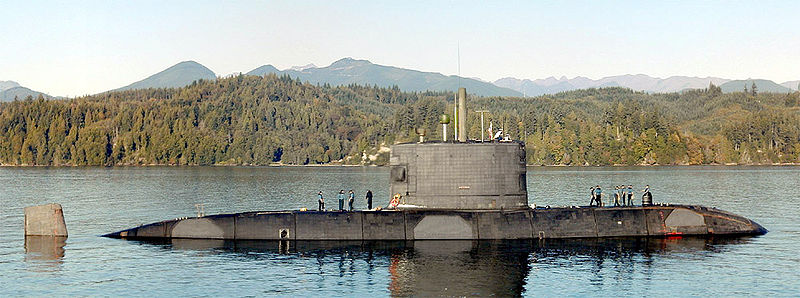
HMCS Victoria near Bangor. (Image from Wikimedia).

In spite of the tone of my comments in the earlier post (generally agreeing with Ivison’s criticisms), I’m pro-RCN and very much pro-submarine as part of our navy. But what we need are submarines that can perform the duties required, and ever since we acquired the Victoria class, they’ve signally failed to do this. Anyone who’s ever watched a WWII film or newsreel knows that submarines fire torpedoes — except the Victoria class, which still do not have effective torpedo armament. We bought these submarines in 1998. HMCS Victoria has been in commission since 2000 and we’re only just getting around to test-firing a torpedo later this year? This is insane.

Of course, it’s not fair to blame the RCN for all the problems: the government of the day bought the subs on the cheap and then didn’t fully fund the necessary repairs to bring the boats back into operation in a timely fashion (but the military may not have done proper due diligence before recommending the purchase, either). Today’s government may cut funding as part of the austerity budget we’re rumoured to be facing soon. If so, we can expect fewer days when any of our submarines are in the water, operational, and fully crewed.

February 29, 2012

Is it time to abandon the RCN’s submarine experiment?

Filed under: Britain, Cancon, Military — Tags: , , — Nicholas @ 00:05

John Ivison recounts the ill-fated story of the Royal Canadian Navy’s current submarines in the National Post:

The Liberal government bought four second-hand subs for $750-million from the British in 1998 and renamed them the Victoria class — HMCS Victoria, HMCS Windsor, HMCS Chicoutimi and HMCS Corner Brook.

Since then, billions more have been spent trying to “Canadianize” the subs, including thousands of dollars blown trying to stop pigeons roosting in them, such is the length of time they have been in dry-dock. At various times over the past 10 years, the whole fleet has been out of commission.

The history of Canada’s submarine fleet would be laughable, were it not so tragic. People in government at the time remember the surprise expressed by Liberal ministers that the Defence department accepted the British military’s statement of quality assurance, without doing their own due diligence. That the buyer should have been more wary quickly became apparent.

The Chicoutimi caught fire on her maiden voyage from Faslane in Scotland in October 2004, with the death of one sailor and smoke-inhalation injuries to nine others. The sub has been in dry-dock ever since and is scheduled to return to service in 2013, although some stories have suggested 2016 is more realistic and others that she may never again be operational.

I blogged about HMCS Chicoutimi at the old blog, when it was expected that she’d be back in service in 2010.

Last year, HMCS Corner Brook had what some wag at the Department of National Defence characterized as a “fender bender”:
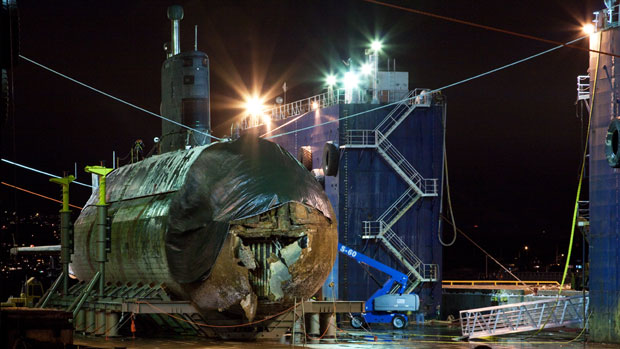
Some fender. The CBC reported on the extent of the damage:

The Canadian navy admitted that the submarine crashed off British Columbia in June, but it never described the extent of damage or released a photograph.

“I was gobsmacked. I had no idea that this level of damage had occurred,” said Senator Colin Kenny, the former head of the Senate defence committee. “That may explain why the navy took it out of the water at night.”

[. . .]

Some familiar with the submarine say its pressure hull, the area in which the sailors are housed, may be heavily damaged and that would mean the sub will never go to sea again.

“Canada needs a submarine fleet, and to have this boat not be available would be tragic,” Kenny said

The RCN claimed that there was no cover-up and that they have been completely above-board and “transparent” about the incident. It’s an odd definition of “transparency” that requires you to submit a formal Access to Information request to get the report — and the photos of the damage to the hull were censored from the report anyway.

Back in 2004, it was reported that our submarines were without torpedo armament, but that they would be “fully armed” by 2006. The CBC report mentioned in passing that eight years later, they’re still lacking torpedoes:

The navy said HMCS Windsor is to undergo trials “in the coming months” and is also expected to be back in operation later in 2012.

Not one submarine is capable of firing a torpedo, however the navy said Tuesday that a test firing of a torpedo from HMCS Victoria is planned for the coming weeks and the submarine is supposed to be operational this year.

Back to John Ivison:

In all this time, the fleet has hardly been crucial to our defence. According to people familiar with its role, it has spent time at sea monitoring fishing fleets and acting as “prey” for U.S. forces, who don’t have diesel-electric subs of their own and like to use ours for hunting practice.

Peter MacKay, the Defence Minister, recently lamented the decision to buy the British diesel-electric subs, which are not capable of diving below ice in the Arctic. “In an ideal world, I know nuclear subs are what’s needed under deep water, deep ice,” he mused.

That we do not live in an ideal world was quickly made apparent by Government House Leader Peter Van Loan, who all but disowned the fleet in a response to a question in the House. “There is no plan to replace the diesel-electric fleet purchased by the Liberals,” he said.

But if there is no plan to replace the fleet, is there a plan to scrap it?

[. . .]

The Navy defines “full operational capability” as having a weapons-ready sub on each coast. It has yet to put one sub to sea that meets that standard, a decade after the first one was received.

The hope is that two boats will be fully operational within two years, with a “swing boat” available to take over when one goes for refit. That may prove wildly optimistic. Submarines may be a useful addition to our battery of defences — but only if they work. And not at any cost.

These subs have proven themselves to be lemons, they are already past mid-life and the odds are against us having even three boats with operational capacity at any one time.

October 28, 2011

RCN may get nuclear submarines

Filed under: Cancon, Military, Technology — Tags: , , , — Nicholas @ 09:47

A report by the CBC on what may or may not have been a casual remark by Defence Minister Peter MacKay:

CBC News has learned the Harper government is considering buying nuclear submarines to replace its problem-plagued fleet of diesel-powered subs, all of which are currently awash in red ink and out of service for major repairs.

The four second-hand subs Jean Chrétien’s Liberal government bought from the British navy in 1998 for $750 million were portrayed at the time as the military bargain of the century.

Instead, they have spent almost all of their time in naval repair yards, submerging Canadian taxpayers in an ocean of bills now totalling more than $1 billion and counting.

[. . .]

High-ranking sources tell CBC News the government is actively considering cutting its losses on the dud subs, and mothballing some if not all of them.

Defence Minister Peter MacKay is hinting they might be replaced with nuclear submarines that could patrol under the Arctic ice, something the existing diesel-electric subs cannot do.

The deal of the century turned out pretty badly for the Royal Canadian Navy. Let’s hope that the next submarine deal won’t be quite as bad.

Update: At least Lorne Gunter can get some cheap laffs from our dehydrated subs:

Boy did the Brits ever see us coming in 1998 when the Chretien Liberals pulled up to Honest Nigel’s Used Submarine Shop looking to buy four underwater patrol boats. The quartet they sold us for the unbelievably low price of just $750 million have been up on blocks in our front yard almost ever since, with weeds growing out the portholes. I expect Canadian Pickers to come along anytime now and offer us $2,000 for the set, take it or leave it.

[. . .]

Let’s face it, the Limeys sold us lemons. If the Liberals had just agreed from the start to buy new nuclear subs, Canada would have spent about the same money ($3 billion), but we would have had subs we could have been using for the past 10 years already, with another 30 years to go. Now by the time we get our British diesel subs fixed, they will be 30 years old and have only about 10 years of serviceable life remaining. Moreover, they still won’t be able to sail under the North Pole and patrol the Arctic because they need air to feed their engines and no aspirated sub can stay underwater for the 14-21 days it takes to sail under the Polar icepack.

This is not unlike the Liberals decision in the same era to cancel the EH-101 helicopter contract. Breaking the deal signed by the Mulroney Tories in the early 1990s cost taxpayers $500 million, on top of which we had to buy new helicopters anyway. Pretty much the same helicopter at pretty much the same price.

October 24, 2011

Government to freeze Canadian Forces at current size and sell off surplus properties

Filed under: Cancon, Economics, Military — Tags: , , , — Nicholas @ 09:38

David Pugliese reports on the federal government’s announced freeze-and-sell-off in the Department of National Defence:

The size of the regular Canadian Forces will be frozen at 68,000 people for the next several years and the military and Defence Department will look at selling off property and shutting down facilities as part of its belt-tightening, according to documents obtained by the Ottawa Citizen.

The new directive from Chief of the Defence Staff Gen. Walter Natynczyk and Deputy Minister Robert Fonberg outlines in broad terms how DND and the Canadian Forces plan to deal with a tighter fiscal situation between now and 2016.

A national plan will be developed for DND’s property holdings, putting emphasis on only keeping sites that support operations, the directive notes.

[. . .]

DND’s property holdings are massive, comprising of approximately half of all federally owned buildings. They include various bases across the country. In total DND has 21,000 buildings and 800 parcels of land covering 2.25 million hectares.

That portfolio also includes a large number of buildings with cultural and historical significance to local communities. There are 318 buildings that are considered as heritage structures, including the Cartier Drill Hall in Ottawa, La Citadelle in Quebec City and the Seaforth Armoury in Vancouver.

But the reference to dumping property has some wondering whether base closures could be coming.

September 24, 2011

Canadian military: “the bureaucratic tail is wagging the Parliamentary dog”

Filed under: Bureaucracy, Cancon, Military — Tags: , , , — Nicholas @ 10:48

Christie Blatchford looks at the amazing ability of the military bureaucracy to frustrate, delay, obfuscate, and disobey their parliamentary masters:

Written by distinguished military scholar and veteran Dr. Jack English, it shows how the bureaucracy in Ottawa — an incestuous nest of regular army bosses with turf to protect and intractable civil servants — has consistently ignored or thwarted government directives to increase the size of the reserves.

What’s more, either those defence ministers whose pledges came to nought had the collective attention span of gnats, or they failed to grow a set of nuts sufficient to demand their instructions be followed, or they were simply shifted within Cabinet and the new fellow came in.

Any way you look at it, Dr. English says, the bureaucracy is calling the shots.

In the result, despite pledges to grow the reserves, the militia part-time head count remains still at about 16,500, or, as Dr. English wryly notes, about the size of National Defence Headquarters, or NDHQ as it’s called.

By the way, just getting the damn numbers out of NDHQ is a trick.

[. . .]

Virtually everyone who has studied the Canadian army, and their number is legion, agrees on a couple of things: The bureaucracy is obscenely bloated, far out of proportion for the size of the army; the citizen soldier, who until called up to full-time service costs only about 20% of the regular one, is a bargain for the taxpayer; the militia is more diverse, ethnically and otherwise, than the regular army.

August 16, 2011

Renaming isn’t enough

Filed under: Cancon, Military — Tags: , , , , , — Nicholas @ 07:51

The National Post editorial board insists that mere renaming for the Royal Canadian Navy and the Royal Canadian Air Force isn’t enough:

Should the unified Forces be replaced by the three original branches, as is expected from Tuesday’s announcement, many members of the military, past and present, will be delighted and indebted to the Conservatives for restoring the honour and pride of their beloved Navy, Army and Air Force. And if the move is limited to new flags and a nod to history, it is indeed something that Canadians should applaud.

But there is danger in allowing symbolic gestures to supplant firm, material support. It is ironic that the government seems set to make a symbolic move to please serving and retired naval personnel when the naval branch of the Canadian Forces is struggling to sustain itself for want of money and manpower, and operates a fleet of vessels in desperate need of modernization. The navy’s list of woes include losing more than 1,100 full-time members since 2004, despite the continued high demand for its services, a submarine fleet that is essentially undeployable and incapable of firing Canada’s stockpiled torpedoes, 40-year-old supply ships and helicopters that are overdue for replacement, and obsolete, elderly air-defence destroyers.

The government intends to begin a major shipbuilding program to replace dozens of navy and coast guard vessels within the next several years, but warships take a long time to build. It will be years before new vessels enter service or receive needed upgrades. The air force is also in need of major equipment purchases (the controversial F-35 purchase being the best known example) and even the army, despite investments made during the war in Afghanistan, needs more troops and equipment.

August 15, 2011

Navy and Air Force to be “Royal” again?

Filed under: Cancon, Government, Military — Tags: , , , , , , — Nicholas @ 14:12

Andrew Coyne linked to this article at the Huffington Post:

Canada’s navy and air force will get a royal name change Tuesday, The Huffington Post Canada has learned.

The Conservative government plans to announce that Maritime Command and Air Command, the official names of the two Canadian Forces’ units, will be returned to Royal Canadian Navy and Royal Canadian Air Force, monikers last used in 1968. Simultaneous announcements on the name change are planned for Tuesday in Halifax, Kingston, Valcartier, Que., Cold Lake, Alta., and Esquimalt, B.C.

The Canadian army, which is officially called Land Command, will also be renamed simply Canadian Army.

The change is mostly symbolic and won’t affect how the Canadian Forces are run.

It may be “mostly symbolic”, but symbols matter.

Up yours, Mr. Hellyer.

« Newer Posts

Powered by WordPress


