Quotulatiousness

April 26, 2011

Americans really are jaded about their politicians

Filed under: Politics, USA — Tags: , , — Nicholas @ 08:59

A survey from Rasmussen shows that many Americans think of their political representatives as little better than scum:

Mark Twain once said, “It could probably be shown by facts and figures that there is no distinctly native American criminal class except Congress.” A large number of Americans share that skepticism.

A new Rasmussen Reports national telephone survey finds that 43% of the nation’s voters believe that most members of Congress are corrupt. Only 27% disagree and doubt that most national legislators are that dishonorable. Thirty percent (30%) are not sure.

Interestingly, there’s little difference of opinion on this question between Republicans and Democrats. But voters not affiliated with either of the major parties are more doubtful: 51% think most members of Congress are corrupt.

That’s got to be an affront to the honest politicians . . . the other 91% are giving them a bad reputation:

Only nine percent (9%) of voters now say Congress is doing a good or excellent job. Fifty-six percent (56%) rate its performance as poor.

April 25, 2011

Majority in reach for Harper, if Ontario numbers hold up

Filed under: Cancon, Politics — Tags: , , , — Nicholas @ 11:17

The latest Nanos/Globe & Mail poll shows that the Conservatives might just be able to reach majority status if the Ontario numbers stay steady for the final week:

Nationally, the NDP is statistically tied for second place with the Liberals. But another story is emerging out of Ontario, where they are running third; the party’s surge in Quebec and other regions has not given it a similar bump in Ontario.

Pollster Nik Nanos sees this as a boon for the Tories — one that could well provide the Conservatives a route to that coveted majority.

“Talk about Jack Layton in Stornoway has actually helped the Conservatives in Ontario,” Mr. Nanos said Monday. “The Conservatives best chance to win a majority is in Ontario. If their numbers hold or start ramping up in Ontario that could be good news for the Conservatives. One of the scenarios that we could be looking at now is a squeaker of a majority government.”

Of course, the regional numbers are subject to a larger margin of error:

There is a margin of error of plus or minus 64 percentage points, 19 times out of 20, for the provincial sample.

I hope there’s a decimal place somewhere in that MoE.

April 24, 2011

Latest poll shows Liberals in statistical tie with NDP

Filed under: Cancon, Politics — Tags: , — Nicholas @ 12:41

If you wanted an interesting election, this one is certainly shaping up as the most interesting in the last ten years:


April 21, 2011

News topic for today: the rise in NDP support in Quebec

Filed under: Cancon, Politics — Tags: , , , , , , — Nicholas @ 08:04

It may be just another blip in the polling, or it could really be the NDP benefitting from weaker BQ numbers. Lots of trees will be consumed in this debate, and many electrons will be inconvenienced. The national numbers don’t show the pattern all that well, but the NDP may finally be close to that popularity breakthrough they’ve been hoping for since the brief taste of power they got in the Trudeau years. Instead of asking the Liberal leader how many NDP cabinet seats he’d need to give to Jack Layton, we might be asking Jack how many Liberal cabinet ministers he’d have in his coalition.

Jack Layton’s New Democratic Party has surged past Gilles Duceppe’s faltering Bloc Quebecois and is now in first place in Quebec, according to an Ekos public opinion poll released exclusively to iPolitics.

The poll, conducted earlier this week, found the New Democrats have jumped 10 percentage points since the eve of the leaders debate to 31.1% while the Bloc has dropped like a rock by 7.4 percentage points to 23.7%.

The Liberals are steady at 20.6% while the Conservatives have dropped slightly to 16.9%.

While the margin of error is higher at the city level, in Montreal the NDP is at 32.9% while the Bloc is at 29.7%.

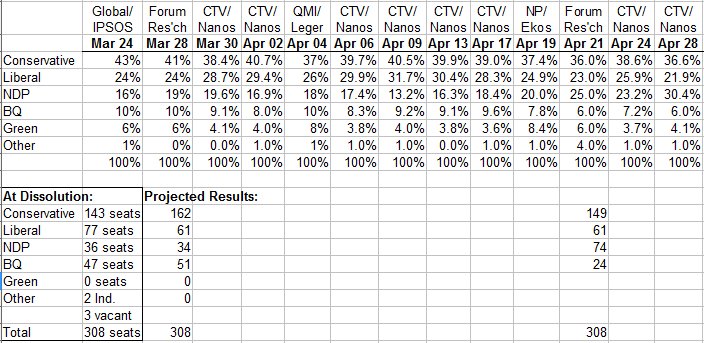
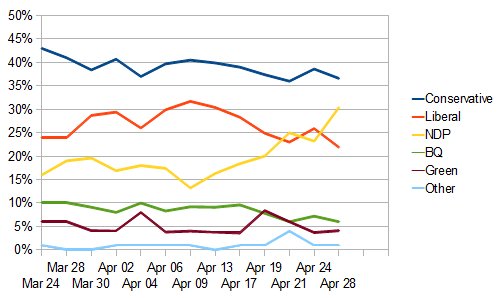
Nationally, the NDP is now in a statistical tie with the Liberals at 24.9% to 25.8%. Both lag well behind the Conservatives who were preferred by 34.5% of respondents.

Update: Jane Taber has more on the regional breakdown:
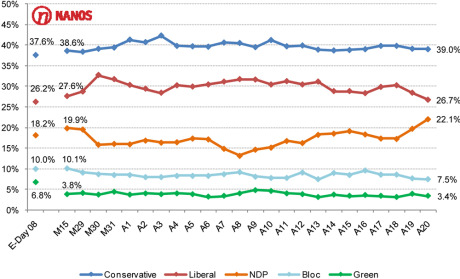
Atlantic Canada now is shaping up to be a three-way race, with the NDP gaining every day for the past seven days. The Tories are at 36.3 per cent followed by the Liberals with 33.1 per cent and the NDP at 28.3 per cent. (There is a margin of error of plus or minus 9.7 percentage points, 19 times out of 20 in the regional sample.)

In British Columbia, the Liberals have dropped significantly — Mr. Ignatieff has seen his support decrease from 33.5 per cent Monday to 22.7 per cent Wednesday night. The Conservatives have 43.5 per cent support and the NDP are at 29.6 per cent, up from 24.7 per cent the night before. (The margin of error in that province is plus or minus 7.9 percentage points, 19 times out of 20.)

In Quebec, Mr. Layton remains strong although the Bloc is still in first place with 32 per cent support compared to 23.4 per cent for the NDP, 20.8 per cent for the Liberals and 17.5 per cent for the Conservatives. “At 32 per cent it would be the worst ever showing for the BQ in a federal election,” Mr. Nanos said, noting that their previous worst showing was in 1997 where they won 37.9 per cent of the vote.‬

If all of this isn’t just a blip, it’s terrible news for Michael Ignatieff. That grinding noise you hear is the knife-sharpening back at Liberal HQ.

Update, the second: If the initial news was promising for Jack Layton, the poll done for La Presse must have been like a big shot of adrenalin:

A new poll by CROP for La Presse suggests that the enthusiasm for Mr. Layton is such that the NDP has now overtaken the Bloc Québécois in voting intentions for the first time in Canadian history. The online poll suggested that the NDP is now first choice for 36% of Quebecers, compared to 31% for the Bloc, 17% for the Conservatives and a mere 13% for the once mighty Liberal Party.

Having heard the NDP boast about “historic breakthroughs” over the years, I’m loath to get too carried away until these numbers are confimed by other pollsters. In 2008, Mr. Layton was in a statistical tie with Stéphane Dion two weeks before election day but ended up trailing by eight points and 40 MPs.

Yet there are signs this time might be different. In Quebec in particular, the Liberal brand is damaged goods and the Bloc is looking like a tired, one-trick pony. There is nowhere else to go for left-of-centre voters.

Update, the third: Forum Research says that the NDP is already in second place nationally:

“The Tories are ahead everywhere except Quebec, it’s all going to come down to what happens in Quebec,” says Mr. Bozinoff, noting the tradition of Quebec voters to move en masse when they have sharply changed preferences in past elections.

The survey of 2,727 voting-age Canadians was conducted Wednesday evening. It was an interactive voice response survey with a margin of error of plus or minus 2.2 per cent 19 times out of 20. The margin of error for regional and provincial breakdowns is slightly higher, but in such a large survey, with 348 citizens reached in the GTA alone, it is a reliable indicator of election trend lines.

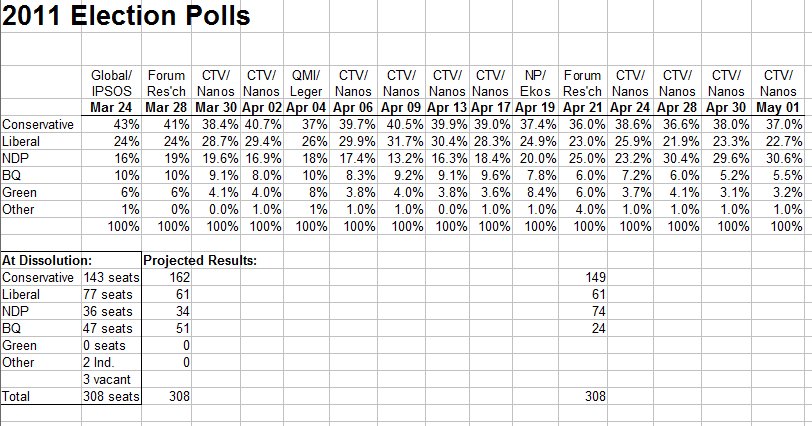
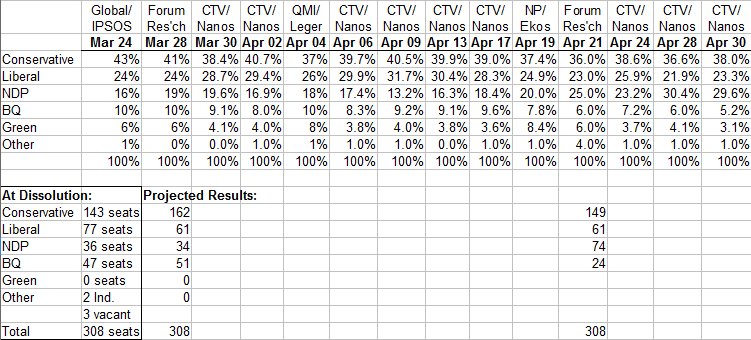
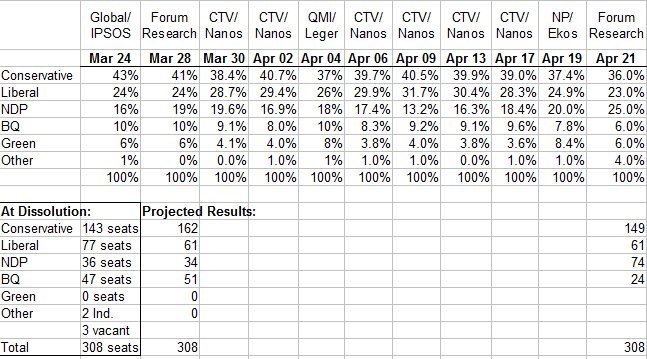
Nationally, the survey gave the Conservative Party support from 36 per cent of decided and leaning voters, 25 per cent for the NDP, 23 per cent for the Liberal party, and six per cent each for the Green Party and the Bloc Québécois. A separate Forum Research analysis, based partly on ridings won and lost in the 2008 election, suggest the survey results would give the Conservatives 149 of the 308 Commons seats if an election were held today, with 71 seats for the NDP, 64 for the Liberals and the Bloc Québécois would have 24 seats.

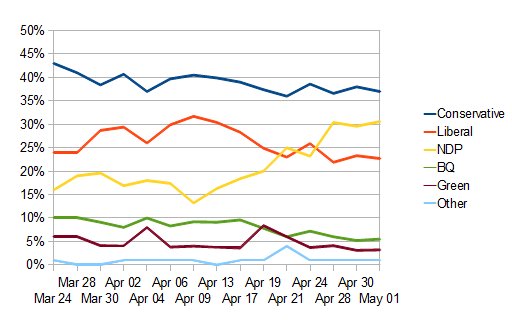
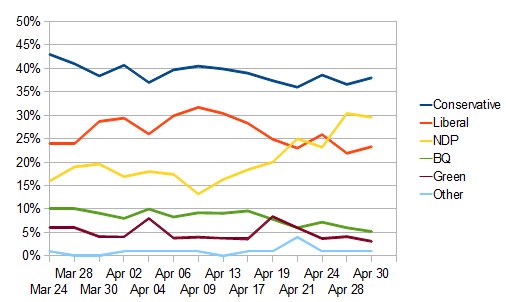
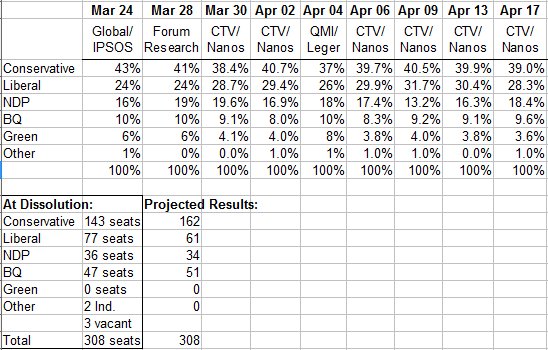
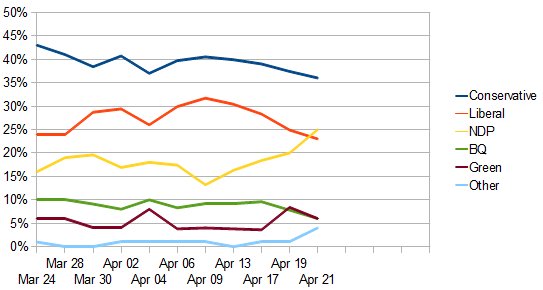
My occasionally updated percentage tracker, now (thanks to commenter request) with a graph to match:

April 17, 2011

Latest polling data

Filed under: Cancon, Politics — Tags: , — Nicholas @ 09:38

April 15, 2011

Finnish election still up for grabs

Filed under: Europe, Politics — Tags: , , — Nicholas @ 15:11

Remember I mentioned the “True Finns” party in passing last week? The election is this weekend and it looks like a four-way race:

Finland votes on Sunday in its most closely watched general election in years, with the campaign hijacked by a Eurosceptic maverick riding roughshod over the consensus that has long characterised the country’s politics.

Timo Soini has alarmed the European and Finnish elites by leading his True Finns party into a neck-and-neck position with the three mainstream parties that traditionally dominate Finnish politics.

The quadrupling of support for the True Finns since the last election in 2007 puts Finland firmly in line with the cardinal trend in politics across Europe in the past year — the emergence of the populist far right combining nostalgia for disappearing values and traditions with anti-immigrant and anti-EU appeal.

An opinion poll on Friday put the True Finns at around 16% in a coalition system, soaring from 4% in 2007 albeit sliding a little from their position in surveys last week. That put True Finns neck and neck with the Centre party of the prime minister, Mari Kiviniemi, and the opposition social democrats, and a few points behind the poll leaders, the National Coalition party led by the finance minister, Jyrki Katainen.

April 13, 2011

Surprisingly little movement in the polls

Filed under: Cancon, Politics — Tags: , — Nicholas @ 12:07

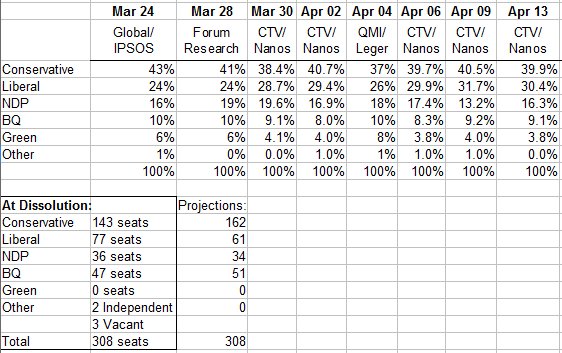
So far, based on the three-day sample Nanos works with for their daily poll release, there hasn’t been a lot of identifiable shifting support among the parties in spite of the leaked AG report:

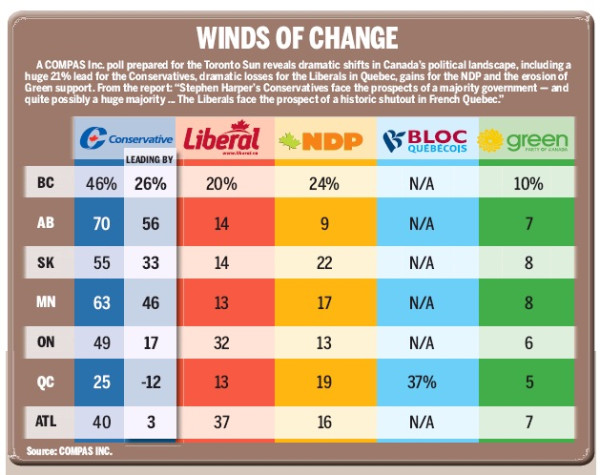
Update: Of course, not all polls agree, but the Compas poll for the Toronto Sun has radically different numbers based on the regional breakdown:

H/T to David Akin for the image (via Twitpic).

Leaders’ debate provides no significant changes

Filed under: Cancon, Media, Politics — Tags: , , , , , — Nicholas @ 07:26

I didn’t bother watching the first debate on TV last night, as I didn’t think there would be any purpose in doing so. Lots of people seem to have felt the same way, as polling immediately after the debate showed little change in support:

It was Stephen Harper’s debate to lose — and he did not.

It was Michael Ignatieff’s debate to win — and he did not.

A poll done exclusively for QMI Agency immediately after Tuesday night’s English-language debate shows that English-speaking Canada was, by and large, unmoved by the two-hour duel among the four party leaders.

Asked who won the debate, 37% of those surveyed by Leger Marketing said Harper was the victor. About 21% said Ignatieff won.

Those numbers roughly mirror voter support in polls Leger has done before and during the election campaign.

April 9, 2011

Latest poll: Liberals up, NDP down

Filed under: Cancon, Politics — Tags: , — Nicholas @ 11:22

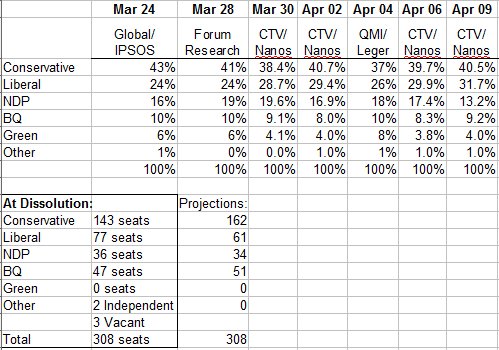
The Liberals appear to the party primarily benefitting from a slackening in NDP support:

April 6, 2011

Latest polling results

Filed under: Cancon, Politics — Tags: , — Nicholas @ 07:46

April 4, 2011

Politics: Tories have terrible week, yet are up to 14 point lead

Filed under: Cancon, Politics — Tags: , — Nicholas @ 09:34

The most useful polling right now is coming from Nanos Research, who are conducting daily summaries of the previous three-day trend. After getting slapped around by the press much of last week, the Conservatives are . . . the only party making gains over the last three days:

  • Conservative: 42%, up 1.6%
  • Liberal: 28%, down 1%
  • NDP: 16%, down 0.5%
  • Bloc Quebecois: 8%, unchanged
  • Green: 4%, down 0.2%

The Twitter reactions are . . . surprised. Paul Wells “If the Conservatives lost week one and gained four points, the Liberals can’t afford to win many more weeks.” Andrew Coyne “Another such victory and I come back to Epirus alone.”

Updating the non-scientific, unbalanced sample of published polls:

March 30, 2011

Nanos poll for CTV/Globe still shows large Tory lead

Filed under: Cancon, Politics — Tags: , , , — Nicholas @ 10:25

The latest election poll is from Nanos, conducted for CTV and the Globe and Mail. The numbers show a smaller lead for Stephen Harper’s Conservatives, but it’s still ten percent over Michael Ignatieff and the Liberal party:

Nationally, the Conservatives are in front with 38.4 per cent. The Liberals are 10 points behind at 28.7 per cent, followed by the NDP at 19.6 per cent, the Bloc Quebecois at 9.1 per cent and the Greens at 4.1 per cent.

In comparison, a March 15 Nanos survey found the Tories at 38.6 per cent, the Liberals at 27.6 per cent, the NDP at 19.9 per cent, the Bloc at 10.1 per cent and the Greens at 3.8 per cent.

[. . .]

Pollster Nik Nanos said there’s reason for disappointment in the numbers for both the Conservatives and the Liberals.

For the Tories, it shows that so far Stephen Harper’s campaign for a majority mandate is not attracting enough support to actually win a majority of seats when Canadians vote again on May 2.

For the Liberals, Mr. Nanos noted that Michael Ignagtieff’s team might have expected its numbers to improve with the added attention that comes from a campaign, and the fact that they are now running TV ads in heavy rotation.

The Nanos numbers put the Conservatives back down in minority territory, unlike the two previous polls which indicated a majority government.

March 28, 2011

Tory lead still holding in latest poll result

Filed under: Cancon, Politics — Tags: , — Nicholas @ 15:39

So far, the opposition hasn’t been able to make much headway against that strong Conservative lead:

2011 Election poll results for 28 March

Here’s a summary from Kathryn Blaze Carlson:

The first poll since Saturday’s election call shows Tory support largely unchanged, bringing into question the opposition’s early emphasis on ethics.

Despite a weekend of being hammered for their alleged contempt of Parliament, the Conservatives boast the support of 41% of decided voters — 17 points ahead of the Liberals, who are at 24%. The NDP is at 19%, and the Bloc 10%.

The Forum Research poll also breaks it down by seat count, suggesting that if the election were held today, the Tories would surge from 143 seats to 162 seats, the Liberals would drop 17 seats to 61, the Bloc would rise from 44 to 51 and the NDP would be whittled from 36 seats to 34. The poll, conducted over the weekend via telephone with a random sample of 2,095 voters, is within the range of approximately plus or minus 10 seats for each party.

The seat projections reflect the regional strength of the BQ, who only run candidates in Quebec, and the natural disproportion of first-past-the-post voting.

Update: Publius points out the real root of Canada’s election issues:

Unfortunately neither you, nor any of the party leaders, have the temerity to admit what is actually wrong with Ottawa. Let me give you a hint. It’s not Stephen Harper’s pragmatism. It isn’t Lord Iggy’s incompetence. Not even Jack Layton’s spend till you’re broke ideology. The problem with Ottawa is Quebec. Gilles Duceppe and the Bloc Quebecois are merely the symptoms. Our national democracy is broken because part of the electorate refuses to participate.

In the 2006 and 2008 federal elections there were 308 seats up for grabs. That’s 75 in Quebec and 233 in the Rest of Canada (ROC). The 2006 election saw the Conservatives win 114 seats in ROC and 10 in Quebec. The Conservatives did better in the ROC in 2008 winning 133 seats and holding on to their seats in Quebec. If we were to remove Quebec’s 75 seats from Parliament a majority government could be formed with 117 seats. On that basis, including only their ROC seats, the Harper Tories would have won a strong minority government in 2006 and a clear majority in 2008. To say, as the opposition parties and the MSM have, that Harper has failed to seal the deal with Canadians is only partially correct.

For all his faults, chronicled in some detail on this blog over the years, Stephen Harper has in fact convinced a critical mass of the interested Canadian electorate of his fitness to lead us. Those who vote for the Bloc Quebecois have declared their disinterest in Canada as a working proposition.

The Bloc Quebecois are not political party in any meaningful sense but merely a pressure group that has won election to parliament. It is because of this we find ourselves in a series of weak hung parliaments. The BQ offers no vision for Canada, only its potential destruction. It’s bargaining position with the other parties in recent parliaments has been of routine blackmail. Vote what is in the best interests of Quebec, or else.

March 25, 2011

Polling numbers

Filed under: Cancon, Politics — Tags: , — Nicholas @ 09:54

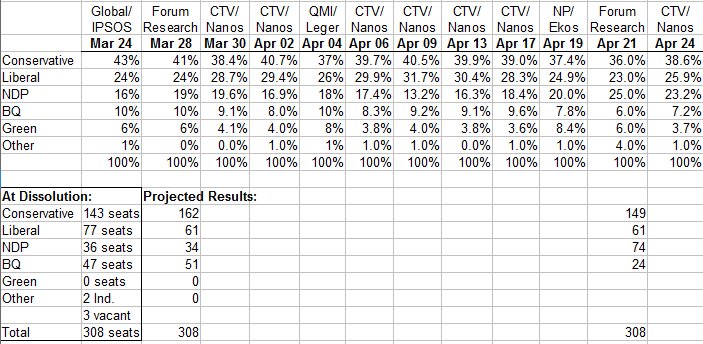
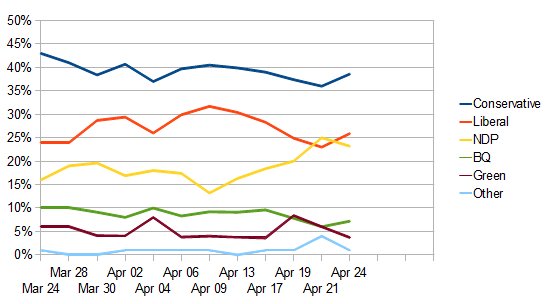
The poll numbers will change over the course of the election as muck is raked, accusations are hurled, and reputations are assailed (assuming that the Conservative government is defeated in Parliament later today). The last poll was conducted by IPSOS for Global News:

I’ll try to update this chart as the polls are published. I doubt that the 19% lead the Tories had yesterday will hold up for the first few days of the election campaign, but anything is possible.

Update: As expected, the government has fallen, so the election is on. Tasha Kheiriddin congratulates the media on their success:

And they’re off. In newsrooms across the country, journalists are tossing their Team 2012 shirts on the trash heap, while the Team 2011 folks are collecting their $5 bets. Sure, they could have cashed in on Tuesday, but it’s always prudent to wait for the chickens to actually hatch. Or, in this case, come home to roost. After stoking election fever for months, the media now get to feast on the fruits of their labors: bad plane food, no sleep, and crazy deadlines.

March 22, 2011

“He is kind of like a rock star, a nerdy professor, and your crazy uncle rolled into one”

Filed under: Economics, Liberty, Politics, USA — Tags: , , , — Nicholas @ 09:22

Andrew Foy tries to place Ron Paul in the context of the modern Republican Party:

In his recent editorial “The Fighters vs. the Fixers,” appearing on National Review Online, Jonah Goldberg discussed what I suspect is his crop of contenders for the upcoming election: Tim Pawlenty, Mitch Daniels, Mitt Romney, Sarah Palin, Newt Gingrich, and Mike Huckabee. Considering that Paul smoked all of these candidates in the 2011 CPAC straw poll, where he garnered 30% of the vote, it was an odd choice to leave him out, and even more so when you account for the fact that Goldberg’s recently edited book Proud to be Right: Voices of the Next Conservative Generation featured several essays in which the authors expressed strong libertarian points of view.

Ah, but that CPAC straw poll was explained away as “Paultards” packing the event, which no other candidate would ever do, so the poll result was therefore invalid. Oh, and lots of chatter that Paul supporters would not be welcome to the next CPAC.

. . . Paul is an outspoken advocate of Austrian economics. Without being an economist myself, I would say that this economic school of thought argues against econometric models, state planning, bailouts, economic stimulus, and the monetary policy of the Federal Reserve. One of the hallmarks of Austrian economics, for which Hayek won a Nobel Prize, is the view that central banks create asset bubbles and hence the business cycle. Austrian economics predicted the recent housing collapse and economic recession when the mainstream economists and politicians, to whom we’re still wedded, were telling us that everything was “A-okay.”

In a 2007 address to the American Economic Association, Bernanke proclaimed, “The greatest external benefits of the Fed’s supervisory activities are those related to the institution’s role in preventing and managing financial crises. In other words, the Fed can prevent most crises and manage the ones that do occur.” A year later, we were mired in the biggest financial collapse since the Great Depression. While the great majority of politicians today (Democrats and Republicans) are happy to heed the advice and inflationary policies of the Fed, such as QE2, Paul is a lone voice in the wilderness crying foul. Conservatives should welcome his dissent.

« Newer PostsOlder Posts »

Powered by WordPress