[poll id=”2″]
February 23, 2011
Poll question: how would you vote if a federal election is called
November 21, 2010
Airline execs will hate to see these results translated into dollars
Reuters has a poll up with current numbers that will send a chill down the spine of airline executives:

Yes, yes . . . self-selected poll . . . non-scientific . . . etc, etc. Even so, it might be a good time to review your stock portfolio in case you’re over-exposed to airline share prices.
September 8, 2010
Ignoring the “don’t know” faction
Michael Blastland thinks there’s a serious issue with how pollsters do their work:
I don’t know about you, but quite often there seems to me only one sensible answer the questions posed in these attempts to canvass opinion: I don’t know.
But that’s not really what I mean. What I really mean is: “it depends”. And for that reason, I might not answer.
Yet the standard way for pollsters to treat people like me is to ignore them.
“Excluding don’t-knows and no answers” say the reports, before telling us that most of us think we should or shouldn’t do this or that. It’s as if the “don’t knows” haven’t been paying attention while the “no answers” don’t care.
Strip out the apathetic and the ignorant and see what’s left, they seem to say.
But isn’t it at least arguable that we’ve thought about it and decided uncertainty is the best response?
Lots of issues don’t fall into easily classified answers, and pollsters often take the easy way out and provide one or two obvious answers (usually tailored to the interests of the commissioning organization, of course), and leave people with a more nuanced view out of the equation.
August 9, 2010
Not news: many Americans prefer religious to scientific answers
Scientific American pretends to be surprised by these findings:
When presented with the statement “human beings, as we know them today, developed from earlier species of animals,” just 45 percent of respondents indicated “true.” Compare this figure with the affirmative percentages in Japan (78), Europe (70), China (69) and South Korea (64). Only 33 percent of Americans agreed that “the universe began with a big explosion.”
Consider the results of a 2009 Pew Survey: 31 percent of U.S. adults believe “humans and other living things have existed in their present form since the beginning of time.” (So much for dogs, horses or H1N1 flu.) The survey’s most enlightening aspect was its categorization of responses by levels of religious activity, which suggests that the most devout are on average least willing to accept the evidence of reality. White evangelical Protestants have the highest denial rate (55 percent), closely followed by the group across all religions who attend services on average at least once a week (49 percent).
I don’t know which is more dangerous, that religious beliefs force some people to choose between knowledge and myth or that pointing out how religion can purvey ignorance is taboo. To do so risks being branded as intolerant of religion.
H/T to Doug Mataconis for the link.
August 4, 2010
Canada’s (lack of) abortion rules
Apparently lots of Canadians think that the country’s laws are far more restrictive of abortion than they really are:
Two-thirds of Canadians do not know that Canada has no abortion law, according to a new poll that indicates Canadians are woefully misinformed about a landmark ruling in the country’s history.
The poll, which asked 1,022 Canadian adults about their understanding of the country’s abortion regulations, found that just 22% of Canadians correctly identified a woman’s right to an abortion with no governmental restrictions. Canada has not had legislated abortion rules since 1988, making the country an “absolute outlier” on the issue, according to a medical ethicist.
“There’s really only a very small number of Canadians that correctly identify the current situation in Canada,” says pollster Jaideep Mukerji, who worked on the Angus-Reid poll, which was released on Tuesday. “That could be problematic.”
This was highlighted over the last couple of months, with the government and opposition wrangling over Stephen Harper’s initiative to increase funding for maternal health in the developing world. Because opinions widely differ over what the law covers in Canada, it was easy for the opposition to portray Harper’s plan as being ideological rather than humanitarian due to the exclusion of abortion.
Canadians don’t want to re-open the debate, although most appear to want more restrictions in place.
July 9, 2010
Poll numbers understate unhappiness with police over G20
Publius makes a very good point here:
The Greater Toronto Area holds a population of about 5.6 million, stretching from Burlington in the west to Oshawa in the East. The City of Toronto comprises less than half the total population, and less than one-tenth of the total land area. The summit, protests and general mayhem occurred in the downtown core, itself a small area of the City of Toronto. In the lands north of Bloor, west of Bathurst and East of the Don River, the summit meant traffic delays, not riot cops.
Travelling on the 400 series highways that weekend entailed some delays — much of the Gardiner Expressway was closed — and the most notable police presence was at highway interchanges and on / off ramps. Even for those who live in the City of Toronto itself, the vast majority saw the violence of the summit weekend on television. A large number of Torontonians had simply evacuated the City altogether, either to the suburbs to stay with relatives, or to cottage country. As a result, the images fixed in most Torontonians minds are of police cruisers burning — played again and again — and not of officers dragging middle aged men with prosthetic legs across city streets. As the stories of that weekend seep out, expect those poll numbers to change.
I was one of those who chose not to hang around in the city for the entire week leading up to the summit: I didn’t see the point in putting up with the delay and hassle. I still think it was a remarkably stupid idea to hold the G20 meetings in downtown Toronto, and that the police were handed a duff hand to play. But even given that, the police played their hand very badly.
There may or may not be a serious inquiry into the affair, but the police lost a lot of support between Friday night and Saturday night: letting the geeky nihilists get away with dramatic street theatre on national TV, then turning around and arresting innocent bystanders. It took remarkable effort to squander public support, but the police or the politicians directing the police managed to do it. Bureaucratic bipolar disorder isn’t pretty.
May 29, 2010
Random links
- Ceremony on the 70th anniversary of the Dunkirk operation.
- P.J. O’Rourke suggests a new way to make newspapers relevant: pre-obituaries.
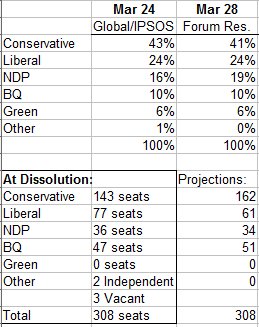
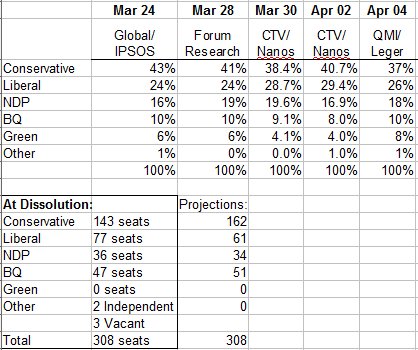
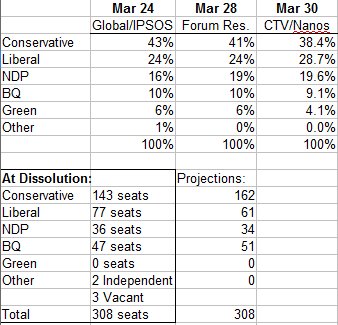
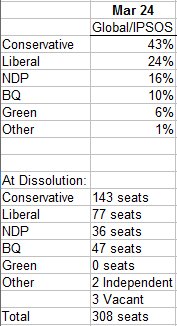
- Federal Tories increase their lead over the Liberals. But don’t expect an election call: they’re back to the same margin that delivered a minority last election.
- That “crazy, hateful, fringe lunatic Ron Paul voted” to eliminate the Don’t Ask, Don’t Tell policy in the US armed forces.
- Who’s afraid of cannabis? The Taliban.
April 20, 2010
No wonder that “sexy librarian” meme got started
It’s all there in the 1992 study, recently made available on the web:
A 1992 survey of 5,000 U.S. librarians, long withheld by a professional journal, found one in five respondents had engaged in sexual trysts among the stacks.
Will Manly, who said the New York-based Wilson Library Bulletin withheld the results of his survey in 1992, published results recently on his Web site indicating 51 percent of librarians in the early 90s were willing to pose nude for money and 61 percent of respondents admitting to renting an X-rated film, the New York Daily News reported Monday.
H/T to Radley Balko for the link.
April 14, 2010
February 12, 2010
Careful wording of poll questions significantly influences responses
I know, “duh!”
But most people don’t know how much the choice of questions does influence the outcome of polling. This is a perfect example:
As the Obama administration proposes repealing the policy known as “Don’t Ask, Don’t Tell,” a new New York Times/CBS News poll finds that a majority of the public support allowing openly gay men and women to serve in the military.
There’s less support, however, for allowing homosexuals to serve openly.
Confused?
The results highlight the importance of wording on the issue. In a test, half of the poll’s respondents were asked their opinion on permitting “gay men and lesbians” to serve, and the other half were asked about permitting “homosexuals” to serve.
The wording of the question proved to make a difference. Seven in 10 respondents said they favor allowing “gay men and lesbians” to serve in the military, including nearly 6 in 10 who said they should be allowed to serve openly. But support was somewhat lower among those who were asked about allowing “homosexuals” to serve, with 59 percent in favor, including 44 percent who support allowing them to serve openly.
This is a very simple example. It can get a lot more sneaky:
December 31, 2009
October 23, 2009
When a poll goes very wrong
Lester Haines reports on a poll that didn’t go quite as the sponsors expected:
An online poll enquiring as to the possible existence of God has somewhat backfired on Christian outfit The Alpha Course, with 98 per cent of the popular vote currently saying he doesn’t:
According to the Sun, The Alpha Course kicked off a multi-million pound advertising campaign back in September to promote its particular road to enlightenment, described as “an opportunity for anyone to explore the Christian faith in a relaxed setting”.
The poster and ad drive was a response to a Humanist Society campaign last year suggesting there was “probably no God” – a view shared by the vast majority of the 154,500 online votes at time of publication.
September 24, 2009
Polls and the 25% nutty fringe
Over at The Crossed Pond, Brad put together an interesting statistical post contrasting the “Birthers” with the “Truthers”:
Generally, I out-of-hand dismiss poll results under, say, 25% meant to imply that a party, country, or demographic are stupid or out of touch. Because almost always, those poll results are entirely without context. X% of Republicans believe Bill Clinton killed Vince Foster. OMG! Y% of Icelanders believe in pixies! What morons!
The fact of the matter is, if you poll any demographic on the right question, you can find a good chunk of them who believe in really dumb things. [. . .]
But, according to my own general yardstick for such things, Trutherism falls about where I would expect it to — in the general range common to any nutty proposition. Roughly the same amount of Democrats believe in Trutherism as people believe in vampires. That says much less about Democrats than it does about the crazy shit people are inclined to believe.
On the Birther question, however, we’re pushing past the normal range of nuttiness, and are getting a bit more mainstream, at least in the Republican ranks. About twice as many people believe in Birtherism as I would expect them to applying my general rule of thumb. In other words, it’s something more than run-of-the-mill crazy.
What bothers me a bit more about this sort of thing entails my own assumptions about crazy thoughts, and is based on what one might call the galaxy of nuttiness that comes in the Truther/Birther package. For example, a Truther, and I’ve known many, will generally have a constellation of other beliefs that sort of goes part-and-parcel with Trutherism, and tends towards a fanatical skepticism about government in general. That often leads to them being “don’t tread on me” style libertarians, ala Ron Paul, or “the government is out to get you” conspiracy theorists ala Alex Jones. Birtherism, and I’ve known less but enough to generalize, tend towards a much more cultural/racial/religion based constellation of thoughts — there are Good Decent Americans and then there are the rest of them, from horrifying illegal immigrants to muslims demographically taking over Europe and about to instantiate Sharia law, etc. etc, which generally leads them into a weird tribalistic culture war crouch, ala “we are being taken over by Others” culturists/racists ala Lou Dobbs, or “there is a conspiracy to subjugate the American way of life” hysterics ala Glenn Beck.