Quotulatiousness

February 25, 2012

Offensensitivity now unites the west and Islam

Filed under: Asia, Media, Religion — Tags: , , , , — Nicholas @ 09:44

Brendan O’Neill on the current wave of outrage in Afghanistan over the “Koran burning” incident:

Yet the present bizarre Koran-burning controversy in Afghanistan has shot down in flames this comforting but misleading idea that “they” are dramatically different from “us”.

Because what the furore over some holy books accidentally burned by NATO confirms is that, in truth, these alleged “weird beards” are in thrall to the same PC culture of complaint that has Western society in its grip.

[. . .]

But the great uniter of the East and West today, the thing that binds Muslim extremist and Western liberal, is a profound belief that to be offended is the worst thing, and that whoever dares to cause offence must be made to pay.

[. . .]

Ironically, these pretty craven apologies from NATO and the Obama administration for an innocent mistake made by two NATO personnel are likely only to have inflamed the protests.

Because, as is the case over here, in our ever more touchy and sensitive societies, when you tiptoe around a certain group of people, when you buy into the idea that offending cultural sensibilities is the greatest sin of our age, you actually give people a licence to feel offended.

When you apologise for causing offence and promise never, ever to do it again, you give succour to the idea that offensiveness is a unique and terrible evil, and you flatter the ostentatious offence-taking of groups who wish to be protected by a moral force-field from public debate or ridicule.

In effectively reorienting its Afghan mission around improving the PC credentials and Islamic empathy of its troops, NATO is unwittingly giving a green light to easily offended agitators, boosting their belief that offensiveness is evil and must be quashed. NATO has made itself a hostage to fortune, giving Afghan radicals a licence to go mental at the next whiff of any slight, whether intentional or accidental, against Islam.

January 5, 2012

Double-jeopardy falls to political correctness

Filed under: Britain, History, Law, Liberty — Tags: , , , — Nicholas @ 10:14

Brendan O’Neill on the terrible precedent of a recent British government decision and it’s most recent mis-use:

On Nick Ferrari’s breakfast show on London’s LBC radio this morning, I argued that all the people describing this case as a victory for justice are overlooking the fact that it is a victory built upon the wreckage of some pretty important legal principles. One longstanding legal protection in particular — the double jeopardy rule, the idea that no one should be tried twice for the same crime — had to be dismantled in order to get Dobson back in the dock. Having been acquitted of the murder of Lawrence in 1996, Dobson was what we used to call ‘autrefois acquit‘, previously acquitted, which in the past would have meant that he could not have been tried for the murder a second time. That all changed in 2003, when New Labour ditched the double-jeopardy rule.

[. . .]

Double jeopardy is the elephant in the room of the Dobson and Norris conviction. Sure, journalists are mentioning it, usually in fluffy factboxes titled ‘How this case came to court’, but no one wants to discuss it in detail. No one wants to discuss the extraordinary amount of history and progressive tradition that had to be consigned to the dustbin of ‘bad ideas’ in order to secure one conviction against two nasty blokes.

The double-jeopardy rule had existed in some form or other for centuries. There was a Roman maxim which said ‘nemo bis in idem debet vexari‘ — no man shall be punished twice for the same. It’s there in early Christianity, too, in St Jerome’s insistence in the fourth century that ‘there shall not rise up a double affliction’. It’s also in the sixth-century Digest of Justinian, the seed of much of modern jurisprudence, which insisted that, ‘The governor should not permit the same person to be accused of a crime of which he has been acquitted’. An academic study of the double jeopardy rule in history points out that it is one of the ‘few legal rights recognised by the Christian fathers throughout the Dark and Middle Ages’.

In twelfth-century England, a form of double jeopardy was codified in the Constitutions of Clarendon, which, in an attempt to rein in the authoritarian instincts of Henry II, stipulated that no man could be tried for the same offence in both the ecclesiastical courts and the king’s courts. It had to be one or the other. From England it spread to the US, where the eighteenth-century revolutionaries and their successors made a bar against double jeopardy a key plank of their new republic’s constitutional guarantee of liberty against state power. In each historic period, the purpose of the rule against ‘double afflictions’ was strikingly similar: to protect individuals from potentially being hounded and interminably retried by governors, crown forces or cops determined to stick them in jail. That’s because being permanently at risk of prosecution is itself a kind of life sentence.

December 22, 2011

Pat Condell on the intolerance of diversity

Filed under: Liberty, Religion — Tags: , , , , — Nicholas @ 11:48

January 20, 2011

QotD: The ongoing retreat of freedom of speech in Canada

It used to be there actually had to be a violent protest before public institutions caved in and cancelled controversial events. That was unjustifiable, too. Police and officials should always seek to protect law-abiding speakers and organizers from the angry mob. Those who seek to disrupt events just because they disagree with the speakers should be the ones inconvenienced, not those exercising their constitutional rights.

Now, though, it seems the mere whiff of protest is enough for officialdom to bow to would-be protestors’ demands. Get together a group of unhinged radicals or zealots in someone’s rumpus room, make a couple of angry phone calls and — poof! — you can get your way and silence free speech and free assembly. Organizers, especially those connected with public institutions such as universities, museums and galleries, apparently care not a whit about free expression or individual choice. Their first instinct is to crater to protestors; let the forces of oppression and extremism have their way. Forget about preserving democracy and open debate, officials will act as the forces of censorship want.

Some of this has to do with the increased anger and vehemence of protestors, no doubt. In recent years, young lefties in particular have convinced themselves that only their positions are fact-based and only their positions can save the world. All other opinions are lies, as well as being threats to mankind and the planet. Therefore they are justified in any action they take to stymie opposing views, which they also believe are unworthy of free speech protection. They truly believe they are doing a public service when they shout down speakers or force the cancellation of events by smashing windows or jostling attendees outside the doors.

Lorne Gunter, “We’ve become a wimpy state, as well as a nanny state”, National Post, 2011-01-20

January 17, 2011

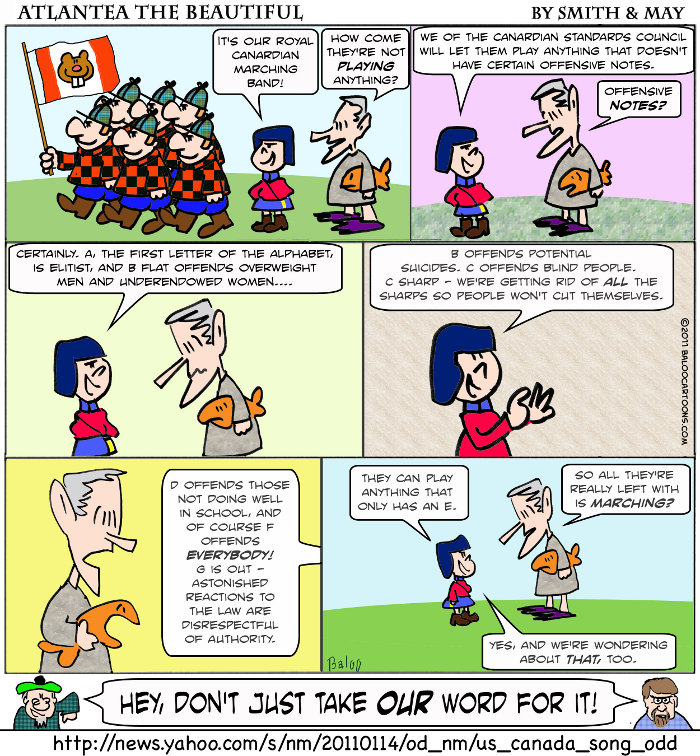
Smith and May illustrate the CBSC decision

Filed under: Bureaucracy, Cancon, Media — Tags: , , , , — Nicholas @ 08:37


Link to news.yahoo.com/s/nm/20110114/od_nm/us_canada_song_odd.

Cartoon from this week’s edition of Libertarian Enterprise.

January 13, 2011

Offensensitivity, the Canadian disease

Filed under: Bureaucracy, Cancon, Liberty, Media — Tags: , , , — Nicholas @ 14:46

Banned on the radio in Canada, but still (for the moment) legal on the internet:

Update, 14 January: I’ve been informed that this video isn’t playing for some, and it’s not working for me now either. I guess it’s another one of those content licensing issues. So I guess I’ll have to make this change:

Banned on the radio in Canada, but still (for the moment) legal on the internet. Banned on the radio in Canada, AND on the internet.

January 10, 2011

Facebook has a repeat of their earlier boob

Filed under: Health, Media, Technology — Tags: , , , — Nicholas @ 07:58

Facebook apparently has something against breasts — specifically those used to feed babies:

Facebook had one of its nipple-related related brainstorms last week, banning, unbanning, then re-banning breastfeeding support group, The Leaky Boob.

The Leaky Boob group allows almost 11,000 mothers to share their experiences on breastfeeding — as well as providing casual visitors with a treasure trove of advice and tips. Well, it would do, if Facebook didn’t keep deleting it — as they did the previous weekend.

This provoked an angry reaction from the tens of thousands of women who use the page for information and support.

Breastfeeding supporters responded swiftly, creating two pages on Facebook, Bring Back the Leaky Boob and TLB Support, which gained the best part of 10,000 fans in just two days.

On Tuesday, according to group founder Jessica Martin-Weber, the page was back up.

On Wednesday it was gone again.

Then, later in the day, it returned and is still up today.

It’s easy to see how the content of TLB might be offensive to closed-minded people, and if the banning mechanism Facebook uses is mostly automated, it’d explain the way in which the group was originally banned. If all it takes is a complaint, and the (I assume automated) follow-up to the complaint only checks for certain things, the first shutdown is explained. The fact that the group has been through this process before shows a weakness in Facebook’s administrative tracking policies.

November 16, 2010

Helpless

Filed under: Books, Bureaucracy, Cancon, Law, Liberty — Tags: , , , , — Nicholas @ 13:17

The National Post is publishing some exerpts from Christie Blatchford’s latest book, Helpless:

But now, occupiers were showing up in force, at least a dozen of them converging on the lone OPP officer, who had already determined that the driver had no licence, no permit and no insurance — oh, and that the car had no plates. He called for backup, a plea that, in the normal course of events in the policing world, usually brings an enormous, instantaneous, gut-level response: Every cop who can get there does.

No one arrived.

In what was probably the single most important early indicator of how the OPP was disintegrating from within, its officers were no longer answering a call for help from one of their own. The constable had been left to fend for himself.

Furious, heartsick, he did what he could — cautioned the driver — and left before things got ugly. Back at the station, he filed a formal complaint. Within a matter of weeks, he was verbally disciplined for having created a possible “flashpoint.”

It was a sign of things to come. The occupation was just a month old, and whenever OPP officers dared speak up about the way things were going, they were slapped down.

November 14, 2010

Life replicates art, kinda

As one of the comments on this article in The Cord points out, it’s highly ironic that “at a speech about a book detailing how the police did nothing to uphold the laws of the land the university did exactly the same thing.”

What was scheduled as a speech by Globe and Mail columnist Christie Blatchford turned sour tonight as protesters opposing the journalist’s new book Helpless: Caledonia’s Nightmare of Fear and Anarchy, and How the Law Failed All of Us took over the stage.

Three protesters locked themselves together at the centre of the stage where Blatchford was meant to speak at the University of Waterloo’s (UW) Humanities Theatre in Hagey Hall, with another individual acting as their “negotiator”. A fifth, Tallula Marigold, acted as the group’s media representative.

“We don’t want people who are really, really racist teaching [the people we love],” said Marigold of Blatchford. “And we don’t want that person to have a public forum because it makes it dangerous for others in the public forum.”

If nothing else, the passion of the protesters has persuaded me that I must buy and read Blatchford’s latest book . . .

November 10, 2010

Pat Condell: Free speech in Europe

Filed under: Europe, Law, Liberty, Religion — Tags: , , , — Nicholas @ 12:24

August 7, 2010

Pat Condell: Freedom is my religion

Filed under: Europe, Liberty, Religion — Tags: , , , , , — Nicholas @ 20:14

October 16, 2009

QotD: Maturity, fading

Filed under: Education, Quotations — Tags: , , — Nicholas @ 13:11

Maturity as a general virtue, however, declined in the Sixties when indiscriminate sexual liberty, detached from responsibility and emotional engagement, became a human right from puberty forward. With no need to defer the gratification of appetite, there was no further need for patience, maturity’s hallmark.

And yet what stage of life could be worse for indefinite prolongation? Adolescence is a period marked by extreme intellectual callowness, thrall to raging hormones, obsession with appearance and social caste, contempt for authority, fascination with the transgression of rules, immoderate self-righteousness and intense sensitivity to perceived offence.

For the negative physical consequences of adolescence as a cultural norm, consider the body-sculpting, porn and plastic surgery industries. Our culture’s obsession with youthful appearance and limitless, Dionysiac sexuality is pandemic.

For the more pernicious negative intellectual and political consequences, consider the universities. In academia one finds a ruling cadre of grey-haired, jeans-clad university teachers pickled in Woodstock-nostalgic revolutionary amber, still rebelling against their parents’ conformity and hypocrisy, still contemptuous of their parents’ institutions and values, even those that stabilized family life and nourished communitarianism.

The political correctness these ideologues embody, Epstein shrewdly notes, is a peculiarly adolescent phenomenon: “Political correctness . . — from academic feminism to cultural studies to queer theory — could only be perpetrated on adolescent minds: . . . Only an adolescent would find it worthwhile to devote his or her attention chiefly to the hunting of offenses [and] the possibility of slights, real and imagined.”

Barbara Kay, “The decline of maturity”, National Post, 2009-10-16

« Newer Posts

Powered by WordPress