Published on 12 Dec 2015
Indy sits in the Chair of Wisdom again to answer your questions of WW1. This time we are talking about submarine warfare during the First World War.
December 16, 2015
How Did Submarine Warfare Change During World War 1? I OUT OF THE TRENCHES
December 10, 2015
Korea: Admiral Yi – Lies – Extra History
Published on 7 Nov 2015
Yi’s life has been turned into a Confucian parable: a highly competent person who bore betrayal stoically and stayed loyal to the king. Since there was no record of his early life, that pattern is reflected in the way his early life is described. That pattern of thinking clearly influenced the historians who did cover Yi’s life, but while it stands out as unusual to those of us who aren’t familiar with that tradition, it has a subconscious impact on the people who were raised with Confucian thinking and wrote this history from it. If we looked at Western history from a foreign perspective, we would likely notice similar patterns being overlaid onto Western ways of telling history as well.
December 3, 2015
Korea: Admiral Yi – V: Martial Lord of Loyalty – Extra History
Published on 24 Oct 2015
After his success at Myeongnyang, Yi began rebuilding the Korean navy and strengthening his partnership with the Chinese. But then, Toyotomi Hideyoshi died. Japan’s new leaders had no interest in continuing the war, but although they sued for peace, Korea now held the upper hand and was determined to punish the people who had committed so many massacres against their people. Yi and the Chinese fleet bottled up the Japanese at the fort in Suncheon. When the Japanese called for reinforcements, Yi interrupted them in Noryang Strait. Again they were outnumbered, 500 to 150, but the Chinese commander did not yet understand Yi’s long range style of warfare and immediately closed for close combat. Yi ordered his flagship to rescue their allies, and as soon as the Japanese recognized him, they focused fire on him. This allowed the Chinese, suddenly forgotten, to fire freely on them. The Japanese realized their error and tried to flee, but Yi would have none of it. Beating the war drum himself, he urged his ships to chase the Japanese – to punish them for all the slaughter they brought to Korea. It was then that he was struck by a fatal gunshot. Before he died, he ordered his son and nephew to command the battle for him. They dressed in his armor to hide his death from the troops and continued beating the dream. Together, they carried the day – only for Yi’s tragic death to be revealed at the moment of victory. But although Yi did not live to see it, 300 Japanese ships were captured and destroyed that day and the rest of their invading force was rounded up soon after. For his tireless service, his brilliant leadership, and his unwavering devotion to Korea, Yi was given the posthumous title of Chungmugong, the Martial Lord of Loyalty.
December 2, 2015
Can the Royal Navy fund a “cheap and cheerful” frigate?
In the most recent British government SDSR plan, the Royal Navy’s hopes to get 13 new Type 26 frigates have been trimmed down to only eight. Save the Royal Navy speculates on developing a cheaper ship design that could perhaps fill the gap:
Is it really possible to produce a fully effective frigate that is significantly cheaper than a T26? Let us call it the ‘Type 31’, It still requires point defence missiles, anti-ship weaponry, a hangar and small flight deck (even if only for a UAV or Lynx size helicopter), plus a command and control system and suite of sensors. Although the hull size could be reduced, a simpler propulsion system used and the anti-submarine capability eliminated or reduced. You might cut the cost by 30%, and get a general purpose ship but there is still the cost of developing a new design. (At least £200M has already been spent on the T26 design as well as various development ‘blind alleys’ along the way.) A second frigate type will also need its own equipment support logistics and training pipelines.
The desire to create an exportable frigate is laudable but will we not be re-inventing the wheel when there are already cheaper foreign designs that could be licensed or adapted. The highly successful German MEKO design and the Danish Stanflex system are good examples.
If your warship is designed to cope in high-intensity conflict then it will need expensive weapons and sensors. Today’s generation of supersonic anti-ship missiles are truly formidable. Modern surface ships face greater and more diverse threats than ever. To counter this requires good sensors, agile missiles and an array of decoys, backed up by last-ditch close in weapon systems (CIWS). Although the general purpose frigate may not be dedicated to hunting submarines, it will still need a decent sonar to give some hope of prosecuting a submarine or detecting and avoiding torpedo attack. Submarines are also getting more and more stealthy with a growing arsenal of weapons. Without quiet propulsion and sophisticated sonars (i.e. towed arrays) that can detect threats at range and helicopters to attack, the Type 31 could ‘just be another target’.
If your escorts are really going to escort anything eg. an aircraft carrier or merchant shipping, then it needs more than just last-ditch self-defence weapons. A Phalanx CIWS may defend the ship it is mounted on, but it is little use protecting another vessel. If the escort ship can only defend itself, it has very limited use or must be permanently on the offensive. The Sea Ceptor being fitted to the Type 23 and Type 26 frigates has the major advantage over the Sea Wolf it replaces by having more than double the range (around 25Km), significantly extending the size of the protection umbrella over ships being escorted. Frigates are traditionally built to hunt submarines, if our Type 31 has no real ASW capability then it is pretty limited in a wartime role.

Sleek, fast and loved by their crews, the Type 21 was the poster child for the cheap frigate. There is a very fine line between a successful ‘less capable, cheaper frigate’ and a compromised warship design that becomes a liability. The Type 21 Frigate design of the 1970s was designed by a private company and accepted by the RN as a way to get a modern and affordable frigate to sea. Unfortunately when tested in the heat of the Falklands war their deficiencies became obvious. A top-heavy design on a lightweight hull, they suffered structural problems in the prolonged South Atlantic operations. They were also inadequately armed and suffered accordingly. God help them if they had gone up against Soviet aircraft or missiles. Ironically the surviving Type 21s still soldier on today in the Pakistani navy. Upgraded with a Phalanx system and Chinese SAMs / Harpoon missiles they are now slightly more potent.
November 26, 2015
Britain’s latest military and strategic five-year plan
Back in 2010, the British government published the Strategic Defence and Security Review (SDSR), which I joked should properly have been called the “Slashing Damage to Strategic Resources” plan. Back then, the strategic picture was fairly undisturbed with no obvious rising threats, but the economy was still in bad shape. That meant that the RN, RAF, and the army had to cut, cut, cut (and cut some more). The next version of that document has just been published and this time it’s been joined to the National Security Strategy in a single document. Patrick Bury looks at how things have changed from SDSR 2010 to the new NSSSDSR 2015:
On Monday, Prime Minister David Cameron unveiled Britain’s new National Security Strategy and Strategic Defence and Security Review in the House of Commons. It marked the first time the United Kingdom has undertaken a review of its strategy and security within the new five-year schedule. This edition is also notable in that it combines the National Security Strategy (NSS) and Strategic Defence and Security Review (SDSR), which were previously two separate documents. True to its name, the NSS outlines the perceived threats to Britain and its vision for dealing with them, while the SDSR details how the armed forces are configured to execute this vision.
These developments point to a realization in the United Kingdom that it must be more flexible and responsive in terms of setting strategy and defense priorities. After introducing the NSS in 2010 in the wake of criticism that Britain “couldn’t do strategy,” the Conservative government clearly feels it now makes sense to present both policies in a single document. Similarly, the overarching tone of the document is one of internationality. Britain clearly believes it will be working with the United States and France especially closely in the future. But what is inside, and what does it mean?
The NSS related-chapters outline the usual myriad of threats commonly listed in the post-Cold War era. Based on the security services’ National Security Risk Assessment, these threats are then classed into tiers. Tier One risks are the highest priority based on high likelihood and/or high impact. Reflecting the impact of threats and hazards, and the development of risks since 2010, the latest assessment includes a greater number of Tier One risks than in 2012. These are listed in order as terrorism, cyber, international military conflict (rising since 2010), instability overseas (Tier Two in 2010), public health (a new addition), and natural disasters. Interestingly, the general erosion of international order and resulting chaos also makes a more significant appearance.
Here’s the quick overview of what is promised this time around:
One area that looks concerning is that the British government appears to be considering replicating the Canadian experiment with merging the military services into a “unified” structure:
Tying all these developments together, this SDSR is notable for its underlying shift towards viewing Britain’s smaller services as a single force, as unveiled in the new Joint Force 2025. Over the next decade, the core of the Joint Force will be based around an expeditionary force of around 50,000 (compared with around 30,000 planned in 2010’s Future Force 2020) and is set to include a new F-35 equipped aircraft carrier, “a land division with three brigades including a new Strike Force; an air group of combat, transport and surveillance aircraft,” and a special forces task group. Of course, the Whole Force concept underpins jointness, but one gets the sense that future SDSRs may well pave the way for the merging of all three services into one force in the name of flexibility and in the search for efficiencies. Another interesting nuance was the primacy of special forces in the document – above that of the Royal Navy which is the senior service – perhaps an indication of why the government is investing an extra £2 billion ($3 billion) in its equipment as well. The number of staff at GCHQ (the signal-intelligence agency), MI5 and MI6 (the domestic and foreign intelligence services) is to also increase by 1,900.
Despite this SDSR unveiling the first major investment, rather than reductions, in the United Kingdom’s security forces for about 25 years, there are a number of noticeable gaps. The first concerns its people. The army remains at its smallest size since the Napoleonic era; recruitment and retention is a problem across British defense; and it remains to be seen if the government’s Spending Review released tomorrow will better the terms and conditions of service. Without the right people in the right place, all the fancy kit in the world is not much use. The message is also clear that rapid-reaction forces are in fashion, and boots on the ground and long-term counter-insurgency operations are out, at least for now. The now bit is important: with a lot of these investments and the Joint Force structure not scheduled for delivery for ten years, there is plenty of scope to adjust or change course entirely between now and then. Which is exactly how the Brits do long-term strategy. Nevertheless, this SDSR is clearly intended to show that Britain wants to remain in the top tier of international powers over the coming decade.
Korea: Admiral Yi – IV: Those Who Seek Death Shall Live – Extra History
Published on 17 Oct 2015
Yi’s success had forced the Japanese to give up offensive naval operations, but their huge fleet remained entrenched in Busan harbor. While Yi pinned them down, reinforcements from the Chinese army had finally arrived and helped the Korean army take back the country on land. Yi petitioned for marines to take Busan back from the Japanese, but his requests were ignored. Instead, he focused on making his base on Hansando self-sufficient: he promised protection to refugees in exchange for them working the island, building his equipment, and even researching military technology. But a truce was called with Japan, one that dragged on for years until Hideyoshi broke it by ordering a second invasion. An informant brought word of secret, unprotected Japanese fleet movements, but Yi recognized it as a trap and refused to go. However, his friend Ryu’s enemies at court seized on this as an opportunity to put Yi on trial for treason. They demoted him again, and gave his fleet to Won Kyon. Won Kyon fell into the trap Yi had refused, and a coordinated surprise attack from the Japanese resulted in the destruction of all but 12 ships. Yi was quickly re-instated, but ordered to disband the navy. He refused, and planned his counterattack carefully: he would fight at Myeongnyang Strait, where he hoped the natural currents would do what his numbers could not. His plan worked: the reversing tide caught the Japanese by surprise and flung their ships against each other right as he pressed the attack. With 13 ships versus 133, he once again drove back Japan with zero losses to his own navy. Word of his success brought other ships out of hiding and convinced the Chinese navy to ally with him at last.
November 19, 2015
Korea: Admiral Yi – III: The Bright Moonlight of Hansando – Extra History
Published on 10 Oct 2015
While Yi found success at sea, the Korean land army suffered terrible losses. Yi Il, the man who once accused Yi of negligence, lost one battle after another, until finally the regular forces were annihilated at Chungju. The Joseon court that ruled to Korea fled to Pyongyang, on the verge of being pushed out of their own country. But that same day, Admiral Yi tore through a Japanese fleet at Okpo. He moved on to Sacheon, where he baited the Japanese commander into a trap and debuted his turtle ship. The unstoppable turtle ship carried the day, so he used this tactic again and again he destroyed a Japanese fleet while suffering no losses of his own. Finally, Hideyoshi ordered his naval commanders to take Jeolla, Yi’s headquarters. Sadly for him, his general Wakisaka Yasaharu grew too eager and engaged Yi without backup at Gyeonnaeryang Strait, only to find himself lured into an even more sophisticated version of Yi’s bait-and-retreat strategy: a “Crane’s Wing” of ships that collapsed on the overextended target from all sides. In one of the largest naval battles in history, Yi scored a decisive win and again didn’t lose a single ship. He headed to Angolpo to attack Hideyoshi’s two remaining generals and seal his victory, but they refused to be baited. He had to settle for a long range exchange of cannon fire, which worked at the cost of many injuries to his own men. In the end, he destroyed all but a few Japanese ships, and those he only spared to give the Japanese some means to escape and stop raiding in Korea. But he had accomplished his goal: Hideyoshi ordered a halt to all naval operations except guarding Busan, and without this control of the sea, Japan could not re-supply their troops nor hope to resume the assault that would have finally pushed Korea’s leaders out of Korea.
November 12, 2015
Korea: Admiral Yi – II: Be Like a Mountain – Extra History
Published on 3 Oct 2015
Japan invaded Korea after a series of long civil wars that had finally culminated in Toyotomi Hideyoshi leading a unified Japanese army. Their martial society had trained extensively with weapons like the arquebus, early guns, and the civil war had given them tremendous experience with siegecraft. By contrast, Korea had not been at war for hundreds of years: they were mostly troubled by raiders from without and corrupt government officials from within. However, their unique situation meant that they had great cannons for fighting off pirates and secure if minimal hill-top forts. As a tributary ally of the Chinese, the Koreans were startled and confused when Japan asked permission to march through their territory and make war on China. Many officials thought the Japanese were only bluffing, but Ryu Seong-ryong recognized the threat and made sure his friend Yi was moved to naval service to help defend the country. Yi trained his men and commissioned a new ironside ship design called the Turtle Ship. Unfortunately, other commanders did not take the threat seriously: even when Japanese ships appeared on the horizon, the southern commander convinced himself it was a trade fleet and took no action while the ships docked, then unloaded their soldiers onto Korean soil. The well-trained Japanese army crushed the Korean army and quickly advanced to Seoul. Meanwhile, Yi organized his small fleet of warships and launched quick strikes against the Japanese navy, catching them off-guard and on-patrol. He destroyed 43 enemy ships without losing a single one of his own, and was promoted accordingly to become the new Southern Commander of the Korean navy.
November 11, 2015
In memoriam
A simple recognition of some of our family members who served in the First and Second World Wars:
The Great War
Private William Penman, Scots Guards, died 1915 at Le Touret, age 25
(Elizabeth’s great uncle)- Private David Buller, Highland Light Infantry, died 1915 at Loos, age 35
(Elizabeth’s great grandfather) - Private Walter Porteous, Northumberland Fusiliers, died 1917 at Passchendaele, age 18
(my great uncle) - Corporal John Mulholland, Royal Tank Corps, died 1918 at Harbonnieres, age 24
(Elizabeth’s great uncle)
The Second World War
- Flying Officer Richard Porteous, RAF, survived the defeat in Malaya and lived through the war
(my great uncle) - Able Seaman John Penman, RN, served in the Defensively Equipped Merchant fleet on the Murmansk Run (and other convoy routes), lived through the war
(Elizabeth’s father) - Private Archie Black (commissioned after the war and retired as a Major), Gordon Highlanders, captured at Singapore (aged 15) and survived a Japanese POW camp
(Elizabeth’s uncle) - Elizabeth Buller, “Lumberjill” in the Women’s Land Army in Scotland through the war.
(Elizabeth’s mother) - Trooper Leslie Taplan Russon, 3rd Royal Tank Regiment, died at Tobruk, 19 December, 1942 (aged 23).
A recently discovered relative. Leslie was my father’s first cousin, once removed (and therefore my first cousin, twice removed).
In Flanders fields the poppies blow
Between the crosses row on row,
That mark our place; and in the sky
The larks, still bravely singing, fly
Scarce heard amid the guns below.We are the Dead. Short days ago
We lived, felt dawn, saw sunset glow,
Loved and were loved, and now we lie
In Flanders fields.Take up our quarrel with the foe:
To you from failing hands we throw
The torch; be yours to hold it high.
If ye break faith with us who die
We shall not sleep, though poppies grow
In Flanders fields.Lieutenant Colonel John McCrae, MD Canadian Army Medical Corps (1872-1918)
November 10, 2015
QotD: The Imperial Roman navy
The navy maintained by the emperors might seem inadequate to their greatness; but it was fully sufficient for every useful purpose of government. The ambition of the Romans was confined to the land; nor was that warlike people ever actuated by the enterprising spirit which had prompted the navigators of Tyre, of Carthage, and even of Marseilles, to enlarge the bounds of the world, and to explore the most remote coasts of the ocean. To the Romans the ocean remained an object of terror rather than of curiosity; the whole extent of the Mediterranean, after the destruction of Carthage, and the extirpation of the pirates, was included within their provinces. The policy of the emperors was directed only to preserve the peaceful dominion of that sea, and to protect the commerce of their subjects. With these moderate views, Augustus stationed two permanent fleets in the most convenient ports of Italy, the one at Ravenna, on the Adriatic, the other at Misenum, in the Bay of Naples. Experience seems at length to have convinced the ancients, that as soon as their galleys exceeded two, or at the most three ranks of oars, they were suited rather for vain pomp than for real service. Augustus himself, in the victory of Actium, had seen the superiority of his own light frigates (they were called Liburnians) over the lofty but unwieldy castles of his rival. Of these Liburnians he composed the two fleets of Ravenna and Misenum, destined to command, the one the eastern, the other the western division of the Mediterranean; and to each of the squadrons he attached a body of several thousand marines. Besides these two ports, which may be considered as the principal seats of the Roman navy, a very considerable force was stationed at Frejus, on the coast of Provence, and the Euxine was guarded by forty ships, and three thousand soldiers. To all these we add the fleet which preserved the communication between Gaul and Britain, and a great number of vessels constantly maintained on the Rhine and Danube, to harass the country, or to intercept the passage of the barbarians. If we review this general state of the Imperial forces; of the cavalry as well as infantry; of the legions, the auxiliaries, the guards, and the navy; the most liberal computation will not allow us to fix the entire establishment by sea and by land at more than four hundred and fifty thousand men: a military power, which, however formidable it may seem, was equalled by a monarch of the last century, whose kingdom was confined within a single province of the Roman empire.
Edward Gibbon, “Chapter I: The Extent Of The Empire In The Age Of The Antonines — Part III”, History of the Decline and Fall of the Roman Empire, 1782.
November 8, 2015
The Legend of the Desk & the Far Ends of the Trenches I OUT OF THE TRENCHES
Published on 7 Nov 2015
Indy sits in the chair of wisdom again to answer your questions. And this time, we’re talking about the legend behind our desk and how the far ends of the trenches looked like. Don’t forget to ask us more questions.
November 6, 2015
The evolution of the Royal Navy’s ship designs
This post is a nice summary of the Royal Navy’s frigates, destroyers, and cruisers from the Second World War through to the present day:
Before the Second World War the RN was predominantly a “cruiser navy”, holding down a range of global deployments with its 15 heavy and 41 light cruisers. These ships had endurance and combat power at the core of their designs, each could operate alone for extended periods, effectively defend itself in most circumstances and demonstrate the interest or resolve of the government in a particular region. The ensuing World War and the Cold War radically changed the type of warships the RN needed. Instead of cruisers built for endurance and complex warfighting the navy built a profusion of smaller frigates and destroyers, mainly to guard convoys and fight submarines close to the UK and in the North Atlantic. To carry out these tasks the navy could make do with smaller, cheaper, ships with relatively shorter legs and far less ability to act independently in high threat environments. Trade-offs like these were made in order to ensure the navy got enough escorts to protect the convoys which would be vital to Britain’s survival in the event of a war; and to hunt the Soviet ballistic missile submarines that threatened NATO. These were ships designed to act as part of a military system that would defeat the threat posed by hostile submarines. This system also included land based aircraft, anti submarine helicopters, aircraft and helicopter carriers and the enormous US/NATO SOSUS fixed sonar array. The Leander class is probably the most famous example of these sort of light frigates, operated by the RN into the early 1990s. When the immediate and pressing threat from submarines operating in the North Atlantic, be they German or Soviet, ceased to exist so the naval forces the UK had constructed to defeat them also fell by the wayside. These ships were, broadly speaking, a product of their time and a deviation from the much older structure that had served the RN well for centuries. This structure consisted of a core “battle fleet”, made up of capital ships; mainly there to act as a deterrent, supported by powerful forward deployed cruisers that conducted most of the day to day activity.
By modern standards almost all of the cheap and numerous frigates and destroyers of the past, even the excellent Leanders, would be classed as lightly armed corvettes. The simple fact was that these cheap and numerous ships sacrificed a lot of capability in order to achieve the affordability necessary to build them in numbers. They were still recognisable as frigates built in the convoy escort mold. Similarly the Type 42 anti-aircraft warfare destroyers, in service from the mid-1970s, were also a design that compromised range and armament for numbers. At only 3500 tonnes the Batch 1 Type 42s were clearly a very light and economical design. When compared with their American counterparts, the 8000 tonne Spruance class, it’s clear that these ships sacrificed range and armament for economy and numbers. Both the Leanders and the Type 42s are recognisable as frigates and destroyers, light warships designed to act in groups and alongside other warships, auxiliaries and aircraft to be effective in combat. The closest the RN came to “cruiser” designs during the Cold War were the eight County Class missile destroyers commissioned in the early 1960s and HMS Bristol, the sole survivor of the pre-1968 carrier escort programme. While these destroyer classes were cruiser-like in some aspects, they carried a far more comprehensive armament and had a greater range (in terms of fuel) than their contemporaries, they lacked the self-sustainment ability, protection, survivability and range of “true” cruisers. While Bristol was initially labelled a light cruiser by Jane’s, the Royal Navy always saw her for what she was: an oversize missile destroyer with the similar limitations to the navy’s other destroyers.
With the later Type 22 and 23 frigates the RN moved to fewer, more individually capable, platforms. This change was partly necessitated by the introduction of a new generation of bigger towed array sonars which required larger ships to operate effectively. Despite their greatly improved self defence ability, achieved by fitting the Sea Wolf point defence missile system, these ships were still designed to be expendable escorts and lacked the endurance of cruisers. That said, these two classes signalled the start of the navy’s shift from a fleet of numerous, small and cheap escorts to fewer, larger ships capable of independent operations in a high threat environment.
November 4, 2015
Sometimes the US Navy isn’t subtle
At the RCN News site, a recent press release from the US Navy expresses just a bit more than most civilian readers will get:
U.S. and Canadian naval units began a Task Group Exercise (TGEX) off the coast of Southern California, Oct. 20.
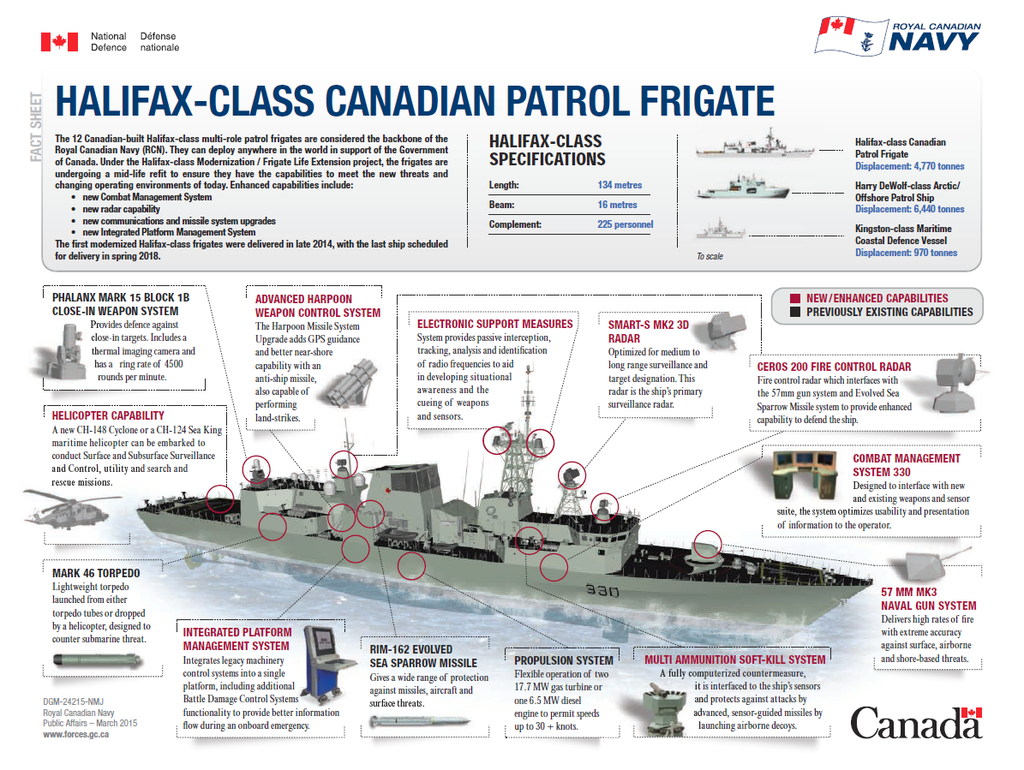
Participating units from the Royal Canadian Navy include Canadian Fleet Pacific, Halifax-class frigates HMCS Calgary (FFH 335) and HMCS Vancouver (FFH 331), and Victoria-class ASW target HMCS Chicoutimi (SSK 879).
Emphasis mine.
October 18, 2015
Should we build “modern battleships”? The answer is probably “no”
The question, raised by Robert Farley at The National Interest is “Is it time to bring back the Battleships?”
Is it time to bring back the battleship?
For decades, naval architects have concentrated on building ships that, by the standards of the World Wars, are remarkably brittle. These ships can deal punishment at much greater ranges than their early 20th century counterparts, but they can’t take a hit. Is it time to reconsider this strategy, and once again build protected ships? This article examines how these trends came about, and what might change in the future.
The label “battleship” emerges from the older “ship of the line” formulation, in the sense that a navy’s largest ships participated in the “line of battle” formation that allowed them to bring their broadsides to bear on an opposing line. After the development of ironclad warships, the “battle ship” diverged from the armored cruiser based on expectations of usage; “battleships” were expected to fight enemy “battleships.” The modern battleship form settled around 1890, with the British Royal Sovereign class. These ships displaced about 15,000 tons, with two heavy guns each in turrets fore and aft, and steel armor. The rest of the navies of the world adopted these basic design parameters, which provided a ship that could both deal out and absorb punishment. The process of ensuring survivability was simplified, in these early battleships, by the predictability of the threat. The most likely vector of attack in the late 1890s came from large naval artillery carried by other ships, and consequently protective schemes could concentrate on that threat.
From the American perspective, even if through some collective congressional brain-fart the US Navy was compelled to build and deploy modern analogues to the classic battleship, what the hell would they be used for? China and Russia are not going to build opposing battleships, and it’s difficult to imagine anyone else on the planet who would have both the economic resources and the strategic desire to go toe-to-toe in Jutland fashion against the USN.
September 27, 2015
World of Warships – The Tirpitz!
Published on 27 Aug 2015
What’s the matter, Tommy… are ze Germans coming? Actually yes, they are and they’re in dirty great Battleships! I think we’re going to need bigger guns…