Forgotten Weapons
Published on 11 May 2014Cool Forgotten Weapons Merch! http://shop.bbtv.com/collections/forg…
Theme music by Dylan Benson – http://dbproductioncompany.webs.com
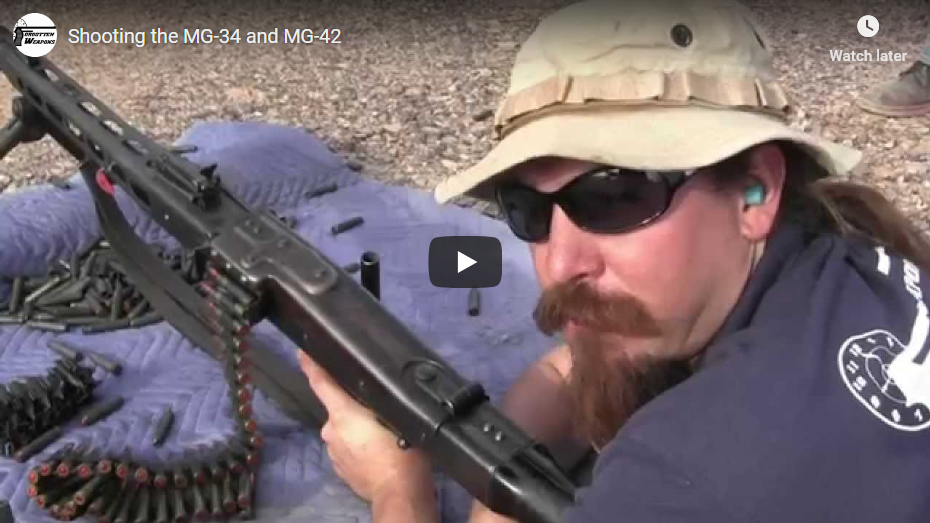
The MG-34 and MG-42 machine guns were the mainstay of German infantry (and vehicle) firepower during World War II, and it will take several videos to properly cover them. For now, we are shooting them both, and explaining how to load, unload, and operate them (including changing barrels on the MG42). Enjoy!
June 13, 2019
Shooting the MG-34 and MG-42
June 7, 2019
Bren Gun at the Range
Forgotten Weapons
Published on 23 Aug 2011We take a 1940 Bren gun to the range to demonstrate function, disassembly, and shooting from a variety of positions. For more information, check out http://www.ForgottenWeapons.com .
June 4, 2019
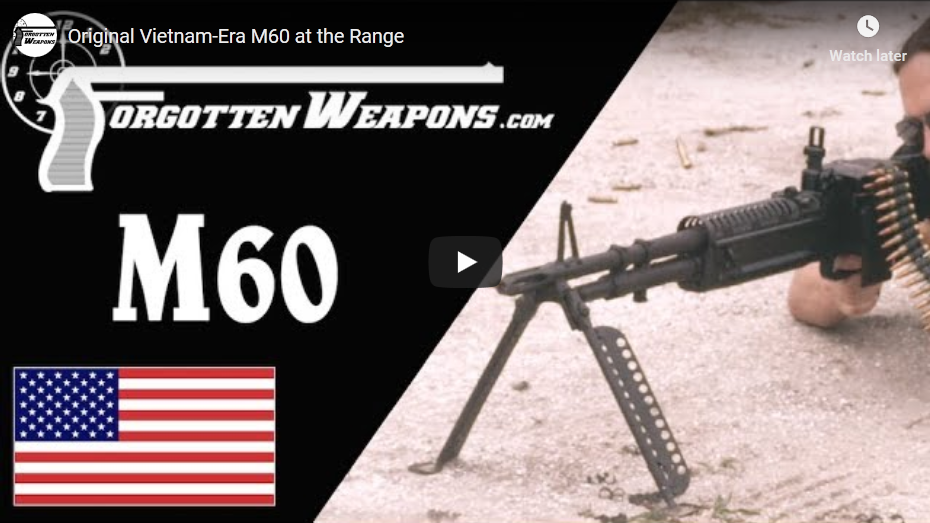
Original Vietnam-Era M60 at the Range
Forgotten Weapons
Published on 27 Apr 2019http://www.patreon.com/ForgottenWeapons
Cool Forgotten Weapons merch! http://shop.bbtv.com/collections/forg…
The M60 was the first modern American military machine gun, developed from the operating system of the German FG-42 and the feed system of the German MG-42 in the years after World War Two. It has a rather schizophrenic reputation, being loved by many who used it in Vietnam and hated by many who used it later in its service life. The design had some fundamental flaws, but did offer a far more mobile base of fire than the M1919A6 that it replaced. Today, I am going to do a bit of shooting with an original Vietnam pattens M60, which will act as a baseline for future videos covering the various improvements and modernizations of the platform.
Thanks to the Institute of Military Technology (https://www.instmiltech.com) for giving me the opportunity to bring this M60 on camera for you!
Contact:
Forgotten Weapons
PO Box 87647
Tucson, AZ 85754
May 22, 2019
Hotchkiss 1914: A French and American WWI Heavy MG
Forgotten Weapons
Published on 19 Apr 2019This Hotchkiss machine gun and its tripod are lot #2027 in the upcoming April 2019 Morphy auction:
https://www.forgottenweapons.com/hotc…
The gun that became the Hotchkiss 1914 and served as the bulwark of French and American forces in World War One was actually first designed and patented by an Austrian officer; Adolph von Odkolek. He took his idea to the Hotchkiss company in Paris hoping to arrange for them to produce it under license. The design was inspected by Laurence Benet (chief engineer at Hotchkiss) and Henri Mercie (Benet’s assistant), and they concluded that the gun was not suitable for production. However, the core concept in the patent – Odkolek’s gas piston system – was a worthy one and would allow production of machine guns to compete with Maxim and Colt without violating their existing patents. So Benet arranged to simply buy the patent outright for a flat fee, and then Hotchkiss set about redesigning the gun to be much better.
The result was the model 1897, an air-cooled, strip-fed heavy machine gun that was sold to many different nations. It was improved in 1900, and between the two models sales were made to Japan, Mexico, Chile, Brazil, China, Spain, Ethiopia, Finland, Greece, Guatemala, Luxembough, Norway, Sweden, Turkey, Portugal, and Venezuela in a variety of calibers. The French government also purchased some Hotchkiss guns, primarily for colonial use. For the bulk of the metropolitan army, France opted to design its own gun in the state arsenals (which was the Modele 1907 St Etienne gun; which is suspiciously like a Hotchkiss with the operating direction of the parts reversed to avoid patent infringement).
When World War One broke out, and the need for vast quantities of machine guns became apparent, the Hotchkiss was finally adopted on a large scale by France. The commercial 1900 pattern was revised slightly (a better barrel-locking system and replacement of the shoulder stock with a D-ring rear handle) and some 45,000 would be produced by 1918. The Hotchkiss would supplant the 1907 St Etienne over the course of the war, as it was a more reliable and less expensive design. It would go on to serve the French military through the end of World War Two, gaining a reputation as a gun of unparalleled simplicity and reliability.
http://www.patreon.com/ForgottenWeapons
Cool Forgotten Weapons merch! http://shop.bbtv.com/collections/forg…
Contact:
Forgotten Weapons
PO Box 87647
Tucson, AZ 85754
April 24, 2019
Vickers Heavy Machine Gun
Forgotten Weapons
Published on 14 Dec 2016http://www.patreon.com/ForgottenWeapons
Cool Forgotten Weapons Merch! http://shop.bbtv.com/collections/forg…
I may be a bit biased here, but I believe that the Vickers gun is one of the best all-around firearms ever made. It was designed during an era of experimentation and craftsmanship, with a quality and care that would make it today prohibitively expensive. It was exemplary in action, and served in every environment on earth through six decades and in the hands of 50 different nations. It was an infantry gun, an aircraft gun, an armored vehicle gun, and a shipboard gun.
Captain Graham Hutchison recorded this account of the Vickers in action during an attack on High Wood in August 1916 (exerpted from “The Grand old Lady of No Man’s Land by Dolf Goldsmith):
“For this attack, [ten] guns were grouped in the Savoy Trench, from which a magnificent view was obtained of the German line at a range of about 2000 yards. These guns were disposed for barrage. On August 23rd and the night of the 23rd/24th the whole Company was, in addition to the two Companies of Infantry lent for the purpose, employed in carrying water and ammunition to this point. Many factors in barrage work which are now common knowledge had not then been learned or considered. It is amusing today to note that in the orders for the 100th Machine Gun Company’s barrage of 10 guns, Captain Hutchison ordered that rapid fire should be maintained continuously for twelve hours, to cover the attack and consolidation. It is to the credit of the gunners and the Vickers gun itself that this was done! During the attack on the 24th, 250 rounds short of one million were fired by ten guns; at least four petrol tins of water besides all the water bottles of the Company and urine tins form the neighborhood were emptied into the guns for cooling purposes; and a continuous party was employed carrying ammunition. Private Robertshaw and Artificer H. Bartlett between them maintained a belt-filling machine in action without stopping for a single moment, for twelve hours. At the end of this time many of the NCOs and gunners were found asleep from exhaustion at their posts. A prize of five francs to the members of each gun team was offered and was secured by the gun team of Sgt. P. Dean, DCM, with a record of just over 120,000 rounds.”
The attack on the 24th of August was a brilliant success, the operation being difficult and all objectives being taken within a short time. Prisoner examined at Divisional and Corps Headquarters reported that the effect of the Machine Gun barrage was annihilating, and the counterattacks which had attempted to retake the ground lost were broken up whilst being concentrated east of the Flers Ridge and of High Wood.
In 1963 in Yorkshire, a class of British Army armorers put one Vickers gun through probably the most strenuous test ever given to an individual gun. The base had a stockpile of approximately 5 million rounds of Mk VII ammunition which was no longer approved for military use. They took a newly rebuilt Vickers gun, and proceeded to fire the entire stock of ammo through it over the course of seven days. They worked in pairs, switching off at 30 minute intervals, with a third man shoveling away spent brass. The gun was fired in 250-round solid bursts, and the worn out barrels were changed every hour and a half. At the end of the five million rounds, the gun was taken back into the shop for inspection. It was found to be within service spec in every dimension.
During its service life, the Vickers was made in .303 British, .30-06, 0.50 Vickers, .50 High Velocity, 7×57 Mauser, 7.65×53, 8mm Mauser, 8mm Lebel, 7.7 Japanese, 6.5×54 Dutch, 7.9x57R Dutch, 7.62 NATO, 7.62x54R, 8x52R Siamese, 11mm Vickers, and three different 40mm cartridges.
The Vickers was retired from British military service in 1968, having finally become obsolete. Its GPMG role was taken over by the FN MAG, and its long range indirect fire role performed by 3″ mortars. The Vickers was a weapon which required training and dedication to master, but rewarded its users with phenomenal endurance and a wide range of capabilities. Among all contenders, only the Browning machine gun can attempt to compare to the outstanding qualities of the Vickers, and even the Browning fails to match the elegance of the stalwart Brit.

April 14, 2019
Shooting the Inglis 8mm Bren Gun
Forgotten Weapons
Published on 13 Apr 2019This Bren is lot #1013 at Morphy’s April 2019 auction:
https://www.forgottenweapons.com/shoo…The Bren gun is widely regarded as one of the best light machine guns ever built, but that reputation is based on the British .303 caliber version. How does the design perform in 8mm Mauser? Today I am going to find out, using one of the John Inglis “sterile” 8mm Brens.
http://www.patreon.com/ForgottenWeapons
Cool Forgotten Weapons merch! http://shop.bbtv.com/collections/forg…
Contact:
Forgotten Weapons
PO Box 87647
Tucson, AZ 85754
April 13, 2019
Canadian 8mm “Sterile” Bren Gun
Forgotten Weapons
Published on 12 Apr 2019This Bren is lot #1013 at Morphy’s April 2019 auction:
https://www.forgottenweapons.com/cana…The John Inglis company in Toronto first opened in 1859 as a metalworking shop, and grew steadily over the decades under first John Inglis, and then later his sons. Inglis did substantial amounts of military work during World War One, but the Great Depression hit it hard, and both William and Alexander Inglis died in 1935 and 1936 respectively. The company went into receivership but was purchased by one Major James Hahn (DSO) and a group of business partners in November of 1936. Hahn and his associates saw an opportunity to use this large manufacturing facility to make machine guns for the military, and they were successful – in October 1938 they were awarded a contract to make 5000 MkI Bren guns. More contracts would follow, and by the height of World War Two the company had some 15,000 employees and more than a million square feet of floor space.
Among many other projects, Inglis was contracted to make small arms for sale to the Nationalist Chinese government under Chiang Kai Shek – both High Power pistols and Bren guns in 8mm Mauser (to fit the Chinese standardization on that cartridge). A batch of 8mm ZB-30 light machine guns were brought in from the Far East to use as a pattern, and Inglis engineers were able to successfully redesign the Bren to use that cartridge and magazine.
Where the story gets hazy is in trying to determine how many were made and for whom. The Chinese guns are marked in Mandarin on the receivers, and have “CH” prefix serial numbers, like the Chinese contract High Power pistols. However, two additional variations exist without those Chinese markings. Some are marked “7.92 Bren MkI” and “Inglis 1943” (or 44 or 45), and others – like this one – are just marked “7.92 Bren MkI”. The dated ones are typically referred to as Resistance guns, intended to be supplied to European resistance units for whom 7.92mm ammunition was more readily available than .303 – although information on how many guns were supplied in this way (if any) is difficult to find. The last group is generally called “sterile”, and it is not clear what their purpose is. This particular example is one of 23 that were registered in the US in the early 1960s to Interarms, and it does appear that they were associated with some clandestine US military activities. The serial numbers of those 23 Interarms guns range from 1-5343 to 2-8045, suggesting a production of 13,000 or perhaps as many as 28,000 guns – that is quite a lot to be undocumented and missing.
Hopefully, more information will turn up in the future to shed light on the purpose and use of these 8mm Brens. We do know for sure that many thousands did go to Chinese forces, and some were brought into the UK, where in the 1960s they were used in the development of the 7.62mm NATO L4 version of the Bren.
http://www.patreon.com/ForgottenWeapons
Cool Forgotten Weapons merch! http://shop.bbtv.com/collections/forg…
Contact:
Forgotten Weapons
PO Box 87647
Tucson, AZ 85754
April 12, 2019
Machine-guns: light, medium, heavy, or sub?
Lindybeige
Published on 2 Mar 2016Machine-guns – do you know the difference between light, medium, and heavy? What is a ‘submachinegun’?
Support me on Patreon: https://www.patreon.com/LindybeigeMany people are hazy over the differences between the various types of machine-gun, and here I ramble on for ten whole minutes about the distinctions. It is a bit of a moving target, as terminology alters as technology does, but the terms used in World War Two are still reasonably current.
Lindybeige: a channel of archaeology, ancient and medieval warfare, rants, swing dance, travelogues, evolution, and whatever else occurs to me to make.
For the detail-minded, don’t panic: he’s taken to task in the comments on this video for a few of the howlers you may have noticed on the way by.
April 10, 2019
M37: The Ultimate Improved Browning 1919
Forgotten Weapons
Published on 8 Mar 2019http://www.patreon.com/ForgottenWeapons
Cool Forgotten Weapons merch! http://shop.bbtv.com/collections/forg…
In November of 1950, the US Ordnance Department requested an improved version of the Browning 1919 air cooled machine gun for use in tanks. The new version was to be able to feed from either the left or right, a feature which was unimportant for an infantry gun but much more relevant when mounting guns into the tight spaces of an armored vehicle. An interim conversion of existing guns to the M1919A4E1 pattern came first, followed by manufacture of all-new guns by the Rock Island Arsenal and Saco-Lowell company from 1955 until 1957.
The design of the gun fell to Bob Hillberg at High Standard. He came up with a clever set of reversible plugs to change the bolt between left and right hand feed, as well as a captive recoil spring, manual safety, improved top cover and rear cover latches, and several other strengthened parts. He also incorporated a charging handle extension with integral manual hold open and a link ejection chute that could be mounted to either side of the gun. His T153 design was formally adopted as the M37, in caliber .30-06. A 7.62mm NATO version (the M37E1) followed as well. The M37 would serve into the late 1960s on the M48 and M60 tanks as well as several helicopters.
Contact:
Forgotten Weapons
PO Box 87647
Tucson, AZ 85754
March 29, 2019
How Does it Work: Long Stroke Gas Piston
Forgotten Weapons
Published on 28 Mar 2019http://www.patreon.com/ForgottenWeapons
Cool Forgotten Weapons merch! http://shop.bbtv.com/collections/forg…
The long stroke gas piston system was in its heyday about 50 years ago, and was popular in both rifles and machine guns. The principle is that the gas piston is fixed to the bolt carrier, and both cycle rearward for the full length of the cartridge upon firing. The system was used in such distinguished designs as the M1 Garand, Kalashnikov, Browning Automatic Rifle, and ZB/Bren light machine guns among others. By including the mass of the gas piston in the reciprocating parts, the long stroke system potentially carries more momentum when cycling, this improving extraction and feeding. This generally comes at the cost of increased perceived recoil, as the extra mass impacting the rear of the receiver at the end of travel is felt by the firer.
Contact:
Forgotten Weapons
PO Box 87647
Tucson, AZ 85754
March 9, 2019
Project Lightening Episode 08: Outtakes
C&Rsenal
Published on 7 Mar 2019Project Lightening is the first collaborative project between C&Rsenal and Forgotten Weapons. It features SEVEN World War One light machine guns put head to head to see which is the best!
March 8, 2019
Project Lightening Episode 07: Conclusions
Forgotten Weapons
Published on 7 Mar 2019Want to keep a copy of the entire series for yourself? You can download the entire series right now to keep for just $6:
https://candrsenal.com/product/lighte…
Project Lightening is a collaborative series with Othais and Mae of C&Rsenal in which we test all seven light machine guns and automatic rifles of World War One and put them through a series of tests and evaluations. Each week we will be posting one video on Forgotten Weapons and one on C&Rsenal. Today we have the final conclusions, with a series blooper reel posted right now over on C&Rsenal:
http://www.patreon.com/ForgottenWeapons
Cool Forgotten Weapons merch! http://shop.bbtv.com/collections/forg…
Contact:
Forgotten Weapons
PO Box 87647
Tucson, AZ 85754
March 5, 2019
Project Lightening Episode 06: Total Damage
C&Rsenal
Published on 28 Feb 2019Project Lightening is the first collaborative project between C&Rsenal and Forgotten Weapons. It features SEVEN World War One light machine guns put head to head to see which is the best!
We’re releasing two episode a week but you can get them all at once over at C&Rsenal AND support both shows at the same time!
http://candrsenal.com/product/lightening
Episode 01: https://youtu.be/TVgkwQTo2n4
Episode 02: https://youtu.be/-hSZbo8Hvn4
Episode 03: https://youtu.be/A9ryJaj3mPw
Episode 04: https://youtu.be/I3ZA9rg8uKI
Episode 05: https://youtu.be/Eee7-5Oo0nU
March 4, 2019
Project Lightening Episode 05: Reload
Forgotten Weapons
Published on 28 Feb 2019Want to see the last two parts right now, instead of waiting until next week? You can download the entire series right now and have a permanent copy to keep for just $6:
https://candrsenal.com/product/lighte…
Project Lightening is a collaborative series with Othais and Mae of C&Rsenal in which we test all seven light machine guns and automatic rifles of World War One and put them through a series of tests and evaluations. Each week we will be posting one video on Forgotten Weapons and one on C&Rsenal. Today we have the reloading comparison, and the TOTAL DAMAGE over on C&Rsenal:
http://www.patreon.com/ForgottenWeapons
Cool Forgotten Weapons merch! http://shop.bbtv.com/collections/forg…
Contact:
Forgotten Weapons
PO Box 87647
Tucson, AZ 85754
February 25, 2019
Project Lightening Episode 04: Field Strip
C&Rsenal
Published on 21 Feb 2019Project Lightening is the first collaborative project between C&Rsenal and Forgotten Weapons. It features SEVEN World War One light machine guns put head to head to see which is the best!
We’re releasing two episodes a week but you can get them all at once over at C&Rsenal AND support both shows at the same time!
http://candrsenal.com/product/lightening
Episode 01: https://youtu.be/TVgkwQTo2n4
Episode 02: https://youtu.be/-hSZbo8Hvn4
Episode 03: https://youtu.be/A9ryJaj3mPw