
Quotulatiousness

February 9, 2026

Jamil Jivani on his trip to Washington DC

Filed under: Cancon, Economics, Government, Media, Politics, USA — Tags: , , , , , — Nicholas @ 05:00

If you depend on the CBC, the Toronto Star or other legacy Canadian media, if you heard anything at all about Bowmanville-Oshawa North MP Jamil Jivani’s visit to key American leaders in Washington DC, you probably got the story framed as Liberals tut-tutting and disapproving of Jivani, his initiative to make the trip, and how he should leave everything to the government. If nothing else, it further proved that Prime Minister Carney doesn’t actually want better relations with the US, as his entire campaign was based on opposition to Trump and its success in riling up Canadian boomers with the moronic eLbOwS uP nonsense.

In the National Post Jivani discusses the trip and what he’s learned from it:
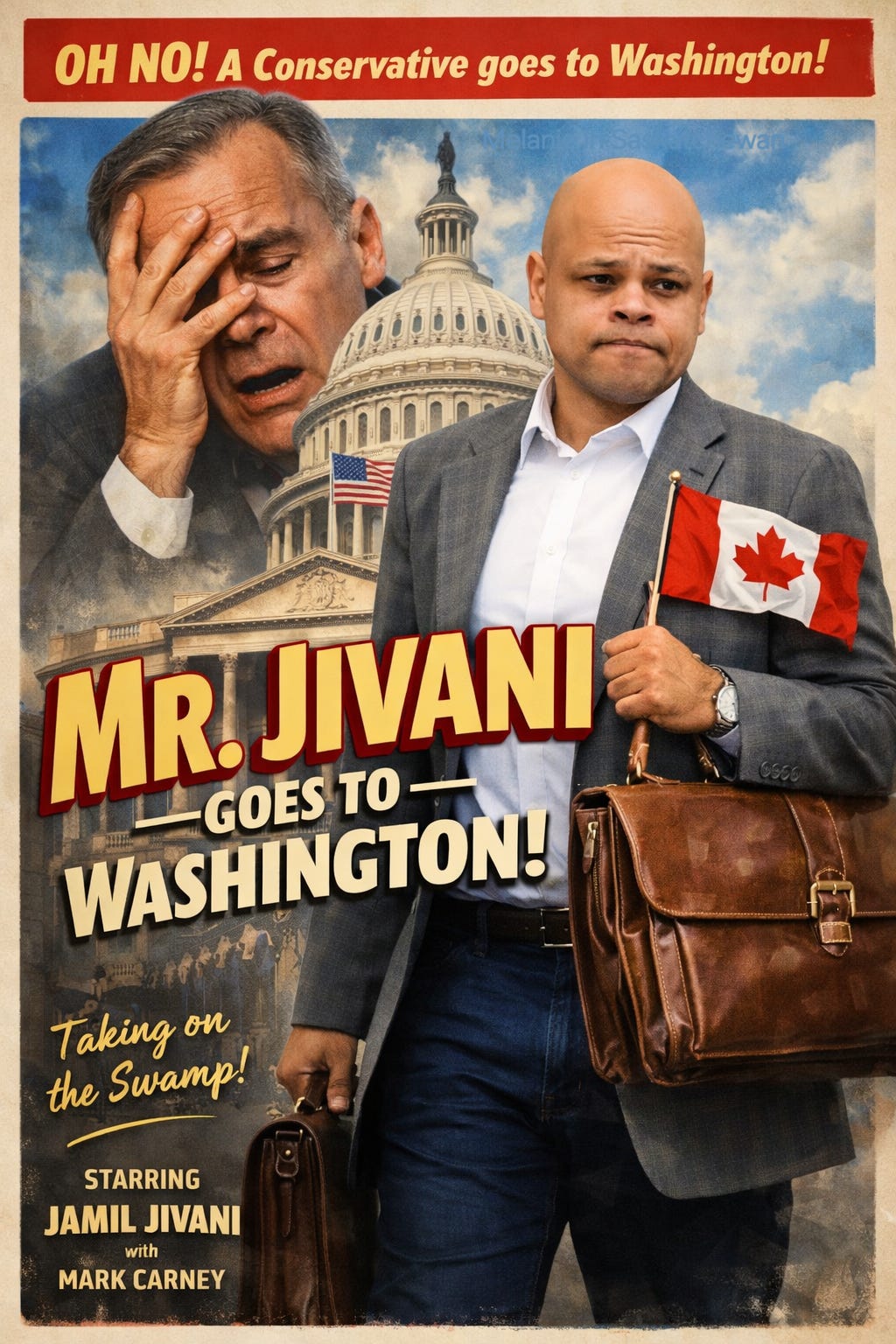
Image from Melanie in Saskatchewan

It was a whirlwind of a trip, full of excellent conversations. I had meetings with the White House and State Department, including conversations with President Donald Trump, Vice-President JD Vance, and Secretary of State Marco Rubio. Senators from Montana, Ohio, and Wisconsin, as well as the United States Trade Representative, each sat down with me to share their priorities. Businesses and industries employing thousands of Canadians shared their insights with me on where Canada-U.S. trade fits into their vision for economic growth.

Doors were open for dialogue about how Canada and the U.S. can work together at a time when pessimism gets most of the media attention. Certainly, my 15-year friendship with the vice-president played a key role in opening those doors. But what I found across the board was optimism about how we can move trade negotiations forward. I was particularly happy to hear key insights on how we can make progress on specific sectoral priorities, and the importance of strategic diplomacy. I offered my perspective on why CUSMA is so important to communities like mine in Bowmanville—Oshawa North, and I expressed my hope that CUSMA will continue to ensure Canada and the U.S. both benefit from a special economic and security relationship.

There is only so much I can share without first having the chance to speak with Prime Minister Mark Carney and Minister Dominic LeBlanc. Out of respect for their unique responsibilities in negotiating trade with the United States, it’s important that I debrief them before saying too much publicly and see how we can work together moving forward as Conservatives and Liberals.

However, I do want to point out a key observation related to the need for strategic diplomacy. Mexico — the third partner in our trilateral trade agreement with the U.S. — is further ahead in its engagement with the U.S. than Canada is. On Jan. 28, 2026, Mexico and the U.S. announced formal talks on CUSMA reforms. A week later, Mexico and the U.S. announced a joint action plan for critical minerals. Neither of these announcements included Canada.

Observers of this news would be right to worry that the current Canadian government may be making similar mistakes as were made under Prime Minister Justin Trudeau during the 2017 CUSMA negotiations. At that time, Mexico advanced its negotiations with the U.S. while Canada was largely left out of the process. It was only at the last minute, when a bilateral agreement between Mexico and the US was a real possibility, that Canada was included and our unique trilateral arrangement continued.

It would be a mistake to relive 2017 all over again, if for no other reason than Canadian workers and businesses deserve to have full representation in a process that has such a significant impact on our economy. The workers at the GM plant in Oshawa deserve to know that their government did everything possible to protect their jobs and encourage investment in their industry. All Canadians deserve to know that their elected officials are making the best effort possible to advance our national interests.

Full disclosure: Jamil Jivani is my Member of Parliament, and I fully support his decision to go and I hope that it actually does help make for improved trade relations between Canada and the United States. Bitterness and uncertainty only benefit the Liberal Party and Mark Carney, not ordinary Canadians. Attacking and criticizing Donald Trump plays well in our deranged and sycophantic media, but it makes Trump less willing to deal fairly with Canada on trade or other issues of critical importance to both nations.

February 7, 2026

Liberal horror at a Conservative MP going to Washington to talk trade

Jamil Jivani, Conservative Member of Parliament for the riding of Bowmanville-Oshawa North, is being called all sorts of names by Liberals and their creatures in the mainstream media for his temerity in actually going to Washington DC to try to encourage trade talks between Canada and the United States:

Image from Melanie in Saskatchewan

Mark Carney, I want to speak to you directly for a moment, because this whole episode has your fingerprints all over it.

You have spent months telling Canadians we live in a more dangerous and divided world. You have warned us that this is not a transition but a rupture. You have explained, repeatedly, that Canada must adapt, that middle powers must act differently, that old assumptions no longer apply. It is very serious language. Big language. The kind you deliver slowly, as if the room should be taking notes.

So imagine my surprise when a Conservative MP behaved exactly the way your speeches suggest Canada must behave, and Ottawa promptly short-circuited.

Jamil Jivani went to Washington to try to open a door you and your government have been telling Canadians does not exist. He used a personal relationship with JD Vance, not for applause, not for theatrics, but for the radical act of actually talking to someone who matters. And suddenly, Mark, this was not adaptive diplomacy. It was alarming. Inappropriate. A problem.

This is the part where your credibility starts to wobble.

Because let’s be honest. When people asked you about engaging Donald Trump directly, your response boiled down to “Who cares?” Either because it bored you or because you preferred not to acknowledge that door at all. So when a Conservative tries anyway, the issue is not that the door was touched. It is that someone proved it was never locked in the first place.

Jivani did not freelance. He did not sneak off. He offered this connection to your government first. Openly. Calmly. And it was dismissed. Brushed aside. Not interested. And when he went anyway, your side did not react with curiosity or even grudging respect. It reacted with outrage.

The kind of outrage you see when someone fixes a problem you have been holding meetings about for weeks without ever intending to solve it. Like an office that has spent months discussing a flickering lightbulb, only to panic when someone quietly screws in a new one and sits back down before the chair can call the meeting to order.

And then, almost on cue, came the shiny object.

I am not accusing you of anything, Mark. I am simply asking whether it is coincidence that the outrage over Jivani going to Washington was followed almost immediately by a dramatic announcement about dropping the EV mandate. Was that timing accidental, or was it a convenient way to make Canadians look over there while a Conservative threatened to come back with something measurable. I am not saying it was a distraction. I am just saying the choreography was impressive.

Now, let’s talk about cooperation, because you and your allies invoke that word constantly.

When generalized liberals complain that Conservatives will not “play ball”, what they seem to mean is that Conservatives are not being obedient. Cooperation, in practice, appears to mean standing aside politely while you govern unchallenged. It does not mean Conservatives doing something useful that might work. Especially not if it works where you did not.

And this is where your rhetoric corners you.

November 20, 2025

“Oh my God, the Conservatives support children starving at school”

In the National Post, Chris Selley profiles my local MP, Jamil Jivani:

A screengrab from MP Jamil Jivani’s video that is critical of the Liberals’ national school-lunches program. Photo by Jamil Jivani/X

A few eyebrows raised earlier this year when Toronto-area MP Jamil Jivani, long heralded as an essential younger voice in the Canadian conservative movement, wasn’t offered a critic role by party leader Pierre Poilievre. There are 74 official Opposition critics, which is more than half the Conservative caucus. And if Poilievre and Jivani don’t see eye to eye, one might still have thought Jivani’s relationship with U.S. Vice-President JD Vance would be a useful resource.

There’s also the fact that Jivani is rather good at defending conservative policy, especially on the social side — better, one might argue, than Poilievre. On Monday, Jivani posted a video of himself arguing that Canadian children should go hungry at school. Or at least, that’s how certain hysterics chose to interpret his opposition to the Liberals’ national school-lunches program.

“It should frighten us that there are parents who can’t buy their own kids lunch,” he tells a constituent in the video. “(But) the government shouldn’t be your daddy; the government shouldn’t be your mother. We have families, and families should be strong enough to provide for their children, and when they’re not that should break our hearts. … It should not be used as a justification for the government to have even more influence, even more input, even more control over our lives.”

The program is already underway, with $1 billion in funding over five years committed as transfers to the provinces in 2024 — three years after the Liberals first promised it. And the Liberals recently announced plans for more. “Permanent” funding of more than $200 million is set to kick in in 2029.

The response anywhere to Jivani’s intervention, anywhere to his left, in a nutshell: “Oh my God, the Conservatives support children starving at school”. Even among some conservatives we hear the traditional timid refrain: Is this a “winning issue”? Or is the party just making itself look callous? What will the media think? Jivani, unlike many more seasoned Conservatives, seems not to care so much about the potential blowback.

Lunches served at school — paid or subsidized — are hardly a brand-new statist invention. They’ve been around forever, although they’re more common in certain kinds of schools than others. A 2013 Queen’s University study looked at 436 Canadian schools and found only 53 per cent had a cafeteria. (When I was a kid, many of my friends walked home for lunch and back afterwards.) And Jivani concedes in the video that many Canadians will like the sound of a national school-lunch program. Who would argue against it? It’s obviously far more important that kids eat breakfast and lunch (and dinner) than it is who provides it.

But that assumes a national school-lunch program, or even a provincial or local school-lunch program, is the quickest and easiest way to make sure kids are fed. It obviously isn’t, but trust in government, somehow, is a tough nut to crack in this country. Mass pandemic-era supports like CERB weren’t unalloyed successes, but they proved governments at least know how to shovel money out the door when they feel it absolutely necessary.

Especially since so many Canadian schools don’t have cafeterias — 53 per cent of elementary schools in the Queen’s study, and 82 per cent of combined elementary-secondary schools — it would make much more sense just to mail every parent who needs one a subsidy and let them pack the lunch, or the lunch money, that their kids need.

I’ve mentioned many times that I’m not a Conservative, but I don’t mind Mr. Jivani as my Member of Parliament because he doesn’t seem to me to be a typical Canadian Conservative (I thought it was significant that the PPC chose not to run against him once he became the Conservative candidate). In my YouTube recommendations, this video appeared with some sensible views from the Deputy Leader of His Majesty’s Loyal Opposition, Melissa Lantsman:

The trouble, as always with parties in opposition, is that they can sound like they’ve got great ideas and will energetically address the problems they identify while not in government … but once they go into office, sound remarkably like the government they just defeated and little or nothing actually changes.

Powered by WordPress

