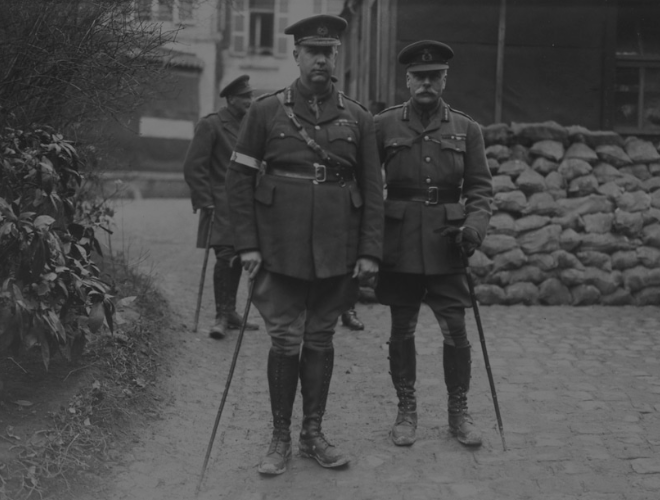
One way to respond to a novel tactical problem is with novel tactics. And the impetus for this kind of thinking is fairly clear: if your own artillery is the problem digging you into a hole, then find a way to use less of it.
The mature form of this tactical framework is often called “Hutier” tactics, after German general Oskar Emil von Hutier, though he was hardly the sole or even chief inventor of the method. In its mature form, the technique went thusly: instead of attacking with large waves of infantry which cleared each objective in sequential order, attacks ought to be proceeded by smaller units, carefully trained with the layout of the enemy positions. Those units, rather than having a very rigid plan of attack, would be given those general objectives and left to figure for themselves how to accomplish them (“mission tactics” or Auftragstaktik)1, giving them more freedom to make decisions based on local conditions and the ground.
These elite spearhead units, called Stoßtruppen or “Stormtroopers” were well equipped (in particular with a higher amount of automatic firearms and hand grenades, along with flamethrowers). Importantly, they were directed to bypass enemy strong-points and keep moving forward to meet their objectives. The idea here was that the follow-up waves of normal infantry could do the slow work of clearing out points where enemy resistance was strong, but the stormtroopers should aim to push as deeply as possible as rapidly as possible to disorient the defenders and rapidly envelop what defenses remained.2
These sets of infantry tactics were in turn combined with the hurricane barrage, a style of artillery use which focused on much shorter but more intense artillery barrages, particularly associated with Colonel Georg “Breakthrough” Bruchmüller. Rather than attempting to pulverize defenses out of existence, the hurricane barrage was designed merely to force enemies into their dugouts and disorient the defenders; much of the fire was directed at longer ranges to disrupt roads and artillery in the enemy rear. The short barrage left the ground relatively more intact. Meanwhile, those elite infiltration units could be trained to follow the creeping barrage very closely (being instructed, for instance, to run into the shell explosions, since as the barrage advantages, no gun should ever strike the same spot twice; a fresh shell-hole was, in theory, safe). Attentive readers will recognize the basic foundations of the “move fast, disorient the enemy” methods of the “modern system” here.
So did infiltration tactics break the trench stalemate? No.
First, it is necessary to note that while infiltration tactics were perhaps most fully developed by the Germans, they were not unique to them. The French were experimenting with many of the same ideas at the same time. For instance, basic principles of infiltration were being published by the French General Headquarters as early as April, 1915. André Laffargue, a French infantry captain, actually published a pamphlet, which was fairly widely distributed in both the French and British armies by the end of 1915 and in the American army in 1916, on exactly this sort of method. In many cases, like at the Second Battle of Artois, these French tactics bore significant fruit with big advances, but ran into the problem that the gains were almost invariably lost in the face of German counter-attacks. The Russians, particularly under Aleksei Brusilov, also started using some of these techniques, although Brusilov was as much making a virtue of necessity as the Russians just didn’t have that much artillery or shells and had to make do with less and Russian commanders (including Brusilov!) seem to have only unevenly taken the lessons of his successes.
The problem here is speed: infiltration tactics could absolutely more efficiently overrun the front enemy lines and even potentially defeat multiple layers of a defense-in-depth. But after that was done and the shock of the initial push wore off, you were still facing the same calculus: the attacker’s reinforcements, shells, artillery and supplies had to cross broken ground to reach the new front lines, while the defender’s counter-attack could ride railways, move over undamaged roads and then through prepared communications trenches. In the race between leg infantry and trains, the trains always won. On the Eastern Front or against the Italians fighting under the Worst General In History at Caporetto (1917), the already badly weakened enemy might simply collapse, producing massive gains (but even at Caporetto, no breakthrough – shoving the enemy is not a breakthrough, to qualify as a breakthrough, you need to get to the “green fields beyond” that is open ground undefended by the enemy), but against a determined foe, as with the 1918 Spring Offensives, these tactics, absent any other factor, simply knocked big salients3 in the line. Salients which were, in the event, harder to defend and brought the Germans no closer to victory. Eventually – often quite rapidly – the front stabilized again and the deadlock reasserted itself. Restoring maneuver, the actual end-goal of these tactics, remained out of reach.
None of this is to say that infiltration tactics were useless. They represented a real improvement on pre-war infantry tactics and continue to serve as the basis for modern infantry tactics. But they could not break the trench stalemate or restore maneuver.
Bret Devereaux, “Collections: No Man’s Land, Part II: Breaking the Stalemate”, A Collection of Unmitigated Pedantry, 2021-09-24.
- Because it doesn’t fit anywhere else, I want to make a rather long note here. There is an odd tendency which I find quite frustrating, in which military concepts, unit designations and terminology from other languages are all translated into English when used, except for German terms. I suspect this has to do with the high reputation German military thinking holds in among the general public and some military practitioners. I do not share this view; both the German Imperial Army and the Nazi Wehrmacht (another term we never translated yet we feel no need to call the French army l’armée de terre) managed to lose the only major wars they were in, leading to the end of the states they served. Both armies were capable at some things and failed at others; their record certainly does not make German some sort of Holy Language of War. Nevertheless, where German technical terms are notable, I will include them so that the reader will know, should they encounter them elsewhere, that this is a term they are already familiar with, albeit in translation.
- It should be noted that the emphasis here remained on envelopment and destruction rather than on disorientation. The latter is a feature of subsequent systems based on German maneuver warfare, but was not a goal of the doctrine itself initially.
- A salient is a bulge in the line such that your position is bordered by the enemy on three sides. Such positions are very vulnerable, since they can be attacked from multiple directions and potentially “pinched off” at the base.
November 15, 2025
QotD: The innovation of infiltration tactics in trench warfare
November 9, 2025
Sir Arthur Currie, commander of the famous Canadian Corps in WW1
As a counterpoint to the OTT summary of Sir Arthur posted last week, here’s The Black Horse with part one of a two-part look at the man’s early career before joining the Canadian Expeditionary Force in Europe:

Sir Arthur Currie with Field Marshal Sir Douglas Haig, February 1918.
Libraries and Archives Canada item ID number 3404878.
The Red Ensign is a publication deeply interested in leadership; the good, the bad, and the ugly. For this reason, this Remembrance Day, I have chosen to draw the audience’s attention to the life and times of Sir Arthur Currie, the first Canadian commander of the Canadian Corps during the Great War. This presents an opportunity to both on honour and reflect upon the courage and sacrifice of the men who have fought under the flag of this great nation, but also offers the language to articulate the task facing any who would attempt to lead Canada today. As Currie’s war was defined by the challenge [of] leadership of Canadians in the context of the shifting priorities of the late British Empire, any who would seek to lead Canadians today face will struggle to harmonize efforts on behalf of the Canadian people and the priorities and policies of the American power block which he cannot eschew.
Dulce et decorum est pro patria mori; but when your country is an Imperial Dominion, who and what is “pro patria“, and how can one spend their life for them?
The Man Before the Great Man:
Arthur Currie was born in 1875 in Napperton, Ontario [50 km West of London], the third of eight children living on a homestead belonging to his grandfather. Raised with a the vigorous discipline of a Methodist home, Currie would remain a convicted Christian for his entire life, though he converted to Anglicanism as an adult. Currie was a good student, intending to pursue a career in law or medicine but dropped out of school twice, first temporarily because of the financial constraints brought on by the death of his father, and then for a second time at 19 because of a quarrel with one of his teachers. After leaving school he went West; after a string of failed efforts to establish himself via entrepreneurship and real-estate speculation he joined the Canadian militia as a gunner in 1897 in Victoria B.C. at the age of 23. A giant man (6’3″ at a time when the average Canadian height was 5’7″) with a noted eye for technical detail and, in the words of his son, a “tremendous command of profanity”, he quickly distinguished himself and was promoted to corporal before earning a commission as an officer in 1900. As an officer in peace time Currie was noted for his detailed inspections and his rapid transformation from “one of the boys”, into a rigid disciplinarian. This duality, an officer raised from the ranks, who could both embody the rigid tradition of the British military and who had an intimate familiarity with the life and ways of the enlisted men would become a defining feature of his career.
During Currie’s peace-time career as an officer he maintained a second career as a real-estate [agent]. After becoming head of Matson Insurance Firm 1904, he and the firm invested aggressively in the Victoria real-estate market. In 1913 Currie’s financial situation began to rapidly deteriorate as a consequence of price declines in the real-estate market. Currie’s financial problems nearly led him to refuse to stand up the 50th Regiment Gordon Highlanders of Canada in 1913. In July 1914 Curry used $10,833.34 of regimental funds intended for the purchase of uniforms and kit to pay his personal debts, and found himself facing forcible retirement just as the Canadian Army was being mobilized for war. At the intervention of one of his subordinates, Major Garnet Hughes, he instead accepted promotion as brigadier-general of the 2nd Brigade of the 1st Canadian Division, and ignored correspondence from the new commander of the 50th regiment, Major Cecil Roberts, about the missing funds until he was overseas.
Currie arrived at camp Valcartier on September 1st, 1914 to find himself charged with 10x as many men as he had ever led before, no staff, a shared tent as a command center, and the duty to prepare these men for one of the most difficult theatres of war the world has ever seen. The six months between taking command and the arrival of his brigade in the trenches near Ypres were marked by two mud besotted poorly supplied training camps, shoddy kit, rampant disease, and the company of a certain bear that was to become beloved by children around the world. Through this period Currie was well liked by the men, but known as a disciplinarian with an eye for technical detail. In March 1915 the brigade was deployed to what was expected to be a quiet part of the front with the intent of allowing the men to gain some experience with trench warfare before they were relied upon for action. Nobody anticipated what would happen next.
September 22, 2025
QotD: Tactical combat on the pre-modern battlefield
Pre-modern armies certainly do demand a considerable degree of coordination. In film and even sometimes in video games armies clash together in a confused melee with friends and foes all intermixed at random. Indeed, I have been asked by students more than once “What happens when X type of soldier ends up in a confused melee?” and had to explain that the answer is “they don’t”. Because no one fights that way, at least not intentionally.
In a fight, after all, a combatant is extremely vulnerable to attacks from behind or in their peripheral vision, especially if they are focused forward on the foe in front of them. A confused melee would thus produce extreme casualties and produce them extremely quickly. But fighters want to survive their combats and their leaders would like not only to win the battle but to have an army at the end of it. Remember: the purpose of the battle is to deliver a siege: if you win the battle but with only a pathetic handful of survivors, you haven’t really won much of anything.
The battle line is the obvious solution: each fighter is only responsible for a few feet of frontage directly in front of them, a small enough area that they can focus on it visually and direct whatever shield or armor or weapons they have towards it, giving them a greater margin of safety. Adding depth to the formation (that is, increasing the number of ranks, that is a row of fighters right to left) both secures each fighter against the possibility of being flanked due to the death of the fellows to their right or left (as now they’ll just be replaced by the next rank moving up) and adds a morale reinforcement which we’ll come back to […] But now you have a formation that consists essentially of a large number of files (that is, a single row of fighters front-to-back) which need to move together to create that unbroken, mutually supporting front line so that no one is being attacked from many sides at once. Again, all of this is before we start adding fighting styles like pike-formations or shield-walls that are designed to excel in this environment (and fare poorly out of it).
As an aside, this is one dynamic that I find games like Mount and Blade or the Total War series that simulate individual soldiers struggle to get quite right. In most games the line of formation either remains almost perfectly rigid (think units on “pike phalanx” in Rome: Total War) or units the moment they come into contact form rough blobs of models all pushing forward. But actually you are going to have men in the rear ranks trying to keep their relative position to the front ranks so the formation neither holds rigidly steady nor dissolves but is going to almost flex and bend (and if you are lucky, not tear or break). This is only an aside though because we’re not well informed about these sorts of dynamics, so it is hard to speak about them in-depth.
But to fight this way now means that all of your soldiers (really here we are talking about infantry; cavalry must also be coordinated but in different ways and because they are often composed of elites that coordination may be produced through different training methods) need to move in the same direction at the same speed in order to retain that front line where they can support each other. Again, we are not yet to something like a shield-wall or a sarisa-phalanx which demands tight coordination; even in a rough skirmish line you need to get everyone moving together just to maintain that unbroken front. A break in the front, after all, would be dangerous: enemies filtering into it uncontrolled could then flank and defeat individually the members of the broader line (two-on-one contests in melee combat typically end in seconds and are very lopsided), causing collapse.
Now the good news is that if all you need an army to do is form up in a rough line a few ranks deep and then move more or less forward, the coordination demands are not insurmountable. We’ve already discussed using marching formations to create the line of battle so all you need is a way to regulate speed (since forward is a fairly easy direction for everyone). It isn’t quite ideal for everyone to simply self-regulate their speed by looking around (at least not for a contact infantry line; for missile-skirmish troops moving in a “cloud” rather than a line they can absolutely do that) because that will produce a lot of stagger-start-stopping and accordioning which at best will slow you down and at worst will eventually turn your neat line into a rough crowd – one easily defeated if it is opposed by a line of infantry in good order. Keeping everyone in the same speed can be handled with music: the regular beat regulates the footsteps. That can be a marching song or it can be an instrument (ideally one easy to hear).
We’ve talked about armies – or components of armies – like this. I’ve described hoplite phalanxes through much of the classical periods, for instance, as essentially unguided missiles for this reason: the general hits “go” and the line moves forward. Likewise a shield-wall formation like the early English fyrd doesn’t need to do complex maneuvers. And for many armies, that was enough: a body of infantry which either held a position or moved forward in a single line, in some cases with a body of aristocratic cavalry which might be capable of more complex maneuvers (that the aristocrats had trained in since a young age). And you can see, if your culture has armies like this, why the general might be focused on either leading the cavalry in particular or else being the motivating “warrior-hero” general – such an army isn’t capable of much command once the advance starts in any event. They haven’t trained or prepared for it.
Bret Devereaux, “Collections: Total Generalship: Commanding Pre-Modern Armies, Part IIIa”, A Collection of Unmitigated Pedantry, 2022-06-17.
September 4, 2025
QotD: The development of the “halftrack” during the interwar period
The period between WWI and WWII – the “interwar” period – was a period of broad experimentation with tank design and so by the time we get to WWII there are a number of sub-groupings of tanks. Tanks could be defined by weight or by function. The main issue in both cases was the essential tradeoff between speed, firepower and armor: the heavier you made the armor and the gun the heavier and thus slower the tank was. The British thus divided their tank designs between “cruiser tanks” which were faster but lighter and intended to replace cavalry while the “infantry tanks” were intended to do the role that WWI tanks largely had in supporting infantry advances. Other armies divided their tanks between “light”, “medium”, and “heavy” tanks (along with the often designed but rarely deployed “super heavy” tanks).
What drove the differences in tank development between countries were differences between how each of those countries imagined using their tanks, that is differences in tank doctrine. Now we should be clear here that there were some fundamental commonalities between the major schools of tank thinking: in just about all cases tanks were supposed to support infantry in the offensive by providing armor and direct fire support, including knocking out enemy tanks. Where doctrine differed is exactly how that would be accomplished: France’s doctrine of “Methodical Battle” generally envisaged tanks moving at the speed of mostly foot infantry and being distributed fairly evenly throughout primarily infantry formations. That led to tanks that were fairly slow with limited range but heavily armored, often with just a one-man turret (which was a terrible idea, but the doctrine reasoned you wouldn’t need more in a slow-moving combat environment). Of course this worked poorly in the event.
More successful maneuver warfare doctrines recognized that the tank needed infantry to perform its intended function (it has to have infantry to support) but that tanks could now move fast enough and coordinate well enough (with radios) that any supporting arms like infantry or artillery needed to move a lot faster than walking speed to keep up. Both German “maneuver warfare” (Bewegungskrieg) and Soviet “Deep Operations” (or “Deep Battle”) doctrine saw the value in concentrating their tanks into powerful striking formations that could punch hard and move fast. But tanks alone are very vulnerable and in any event to attack effectively they need things like artillery support or anti-air protection. So it was necessary to find ways to allow those arms to keep up with the tanks (and indeed, a “Panzer divsion” is not only or even mostly made up of tanks!).
At the most basic level, one could simply put the infantry on trucks or other converted unarmored civilian vehicles, making “motorized” infantry, but […] part of the design of tanks is to allow them to go places that conventional civilian vehicles designed for roads cannot and in any event an unarmored truck is a large, vulnerable tempting target on the battlefield.
The result is the steady emergence of what are sometimes jokingly called “battle taxis” – specialized armored vehicles designed to allow the infantry to keep up with the tanks so that they can continue to be mutually supporting, while being more off-road capable and less vulnerable than a truck. In WWII, these sorts of vehicles were often “half-tracks” – semi-armored, open-topped vehicles with tires on the front wheels and tracks for the back wheels, though the British “Universal Carrier” was fully tracked. Crucially, while these half-tracks might mount a heavy machine gun for defense, providing fire support was not their job; being open-topped made them particularly vulnerable to air-bursting shells and while they were less vulnerable to fire than a truck, they weren’t invulnerable by any means. The intended use was to deposit infantry at the edge of the combat area, which they’d then move through on foot, not to drive straight through the fight.
The particular vulnerability of the open-top design led to the emergence of fully-enclosed armored personnel carriers almost immediately after WWII in the form of vehicles like the M75 Armored Infantry Vehicle (though the later M113 APC was eventually to be far more common) and the Soviet BTRs (“Bronetransporter” or “armored transport”), beginning with the BTR-40; Soviet BTRs tended to be wheeled whereas American APCs tend to be tracked, something that also goes for their IFVs (discussed below). These vehicles often look to a journalist or the lay observer like a tank, but they do not function like tanks. The M113 APC, for instance, has just about 1.7 inches of aluminum-alloy armor, compared to the almost four inches of much heavier steel armor on the contemporary M60 “Patton” tank. So while these vehicles are armored, they are not intended to stick in the fight and are vulnerable to much lighter munitions than contemporary tank would be.
At the same time, it wasn’t just the infantry that needed to be able to keep up: these powerful striking units (German Panzer divisions, Soviet mechanized corps or US armored divisions, etc.) needed to be able to also bring their heavy weaponry with them. At the start of WWII, artillery, anti-tank guns and anti-air artillery remained almost entirely “towed” artillery – that is, it was pulled into position by a truck (or frequently in this period still by horses) and emplaced (“unlimbered”) to be fired. Such systems couldn’t really keep up with the tanks they needed to support and so we see those weapons also get mechanized into self-propelled artillery and anti-air (and for some armies, tank destroyers, although the tank eventually usurps this role entirely).
Self-propelled platforms proved to have another advantage that became a lot more important over time: they could fire and then immediately reposition. Whereas a conventional howitzer has to be towed into position, unlimbered, set up, loaded, fired, then limbered again before it can move, something like the M7 Priest can drive itself into position, fire almost immediately and then immediately move. This maneuver, called “shoot-and-scoot” (or, more boringly, “fire-and-displace”) enables artillery to avoid counter-battery fire (when an army tries to shut down enemy artillery by returning fire with its own artillery). As artillery got more accurate and especially with the advent of anti-artillery radars, being able to shoot-and-scoot became essential.
Now while self-propelled platforms were tracked (indeed, often using the same chassis as the tanks they supported), they’re not tanks. They’re designed primarily for indirect fire (there is, of course, a sidebar to be written here on German “assault guns” – Sturmgeschütz – and their awkward place in this typology, but let’s keep it simple), that is firing at a high arc from long range where the shell practically falls on the target and thus are expected to be operating well behind the lines. Consequently, their armor is generally much thinner because they’re not designed to be tanks, but to play the same role that towed artillery (or anti-air, or rocket artillery, etc.) would have, only with more mobility.
So by the end of WWII, we have both tanks of various weight-classes, along with a number of tank-like objects (APCs, self-propelled artillery and anti-air) which are not tanks but are instead meant to allow their various arms to keep up with the tanks as part of a combined arms package.
Bret Devereaux, “Collections: When is a ‘Tank’ Not a Tank?”, A Collection of Unmitigated Pedantry, 2022-05-06.
August 17, 2025
QotD: The benefits of using auxilia units to the Roman Empire
That frankly unusual structure for a multi-ethnic imperial army [the non-citizen auxilia numbering about half the total “Roman” army] brought three principal benefits for the Roman army and consequently for the Roman empire itself.
The most obvious of these is manpower. Especially with a long-service professional army, capable and qualified recruits are in limited supply. The size of the Roman army during the imperial period ranged from around 300,000 to around 500,000, but in 14 AD (the year of Augustus‘ death) there were only 4,937,000 Roman citizens (Res Gestae 8.11), a figure which probably (a word I am using to gloss over one of the most technical and complex arguments in the field) includes women and children. Needless to say, keeping something close to a fifth of the adult male citizen population under arms continually, forever was simply never going to be feasible. After his victory in 31 BC at Actium, Octavian (soon to be Augustus) had acted quickly to pare down the legions, disbanding some, merging others, until he reached a strength of just 28 (25 after the three legions lost in 9 AD were not replaced). It was a necessary move, as the massive armies that had been raised during the fever-pitch climax of the civil wars simply could not be kept under arms indefinitely, nor could a short-term service conscript army be expected to garrison the hundreds of miles of Roman limes (“frontier, border”) in perpetuity.
Harnessing the manpower of the provinces was simply the necessary solution – so necessary that almost every empire does it. By their very nature, empires consist of a core which rules over a much larger subject region, typically with far greater population; securing all of that territory almost always requires larger forces than the core’s population is able or willing to provide, leading to the recruitment of auxiliaries of all kinds. But whereas many imperial auxiliaries, as noted above, turn out to be potential dangers or weaknesses, Rome’s auxilia seem to have been fairly robustly “bought in” on the system, allowing Rome to access motivated, loyal, cohesive and highly effective manpower, quite literally doubling the amount of military force at their disposal. Which in turn mattered a great deal because the combat role of the auxilia was significant, in stark contrast to many other imperial armies which might use auxiliaries only in subsidiary roles.
The auxilia also served to supply many of the combat arms the Romans themselves weren’t particularly good at. The Romans had always performed very well as heavy infantry and combat engineers, but only passably as light infantry and truly poorly as shock cavalry; they generally hadn’t deployed meaningful numbers of their own missile cavalry or archers at all. We’ve already talked a lot about how social institutions and civilian culture can be important foundational elements for certain kinds of warfare, and this is no less true with the Romans. But by recruiting from subject peoples whose societies did value and practice the kinds of warfare the Romans were, frankly, bad at, the Roman skill-set could be diversified. And early on, this is exactly what we see the auxilia being used for (along with also providing supplemental heavy infantry), with sagitarii (archers), funditores (slingers), exploratores (scouts) and cavalry (light, heavy and missile), giving the Romans access to a combined arms fighting force with considerable flexibility. And the system clearly works – even accounting for exaggerated victories, it is clear that Roman armies, stretched over so long a frontier, were both routinely outnumbered but also routinely victorious anyway.
As Ian Haynes notes, the ethnic distinctiveness of various auxilia units does not seem to have lasted forever, though in some cases distinctive dress, equipment and fighting styles lasted longer. Most auxilia were posted far from their regions of origin and their units couldn’t rely on access to recruits from their “homeland” to sustain their numbers over the long haul (although some number of recruits would almost certainly come from the military families of veterans settled near the forts). But that didn’t mean the loss of the expertise and distinctive fighting styles of the auxilia. Rather skills, weapons and systems which worked tended to get diffused through the Roman army (particularly in the auxilia, but it is hard not to notice that eventually the spatha replaces the gladius as the sword of the legions). As Ovid quips, Fas est et ab hoste doceri, “It is right to learn, even from the enemy” (Met. 4.428); the Romans do that a lot. The long-service professional nature of these units presumably made a lot of this possible, with individual cohortes and alae becoming their own pockets of living tradition in the practice of various kinds of fighting and acclimating new recruits to it. Consequently, not only did the Roman army get access to these fighting-styles, because the auxilia were actually integrated into the military system rather than merely attached to it, they also got the opportunity to adopt or imitate the elements of the fighting styles that worked.
Finally, the auxilia system also minted new Romans. We’ve already mentioned that auxilia veterans received Roman citizenship on retirement, but that wasn’t the extent of it. We can see in inscriptions that the degree of cultural fluency that soldiers in the auxilia gained with Roman culture was high; they often adopted Roman or Romanized names and seem to have basically always learned Latin (presumably because their Roman officers wouldn’t have spoken their language). While some units of the auxilia kept distinctive national dress as a sort of uniform, most of the auxilia seem to have adopted a style of dress that, while distinct from the legions, was generally in keeping with the Roman tradition of military dress (which was not quite the same as Roman civilian dress). They also partook of the Roman military diet (Roman soldiers kept a similar diet all over the empire, even if that meant shipping thousands of amphora of olive-oil and sour wine to northern England) which would have given them a diet in common with many work-a-day Romans too. Once retired, auxilia soldiers tended to settle where they served (rather than returning to their “home” provinces), which meant settling in frontier provinces where their citizenship set them apart as distinctively Roman, wherever they may have come from.
Exactly how many auxilia would have retired like this requires a degree of number crunching. Given a 20-year tour of service and zero mortality, we might expect around 7,500 men to pass through the auxilia each year. But of course, mortality wasn’t zero and so we have to expect that of our c. 20-year-old recruits, some number are going to die before retirement. Using some model life tables (following B. Frier, “Demography” in CAH^2 XI (2000)), we should figure that very roughly one third of our recruits will have died before reaching discharge. We then we need to adjust our recruitment figures to retain the same total strength and we get something like 9,000 new recruits each year to keep a strength of c. 150,000 with mortality counted for and 20 year tours. That gives us roughly 6,000 auxilia living to retirement each year. That may seem a small number, but that gradual accretion matters when it runs for decades and centuries and the newly enfranchised family units (recall that the citizenship grant covers children and sort-of-kind-of his spouse1) tend to settle on the frontiers, which is a really handy place to have communities of citizens. If we assume that these new citizen families mostly reproduced themselves (or more correctly that they went extinct or split with multiple children at roughly the same rate with no natural population growth), then we’d expect this process to produce perhaps something like 1.5 million new citizen households up until the Constitutio Antoniniana. Being very back of the envelope then, we might – once we account for women and children descendants of those soldiers – assume that on the eve of the general grant of citizenship in 212, there were perhaps 4 million Romans whose citizenship status was a product of service in the auxilia somewhere in their history; perhaps representing something like 7% of the entire population (including non-free persons). Were we to assume larger households (which seems wise, given that retired auxiliaries are probably more likely than average to be in an economic position to have a larger family), that figure would be even higher.
That is a very meaningful number of new Romans. And those figures don’t account for some of the other ways Roman citizenship tended to expand through communities both through manumission but also the political networks citizenship created (your Latin-speaking former-auxiliary citizen neighbors are a lot more likely to be able to help intercede to get you citizenship or get your community recognized as a municipia with that attendant citizenship grant). And not only are those new Romans by legal status, but new Romans who have, by dint of military training and discipline, absorbed quite a lot of Roman culture. As best we can tell, they tended to view the Roman Empire as their polity, rather than as a foreign or oppressive entity. They were “bought in” as it were. Again, this does not seem to have been the Roman intent, but rather an opportunistic, self-serving response to the need to maintain the loyalty of these troops; citizenship was, after all, a free benefit the emperor might bestow at no cost to the treasury (since citizens who lived outside of Italy still owed taxes) or himself.
Of course that fits the auxilia in to a later pattern in the provinces which becomes perhaps most apparent as the Roman Empire begins to collapse …
Bret Devereaux, “Collections: The Queen’s Latin or Who Were the Romans, Part V: Saving and Losing and Empire”, A Collection of Unmitigated Pedantry, 2021-07-30.
- Note on the coverage of the spouse. The grant of citizenship covered any biological children of the discharged auxiliary but did not extend citizenship to his wife. It did however, give an auxiliary the right to contract a lawful marriage with effectively any free woman, including non-citizens and the children resulting from such a union would be citizens themselves. Consequently, it extended one of the core privileges of citizenship to the non-citizen wife of a discharged auxiliary: the right to bear citizen children. Since the wife would be part of the retired auxiliary’s household (and then later, if he predeceased her, potentially in the household of her male citizen children) she’d be legally covered in many cases because a legal action against her would generally be an action against her husband/child. Given that a number of the rights of citizens simply didn’t apply to women in the Roman world (e.g. office holding), this system left the wife of a retired auxiliary with many, but not all, of the privileges of citizenship, so long as her husband and her marriage survived. That said, the legal status remained vested in her husband or her children, which made it more than a little precarious. One of these days, we can talk more about the structure of the Roman familia.
August 5, 2025
QotD: Fighting a Middle Republic Legion
You’ve formed up in your fighting order and begun to advance and first a cloud of light enemies (the velites) move up against you. Behind them, you can vaguely see the main Roman body, but not in much detail yet. Instead, you are treated to shower of lighter javelins; these only mass around 250g or so, but some of them are bound to catch a face or an unarmored leg and bring someone down or get stuck in a shield. The damage is probably minimal, but what the velites are doing is already wearing you down: you are now, physically and mentally “in combat”, with weapons flying and adrenaline running (whereas the Roman heavy infantry are not!). The velites don’t need to inflict casualties at this stage to have an effect: they’re inflicting friction (in the Clausewitzian sense, drink!) and that is enough.
As you approach the velites, they scatter back to their lines and now the first real trial comes: when you are about twenty meters out from the enemy line, a storm of those heavy pila come in, thick and all at once. Each one masses around 1.3kg (just short of three pounds) so even if the tip doesn’t bite, one of these things clanging off of armor or a shield is going to hurt, the impacts stagger men near you as you struggle to keep formation (and for a Hellenistic army, get and keep those sarisa-points down). The impact of the massed volley, especially against close-order infantry with tight fighting-width, is going to be chaotic as some men are killed, others disabled, still more suddenly staggered. The volley is followed almost immediately by the on-rush of the hastati. These guys don’t have a long spear for keeping you at a distance, they’re all brandishing swords and aim to get in close, using their large body-shields to absorb any blows you might throw while they get right up in your face, where their swords can stab and slash viciously over or under your shield. These hastati are aggressive and they’re probably better armored than you are.
And of course an engagement in contact like this is unpredictable. Perhaps in some areas, your lines push forward, whereas in other places it bends back. For large maneuver units (like taxeis!) this can be a real problem, but Roman maniples are small, so one maniple can advance if it finds the opportunity while others hold position or are even forced back (we actually see a general give, essentially, an “advance at your own discretion” order at Pydna, Plut. Aem. 20.8).
After a short and terrifying experience – these moments of shock combat probably didn’t last all that long, perhaps as little as just a few minutes – the hastati fall back. The front of your line is already physically and mentally exhausted. Many men are wounded and certainly some have been killed or disabled. I don’t want to oversell the casualties aspect of this: armies don’t annihilate each other in stand-up engagements (instead more casualties happen in pursuit), but wounds and exhaustion matter. Latin has this phrase, of being confectus vulneribus, “exhausted by wounds” or perhaps “worn down by wounds” (Liv. 24.26.14, 31.17.11, Caes. BGall. 5.45) to describe how the accumulation of a lot of little wounds can sap soldiers of their ability to resist effectively, even if no one wound is lethal. And just as important, all of the emotional impetus of your initial attack is spent. And there’s a decent chance that, as you try to breath, you still have these light velites‘ javelins (the hasta velitaris) thudding into your line every few seconds, because – again – they carry seven of them. They’re not out.
And then, as you are getting your bearings, trying desperately to catch your breath, the principes come up. They’re not physically tired or emotionally exhausted, but eager (like you were a half an hour ago when you advanced), they’ve been waiting all this time. Worse yet, these are probably the most combat-effective soldiers the Romans have, in the prime of their life, with years of combat experience. Now the second volley of pila comes in, creating yet more chaos. And then more angry, heavily armored Romans, behind their big shields, stabbing and cutting with their deadly gladii.
Now the men at the back of your single line may be relatively fresh, but you have no real way to get them to the front, so the wrath of the principes falls on men who are already exhausted, already wounded, already tired and already out of fight. Your line isn’t advancing so stridently; the men in the back, if the formation is deep, don’t know why the advance is slowed, why the line seems to be wavering, only that it seems to be wavering. And meanwhile, everyone is hoping that, at any moment, the victorious cavalry on the flanks is going to show up and win the battle, but they can’t see it anywhere in the confusion. Maybe your cavalry has won and is moments away – or perhaps Antiochus III charged it off the field again and no help is coming. Or perhaps the enemy cavalry has tied it up or worse yet, the Romans’ highly skilled Numidian allies might have mastered the flanks. You have no idea, you only know that help isn’t here, you are tired and more Romans are upon you. And somewhere, the thin thread of human courage snaps, either from the exhausted men in front or the confused men behind and the formation begins to collapse.
As the collective defense of lapped shields or serried pikes gives way, the Romans are now truly in their element: their large shields function just fine in individual combat and their versatile swords do as well. Lead by their centurions, the principes, with practiced and experienced skill, are finding the gaps, cutting as they go. As the formation crumbles, the velites can pursue – lightly armored, but well enough armed, backed up by the equites if there are any left.
You can see thus how this is a formation designed to wear down an enemy’s main battle line. It isn’t that the Romans are set massively deeper than a Hellenistic army, either. Assuming a base-3 set of file-depths (which seems to me the most likely), the Roman ranks are probably six, six and three men deep (hastati, principes, triarii), for a total depth over each file of 15, one less than the normal Macedonian formation. And with the wider fighting intervals the Romans use, they won’t normally have much of a problem matching the fighting width of the enemy army, unless substantially outnumbered (as, for instance, at Magnesia).
It’s not the Roman formation is deeper, it’s that its successive battle lines avoid exposing the entire army to exhaustion, attrition and friction all at once. In effect, it uses the same principles as defense-in-depth, exploiting the effect of friction on the enemy line to wear it down, but does so on the offensive. I don’t think it is an accident that when the Romans do lose, it tends to be because this model battle was spoiled in some way, either because the army was ambushed, enveloped, something disrupted the triplex acies or because the enemy was able to carry the field with just the momentum of the first charge – the Roman lines essentially failing like a building undergoing controlled demolition, as each floor pancakes the next without slowing.
But an army that isn’t able to decisively win the battle either at the first onset or somewhere else on the line is going to find itself in quite a lot of trouble as the Romans almost inevitably sandpaper away the morale and stamina of the main line of resistance until it collapses.
Now many of you may already be realizing that this kind of force is going to present a Hellenistic army with a lot of problems, both because it is set up for a different kind of fight than they are, but also because it may end up matching much heavier troops against the lighter parts of a Hellenistic army. But before we jump into battles, we need to zoom up to the upper levels of military analysis – operations and strategy – and talk about the advantages the Romans have there.
Because if all the Romans had was an edge in their tactical system, we might expect them to win battles but sometimes lose wars. Instead, while the Romans sometimes lose battles, they seemingly always win the war.
Bret Devereaux, “Collections: Phalanx’s Twilight, Legion’s Triumph, Part IIa: How a Legion Fights”, A Collection of Unmitigated Pedantry, 2024-02-09.
August 2, 2025
The Bloody Battle of Cannae | Animated(ish) Episode
The Rest Is History
Published 5 Jun 2025This is the final episode of our series on Hannibal, which is the second season on Carthage, the whole series is here: Rome Vs Cathage
Part 1 of our series on Hannibal is here: Hannibal: The Rise of Rome’s Greatest Nemesis
How did the Battle of Cannae — one of the most important battles of all time for Ancient Rome, with a whole Empire at stake, and a reputation that had reverberated across the centuries — in 216 BC, unfold? What brilliant tactics did Hannibal adopt in order to overcome the Roman killing machine, with its vast numbers and relentless soldiers? Why did so many men die in such horrific circumstances? And, what would be the outcome of that bloody, totemic day, for the future of both Carthage and Rome?
Join Tom and Dominic for the climax of their epic journey through the rise of Hannibal, and his world-shaking war against Rome, in one of the deadliest rivalries of all time.
00:00 Context to the battle
08:30 Prelude to the battle and their plans of attack
37:28 The battle
(more…)
July 23, 2025
QotD: The legion of the Middle Republic
The basic building blocks of Roman armies in the Middle Republic are the citizen legion and the socii alae or “wing”. A “standard” Roman army generally consisted of two legions and two matching alae. but larger and smaller armies were possible by stacking more legions or enlarging the alae. We’re not nearly so well informed as to the structure of the alae of socii (the socii being Rome’s “allied” – really, subject – peoples in Italy), except that they seem to have been tactically and organizationally interchangeable with legions. Combined with the fact that they don’t seem archaeologically distinctive (that is, we don’t find different non-Roman weapons with them), the strong impression is that at least by the mid-third century – if not earlier – the differences were broadly ironed out and these formations worked much the same way.1 So, for the sake of simplicity, I am going to discuss the legion here, but I want you to understand (because it will matter later) that for every legion, there is a matching ala of socii which works the same way, has effectively the same equipment, fights in the same style and has roughly the same number of troops.
With that said, we reach the first and arguably most important thing to know about the legion: the Roman legion (and socii ala) of the Middle Republic is an integrated combined arms unit. That is to say, unlike a Hellenistic army, where different “arms” (light infantry, heavy infantry, cavalry, etc.) are split into different, largely homogeneous units, these are “organic” to the legion, that is to say they are part of its internal structure (we might say they are “brigaded together” into the legion as well). Consequently, whereas the Hellenistic army aims to have different arms on the battlefield in different places doing different things to produce victory, the Roman legion instead understands these different arms to be functioning in a fairly tightly integrated fashion with a single theory of victory all operating on the same “space” in the enemy’s line.
And you may well ask, before we get to organization, “What is that theory of victory?” As we saw, the Hellenistic army aims to fix the enemy with its heavy infantry center, hold the flanks with lighter, more mobile infantry (to protect that formation) and win the battle with a decisive cavalry-led hammer-blow on a flank. By contrast, the Romans seem to have decided that the quickest way to an enemy’s vulnerable rear was through their front. The legion is thus not built for flanking, its cavalry component – while ample in numbers – is distinctly secondary. Instead, the legion is built to sandpaper away the enemy’s main battle line in the center through attrition, in order to produce a rupture and thus victory.
To do that, you need to create a lot of attrition and this is what the manipular legion is built to do.
The legion of the Middle Republic is built out of five components: three lines of heavy infantry (hastati, principes and triariivelites), and a cavalry contingent (the equites). Specifically, a normal legion has 1200 each of velites, hastati and principes, 600 triarii and 300 equites, making a total combined unit of 4,500. Organizationally, the light infantry velites were packaged in with the heavy infantry (Polyb. 6.24.2-5) for things like marching and duties in camp, but in battle they typically function separately as a screening force thrown forward of the legion.
So to take the legion as an enemy would experience them, the first force were the velites. These seem to have been deployed in open order in front of the legion to screen its advance. These fellows had lighter javelins, the hasta velitaris (Livy notes they carried seven, Livy 39.21.13), no body armor and a “simple headcovering” (λιτός περικεφάλαιος, Polyb. 6.22.3), possibly hide or textile; they also carried a smaller round shield, the parma, and the gladius Hispaniensis for close-in defense (Livy 38.21.13). These are, all things considered, fairly typical ancient javelin troops, aiming to use the mobility their light equipment offers them to stay out of close-combat.
Behind the velites was the first line of the heavy infantry, the hastati. These fellows were organized into units called maniples (lit: “a handful”) of 120, which in turn are divided into centuries of 60 each. The maniples are their own semi-independent maneuvering units (note how much smaller they are than the equivalent taxeis in the phalanx, this is a more flexible fighting system), each with its own small standard (Polyb. 6.24.6) to enable it to maintain coherence as it maneuvers. That said, they normally form up in a quincunx (5/12ths, after a Roman coin with the symbol of five punches, like on dice) formation with the rear ranks, as you can see above.
The hastati (and the principes, who are equipped the same way) have the large Roman shield, the scutum, two heavy javelins (pila), the gladius Hispaniensis sword, a helmet (almost always a Montefortino-type in bronze in this period) and body armor. Poorer soldiers, we’re told, wore a pectoral, wealthier soldiers (probably post-225, though we cannot be certain) wore mail. That is, by the standards of antiquity, quite a lot of armor, actually – probably more armor per-man than any other infantry formation on their contemporary battlefield. That relatively higher degree of protection – big shield, stout helmet (Montefortino’s in this period range from 1.5-2.5kg, making them unusually robust), and lots of body armor – makes sense because these fellows are going to aim to grind the enemy down.
Note that a lot of popular treatments of this assume that the hastati were worse equipped than the principes; there’s no reason to assume this is actually true. The principes are older than the hastati, but the way to understand this formation is that the velites are young or poor, whereas for the upper-classes of the infantry (probably pedites I-IV) after maybe the first year or so, they serve in the heavy infantry (hastati, principes, triarii) based on age, not on wealth (and then the equites are the truly rich, regardless of what age they are; the relevant passage here is Polyb. 6.21.7-9, which is, admittedly, not entirely clear on what is an age distinction and what is a wealth distinction).
We’ve discussed the combat width these guys fight with already – somewhat wider spacing than most, so that each man covers the other’s flanks but they all have room to maneuver. It seems like the standard depth in the Middle Republic was either base-3 (so 3 deep on close order, 6 deep for “fighting” open order) or base-4 (so 4 and 8). Even in open-order with the maniples stretched wide (possibly by having rear centuries move forward), there would have been open intervals (10-20m) between maniples, which reinforces the role of a maniple as a potentially independent maneuvering unit – it has the space to move.2
Behind the hastati are the principes, with the same equipment and organization, slightly off-set to cover the intervals between the hastati, with a gap between the two lines (we do not know how large a gap). These men are slightly older, though not “old”. The whole field army generally consists of iuniores (men under 46) and given how the Romans seem to like to conscript, the vast majority of men will be in their late teens and 20s. So we might imagine the velites to be poorer men, or men in their late teens (17 being the age when one become liable for conscription) or so, while the hastati are early twenties, the principes mid-twenties and the handful of triarii being men in their late twenties or perhaps early 30s. The positioning of the principes isn’t to spare older men the rigors of combat, but rather to put more experienced veterans in a position where they can steady the less experienced hastati.3
Finally, behind them are the triarii, who trade the pila for a thrusting spear, the hasta, the Roman version of the Mediterranean omni-spear. These men are, as noted, the oldest and so likely the calmest under pressure and thus form a reserve in the rear. The three-line system here is what the Romans call a triplex acies (“three battle lines”). This wasn’t the only way these armies engaged and they could sometimes be formed up into a single solid line, but the triplex acies seems to have been the standard. We don’t know exactly how deep such a formation would run, but we have fairly good evidence that a legion might occupy a space around 400m wide (with some variation), meaning a whole Roman army’s core heavy infantry component (the two legions and two alae) might be some 1.6km (about a mile) across.
The equites, while organic to the legion organizationally, will be tactically grouped in battle to form cavalry screens on the edges of the army, not as a grand flanking cavalry “hammer”, but as flank-protection for the advancing infantry body (as a result, they tend to fight more cautiously). The equites in this period are heavy cavalry, with armored riders (after c. 225, that would be mail), using a shield and a hasta, along with a gladius as a backup weapon and thus serving as “shock” cavalry. Roman cavalry, if we look at their deployments, is generally ample in numbers, but the Romans seem to have been well aware it wasn’t very good, and sought allied cavalry (especially non-Italian allied cavalry) whenever they could get it. But the cavalry, Roman or not, was almost never the decisive part of the army.
Polybius tells us that the socii supplies more cavalry than the Romans and implies that there was a standard rule of three socii cavalrymen to every Roman equites, while socii infantry matched Roman infantry numbers (Polyb. 6.26.7). Looking at actual deployments though, we see that the socii tend to outnumber the Romans modestly, on about a 2:3 ratio, with socii cavalry only modestly outnumbering Roman cavalry.4 Consequently a normal Roman consular field army (of which the Romans generally had at least two every year) was 8,400 Roman infantry, around 12,600 socii infantry, 600 Roman cavalry and perhaps a thousand or so socii cavalry, for a combined force of 21,000 infantry (c. 5,000 light 16,000 heavy, so that’s a lot of heavy infantry) and 1,600 cavalry. That somewhat undersells the cavalry force the Romans might bring, as Roman armies also often move with auxilia externa (allied forces not part of the socii), which are very frequently cavalry-heavy (especially, after 203, that really good Numidian cavalry).5 By and large, it’s not that the Romans bring a lot less cavalry (as a percentage of army size), but that Italian cavalry tends to perform poorly and the as a result the Romans do not built their battle plans around their weakest combat arm.
Perhaps ironically, the Romans used their cavalry like Alexander and Hellenistic armies used their light infantry: holding forces designed to keep the flanks of the battlefield busy while the decisive action happened somewhere else.
Bret Devereaux, “Collections: Phalanx’s Twilight, Legion’s Triumph, Part IIa: How a Legion Fights”, A Collection of Unmitigated Pedantry, 2024-02-09.
1. On this, see Burns, M. T. “The Homogenisation of Military Equipment under the Roman Republic”. In Romanization? Digressus Supplement I. London: Institute of Archaeology, University College London, 2003.
2. On this, M.J. Taylor, “Roman Infantry Tactics in the Mid-Republic: A Reassessment”, Historia 63.3 (2014): 301-322.
3. To expound at some length on my own thoughts on how I think the wealth/age issue was probably managed, Dionysius (4.19.2) claims that the Romans recruited by centuries in the comitia centuriata such that the wealthy, divided into fewer voting blocks, served more often, and we know from Polybius that the maximum period of service for the infantry was sixteen years and from some math done by N. Rosenstein in Rome at War (2004) that the average service must have been around seven years. My suspicion, which I cannot prove is that the very poorest Roman assidui (men liable for conscription) might have only been serving fewer years on average and so it wasn’t a problem having them do all of their service as velites (the only role they can afford), whereas wealthier Romans (my guess is pedites IV and up) are the ones who age into the heavy infantry, with pedites I, whose members probably serve more than the seven-year average (perhaps around 10?) might make up close to 40% of the actual heavy infantry body (which is their balance in the comitia centuriata). The velites thus serves two important functions: a place to “blood” wealthier young Roman men to prepare them to stand firm in the heavy infantry line, as well as a place for poorer Romans to contribute militarily in a way they could afford. But I think that, once in the heavy infantry, the division between hastati, principes and triarii was – as Polybius says (6.21.7-9 and 6.23.1) – an age division, not a wealth division. Instead, the next wealth line is for the equites.
4. The data on this is compiled by Taylor, Soldiers & Silver (2020), 26-28.
5. Taylor, op. cit., 54-7 compiles examples.
June 11, 2025
QotD: “Pike and Shot” in the early gunpowder era
… this is why the pike[-armed infantry] fought in squares: it was assumed the cavalry was mobile enough to strike a group of pikemen from any direction and to whirl around in the empty spaces between pike formations, so a given pike square had to be able to face its weapons out in any direction or, indeed, all directions at once.
Instead, pike and shot were combined into a single unit. The “standard” form of this was the tercio, the Spanish organizational form of pike and shot and one which was imitated by many others. In the early 16th century, the standard organization of a tercio – at least notionally, as these units were almost never at full strength – was 2,400 pikemen and 600 arquebusiers. In battle, the tercio itself was the maneuver unit, moving as a single formation (albeit with changing shape); they were often deployed in threes (thus the name “tercio” meaning “a third”) with two positioned forward and the third behind and between, allowing them to support each other. The normal arrangement for a tercio was a “bastioned square” with a “sleeve of shot”: the pikes formed a square at the center, which was surrounded by a thin “sleeve” of muskets, then at each corner of the sleeve there was an additional, smaller square of shot. Placing those secondary squares (the “bastions” – named after the fortification element) on the corner allowed each one a wide potential range of fire and would mean that any enemy approaching the square would be under fire at minimum from one side of the sleeve and two of the bastions.
That said, if drilled properly, the formation could respond dynamically to changing conditions. Shot might be thrown forward to provide volley-fire if there was no imminent threat of an enemy advance, or it might be moved back to shelter behind the square if there was. If cavalry approached, the square might be hollowed and the shot brought inside to protect it from being overrun by cavalry. In the 1600s, against other pike-and-shot formations, it became more common to arrange the formation linearly, with the pike square in the center with a thin sleeve of shot while most of the shot was deployed in two large blocks to its right and left, firing in “countermarch” (each man firing and moving to the rear to reload) in order to bring the full potential firepower of the formation to bear.
Indeed it is worth expanding on that point: volley fire. The great limitation for firearms (and to a lesser extent crossbows) was the combination of frontage and reloading time: the limited frontage of a unit restricted how many men could shoot at once (but too wide a unit was vulnerable and hard to control) and long reload times meant long gaps between shots. The solution was synchronized volley fire allowing part of a unit to be reloading while another part fired. In China, this seems to have been first used with crossbows, but in Europe it really only catches on with muskets – we see early experiments with volley fire in the late 1500s, with the version that “catches on” being proposed by William Louis of Nassau-Dillenburg (1560-1620) to Maurice of Nassau (1567-1625) in 1594; the “countermarch” as it came to be known ends up associated with Maurice. Initially, the formation was six ranks deep but as reloading speed and drill improved, it could be made thinner without a break in firing, eventually leading to 18th century fire-by-rank drills with three ranks (though by this time these were opposed by drills where the first three ranks – the front kneeling, the back slightly offset – would all fire at once but with different sections of the line firing at different times (“fire-by-platoon”)).
Coming back to Total War, the irony is that while the basic components of pike-and-shot warfare exist in both Empire: Total War and for the Empire faction in Total War: Warhammer, in both games it isn’t really possible to actually do pike-and-shot warfare. Even if an army combines pikes and muskets, the unit sizes make the kind of fine maneuvers required of a pike-and-shot formation impossible and while it is possible to have missile units automatically retreat from contact, it is not possible to have them pointedly retreat into a pike unit (even though in Empire, it was possible to form hollow squares, a formation developed for this very purpose).
Indeed if anything the Total War series has been moving away from the gameplay elements which would be necessary to make representing this kind of synchronized discipline and careful formation fighting possible. While earlier Total War games experimented with synchronized discipline in the form of volley-fire drills (e.g. fire by rank), that feature was essentially abandoned after Total War: Shogun 2‘s Fall of the Samurai DLC in 2012. Instead of firing by rank, musket units in Total War: Warhammer are just permitted to fire through other members of their unit to allow all of the soldiers in a formation – regardless of depth or width – to fire (they cannot fire through other friendly units, however). That’s actually a striking and frustrating simplification: volley fire drills and indeed everything about subsequent linear firearm warfare was focused on efficient ways to allow more men to be actively firing at once; that complexity is simply abandoned in the current generation of Total War games.
Bret Devereaux, “Collection: Total War‘s Missing Infantry-Type”, A Collection of Unmitigated Pedantry, 2022-04-01.
June 5, 2025
D-Day and the Battle of Normandy on screen
Adrian Goldsworthy. Historian and Novelist
Published 4 Jun 2025Following on from the video about tank battles on screen, we look at the coverage of D-Day and the Battle of Normandy in movie and television dramas. This will be posted two days before the 81st anniversary of D-Day. As usual, this is a little about how good they are as drama and more about the historical background.
00.00 Introduction
02.50 Churchill
11.38 “Men on a mission” movies INTRO
16.45 Female Agents
20.20 The Dirty Dozen
32.06 The Big Red One
38.10 D Day: The Sixth of June
41.58 Patton
46.00 Night of the Generals
47.48 Breakthrough (1950)
49.36 Breakthrough (1971)
50.24 Pathfinders
57.48 Overlord
01.00.00 Storming Juno
01.04.48 My Way
01.12.12 They were not divided
01.17.24 Band of Brothers
01.51.00 Saving Private Ryan
02.33.45 The Longest Day
03.00.48 Conclusion and the “Ones that got away”For the discussion of the Pegasus Bridge project:
• Fighting On Film Podcast: Pegasus Bridge S…
May 9, 2025
Steyr AUGs of the Falkland Islands Defense Force
Forgotten Weapons
Published 8 Jan 2025The Falkland Islands Defense Force is a small organization independent of the British military, run directly by the Falkland Islands government. When it decided to update its small arms form the L1A1 SLR (aka British FAL) in the early 1990s, the British assumed they would purchase the new L85A1 rifles. However, by that time the flaws in the L85 were pretty well known, and the Islanders exercised their independence and chose to adopt something different. After investigating a number of different options they chose to use the Steyr AUG. At this time the AUG was in service with a number of other nations including the Australians and New Zealanders, and Steyr offered good terms and good support for the FIDF.
The FIDF purchased about 160 AUG rifles in total, including a small number of carbines and heavy-barreled LMGs. The carbines were particularly useful in a maritime role, which was part of the FIDF mission at the time (fisheries patrol). The LMG version, fitted with an Elcan C79 4x optic, was intended to supplant the FN MAG as a support weapon, but was found unfit for that role. Instead, most of the LMGs were converted to standard rifles via simple barrel swap. In addition, the Elcan optics proved prone to breakage, and were eventually replaced with British SUSATs. Indeed, some of the standard AUGs had their factory scopes replaced with SUSATs as well.
The AUG remained the standard rifle for the FIDF until recently, when the service received L85A3 rifles from the British. The AUG was not configured to use the bullet-trap blank adapters that the British used, and the L85s were intended to allow better integrated training between the two forces. A formal replacement for the AUG has not yet been determined, as it remains a bit unclear what the British military will decide to do to replace the L85 in the coming years.
Many thanks to the FIDF for giving me access to their armory to dig out these rifles to film for you! They remain today a small but quite well-equipped all-volunteer force dedicated to maintaining the security of the Falkland Islands.
(more…)
May 5, 2025
The Bloody Battle of Agincourt | Animated Episode
The Rest Is History
Published 30 Nov 2024“We few, we happy few, we band of brothers”.
The Battle of Agincourt in 1415 endures as perhaps the most totemic battle in the whole of English history. Thanks in part to Shakespeare’s masterful Henry V, the myths and legends of that bloody day echo across time, forever enshrining the young Henry as the greatest warrior king England had ever known. So too the enduring idea of the English as plucky underdogs, facing down unfavourable odds with brazen grit. And though the exact numbers of men who fought in the two armies is hotly contested, the prospect was certainly intimidating for the English host looking down upon the vast French force amassed below them the day before the battle. Hungry and weary after an unexpectedly long march, and demoralised by the number of French that would be taking to the field, the situation certainly seemed dire for the English. One man amongst them, however, held true to his belief that the day could still be won: Henry V. An undeniably brilliant military commander, he infused his men with a sense of patriotic mission, convincing them that theirs was truly a divinely ordained task, and therefore in this — and his careful strategic planning the night before the battle — he proves a striking case of one individual changing the course of history. However, the French too had plans in place for the day ahead: total warfare. In other words, to overwhelm the English in a single devastating moment of impact, sweeping the lethal Welsh archers aside. So it was that dawn broke on the 25th of October to the site of King Henry wearing a helmet surmounted by a glittering crown and bearing the emblems of both France and England, astride his little grey horse, and riding up and down his lines of weathered silver clad men, preparing them to stride into legend … then, as the French cavalry began their charge, the sky went black as 75,000 arrows blocked out the sun. What else would that apocalyptic day hold in store?
Join Tom and Dominic as they describe the epochal Battle of Agincourt. From the days building up to it, to the moment that the two armies shattered together in the rain and mud of France. It is a story of courage and cowardice, kings and peasants, blood and bowels, tragedy and triumph.
00:00 What is to come …
00:50 Shakespeare and Henry V
02:53 Agincourt is exceptional
04:15 The battle is a test of God’s favour
05:27 The English see the French forces …
09:30 The French aren’t offering battle
10:40 Why the French delay
11:13 The French think they’re going to win
11:35 An ominous silence
12:35 Henry’s plan
20:50 The French plan
24:28 How big were the armies
28:49 The lay of the land
34:50 Henry makes the first move
37:00 The French charge into darkness
38:57 The French army advances
45:50 Reaction to the slaughter
(more…)
May 1, 2025
Military Tactics In The Falklands
Pegasus Tests
Published 27 Dec 2024A discussion with Ian McCollum of Forgotten Weapons about Argentine and British tactics during the Falklands War.
#forgottenweapons
April 30, 2025
QotD: The experience of the infantryman through the ages
What about the other common difficulties of soldiering? How universal are those experiences: the bad food, long marches, heavy burdens and difficult labor and toil?
Well, here is where we come back to the note I made earlier about how “warring” and “soldiering” were different verbs with different meanings. After all, while soldiering implies these difficulties, warring doesn’t, necessarily. And it isn’t hard to see why – the warrior classes in these societies, often being aristocrats, generally didn’t do a lot of these things. It is, for instance, noted in the Roman sources when a general chose to eat the same food as his soldiers, because most Roman aristocrats didn’t when they served as generals or military tribunes. The privileges of rank and class applied.
And that’s something we see with medieval aristocrats too. On the one hand, Jean de Bueil talks about the “difficulties and travail” of war, but at the same time, Clifford Rogers notes one (fictional and lavish, but not outrageous) war party “suitable for a baron or banneret” included a chaplain, three heralds, four trumpeters, two drummers, four pages, two varlets (that is, servants for the pages), two cooks, a forager, a farrier, an armorer, twelve more serving men (with horses, presumably both as combatants and as servants), and a majordomo to manage them all – in addition to the one lord, three knights and nine esquires (C. Rogers, Soldiers’ Lives through History: the Middle Ages (2007), 28-9).
Jean le Bel (quoted in Rogers, op. cit.) contrasts the situation of the nobles in Edward III’s army (1327), where “one could see great nobility well served with a great plenty of dishes and sweets – such strange ones that I wouldn’t know to name or describe them. There one could see ladies richly adorned and nobly ornamented” while in the camp proper an open brawl between the regular soldiers from England and Hainault broke out and eventually turned into an open battle in which 316 died, but so segregated was the camp that, “most of the knights and of their masters were then at court, and knew nothing of this” (Rogers, 66-7). Likewise, except in fairly extreme positions, most of the ditch-digging, camp-building duties would fall to the common soldiers (and, as Roel Konijnendijk can quite accurately tell you, ditches are important! When in doubt, dig some ditches – or make others dig ditches for you).
That said, these differences are not merely confined to the high aristocrats. Marching under a heavy load is often given as one example of the quintessential “soldier experience”, but it seems that many Greek hoplites went to war with a personal slave or servant to carry their equipment for them, despite being infantrymen. The Romans carried equipment and supplies something closer to what a modern soldier might (both in terms of weight and also, apart from ammunition, in terms of what was carried), but then non-Roman sources like the Greek writer Polybius (18.18.1-7) or the Jewish writer Josephus (BJ 3.95) appear quite stunned with the amount of tools and equipment the Romans carry (and Polybius, by the by, is writing before Marius’ mules). Evidently the Roman impedementia was quite a bit heavier, though even the Macedonians carried much more than a Greek hoplite army (Note Engels, Alexander the Great and the Logistics of the Macedonian Army, 1978 on this).
Meanwhile, Jonathan Roth is quick to note (in The Logistics of the Roman Army at War (264 B.C. – A.D. 235) (1999)) that despite either bad or insufficient rations being a common complaint of soldiers, such complaints appear absent from Roman sources, even in the context of legionary mutinies. Indeed, the evidence suggests that Roman soldiers ate quite well, with fairly ample rations. In camp the Roman soldier’s diet was not so different from what he might eat in peacetime (especially once we get into the imperial period with legions stationed in semi-permanent bases); on the march they had to make do with bucellatum, a hard biscuit something like hardtack. But for many Italian peasants, the diet doesn’t seem to have been much worse – or much different – from what they ate in peacetime.
By way of sharp contrast to the plodding, heavily loaded but surely very lethal Roman legionary, the impis of the Zulu traveled fast, light and sometimes somewhat hungry. Zulu warriors generally carried only their equipment on the march, while supplies were carried by udibi, boys serving as porters. Even then, such supplies were minimal – the Zulu force that arrived at Rorke’s Drift (1879) had only been out six days, but none of the warriors in it had eaten in two. Such minimally supplied flying columns, moving fast and with considerable stealth (one cannot read anything on the Anglo-Zulu war without noticing how, even with cavalry scouts, Zulu impis seem so often just to appear next to British forces) were the norm for Zulu warfare. And to be clear, this wasn’t some “primitive” or underdeveloped form of war – the light and fast operational movements of the Zulu were intentional (much of it was a product of Shaka’s reforms) and very effective – albeit not so effective as to offset the massive advantages the British possessed in population, economic capacity or military technology. Nevertheless, not even every sort of common soldier was the heavily loaded, slow moving, well-fed ditch-digging sort like the Romans. The “soldier experience” needs to cover the lightly loaded and armed, fast moving, hungry, non-ditch-digging Zulu experience too.
And then of course when we consider nomadic peoples, we find that in many cases their lives on campaign were not that much different from their lives at peacetime, involving many of the same skills and activities.
In short, the experience of the drudgery of war – the bad food, long toil, heavy encumbrance and so on was all still quite contingent (or we might say “dependent”) on the society going to war. Social divisions mattered. Expectations about masculine behavior mattered. Military systems mattered. Yes, modern armies in the European tradition expect their soldiers to do a lot of labor and drudgery, but remember where that military system came from: it was the system of the common soldiers serving under the aristocrats who most certainly did not do those things but who did impose sharp, corporal discipline. Which, to be clear, doesn’t make this system ineffective – it was clearly effective. The point here is that it was socially contingent – a different society would have come up with a different system. And they did! The Early Modern European system is only one way to organize an army and historically speaking not even the most common.
Bret Devereaux, “Collections: The Universal Warrior, Part IIb: A Soldier’s Lot”, A Collection of Unmitigated Pedantry, 2021-02-05.
April 24, 2025
QotD: The Phalanx
… we need to distinguish what sort of phalanx because this is not the older hoplite phalanx in two very important ways: first, it is equipped and fights differently, but second it has a very different place in the overall tactical system: the Macedonian phalanx may be the “backbone” of a Hellenistic army, but it is not the decisive arm of the system.
So let’s start with the equipment, formation and fighting style. The older hoplite phalanx was a shield wall, using the large, c. 90cm diameter aspis and a one-handed thrusting spear, the dory. Only the front rank in a formation like this engaged the enemy, with the rear ranks providing replacements should the front hoplites fall as well as a morale force of cohesion by their presence which allowed the formation to hold up under the intense mental stress of combat. But while hoplites notionally covered each other with their shields, they were mostly engaged in what were basically a series of individual combats. As we noted with our bit on shield walls, the spacing here seems to have been wide enough that while the aspis of your neighbor is protecting you in that it occupies physical space that enemy weapons cannot pass through, you are not necessarily hunkered down shoulder-to-shoulder hiding behind your neighbor’s shield.
The Macedonian or sarisa-phalanx evolves out of this type of combat, but ends up quite different indeed. And this is the point where what should be a sentence or two is going to turn into a long section. The easy version of this section goes like this: the standard Macedonian phalangite (that is, the soldier in the phalanx) carried a sarisa, a two-handed, 5.8m long (about 19ft) pike, along with an aspis, a round shield of c. 75cm carried with an arm and neck strap, a sword as a backup weapon, a helmet and a tube-and-yoke cuirass, probably made out of textile. Officers, who stood in the first rank (the hegemones) wore heavier armor, probably consisting of either a muscle cuirass or a metal reinforced (that is, it has metal scales over parts of it) tube-and-yoke cuirass. I am actually quite confident that sentence is basically right, but I’m going to have to explain every part of it, because in popular treatments, many outdated reconstructions of all of this equipment survive which are wrong. Bear witness, for instance, to the Wikipedia article on the sarisa which gets nearly all of this wrong.
Wikipedia‘s article on the topic as of January, 2024. Let me point out the errors here.
1) The wrong wood, the correct wood is probably ash, not cornel – the one thing Connolly gets wrong on this weapon (but Sekunda, op. cit. gets right).
2) The wrong weight, entirely too heavy. The correct weight should be around 4kg, as Connolly shows.
3) Butt-spikes were not exclusively in bronze. The Vergina/Aigai spike is iron, though the Newcastle butt is bronze (but provenance, ????)
4) They could be anchored in the ground to stop cavalry. This pike is 5.8m long, its balance point (c. 1.6m from the back) held at waist height (c. 1m), so it would be angled up at something like 40 degrees, so anchoring the butt in the ground puts the head of the sarisa some 3.7m (12 feet) in the air – a might bit too high, I may suggest. The point could be brought down substantially if the man was kneeling, which might be workable. More to the point, the only source that suggests this is Lucian, a second century AD satirist (Dial Mort. 27), writing two centuries after this weapon and its formation had ceased to exist; skepticism is advised.
5) We’ll get to shield size, but assuming they all used the 60cm shield is wrong.
6) As noted, I don’t think these weapons were ever used in two parts joined by a tube and also the tube at Vergina/Aigai was in iron. Andronikos is really clear here, it is a talon en fer and a douille en fer. Not sure how that gets messed up.Sigh. So in detail we must go. Let us begin with the sarisa (or sarissa; Greek uses both spellings). This was the primary weapon of the phalanx, a long pike rather than the hoplite‘s one-handed spear (the dory). And we must discuss its structure, including length, because this is a case where a lot of the information in public-facing work on this is based on outdated scholarship, compounded by the fact that the initial reconstructions of the weapon, done by Minor Markle and Manolis Andronikos, were both entirely unworkable and, I think, quite clearly wrong. The key works to actually read are the articles by Peter Connolly and Nicholas Sekunda.1 If you are seeing things which are not working from Connolly and Sekunda, you may safely discard them.
Let’s start with length; one sees a very wide range of lengths for the sarisa, based in part on the ancient sources. Theophrastus (early third century BC) says it was 12 cubits long, Polybius (mid-second century) says it was 14 cubits, while Asclepiodotus (first century AD) says the shortest were 10 cubits, while Polyaenus (second century AD) says that the length was 16 cubits in the late fourth century.2 Two concerns come up immediately: the first is that the last two sources wrote long after no one was using this weapon and as a result are deeply suspect, whereas Theophrastus and Polybius saw it in use. However, the general progression of 12 to 14 to 16 – even though Polyaenus’ word on this point is almost worthless – has led to the suggestion that the sarisa got longer over time, often paired to notions that the Macedonian phalanx became less flexible. That naturally leads into the second question, “how much is a cubit?” which you will recall from our shield-wall article. Connolly, I think, has this clearly right: Polybius is using a military double-cubit that is arms-length (c. 417mm for a single cubit, 834mm for the double), while Theophrastus is certainly using the Athenian cubit (487mm), which means Theophrastus’ sarisa is 5.8m long and Polybius’ sarisa is … 5.8m long. The sarisa isn’t getting longer, these two fellows have given us the same measurement in slightly different units. This shaft is then tapered, thinner to the tip, thicker to the butt, to handle the weight; Connolly physically reconstructed these, armed a pike troupe with them, and had the weapon perform as described in the sources, which I why I am so definitively confident he is right. The end product is not the horribly heavy 6-8kg reconstructions of older scholars, but a manageable (but still quite heavy) c. 4kg weapon.
Of all of the things, the one thing we know for certain about the sarisa is that it worked.
Next are the metal components. Here the problem is that Manolis Andronikos, the archaeologist who discovered what remains our only complete set of sarisa-components in the Macedonian royal tombs at Vergina/Aigai managed to misidentify almost every single component (and then poor Minor Markle spent ages trying to figure out how to make the weapon work with the wrong bits in the wrong place; poor fellow). The tip of the weapon is actually tiny, an iron tip made with a hollow mid-ridge massing just 100g, because it is at the end of a very long lever and so must be very light, while the butt of the weapon is a large flanged iron butt (0.8-1.1kg) that provides a counter-weight. Finally, Andronikos proposed that a metal sleeve roughly 20cm in length might have been used to join two halves of wood, allowing the sarisa to be broken down for transport or storage; this subsequently gets reported as fact. But no ancient source reports this about the weapon and no ancient artwork shows a sarisa with a metal sleeve in the middle (and we have a decent amount of ancient artwork with sarisae in them), so I think not.3
Polybius is clear how the weapon was used, being held four cubits (c. 1.6m) from the rear (to provide balance), the points of the first five ranks could project beyond the front man, providing a lethal forward hedge of pike-points.4 As Connolly noted in his tests, while raised, you can maneuver quite well with this weapon, but once the tips are leveled down, the formation cannot readily turn, though it can advance. Connolly noted he was able to get a English Civil War re-enactment group, Sir Thomas Glemham’s Regiment of the Sealed Knot Society, not merely to do basic maneuvers but “after advancing in formation they broke into a run and charged”. This is not necessarily a laboriously slow formation – once the sarisae are leveled, it cannot turn, but it can move forward at speed.
The shield used by these formations is a modified form of the old hoplite aspis, a round, somewhat dished shield with a wooden core, generally faced in bronze.5 Whereas the hoplite aspis was around 90cm in diameter, the shield of the sarisa-phalanx was smaller. Greek tends to use two words for round shields, aspis and pelte, the former being bigger and the latter being smaller, but they shift over time in confusing ways, leading to mistakes like the one in the Wikipedia snippet above. In the classical period, the aspis was the large hoplite shield, while the pelte was the smaller shield of light, skirmishing troops (peltastai, “peltast troops”). In the Hellenistic period, it is clear that the shield of the sarisa-phalanx is called an “aspis” – these troops are leukaspides, chalkaspides, argyraspides (“white shields”, “bronze shields”, “silver shields” – note the aspides, pl. of aspis in there). This aspis is modestly smaller than the hoplite aspis, around 75cm or so in diameter; that’s still quite big, but not as big.
Then we have some elite units from this period which get called peltastai but have almost nothing to do with classical period peltastai. Those older peltasts were javelin-equipped light infantry skirmishers. But Hellenistic peltastai seem to be elite units within the phalanx who might carry the sarisa (but perhaps a shorter one) and use a smaller shield which gets called the pelte but is not the pelte of the classical period. Instead, it is built exactly like the Hellenistic aspis – complete with a strap-suspension system suspending it from the shoulder – but is smaller, only around 65cm in diameter. These sarisa-armed peltastai are a bit of a puzzle, though Asclepiodotus (1.2) in describing an ideal Hellenistic army notes that these guys are supposed to be heavier than “light” (psiloi) troops, but lighter than the main phalanx, carrying a smaller shield and a shorter sarisa, so we might understand them as an elite force of infantry perhaps intended to have a bit more mobility than the main body, but still be able to fight in a sarisa-phalanx. They may also have had less body-armor, contributing that the role as elite “medium” infantry with more mobility.6
Finally, our phalangites are armored, though how much and with what becomes really tricky, fast. We have an inscription from Amphipolis7 setting out military regulations for the Antigonid army which notes fines for failure to have the right equipment and requires officers (hegemones, these men would stand in the front rank in fighting formation) to wear either a thorax or a hemithorakion, and for regular soldiers where we might expect body armor, it specifies a kottybos. All of these words have tricky interpretations. A thorax is chest armor (literally just “a chest”), most often somewhat rigid armor like a muscle cuirass in bronze or a linothorax in textile (which we generally think means the tube-and-yoke cuirass), but the word is sometimes used of mail as well.8 A hemithorakion is clearly a half-thorax, but what that means is unclear; we have no ancient evidence for the kind of front-plate without back-plate configuration we get in the Middle Ages, so it probably isn’t that. And we just straight up don’t know what a kottybos is, although the etymology seems to suggest some sort of leather or textile object.9
In practice there are basically two working reconstructions out of that evidence. The “heavy” reconstruction10 assumes that what is meant by kottybos is a tube-and-yoke cuirass, and thus the thorax and hemithorakion must mean a muscle cuirass and a metal-reinforced tube-and-yoke cuirass respectively. So you have a metal-armored front line (but not entirely muscle cuirasses by any means) and a tube-and-yoke armored back set of ranks. I would argue the representational evidence tends to favor this; we most often see phalangites associated with tube-and-yoke cuirasses, rarely with muscle cuirasses (but sometimes!) and not often at all in situations where they have the rest of their battle kit (helmet, shield, sarisa) as required for the regular infantry by the inscription but no armor.
Then there is the “light” reconstruction11 which instead reads this to mean that only the front rank had any body armor at all and the back ranks only had what amounted to thick travel cloaks. Somewhat ironically, it would be really convenient for the arguments I make in scholarly venues if Sekunda was right about this … but I honestly don’t think he is. My judgment rebels against the notion that these formations were almost entirely unarmored and I think our other evidence cuts against it.12
Still, even if we take the “heavy” reconstruction here, when it comes to armor, we’re a touch less well armored compared to that older hoplite phalanx. The textile tube-and-yoke cuirass, as far as we can tell, was the cost-cutting “cheap” armor option for hoplites (as compared to more expensive bell- and later muscle-cuirasses in bronze). That actually dovetails with helmets: Hellenistic helmets are lighter and offer less coverage than Archaic and Classical helmets do as well. Now that’s by no means a light formation; the tube-and-yoke cuirass still offers good protection (though scholars currently differ on how to reconstruct it in terms of materials). But of course all of this makes sense: we don’t need to be as heavily armored, because we have our formation.
Bret Devereaux, “Collections: Phalanx’s Twilight, Legion’s Triumph, Part Ia: Heirs of Alexander”, A Collection of Unmitigated Pedantry, 2024-01-19.
1. So to be clear, that means the useful is P. Connolly, “Experiments with the sarissa” JRMES 11 (2000) and N. Sekunda, “The Sarissa” Acta Universitatis Lodziensis 23 (2001). The parade of outdated scholarship is Andronikos, “Sarissa” BCH 94 (1970); M. Markle, “The Macedonian sarissa” AJA 81 (1977) and “Macedonian arms and tactics” in Macedonia and Greece in Late Classical and Early Hellenistic Times, (1982), P.A. Manti, “The sarissa of the Macedonian infantry” Ancient World 23.2 (1992) and “The Macedonian sarissa again” Ancient World 25.2 (1994), J.R. Mixter, “The length of the Macedonian sarissa” Ancient World 23.2 (1992). These weren’t, to be clear, bad articles, but they are stages of development in our understanding, which are now past.
2. Theophrastus HP 3.12.2. Polyb. 18.29.2. Asclepiodotus Tact. 5.1; Polyaenus Strat. 2.29.2. Also Leo Tact. 6.39 and Aelian Tact. 14.2 use Polybius’ figure, probably quoting him.
3. Also, what very great fool wants his primary weapon, which is – again – a 5.8m long pike that masses around 4kg to be held together in combat entirely by the tension and friction of a c. 20cm metal sleeve?
4. Christopher Matthew, op. cit., argues that Polybius must be wrong because if the weapon is gripped four cubits from the rear, it will foul the rank behind. I find this objection unconvincing because, as noted above and below, Peter Connolly did field drills with a pike troupe using the weapon and it worked. Also, we should be slow to doubt Polybius who probably saw the weapon and its fighting system first hand.
5. What follows is drawn from K. Liampi, Makedonische Schild (1998), which is the best sustained study of Hellenistic period shields.
6. Sekunda reconstructs them this way, without body armor, in Macedonian Armies after Alexander, (2013). I think that’s plausible, but not certain.
7. Greek text is in Hatzopoulos, op. cit.
8. Polyb. 30.25.2. Also of scale, Hdt. 9.22, Paus. 1.21.6.
9. The derivation assumed to be from κοσύμβη or κόσσυμβος, which are a sort of shepherd’s heavy cloak.
10. Favored by Hatzopoulos, Everson and Connolly.
11. Favored by Sekunda and older scholarship, as well as E. Borza, In the Shadow of Olympus (1990), 204-5, 298-9.
12. Representational evidence, but also the report that when Alexander got fresh armor for his army, he burned 25,000 sets of old, worn out armor. Curtius 9.3.21; Diodorus 17.95.4. Alexander does not have 25,000 hegemones, this must be the armor of the general soldiery and if he’s burning it, it must be made of organic materials. I think the correct reading here is that Alexander’s soldiers mostly wore textile tube-and-yoke cuirasses.