Canada’s Free Speech Union has launched a petition to get rid of all our anti-democratic Human Rights Tribunals in the wake of a BC man being penalized three-quarters of a million dollars for not bending the knee to the trans madness:
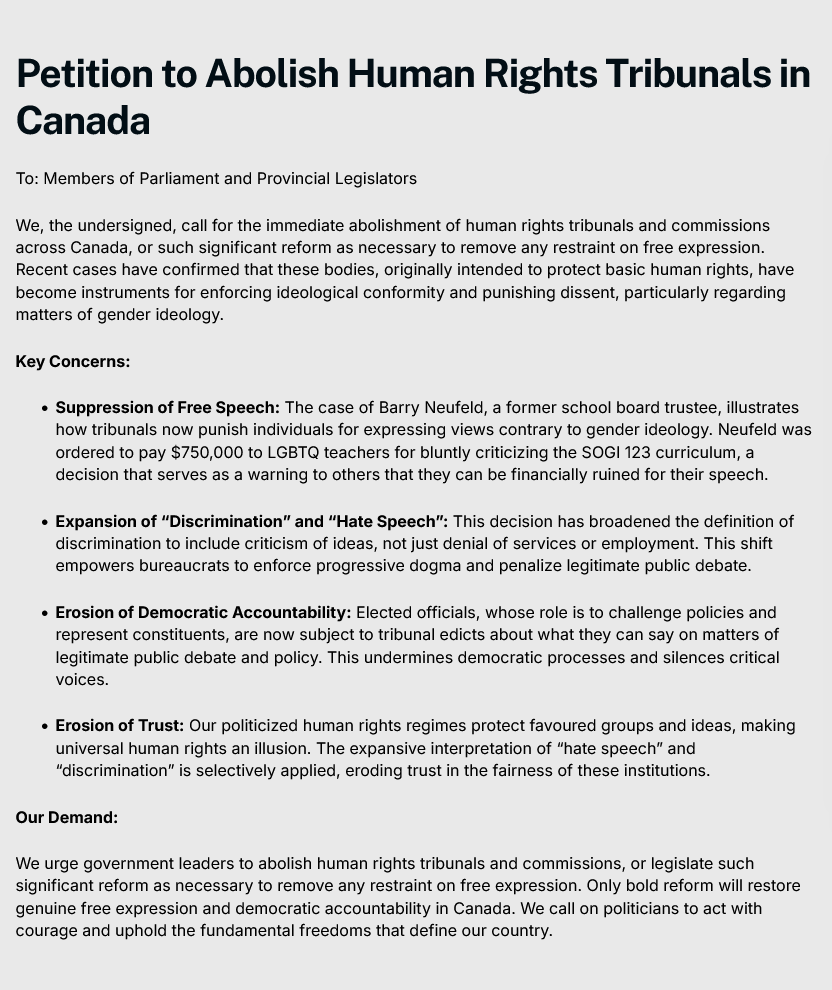

Canada’s Free Speech Union has launched a petition to get rid of all our anti-democratic Human Rights Tribunals in the wake of a BC man being penalized three-quarters of a million dollars for not bending the knee to the trans madness:
Apparently just failing to vote for a “voluntary” observation of Pride season is enough to get the Human Rights Tribunal of Ontario to impose fines and mandatory re-education sentences on elected municipal officials here in the most tolerant province in Canada:

Emo is a township of about 1,300 people located in the far west of Ontario, along the border with Minnesota.
In a decision handed down last week, the Human Tribunal of Ontario ruled that Emo, its mayor and two of its councillors had violated the Ontario Human Rights Code by refusing to proclaim June as “Pride Month”.
The town was also cited for failing to fly “an LGBTQ2 rainbow flag”, despite the fact that they don’t have an official flag pole.
The dispute began in 2020 when the township was approached by the group Borderland Pride with a written request to proclaim June as Pride Month.
Attached to the letter was a draft proclamation including clauses such as “pride is necessary to show community support and belonging for LGBTQ2 individuals” and “the diversity of sexual orientation, gender identity, and gender expression represents a positive contribution to society”.
Emo was also asked to fly an “LGBTQ2 rainbow flag for a week of your choosing”.
Borderland Pride then asked Emo to “email us a copy of your proclamation or resolution once adopted and signed”.
[…]
The claim of discrimination ultimately hinged on a single line uttered by Emo Mayor Harold McQuaker. When the proclamation came up for consideration, McQuaker was heard to say in a recording of the meeting, “There’s no flag being flown for the other side of the coin … there’s no flags being flown for the straight people”.
As Human Rights Tribunal vice-chair Karen Dawson wrote in her decision, “I find this remark was demeaning and disparaging of the LGBTQ2 community of which Borderland Pride is a member and therefore constituted discrimination under the Code”.
Dawson also ruled that given the “close proximity” of McQuaker’s comment to his nay vote — that too “constituted discrimination under the Code”.
[…]
The Human Rights Tribunal ultimately ordered the Township to pay $10,000 to Borderland Pride, and for McQuaker to personally pay them another $5,000.
This was lower than what Borderland Pride had been seeking; they wanted $15,000 from the township and $10,000 each from the three councillors who voted no.
But McQuaker and Emo’s chief administrative officer were also ordered to complete an online course known as “Human Rights 101” and “provide proof of completion … to Borderland Pride within 30 days”.
The course is offered by the Ontario Human Rights Commission, and their latest edition opens with an animated video telling viewers that the Human Rights Code “is not meant to punish”.
There was a point during the last Line podcast where Jen Gerson used the word “assuaged”, and then realized that although she knows what it means and when it’s appropriate to use it, she didn’t know how to say it out loud (a problem I’ve encountered many times in my life, having read widely but not listened to lectures on the various topics I’ve read about). I reference that in the headline, as she recounts going through a belated “technical briefing” on the already tabled bill:
Let’s start by noting that it’s a little bit odd for a government to hold a technical briefing for a bit of legislation more than a week after that legislation has been tabled. Usually presentations of this kind are held for media, MPs, and various stakeholders as or just before a complicated issue or bill is about to be announced to the public.
For the federal government to hold a briefing on the Online Harms Act on March 6 — as it did — raises questions. Questions like “Why?” Questions like “Is this really a ‘technical briefing’ or is this an attempt to assuage concerns about what is actually written in the bill?” And, most importantly, questions like “Am I so assuaged?”
I think, dear readers, that I am not.
Let me explain by appending a caveat about the Online Harms Act, or Bill C-63, which was tabled about two weeks ago. About 75 per cent of what’s in this bill is either good, or benign but potentially useless, and is genuinely focused on mitigating real online harms like child porn and revenge porn. I might nitpick some of those parts if it weren’t for the rest of it. The rest of it consists of “will result in the most significant expansion of Canada’s hate speech laws and create one of North America’s most rigid regulatory environments for media and social media companies”, as law firm Norton Rose Fulbright put it.
In C-63, and its attempts to explain this bill, this government has consistently muddied the waters that delineate between hate crimes and hate speech, and has demonstrated a deep unwillingness to deal with the philosophical problem of defining hate speech in a way that is clear, consistent, and fairly and evenly applied. More specifically, the bill’s attempts to increase the penalties for “advocating genocide” to life imprisonment; the use of peace bonds for pre-crime hate speech; and the re-introduction of Section 13, to be administered by the already questionable Human Rights Tribunal apparatus. All of these present such punitive measures that they would have a chilling effect on speech that is fundamentally incompatible with the freedoms we expect in a Western liberal democracy.
There’s no nice way to put this. These measures reveal deeply authoritarian instincts toward speech and regulation, all the more pernicious as they’re being introduced by people who are absolutely convinced of their own righteous good intentions.
And that brings us back to the aforementioned technical briefing, which attempted to address each of these concerns in turn. I should note that I don’t believe I was invited directly to this briefing — and as I’m not in the Parliamentary Press Gallery, this is not surprising or unusual. I was, however, provided a copy of the briefing in its entirety, and I was told that I was free to quote from it, provided I did not name the Department of Justice official speaking.
To that end, I’d like to provide some excerpts and paraphrases from this briefing, followed by my own observations on what was being presented to an audience of, broadly speaking, laymen. I’ve also run these observations by criminal lawyers to ensure my understanding of the law is sound. If I am in error in any point, I welcome any correction.
The degree of control exercised over individual Canadians by various levels of government was already on the increase before the human rights disaster of the Wuhan Coronavirus pandemic handed the power mongers even more control than they’d dreamed of. In Spiked, Brendan O’Neill outlines the horrific Online Harms Act provisions for even more dystopian government oversight if it is passed in its current form:
It seems Justin Trudeau isn’t only a dick – he also gets his ideas from one. Philip K Dick, to be precise. Trudeau’s government has proposed a new law that would give judges the power to put an individual under house arrest if they fear he might commit a hate crime. That’s right – might. It’s right out of The Minority Report, Dick’s 1956 dystopian tale of a future America in which a “Precrime” police division uses intelligence from mutants known as “precogs” to arrest people before they’ve committed an offence. Welcome to woke Canada, where Dickian nightmares come true.
It is courtesy of Bill C-63 that the pitiable citizens of Canada might soon find themselves languishing in court-ordered confinement despite having committed no crime. The bill is devoted to tackling “hate” on the internet. As is always the case when officialdom puffs itself up and declares war on mean words online, it is riddled with draconianism. For example, the mad law, if passed, would allow people to file complaints (shorter version: snitch) to the Canadian Human Rights Commission if they spot “hate speech” online. Those found guilty of this sin of making a nasty utterance could be ordered to pay victims up to $20,000 in compensation. [NR: Other reports say it’s up to $50,000 with an additional $20,000 in fines … per complainant.]
Imagine the levels of grift this would give rise to. The offence-seeking snowflakes of the phoney left would finally be able to monetise their hurt feelings. Call a “transwoman” a fella and he (yes, he – sue me) could potentially drag you to the CHRC for a nice little payday. The law would incentivise complaint-making. Worse, it would foster self-censorship. Who would risk getting angry online, far less logging on when drunk to wind up the woke, when it’s possible they’ll have their pockets turned out by a misnamed Human Rights Commission so that some professional victim can be compensated for the pain of having seen a word or idea he doesn’t like?
It really is possible it will be ideas, not just blind hatred, that will be punished under C-63. The justice minister Arif Virani’s promise that speech that is “awful but lawful” will not be censored, and that a “high threshold” will have to be met before people are penalised for what they post, is not reassuring. After all, Canada’s a country in which entirely legit publications have found themselves under investigation by the Human Rights Commission just for publishing controversial matter. Maclean’s magazine had its collar felt by the human-rights overlords following a complaint from the Canadian Islamic Congress about an excerpt from a book by Mark Steyn. The CHRC also launched an investigation into Alphonse de Valk, a priest, after he raged with passion against same-sex marriage.
I’m not confident that a nation that has such an inquisitorial body, a body whose very description of itself as a “human rights” commission is a brazen act of Orwellian deceit, will keep its promise of permitting the expression of “awful” thoughts. So much is branded “hate speech” these days – from correctly calling “transwomen” men to saying Islam has a lot of dumb ideas – that it feels inevitable that the expression of fairly normal ideas that Canada’s woke regime just doesn’t like will get swept up in this crusade against “hate”. Indeed, under Canada’s C-16 gender-identity law, “deliberately misgendering” a trans person is treated as a potential “violation” of their human rights. I predict that C-63’s incentivising of snitching will cause an explosion in complaints of “misgendering”. Perhaps Canada will become a no-go zone for thoughtcriminals like JK Rowling.
But it is C-63’s proposal to introduce something like precrime into Canada that has caused most waves. The idea is that individuals who are talking shit online, especially if they’re aiming their invective at minority groups, could be ordered to stay indoors or to wear an electronic tag if a judge fears there could be an “escalation” in their behaviour. Precrime, then. Dick’s idea made flesh. The newspaper headlines give a sense of how chilling this suggestion is, how headlong Canada’s descent into dystopia has become. “Justice minister defends house-arrest power for people feared to commit a hate crime in future”, says the Globe and Mail. Mate, when you’re defending the confinement of people who’ve broken no law, it’s surely time to stop and think.
We have nothing like the First Amendment; our Supreme Court is a Leftist institution par excellence and has even decreed in effect that truth is no defense in cases where “protected groups” are insulted or offended. Paragraph 140 of a 2013 Judgment finds “that not all truthful statements must be free from restriction. Truthful statements can be interlaced with harmful ones or otherwise presented in a manner that would meet the definition of hate speech.” Section 15 (2) of the Constitution Act of 1982 abridges the rights that section 15(1) guarantees Canadian citizens.
Further, our Human Rights Tribunals are Soviet-style shadow courts that discard due process in adjudicating cases of supposed discrimination or “hate speech.” As Canadian Human Rights Commissioner Dean Steacy said: “Freedom of speech is an American concept, so I don’t give it any value.” Openness to everything except freedom of speech, chartered principle and practical reason is the hallmark of our justice system, as it is of the nation. As Carl Sagan quipped in The Demon-Haunted World: “It pays to keep an open mind, but not so open your brains fall out.”
David Solway, “The Canadian Mind: A Culture So Open, Its ‘Brains Fall Out'”, PJ Media, 2018-10-10.
In the Post Millennial, Jordan Schroeder illustrates how BC human rights rules have created a new class of tort:
I would argue that the issue is not with the BC Human Rights Tribunal itself, but with the perverse incentive of litigating for profit that is created by the BC Human Rights Code. The BC Human Rights Code creates this incentive through a type of damages called “injury to dignity, feelings, and self-respect.”
This head of damages is harmful to human rights law in BC. It is unfair to the defendants, and it incentivizes predatory litigation. All of this causes British Columbians to lose trust in the important role that the tribunal can play in redressing wrongs.
Section 37 of the BC Human Rights Code allows the tribunal to make an award of damages to a complainant for “injury to dignity, feelings, and self-respect”. The tribunal is permitted to award any amount for this that it sees fit.
By the admission of the Human Rights Tribunal [PDF], the awards for this type of damages is high and is “trending upwards.” For example, in the Oger v Whatcott case, Whatcott was ordered to pay $35,000 for discriminatory speech against Morgane Oger. Whatcott had made critical comments about Oger based Oger’s transgender identity. In the same case, the tribunal cited $5,000 awards as “lower” awards. Other cases have seen awards of up to $75,000.
Awards for hurt feelings are unique to human rights law. Damages awarded in every other area of law are based on the principle that the award should only make the complainant whole. A complainant should never be better off after receiving the damages award.
For example, consider if a company leased a concert hall to a business that wanted to use the space to put on a production. Imagine that business stood to make $50,000 in profit from a sold-out production.
If the rental was cancelled by the company leasing the concert hall in breach of the contract, that company would have to pay the other party $50,000, representing all of the profit the other party could have made. The other party is not better off after the award. They are only made whole.
In contrast, awards for hurt feelings undoubtedly put the complainant better off than they would have been had the human rights violation not occurred in the first place. It is self-evident that an award in the tens of thousands of dollars outweighs any injury to feelings caused by the discriminatory speech or action.
Why is it a problem to have an award that amounts to more than what the complainant actually lost? Obviously, there is the problem that it saddles a defendant with a massive financial burden that doesn’t reflect the damage that they caused. A woman starting a small business who is ordered to pay a “small” award of $5,000 dollars would likely find it ruinous.
Maxime Bernier’s People’s Party of Canada is posting the individual issues from their 2019 election platform online, and today’s addition was their position on freedom of expression:

The rights of Canadians to freely hold and express beliefs are being eroded at an alarming speed under the Trudeau government. Some of its recent decisions even require that Canadians renounce their most deeply held moral convictions and express opinions they disagree with.
[…]
Our Plan
What some people find politically incorrect, offensive or even hateful cannot serve as the legal basis for discrimination and censorship. Canadians should be able to enjoy maximum freedom of conscience and expression as guaranteed in Section 2 of the Charter.
A People’s Party Government will:
- Restrict the definition of hate speech in the Criminal Code to expression which explicitly advocates the use of force against identifiable groups or persons based on protected criteria such as religion, race, ethnicity, sex, or sexual orientation.
- Repeal any existing legislation or regulation curtailing free speech on the internet and prevent the reinstatement of section 13 of the Canadian Human Rights Act.
- Repeal C-16 and M-103.
- Ensure that Canadians can exercise their freedom of conscience to its fullest extent as it is intended under the Charter and are not discriminated against because of their moral convictions.
- Withhold federal funding from any post-secondary institution shown to be violating the freedom of expression of its students or faculty.
You can read the full policy statement here, or the whole platform here.
Mark Steyn recently testified before the parliamentary Justice and Human Rights Committee recently. They carefully avoided having the video cameras turned on during his testimony and that of two other civil libertarian speakers. The committee clearly ignored everything that was said:
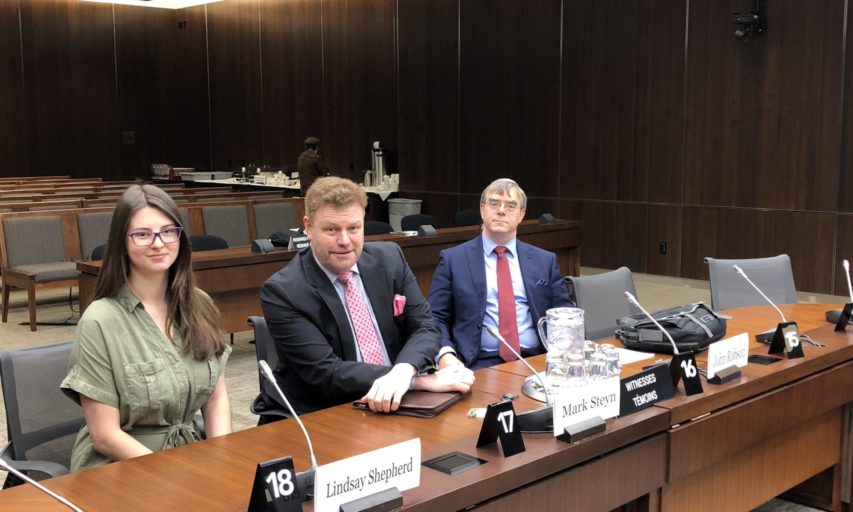
Lindsay Shepherd, Mark Steyn, and John Robson prepare to give testimony to the Parliamentary Justice and Human Rights Committee, June 2019.
Photo via Andrew Lawton.
“No monarch, no parliament, no government, and certainly no bureaucratic agency operating the pseudo-law of section 13 can claim jurisdiction over my right to think freely, to read freely, to speak freely and to argue freely.”
Those were the closing words of Mark Steyn’s testimony before parliamentarians on the Canadian House of Commons’ so-called justice and human rights committee just two weeks ago.
His call fell on deaf ears.
Yesterday, the justice committee tabled its report on “online hate” in Canada’s parliament.
The report laid out nine recommendations, one of which being that government should provide a “civil remedy for those who assert that their human rights have been violated under the Canadian Human Rights Act, irrespective of whether that violation happens online, in person, or in traditional print format. This remedy could take the form of reinstating the former section 13 of the Canadian Human Rights Act, or implementing a provision analogous to the previous section 13 within the Canadian Human Rights Act, which accounts for the prevalence of hatred on social media.”
Once you strip away the mumbo jumbo bureaucrat-speak in there, it means the Canadian Liberals wish not only to revive section 13 from the dead, but to give it untold powers to force social media companies to purge online speech from whomever the government deems the hatemongers du jour.
This is apparent in another recommendation, that lawmakers “establish requirements for online platforms and Internet service providers with regards to how they monitor and address incidents of hate speech, and the need to remove all posts that would constitute online hatred in a timely manner.”
Of course there’s no provided definition for what “hate speech” is in the context of this desired law. Just a promise to figure it out later.
Before section 13’s repeal under the previous Conservative government, there was a quasi-judicial body to decide if online posts were sufficiently “likely to expose a person or persons to hatred or contempt.” Those found guilty of violating this provision were slapped with a fine or gag order, while having none of the protections afforded to criminal defendants throughout the process.
This regime seems like child’s play compared to what’s proposed in this report – elimination of online speech by social media giants under the threat of government penalty. Not sure which I like better, actually: the opaque, unappealable hammer or the sham tribunal that at least pretends to give you a shot at beating the rap.
“And actually it’s no better in the United States. On the one hand you have the absence of a monarchy and free-speech absolutism, but on the other hand you prostrate yourselves before judges. I’m in the fifth year of a lawsuit that started with a 140-word blog post — there’s not much of a First Amendment when that happens. And then, on your college campuses, you have the debate about ‘acceptable’ and ‘safe’ speech. You have a tiny little Canada on each campus, with the same sort of shrunken, shrivelled public discussion. ‘Safe speech’ is a road to hell. Their goal is the abolition of hate — the abolition of a human emotion. They want everyone to have this glassy-eyed look, celebrating diversity. And they don’t recognise their own totalitarianism.”
Mark Steyn, interviewed by John Bloom, “Mark Steyn, Cole Porter and Free Speech”, Quadrant, 2017-05-11.
It’s statements like these that have landed Steyn on various hit lists, including, most famously, those of the Canadian Human Rights Commission, the British Columbia Human Rights Tribunal and the Ontario Human Rights Commission, which are strange quasi-judicial bodies that were stirred to action a decade ago by the Canadian Islamic Congress. Between 2005 and 2007 the weekly news magazine Maclean’s published eighteen articles by Steyn, including an excerpt from America Alone, that were all deemed “Islamophobic” by the human rights tsars. Without going into excruciating detail about the various legal jockeying that took place — who knew one country could have this many commissions and tribunals that could all attack simultaneously? — Steyn and Maclean’s were charged with inciting hatred against Muslims, setting in motion an endless process of discovery and hearings.
“We were trying to lose,” said Steyn. “We wanted them to find us guilty so that we could appeal to a real court, hopefully the Supreme Court, and prove that these hate-speech laws are more absurd than any laws outside North Korea. Before I came along, these human rights tribunals had a 100 per cent conviction rate! The fact that we fought back meant that I became an albatross around their neck. The Thought Police were exposed to massive unrelenting publicity for the first time, and they didn’t expect that. They didn’t expect us to push back. But free speech is on the retreat, and this was not a time for a faint-hearted defence.”
The Canadian Human Rights Commission eventually bowed out of their part in the imbroglio, saying the articles were “polemical, colourful and emphatic” but failed to satisfy the definition of writings “of an extreme nature” as defined by the Supreme Court. But the British Columbia Human Rights Tribunal was not so sure, holding a five-day hearing during which the Canadian Islamic Congress presented evidence that twenty articles in Maclean’s presented Islam as a violent religion and Muslims as violent people, with the Islamist lawyer using words like racist, hateful, contemptuous, Islamophobic and irresponsible. Mahmoud Ayoub, a Harvard historian of religion, testified that Steyn didn’t understand the meaning of the word jihad and that, of the 1.5 billion Muslims in the world, less than a million interpreted jihad to justify violence against non-believers. (I don’t know of any other religion in the world that has merely a million devotees willing to kill, but that’s what the man said.)
Mark Steyn, interviewed by John Bloom, “Mark Steyn, Cole Porter and Free Speech”, Quadrant, 2017-05-11.
Peter O’Brien outlines the proposal to incorporate a permanent formal role for Australian aborigines in the federal government:
It started out as a limited initiative to ‘recognise’ indigenous Australians as the first occupiers of this land in the Constitution. At least that’s what Tony Abbott, an enthusiastic supporter even before he became Prime Minister, thought. And initially, it was thought that a majority of Australians could support such an initiative.
But since that time it has morphed into something much more sinister as revealed by the final report of the Referendum Council.
[…]
Since all government policy specifically relating to indigenes is intended to eliminate discrimination and disadvantage so that they may take their place, as equal in material and aspirational aspects, as they already are in citizenship, then, presumably, one of the aims of the advisory body should be to work towards its own demise. If it is embedded in the Constitution, that will never happen. It will linger on, a cancerous sinecure rather like the HRC, manufacturing reasons to justify its own existence.
Liebler gives the game away before the starting gun has even gone off:
“The option of inserting a new provision into the Constitution prohibiting discrimination on the basis of race was determined by delegates to be a “shield”, vulnerable to interpretation by the High Court, whereas a voice to parliament was viewed as a “sword”.”
Since when has a Constitution been envisaged as a mechanism to provide to some of its citizens a “sword” to use against others of its citizens. Yet Leibler disparages the idea of a ‘shield’ in the Constitution since it is vulnerable to interpretation by the High Court. By using the term ‘vulnerable’ he tacitly acknowledges that activist judges can distort the original good intent of legislation.
If that is true for the ‘shield’ of a Constitutional anti-discrimination provision, why would it not be equally true of the ‘sword’ of an advisory body. Here is one example of logic that might be employed thus:
“If the intent of the framers of this provision was that the Indigenous Council should have no powers other than advisory, why was it put into the Constitution rather than just left to legislation?”
If this sounds simplistic, it is, but it wouldn’t take a legal mind much more sophisticated than mine to turn it into the kind specious nonsense with which we are constantly bombarded by members of the Legal Left.
There is no doubt that the ultimate aim of the activists is sovereignty, because they have repeatedly told us so. This advisory body, this sword’, is the mechanism by which they hope to progress their aim. Some, on the Left, will argue that the activists only represent a hard core and that, if the indigenous population get their way on this, the majority will be happy, that will be an end to the matter and the remaining activists will become irrelevant. Yeah, sure! Pretty much the same way that jihadis have become irrelevant.
Tim Black thinks John Stuart Mill (were he still alive) would be within his rights to sue Chakrabarti for mis-appropriating the title of his famous book:
Given the eponymous nod to John Stuart Mill, Shami Chakrabarti’s On Liberty promises to be a tribute to individual freedom. It promises to be a stirring defence of liberty written by someone who, as the head of the 80-year-old civil-rights campaign group Liberty, has been knee-deep, holding back the tide of aggressive, illiberal legislation. It promises to be an unbowed affirmation of freedom at a time when it has rarely been more devalued.
But the reality of Chakrabarti’s On Liberty, an awkward amalgam of the semi-personal and the mainstream political, never even comes close to realising the promise. Instead, it turns out to be a desperately dull encomium to the human-rights industry, a verveless trudge down Good Cause lane, with every battle against New Labour anti-terror legislation, each scuffle with the ASBO-happy authorities, eventually turning into a victory for the indispensable European Court of Human Rights. Hooray for Strasbourg! If John Stuart Mill wasn’t so liberal (and dead), he’d be within his rights to sue Chakrabarti for calumny.
But first, the prose. Whatever vital impulse there was behind writing this book must have expired long before it reached the page. There’s no life here, no spirit. It as if Chakrabarti has barely thought about the words she’s using. Even when she’s describing the frustrations of her ‘university-educated’ mum, held back ‘by a lack of affordable childcare’, she sounds as if she’s dashing off a policy document, not portraying a loved one. Admittedly, she does prove capable of a geekish whimsy at points — ‘You might say that I am a Jedi Knight who began on the dark side of the force’, she writes of her career beginnings at the UK Home Office. But On Liberty is mainly composed of dead phrases and, worse still, argument-averse legalese. ‘This type of administrative detention by the UK secretary of state’, she writes of the internment of foreign terror suspects at Belmarsh, ‘is not incompatible with the right to personal liberty and the right against arbitrary detention under Article 5 of the Human Rights Convention, as long as it is necessary to the stated purpose, provided for in legislation and subject to scrutiny and appeals in the appropriate courts and tribunals’. Magical stuff.
I heard a lot of that kind of talk during my battles with the Canadian ‘human rights’ commissions a few years ago: of course, we all believe in free speech, but it’s a question of how you ‘strike the balance’, where you ‘draw the line’… which all sounds terribly reasonable and Canadian, and apparently Australian, too. But in reality the point of free speech is for the stuff that’s over the line, and strikingly unbalanced. If free speech is only for polite persons of mild temperament within government-policed parameters, it isn’t free at all. So screw that.
But I don’t really think that many people these days are genuinely interested in ‘striking the balance’; they’ve drawn the line and they’re increasingly unashamed about which side of it they stand. What all the above stories have in common, whether nominally about Israel, gay marriage, climate change, Islam, or even freedom of the press, is that one side has cheerfully swapped that apocryphal Voltaire quote about disagreeing with what you say but defending to the death your right to say it for the pithier Ring Lardner line: ‘“Shut up,” he explained.’
A generation ago, progressive opinion at least felt obliged to pay lip service to the Voltaire shtick. These days, nobody’s asking you to defend yourself to the death: a mildly supportive retweet would do. But even that’s further than most of those in the academy, the arts, the media are prepared to go. As Erin Ching, a student at 60-grand-a-year Swarthmore College in Pennsylvania, put it in her college newspaper the other day: ‘What really bothered me is the whole idea that at a liberal arts college we need to be hearing a diversity of opinion.’ Yeah, who needs that? There speaks the voice of a generation: celebrate diversity by enforcing conformity.
Mark Steyn, “The slow death of free speech”, The Spectator, 2014-04-19
Amy Otto on the attempt to sue McDonald’s because they were handing out “gendered” toys with their Happy Meals:
A recent article in Slate by Antonia Ayres-Brown, a junior in high school, details the valiant feminist struggle she ultimately brought to the Connecticut Commission on Human Rights and Opportunities against McDonald’s for … discriminating on the basis of sex in the distribution of Happy Meal toys. “Despite our evidence showing that, in our test, McDonald’s employees described the toys in gendered terms more than 79 percent of the time, the commission dismissed our allegations as ‘absurd’ and solely for the purposes of ‘titilation [sic] and sociological experimentation,’” she wrote.
Let’s leave aside the fact that Connecticut has a Commission on Human Rights and note that this girl sincerely believes McDonald’s offering toys described, at times, as being for a girl or for a boy is a human rights violation.
While I admire the girl’s plucky disposition and effort, I do hope one day she learns to channel her energy into productive uses that will advance her cause in positive ways. This could have all been solved by her parents simply encouraging her to ask for the toy she wants. If girls are continually taught that they as individuals have no power to negotiate a situation as simple as “I’d like that toy” without the Connecticut Commission on Human Rights getting involved, I submit that these women are proving the case that they should not be put in positions of leadership or power.
By the author’s own admission,“McDonald’s is estimated to sell more than 1 billion Happy Meals each year.” Yet it does not occur to her that the fast food worker giving a “girl’s” toy to a girl is simply trying to give the customer what she wants in the most expeditious manner possible. This is a company that sells a billion of these things a year and gets them in the hands of their customers as fast as possible.
People do not eat at McDonald’s to get into a gender studies discussion with the teenage kid at the register; they go there to get food fast, hence the term “fast food.” If the author had worked in fast food for any nominal period of time, she might realize that the employee’s main motivation is not to spend any time persecuting women but to make it through his or her shift as painlessly as possible.
Being shy can be a handicap for certain kinds of activities. It can prevent you from doing things you might otherwise want to do. Shockingly, however, the Ontario Human Rights Tribunal doesn’t think that you should get special treatment just because you’re afraid to be the only guy in a class full of women:
Sexual politics have erupted again in Toronto’s ivory tower as another male student has lost a bid to be excused from a class with women without losing marks, this time because he’s shy.
The Ontario Human Rights Tribunal has dismissed a complaint by University of Toronto student Wongene Daniel Kim, who accused his professor of discriminating against him as a male when she docked him marks for not coming to class because he was too shy to be the only guy.
The second-year health science major arrived at the opening of a Women and Gender Studies course for which he had signed up in the fall of 2012 — “It had spaces left and fit into my timetable” — only to discover a room full of women and nary a man in sight.
“I felt anxiety; I didn’t expect it would be all women and it was a small classroom and about 40 women were sort of sitting in a semicircle and the thought of spending two hours every week sitting there for the next four months was overwhelming,” said Kim, 20, adding he manages a part-time job with women because there are also other men.
[…]
However the tribunal ruled his complaint did not warrant a hearing.
“The applicant has not satisfied me that his claimed discomfort in a classroom of women requires accommodation under the (Ontario Human Rights) Code,” wrote adjudicator Mary Truemner. “He admitted that his discomfort is based on his own ‘individual preference’ as a shy person … and stated he thought they (the women) would not be willing to interact with him because of his gender.”
This was “merely speculation as he never gave the class, or the women, a chance,” wrote Truemner, vice-chair of the tribunal.
Kim had no evidence of being “excluded, disadvantaged or treated unequally on the basis of” his gender, she said.
H/T to Joey DeVilla who posted on Facebook, “Way to perpetuate the feckless Asian nerd stereotype, Kim. After all the work I did dispelling it!”.



Powered by WordPress