Quotulatiousness

November 4, 2013

“…almost half of all firearms discharges by police officers involve the shooting of a dog”

Filed under: Law, USA — Tags: , , , — Nicholas @ 10:33

Even if you’re not a dog lover, this story from Charles C.W. Cooke should get you upset:

A Google search for “dog shot by police officer” returns countless stories from across the United States. YouTube, too, is full of harrowing videos. There is even a website, the bluntly titled “Dogs That Cops Killed” blog, which seeks to “collect a few of the innumerable instances of police officers killing dogs” and to push back against the “wars on drugs, peace, and liberty.”

This unlovely trend has claimed the attention of Patrick Reasonover, a libertarian filmmaker in California who is currently raising money for a proposed documentary, Puppycide, through the crowdsourcing service Kickstarter. “We’re excited by this one,” Reasonover tells me, “because on so many issues — the War on Drugs, for example — it’s impossible to move the ball. You can feature the problems with the drug war, but there are so many embedded interests that one documentary isn’t really going to solve the problem. With this issue, however? We feel that it could.”

Around eight months ago, Reasonover began to notice the proliferation of online videos of police officers shooting dogs. “People were going nuts about it,” he recalls. “There were tons of views on these things. We had dogs and we were disturbed, so we thought we’d reach out and start contacting some of the victims.” In doing so, he quickly learned that the news reports and the published footage were only the beginning of the story. Because police departments don’t keep easily accessible records of dog shootings, it is hard to gauge the scale. A recent review of public records by the American Society for the Prevention of Cruelty to Animals concluded that almost half of all firearms discharges by police officers involve the shooting of a dog. But nobody really knows.

Indeed, even animal-rights activists aren’t fully aware of the numbers in their communities. “They would tell us that there were, say, five news stories on these dogs that got shot,” Reasonover says. “But through my digging and persistence I found out that actually, you know, 22 were shot and no one ever knew.” One thing led to another, and he discovered that “there is a set of people who are working across the nation, through lawsuits or legislation or appealing to the Justice Department.” As part of his project, Reasonover is hoping to file Freedom of Information Act requests in all major cities and jurisdictions in the U.S. and to get hold of all firearm-discharge records. From that, he hopes to assemble a better list.

It may make brutal reading. A recent lawsuit in Milwaukee filed by a woman whose dog was killed forced that city to compile its records. “They found that a dog was shot every seven days,” Reasonover says. “Just in Milwaukee.” And, unless something changes, the number will only continue to rise. “Over the course of the past forty or fifty years, dogs have moved from the barnyard to the back yard to the bedroom,” Ledy Vankavage, the senior legislative attorney at Best Friends Animal Society, has observed. In the meantime, the drug war has been ratcheted up, terrorism has become a pressing concern, and, as Radley Balko has so distressingly chronicled, the police have become increasingly militarized. “You have this recipe for these police entering our lives more and more and more,” Reasonover explains. “The dogs are there, and so they are killed.”


September 19, 2013

QotD: Guns and mental illness

Filed under: Health, Law, Liberty, Quotations, USA — Tags: , , , — Nicholas @ 00:01

There isn’t much of a culture-war component of discussing mental illness, other than a few folks on the Right who blame the Left for deinstitutionalizing the mentally ill in the 1960s. I suspect that there is no real constituency in favor of the Second Amendment rights of the mentally ill — provided, of course, the definition of “mentally ill” is clear, explicit, and taken seriously. (If you think there’s a stigma to admitting you’re seeing a therapist, a psychologist, or getting mental health treatment now, just wait until some of your legal rights can be restricted because of it.)

Thankfully, I’ve never known anyone who has had violent episodes or threatening mental illness. My sense of reading coverage and the literature is that people rarely “snap” and become dangerous killers overnight. As you’ve probably found in your research, there are certain common threads: withdrawal from others and lack of a support network; hostile behavior and temper control, outbursts, etc. It is maddeningly infuriating to hear friends and acquaintances of past shooters describe behavior that seems, in retrospect, to be a warning sign or red flag.

After Columbine, many school administrators tried to institute a new “If you see something, say something” approach to individuals behaving in a threatening manner. Then we saw in Virginia Tech that many, many students reported the gunman for strange and threatening behavior, including stalking. School administrators ultimately couldn’t do enough to stop him — either from fear of lawsuits or from overall bureaucratic inertia.

[…]

It’s not clear how effective a program like this would be; one would hope that people would already know to report strange, troubling, or threatening behavior to authorities. In past writings, I’ve emphasized that the only authority that can put someone on the federal firearms restriction list is a judge, and so that these sorts of concerns are best sent directly to the cops, not to a school administrator or company HR department.

However, a country where more Americans are trained to spot signs of serious, untreated and potentially dangerous mental illness strikes me as a better path than yet another effort to restrict the rights of 40 million gun owners because of the actions of a handful.

Jim Geraghty, “Why Post-Shooting Gun-Control Debates Are So Insufferable”, National Review Online, 2013-09-18

August 8, 2013

A home-made Gauss gun

Filed under: Technology, Weapons — Tags: , , — Nicholas @ 08:14

It may not be the most functional weapon in the world, but it does show that there might be a niche for this kind of development:

While it may only be able to shoot a few cans right now, we certainly wouldn’t want to be in front of [Jason]‘s fully automatic Gauss gun capable of firing 15 steel bolts from its magazine in less than two seconds.

The bolts are fired from the gun with a linear motor. [Jason] is using eight coils along the length of his barrel, each one controlled by an IGBT. These are powered by two 22 Volt 3600mAh LiPo battery packs.

As for the mechanical portion of the build, the bolts fired from this gun are actually 6.5mm nails, cut off and sharpened. These are chambered from a spring-loaded magazine, with each new bolt put into the breech with a small solenoid retracting for an instant.

July 5, 2013

Dudley Do-Wrong

Filed under: Bureaucracy, Cancon, Law — Tags: , , , , — Nicholas @ 09:32

The Royal Canadian Mounted Police have a great PR image in the rest of the world … for many people, the image of the scarlet-coated Mountie is synonymous with Canada. But for Canadians, there’s a growing unease about the RCMP:

Canadians have mixed views of our national police force, the Royal Canadian Mounted Police. We seem to admire the RCMP as an institution but are increasingly suspicious of the actions of individual Mounties and of the force’s brass — its senior officers and policymakers.

Our attitudes are further complicated by the fact that we seem to see the officers in our local detachments as good guys — they play on our men’s league hockey teams, help out with community charities, take their kids to school like the rest of us — yet we are beginning to see more bad apples elsewhere.

According to an Abacus Data poll of 1,000 Canadians conducted in late June, the Mounties remain one of our most trusted national institutions. A symbol of the country, the RCMP ranks right up there (69%) with the maple leaf (83%) and universal health care (78%).

Yet a majority of Canadians believe officers have used excess force (51%) and that sexism is rampant (54%) within the RCMP. Significant pluralities are also convinced problems within the force are “widespread” (43%) and are not being exaggerated (42%).

[. . .]

But I would guess, the biggest strains on the Mounties’ credibility, particularly in rural Canada and the West, have been over guns. And the warrantless seizure of hundreds of firearms from the homes of evacuees following the flooding in High River, two weeks ago — in which Mounties broke open doors and removed private property arbitrarily — will only widen the existing trust gap.

May 24, 2013

Australian police in a lather over 3D printed guns

Filed under: Australia, Law, Liberty, Technology — Tags: , , — Nicholas @ 08:17

In The Register, Simon Sharwood covers the anguished response of police in New South Wales over the availability of “The Liberator”:

The New South Wales Police Force, guardians of Australia’s most-populous state, have gotten themselves into a panic over the Liberator, the 3D-printable pistol.

The Force’s Commissioner Andrew Schipione today appeared at a press conference to denounce the Liberator and urge residents of the State not to download plans for the gun.

Schipione offered this advice after the Force’s ballistics team acquired a 3D printer, downloaded plans for the Liberator and assembled a pair of the pistols.

One, when fired into a resin block said to simulate human flesh, is said to have penetrated to a depth of 17 fatal-injury-inducing centimetres.

The other experienced “catastrophic failure”, as we predicted a couple of weeks ago. […] That failure didn’t stop Schipione declaring the Liberator a threat to public safety.

To understand why, you need to know that NSW has of late experienced gun violence at rather unusual levels by Australian standards (which means over a year all of Sydney had about half an episode’s worth of gun violence on The Wire). That spate of shootings has led to Operation UNIFICATION, an effort kicking off this weekend that encourages Australians to rat out strike a blow for public safety by informing Police about illegal guns.

May 11, 2013

The “Liberator” isn’t really a gun … it’s a political theatre prop

Filed under: Liberty, Media, Politics, USA, Weapons — Tags: , , , , — Nicholas @ 00:01

In The Register, Lewis Page points out that the 3D printed “Liberator” isn’t actually much of a gun at all:

People are missing one important point about the “Liberator” 3D-printed “plastic gun”: it isn’t any more a gun than any other very short piece of plastic pipe is a “gun”.

You can take my Liberator ... and shove it

You can take my Liberator … and shove it

Seriously. That’s all a Liberator is: a particularly crappy pipe, because it is made of lots of laminated layers in a 3D printer. Attached to the back of the pipe is a needlessly bulky and complicated mechanism allowing you to bang a lump of plastic with a nail in it against the end of the pipe.

An actual gun barrel is a strong, high quality pipe — almost always made of steel or something equally good — capable of containing high pressure gas. It has rifling down the inside, making it narrow enough that the hard, tough lands actually cut into the soft bullet jacket (too small for the bullet to actually move along, unless it is rammed with massive force). At the back end there is a smooth-walled section, slightly larger, into which a cartridge can be easily slipped.

It’s not much of a gun at all. But as with the old saying about the dancing bear, it’s not how well it dances but that it dances at all. After some 100,000 downloads, the company was requested to take the files offline on Thursday:

April 29, 2013

US domestic firearms sales continue to grow

Filed under: Business, USA — Tags: , , , , — Nicholas @ 12:38

In the Wall Street Journal, Tom Gara shows us the booming market for firearms since 2008:

Gun buyers have long demonstrated a tendency to stock up on weapons and ammunition ahead of possible changes to gun laws, and a so-called “Obama surge” in gun sales kicked off in the lead-up to Barack Obama’s first election victory in 2008.

There was a similar pick up in 2012 as a second Obama victory looked likely, and another rush on stores when it became clear the Obama administration would push for tighter gun control laws in the wake of the Sandy Hook school shooting last December.

In fact, the rush beginning in December has been high even by historic standards: the FBI conducted just under 2.8 million background checks on prospective gun buyers in December 2012, the highest number in any single month since records begin in November 1998. That’s more than triple the number it was running in in December 2002.

And the rush has continued through 2013 so far. Here’s the number of monthly background checks in the first three months of each year since 1998. This year looks set to be the busiest ever.

Jan-Mar gun sales 1998-2013

April 18, 2013

Slowing down the urge to “do something” is a feature, not a bug

Filed under: Law, Liberty, Politics, USA — Tags: , , , , , — Nicholas @ 09:23

David Harsanyi discusses the (limited) mechanisms the US constitution put in place to prevent the whims of temporary majorities being imposed on the country:

To begin with, whether Democrats like it or not, this issue concerns the Constitution — where stuff was written down for a reason. That’s not to say that expanding background checks or banning “assault rifles” would be unconstitutional (though you may believe they both should be). It’s to say that when you begin meddling with protections explicitly laid out in the founding document, a 60-vote threshold that slows down stampeding legislators is the least we deserve.

The Founding Fathers worried that “some common impulse of passion” might lead many to subvert the rights of the few. It’s a rational fear, one that is played out endlessly. Obama, who understands how to utilize public passion better than most, flew some of the Newtown families to Washington for a rally, imploring Americans to put “politics” aside and stop engaging in “political stunts.”

[. . .]

I’m not operating under the delusion that any of this is good national politics for Republicans — though the arguments about obstructionism’s dooming the GOP are probably overblown. No doubt, when the next disaster hits — and it will — Democrats will blame the overlords at the National Rifle Association and Republicans for the act of a madman. That’s life.

But generally speaking, it’d be nice if Congress occasionally challenged the vagaries of American majority “instinct.” Though it might seem antithetical to their very existence, politicians should be less susceptible to the temporary whims, ideological currents and fears of the majority. Theoretically, at least, elected officials’ first concern is the Constitution. And if the need for gun control is predicated chiefly on the polls taken immediately after a traumatic national event, they have a perfectly reasonable justification to slow things down. In fact, if Washington internalizes the 60-vote threshold as a matter of routine, voters should be grateful. Considering Washington’s propensity to politicize everything and its increasingly centralized power (what your health care looks like is now up for national referendums, for instance), this might be the only way left to diffuse democracy.

April 13, 2013

3D printing, guns, and the hacker ethic

Filed under: Liberty, Media, Technology — Tags: , , , — Nicholas @ 10:22

At The Verge, Joshua Kopstein outlines the state of play in 3D printing, guns, and the hacker subculture:

Cyberculture icon Stewart Brand’s famous notion that “information wants to be free” has been an almost ubiquitous refrain ever since utopian-minded hackers began populating computer networks in the 1980s. Today, 3D printing has given the phrase a whole new meaning, allowing raw data to become real world weapons with the click of a button. Cody R. Wilson, the antagonistic founder of Defense Distributed, is taking that idea to its logical — and hugely controversial — extreme.

Having recently obtained his federal manufacturing license, Wilson hopes to release files for the world’s first fully 3D-printable firearm by the end of this month. His past progress has already thrown a major wrench into America’s resurgent gun control debate, feeding doubts about the efficacy of renewed bans on undetectable firearms. But his reasoning, he claims, isn’t really about the Second Amendment at all — it’s about technological progress rendering the very concept of gun control meaningless.

“It’s more radical for us,” he told Motherboard in “Click Print Gun,” a recent mini-doc about the dark side of the 3D printing revolution. “There are people all over the world downloading our files and we say ‘good.’ We say you should have access to this. You simply should.”

If this all sounds very similar to the good gospel spread by Brand and advanced by progressives and activists like the late Aaron Swartz, you’re hearing it right. But even without the context of Wilson’s operation, firearms and freedom of information share a strangely similar history, an oft-overlooked ideological confluence between hackers and gun advocates that seems to be gaining momentum.

March 4, 2013

Florida student punished for taking part in incident with a firearm

Filed under: Bureaucracy, Education, Law, USA — Tags: , , , , — Nicholas @ 10:20

His participation in the incident was to wrestle the loaded revolver out of the hands of the football player who was threatening to shoot another player:

A 16-year-old Cypress Lake High School student, who wrestled a loaded revolver away from a teen threatening to shoot, is being punished.

The student grappled the gun away from the 15-year-old suspect on the bus ride home Tuesday after witnesses say he aimed the weapon point blank at another student and threatened to shoot him.

The student, who Fox 4 has agreed not to identify and distort his voice because he fears for his safety, says there’s “no doubt” he saved a life by disarming the gunman. And for that he was suspended for three days.

[. . .]

The teen we spoke to and authorities both confirm the Revolver was loaded. According to the arrest report the suspect, who Fox 4 is not naming because he is a minor, was “pointing the gun directly” at another student and “threatening to shoot him.”

That’s when the student we spoke with says he and others tackled the teen and wrestled away the gun. The next day the school slapped him with a three day suspension.

“It’s dumb,” he said. “How they going to suspend me for doing the right thing?”

According to the referral, he was suspended for being part of an “incident” where a weapon was present and given an “emergency suspension.”

“If they wouldn’t’ve did what they had to do on that bus,” the teen’s mother said, “I think there would have been a lot of fatalities.”

H/T to Charles Oliver for the link.

March 3, 2013

3D-printed gun parts

Filed under: Technology — Tags: , — Nicholas @ 11:19

3D printing is becoming much more interesting every day:

Cody Wilson, like many Texan gunsmiths, is fast-talkin’ and fast-shootin’—but unlike his predecessors in the Lone Star State, he’s got 3D printing technology to help him with his craft.

Wilson’s nonprofit organization, Defense Distributed, released a video this week showing a gun firing off over 600 rounds—illustrating what is likely to be the first wave of semi-automatic and automatic weapons produced by the additive manufacturing process.

Last year, his group famously demonstrated that it could use a 3D-printed “lower” for an AR-15 semi-automatic rifle—but the gun failed after six rounds. Now, after some re-tooling, Defense Distributed has shown that it has fixed the design flaws and a gun using its lower can seemingly fire for quite a while. (The AR-15 is the civilian version of the military M16 rifle.)

The lower, or “lower receiver” part of a firearm, is the crucial part that contains all of the gun’s operating parts, including the trigger group and the magazine port. (Under American law, the lower is what’s defined as the firearm itself.) The AR is designed to be modular, meaning it can receive different types of “uppers” (barrels) as well as different-sized magazines.

H/T to Marina Stover for the link.

February 11, 2013

“I don’t want to use the word buffoonery but it really is unbridled police lawlessness”

Filed under: Law, Liberty, USA — Tags: , , , , — Nicholas @ 08:57

There’s more than a little bit of “explaining” due from the LAPD over these incidents:

David Perdue was on his way to sneak in some surfing before work Thursday morning when police flagged him down. They asked who he was and where he was headed, then sent him on his way.

Seconds later, Perdue’s attorney said, a Torrance police cruiser slammed into his pickup and officers opened fire; none of the bullets struck Perdue.

His pickup, police later explained, matched the description of the one belonging to Christopher Jordan Dorner — the ex-cop who has evaded authorities after allegedly killing three and wounding two more. But the pickups were different makes and colors. And Perdue looks nothing like Dorner: He’s several inches shorter and about a hundred pounds lighter. And Perdue is white; Dorner is black.

“I don’t want to use the word buffoonery but it really is unbridled police lawlessness,” said Robert Sheahen, Perdue’s attorney. “These people need training and they need restraint.”

That incident is pretty bad, and thank goodness that David Perdue wasn’t shot in the Keystone Kops re-enactment. In this earlier incident, however, the innocent civilians didn’t get off without injury:

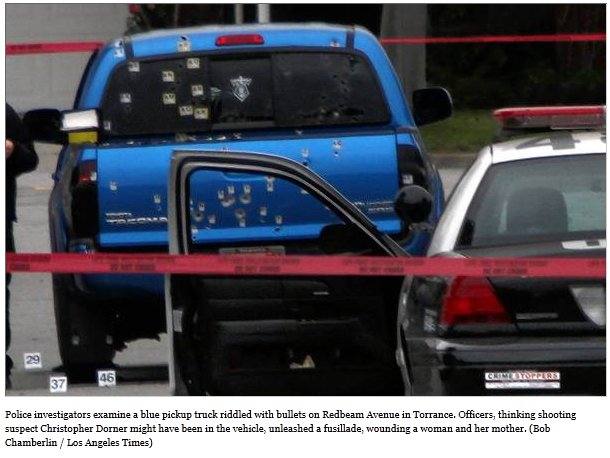
As the vehicle approached the house, officers opened fire, unloading a barrage of bullets into the back of the truck. When the shooting stopped, they quickly realized their mistake. The truck was not a Nissan Titan, but a Toyota Tacoma. The color wasn’t gray, but aqua blue. And it wasn’t Dorner inside the truck, but a woman and her mother delivering copies of the Los Angeles Times.

Pickup shooting by LAPD

In an interview with The Times on Friday, LAPD Chief Charlie Beck outlined the most detailed account yet of how the shooting unfolded. Margie Carranza, 47, and her mother, Emma Hernandez, 71, were the victims of “a tragic misinterpretation” by officers working under “incredible tension,” he said. Just hours before, Dorner allegedly shot three police officers, one fatally. And, in an online posting authorities attributed to him, Dorner threatened to kill more police and seemed to take responsibility for the slaying over the weekend of the daughter of a retired LAPD captain and her fiance.

Beck and others stressed that the investigation into the shooting is in its infancy. They declined to say how many officers were involved, what kind of weapons they used, how many bullets were fired and, perhaps most important, what kind of verbal warnings — if any — were given to the women before the shooting began.

H/T to Jon, my former virtual landlord, for the links to both articles and the urgent advice “You might want to park the Tacoma in the garage for awhile”.

January 11, 2013

British forces to replace venerable Browning 9mm with new Glocks

Filed under: Britain, Military, Weapons — Tags: , , , , — Nicholas @ 10:22

Lewis Page on the recently announced retirement of the Browning 9mm from British military service:

The new pistol is the Glock 17 Gen4, which fires the same NATO standard 9x19mm cartridge as its illustrious predecessor. However the Glock holds 17 rounds as opposed to the Browning’s 13 — and even more crucially the new weapon can be carried with a round in the chamber ready to shoot at a moment’s notice due to its modern safety mechanisms, a practice which was normally forbidden with the Browning.

[. . .]

The now superseded weapon was designed way back in the 1920s by the legendary weapons engineer John Browning and first manufactured by Fabrique Nationale of Belgium in 1935. It was known commercially as the “Browning Hi-Power”. It was first issued to British forces during World War II, and gradually replaced all other pistols then in service to become the UK’s standard military sidearm. In its day it was a great weapon, and pistol design has evolved only incrementally since then, but today’s handguns are measurably superior and it was surely time for a change — the more so as the existing Brownings must have been pretty worn out by now.

The wars in Iraq and Afghanistan have enabled the British forces to slowly and belatedly sort out their dire personal-weapons situation of the 1990s. The crappy Royal Ordnance/BAE Systems SA80 (L85A1) rifle was rebuilt in German factories so that it is now a good weapon, and proper belt-fed light machine guns and 40mm grenade launchers were procured. Other popular pieces of kit such as the L115A1 sniper rifle (from the famous Portsmouth firm Accuracy International, perhaps better known under its commercial name Arctic Warfare Super Magnum), the new combat shotgun and the new 7.62mm Sharpshooter rifle have also appeared in response to battlefield needs. Now with the new Glocks, at last, pretty much all the personal weapons carried by British troops today can be said to be first-class.

The Browning 9mm was first handgun I ever fired, and is still one of my favourites:

January 10, 2013

Reason.tv: 5 Facts About Guns, Schools, And Violence

Filed under: Law, Media, Politics, USA — Tags: , , , , — Nicholas @ 10:39

No one wants to ever again see anything like the senseless slaughter of 26 people — including 20 children — at a school. But as legislators turn toward creating new gun laws, here are five facts they need to know.

1. Violent crime — including violent crime using guns — has dropped massively over the past 20 years.

The violent crime rate — which includes murder, rape, and beatings — is half of what it was in the early 1990s. And the violent crime rate involving the use of weapons has also declined at a similar pace.

2. Mass shootings have not increased in recent years.

Despite terrifying events like Sandy Hook or last summer’s theater shooting in Aurora, Colorado, mass shootings are not becoming more frequent. “There is no pattern, there is no increase,” says criminologist James Allen Fox of Northeastern University, who studies the issue. Other data shows that mass killings peaked in 1929.

3. Schools are getting safer.

Across the board, schools are less dangerous than they used be. Over the past 20 years, the rate of theft per 1,000 students dropped from 101 to 18. For violent crime, the victimization rate per 1,000 students dropped from 53 to 14.

4. There Are More Guns in Circulation Than Ever Before.

Over the past 20 years, virtually every state in the country has liberalized gun ownership rules and many states have expanded concealed carry laws that allow more people to carry weapons in more places. There around 300 million guns in the United States and at least one gun in about 45 percent of all households. Yet the rate of gun-related crime continues to drop.

5. “Assault Weapons Bans” Are Generally Ineffective.

While many people are calling for reinstating the federal ban on assault weapons — an arbitrary category of guns that has no clear definition — research shows it would have no effect on crime and violence. “Should it be renewed,” concludes a definitive study, “the ban’s effects on gun violence are likely to be small at best and perhaps too small for reliable measurement.”

December 22, 2012

The NRA tries fighting hysteria with even more hysteria

Filed under: Law, Media, Politics, USA — Tags: , , , , , — Nicholas @ 09:23

Jacob Sullum on the tone-deaf response of the NRA to criticism arising from the Sandy Hook tragedy:

Not exactly the voice of calm reason. [NRA Executive Vice President Wayne] LaPierre evidently wants people to panic, as long as they stampede in the direction he prefers. Yet the fact remains that mass shootings of any kind, let alone mass shootings at schools, are rare events, and we should be cautious about making any major policy changes in an effort to reduce an already tiny risk. I don’t know what LaPierre means by “an active national database of the mentally ill,” and I’m not sure he does either. But since there is no indication that Adam Lanza was ever declared mentally incompetent or committed to a mental institution, such a database could prevent people like him from buying guns (leaving aside the fact that he used his mother’s weapons) only if the criteria for rejecting buyers are expanded to cover many people who pose no threat of violence (potentially including half the population, if a psychiatric diagnosis is all that’s required).

LaPierre wildly shoots at several other targets, including our allegedly lenient criminal justice system, which supposedly coddles “killers, robbers, rapists and drug gang members”; “vicious, violent video games with names like Bulletstorm, Grand Theft Auto, Mortal Kombat and Splatterhouse“; and “blood-soaked slasher films like ‘American Psycho‘ and ‘Natural Born Killers‘” (which were released 12 and 18 years ago, respectively). There is some sense in there too (about the “assault weapon” bogeyman and the puzzling progessive aversion to armed self-defense), but it is drowned in the flood of foam flying off LaPierre’s lips. And while letting teachers or other staff members with concealed carry permits bring their guns to school seems like a better policy than advertising “gun-free zones” to armed lunatics, the National School Shield Emergency Response Program that LaPierre recommends, featuring “a protection plan for every school,” a potentially smothering “blanket of safety,” and congressional appropriations, including “whatever is necessary to put armed police officers in every school,” seems utterly disproportionate given the level of risk that children (yes, including my own) actually face when they go to school.

Last night I suggested that Piers Morgan’s televised faceoff with Larry Pratt “pretty accurately reflects the general tenor of the current gun control debate, with raw emotionalism and invective pitted against skepticism and an attempt at rational argument.” The NRA and Wayne LaPierre seem determined to prove me wrong.

« Newer Posts — Older Posts »

Powered by WordPress