
Published on 23 Jan 2017
Snipers in World War I on the Western Front were used for psychological warfare in quieter times and during offensive to destroy key enemy positions like machine gun emplacements. While the French and the German Army started with rules and regulations for these troops, the British Army quickly had to adapt.
January 24, 2017
Sharpshooters and Snipers in World War 1 I THE GREAT WAR Special
Comments Off on Sharpshooters and Snipers in World War 1 I THE GREAT WAR Special
November 9, 2016
Italian Rifles of World War 1 featuring Othais from C&RSENAL I THE GREAT WAR – Special
Published on 8 Nov 2016
All about the Carcano Carbine on C&Rsenal: https://www.youtube.com/watch?v=mG3-i…
In our last live stream with Othais we talked about the Italian rifles and pistols of WW1. This is the slightly edited version in which we focus on the rifles. Check out Othais’ channel for more details.
Comments Off on Italian Rifles of World War 1 featuring Othais from C&RSENAL I THE GREAT WAR – Special
September 18, 2016
QotD: Basic rules of firearm safety
1. Treat all guns as though they are loaded.
2. Never point the muzzle at anything you don’t intend to destroy.
3. Keep your finger off the trigger until your sights are on target and you’re prepared to fire.
4. Always confirm your target, as well as what’s in front, behind, and around it.
Comments Off on QotD: Basic rules of firearm safety
September 17, 2016
QotD: Historical clangers in The Last Samurai
… the movie is seriously anti-historical in one respect; we are supposed to believe that traditionalist Samurai would disdain the use of firearms. In fact, traditional samurai loved firearms and found them a natural extension of their traditional role as horse archers. Samurai invented rolling volley fire three decades before Gustavus Adolphus, and improved the musket designs they imported from the Portuguese so effectively that for most of the 1600s they were actually making better guns than European armorers could produce.
But, of course, today’s Hollywood left thinks firearms are intrinsically eeeevil (especially firearms in the hands of anyone other than police and soldiers) so the virtuous rebel samurai had to eschew them. Besides being politically correct, this choice thickened the atmosphere of romantic doom around our heroes.
Another minor clanger in the depiction of samurai fighting: We are given scenes of samurai training to fight empty-hand and unarmored using modern martial-arts moves. In fact, in 1877 it is about a generation too early for this. Unarmed combat did not become a separate discipline with its own forms and schools until the very end of the nineteenth century. And when it did, it was based not on samurai disciplines but on peasant fighting methods from Okinawa and elsewhere that were used against samurai (this is why most exotic martial-arts weapons are actually agricultural tools).
In 1877, most samurai still would have thought unarmed-combat training a distraction from learning how to use the swords, muskets and bows that were their primary weapons systems. Only after the swords they preferred for close combat were finally banned did this attitude really change. But, hey, most moviegoers are unaware of these subtleties, so there had to be some chop-socky in the script to meet their expectations.
One other rewriting of martial history: we see samurai ceremoniously stabbing fallen opponents to death with a two-hand sword-thrust. In fact, this is not how it was done; real samurai delivered the coup de grace by decapitating their opponents, and then taking the head as a trophy.
No joke. Head-taking was such an important practice that there was a special term in Japanese for the art of properly dressing the hair on a severed head so that the little paper tag showing the deceased’s name and rank would be displayed to best advantage.
While the filmmakers were willing to show samurai killing the wounded, in other important respects they softened and Westernized the behavior of these people somewhat. Algren learned, correctly, that ‘samurai’ derives from a verb meaning “to serve”, but we are misled when the rebel leader speaks of “protecting the people”. In fact, noblesse oblige was not part of the Japanese worldview; samurai served not ‘the people’ but a particular daimyo, and the daimyo served the Emperor in theory and nobody but themselves in normal practice.
Eric S. Raymond, “The Last Samurai”, Armed and Dangerous, 2003-12-15.
Comments Off on QotD: Historical clangers in The Last Samurai
September 11, 2016
Anthony Fokker – Japanese Army – Semi-Auto Rifles I OUT OF THE TRENCHES
Published on 10 Sep 2016
It’s time for the chair of wisdom again and of course Indy answering your questions about World War 1.
Comments Off on Anthony Fokker – Japanese Army – Semi-Auto Rifles I OUT OF THE TRENCHES
September 7, 2016
10 Rare And Obscure WW1 Era Guns I THE GREAT WAR Special feat. Rock Island Auction
Published on 6 Sep 2016
The next Rock Island premium auction happens this weekend: http://www.rockislandauction.com/
The era before and during World War 1 saw rapid development in firearms. Some of them were only prototypes or only saw very limited production. In collaboration with Rock Island Auction we present 10 rare and obscure firearms of the WW1 era.
Comments Off on 10 Rare And Obscure WW1 Era Guns I THE GREAT WAR Special feat. Rock Island Auction
September 5, 2016
QotD: Critical gun safety tips for when the police arrive at the crime scene
There were other stories, and commercial breaks, and about thirty minutes later came an update to the shot burglar story: The newscaster now said that it was apparent that the police had shot the homewowner and more details would be forthcoming.
I said to Bobbi: “Dude thinks there’s a robber with a gun outside his house, calls the cops, goes outside with a gun his ownself. Then cops show up, the light on the homeowner’s ‘I’m A Good Guy’ IFF beacon is burnt out, the cops yell ‘Drop the gun, Buddy!’, he thinks ‘Surely they don’t mean me!’, turns toward them, and gets hisself popped.”
Looking at the TV station’s freshly-updated webpage, it looks like that’s more or less what happened […]
Lessons:
- Once the cops have been called, you don’t need to be running around outside with a gun in your hand. The chances for a blue-on-blue shooting skyrocket in incidences like that. Plainclothes officers get shot all the damn time in similar circumstances. It’s easy to tell who the responding officers are because they show up in a car with blinking lights and they’re all dressed the same. You want to not be on the playing field wearing the other team’s uniform when they show up.
- If you are on the playing field when they show up and you hear “Drop the gun!” then you need to drop the gun. Seriously. Like it just turned white-hot. (This is a good reason to carry drop-safe pistols, BTW. I realize that carrying that 1904 Ruritanian army surplus Schnellblitzenselbstlader in 8.3mm semi-rimmed is really cool, but aren’t you going to feel funny getting shot twice when you drop it: Once in the junk by your own gun when it hits the ground ass-end first, and again in the gut by the responding officer because he’s startled by the gunshot?)
Tamara Keel, “Breaking News…”, View From The Porch, 2016-08-23.
Comments Off on QotD: Critical gun safety tips for when the police arrive at the crime scene
September 3, 2016
Advice for people who regularly carry guns
Tamara Keel says that if you carry a gun, you should get into the habit of carrying it all the time:
[…] It’s a safety thing, too. If you just put the gun on in the morning and leave it there all day, it eliminates a lot of unnecessary administrative gun-handling, and as anybody who’s ever looked around the walls of the sally ports, locker rooms, and restrooms of the local cop shop can tell you, unnecessary administrative gun handling is when most of the unnecessary loud noises happen.
Comments Off on Advice for people who regularly carry guns
August 22, 2016
QotD: Terry Pratchett and the hacker mentality
I learned something this weekend about the high cost of the subtle delusion that creative technical problem-solving is the preserve of a priesthood of experts, using powers and perceptions beyond the ken of ordinary human beings.
Terry Pratchett is the author of the Discworld series of satirical fantasies. He is — and I don’t say this lightly, or without having given the matter thought and study — quite probably the most consistently excellent writer of intelligent humor in the last century in English. One has to go back as far as P.G. Wodehouse or Mark Twain to find an obvious equal in consistent quality, volume, and sly wisdom.
I’ve been a fan of Terry’s since before his first Discworld novel; I’m one of the few people who remembers Strata, his 1981 first experiment with the disc-world concept. The man has been something like a long-term acquaintance of mine for ten years — one of those people you’d like to call a friend, and who you think would like to call you a friend, if the two of you ever arranged enough concentrated hang time to get that close. But we’re both damn busy people, and live five thousand miles apart.
This weekend, Terry and I were both guests of honor at a hybrid SF convention and Linux conference called Penguicon held in Warren, Michigan. We finally got our hang time. Among other things, I taught Terry how to shoot pistols. He loves shooter games, but as a British resident his opportunities to play with real firearms are strictly limited. (I can report that Terry handled my .45 semi with remarkable competence and steadiness for a first-timer. I can also report that this surprised me not at all.)
During Terry’s Guest-of-Honor speech, he revealed his past as (he thought) a failed hacker. It turns out that back in the 1970s Terry used to wire up elaborate computerized gadgets from Timex Sinclair computers. One of his projects used a primitive memory chip that had light-sensitive gates to build a sort of perceptron that could actually see the difference between a circle and a cross. His magnum opus was a weather station that would log readings of temperature and barometric pressure overnight and deliver weather reports through a voice synthesizer.
But the most astonishing part of the speech was the followup in which Terry told us that despite his keen interest and elaborate homebrewing, he didn’t become a programmer or a hardware tech because he thought techies had to know mathematics, which he thought he had no talent for. He then revealed that he thought of his projects as a sort of bad imitation of programming, because his hardware and software designs were total lash-ups and he never really knew what he was doing.
I couldn’t stand it. “And you think it was any different for us?” I called out. The audience laughed and Terry passed off the remark with a quip. But I was just boggled. Because I know that almost all really bright techies start out that way, as compulsive tinkerers who blundered around learning by experience before they acquired systematic knowledge. “Oh ye gods and little fishes”, I thought to myself, “Terry is a hacker!”
Yes, I thought ‘is’ — even if Terry hasn’t actually tinkered any computer software or hardware in a quarter-century. Being a hacker is expressed through skills and projects, but it’s really a kind of attitude or mental stance that, once acquired, is never really lost. It’s a kind of intense, omnivorous playfulness that tends to color everything a person does.
So it burst upon me that Terry Pratchett has the hacker nature. Which, actually, explains something that has mildly puzzled me for years. Terry has a huge following in the hacker community — knowing his books is something close to basic cultural literacy for Internet geeks. One is actually hard-put to think of any other writer for whom this is as true. The question this has always raised for me is: why Terry, rather than some hard-SF writer whose work explicitly celebrates the technologies we play with?
Eric S. Raymond, “The Delusion of Expertise”, Armed and Dangerous, 2003-05-05.
Comments Off on QotD: Terry Pratchett and the hacker mentality
August 16, 2016
Austro-Hungarian Pistols of WW1 I THE GREAT WAR Special feat. C&Rsenal
Published on 15 Aug 2016
Check out Othais channel C&Rsenal to learn all about the history of WW1 firearms: https://www.youtube.com/c/candrsenal
We partnered with Othais again a few months ago for a livestream showing the Austro-Hungarian weapons of WW1. This is the 2nd episode about the surprising variety of pistols.
Comments Off on Austro-Hungarian Pistols of WW1 I THE GREAT WAR Special feat. C&Rsenal
April 4, 2016
Inventions That Changed the World – The Gun
Comments Off on Inventions That Changed the World – The Gun
March 27, 2016
Rifles – WW1 Uncut: Dan Snow
Published on 23 May 2014
http://www.bbc.co.uk/ww1 Dan puts to the test two of the most iconic weapons of the war. The Mauser Gewehr ’98 and the Lee Enfield Short Magazine MkIII were the standard issue rifles for the German and British armies respectively.
Comments Off on Rifles – WW1 Uncut: Dan Snow
March 9, 2016
Austro-Hungarian Rifles of WW1 I THE GREAT WAR – Special feat. C&Rsenal
Published on 7 Mar 2016
Indy and Flo sat down for one of our live streams about historical firearms again. Othais from C&Rsenal explained the various Austro-Hungarian rifles and pistols of the First World War. Among them of course the famous Mannlicher rifles. In our next episode we will also have a look at the iconic Austro-Hungarian pistols.
Comments Off on Austro-Hungarian Rifles of WW1 I THE GREAT WAR – Special feat. C&Rsenal
February 8, 2016
Small Arms of WWI Primer 014: Canadian Ross Rifle Mark III
Published on 8 Dec 2015
Othais and Mae delve into the story of this WWI classic. Complete with history, function, and live fire demonstration.
C&Rsenal presents its WWI Primer series; covering the firearms of this historic conflict one at a time in honor of the centennial anniversary. Join us every other Tuesday!
Ross Rifle MkIII
Cartridge: .303
Capacity: 5 rnds
Length: 50.6″
weight: 9.9 lbsThis disastrous straight pull rifle remains an infamous part of WWI. It brought down politicians, cost soldiers’ lives, and was generally a complete failure on the battlefield. But was the Ross Rifle really unfixable? Or did the Canadians drop the gun just when they had it finally working?
Additional reading:
The Ross Rifle Story
Roger F. Phillips
http://astore.amazon.com/candrprimer-20
Comments Off on Small Arms of WWI Primer 014: Canadian Ross Rifle Mark III
January 14, 2016
Conspicuous consumption, firearms division
Cabot Guns is planning to forge a matching pair of 1911 pistols from a fragment of a meteorite:
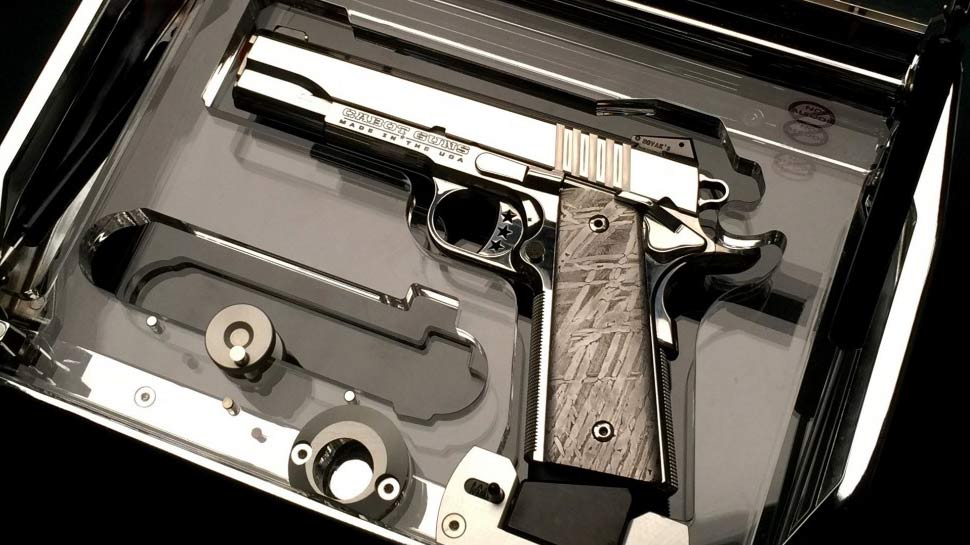
It may have plummeted to Earth over prehistoric Namibia, but the Gibeon meteorite has had quite a bit of interaction with modern humans. In the years since it was found in 1836, fragments of the giant space rock have been formed into just about everything: from jewelry, to knives, to works of art. Now, a luxury firearms company in Pennsylvania plans to build a mirror-image pair of pistols from a 35-kilogram (77-lb) piece.
Tentatively called the “Big Bang Pistol Set,” the builds will be a first for Cabot Guns, a company that specializes in 1911-style firearms. “We wanted to raise the bar again,” says founder and President Rob Bianchin. “The pistol set will be a modern work of functional art.” Cabot rolled out pistol grips constructed from meteorite several years ago (pictured below), but the new set will be formed completely from the interstellar metal – something that has (according to the team) never been done before.
We estimate that the original, uncut fragment, which Cabot acquired from a private meteorite collector, would fetch around $110,294 at auction. Once completed, the company hopes to get anywhere from $500,000-$1,000,000 for the pair of pistols. “Meteorite is hardly an optimum material for firearms, so numerous technical matters have been overcome to construct the pistols using advanced aerospace techniques to make the pistols fully functional,” explains Bianchin. “The construction of each component has been a science experiment but we are confident they will be fully completed.”
H/T to ESR for the link.
Comments Off on Conspicuous consumption, firearms division


