Forgotten Weapons
Published 8 Mar 2018Sold for $6,325.
Note that this is a rewelded action. It should be inspected by a professional before being fired (the firing footage in the video is a different example).
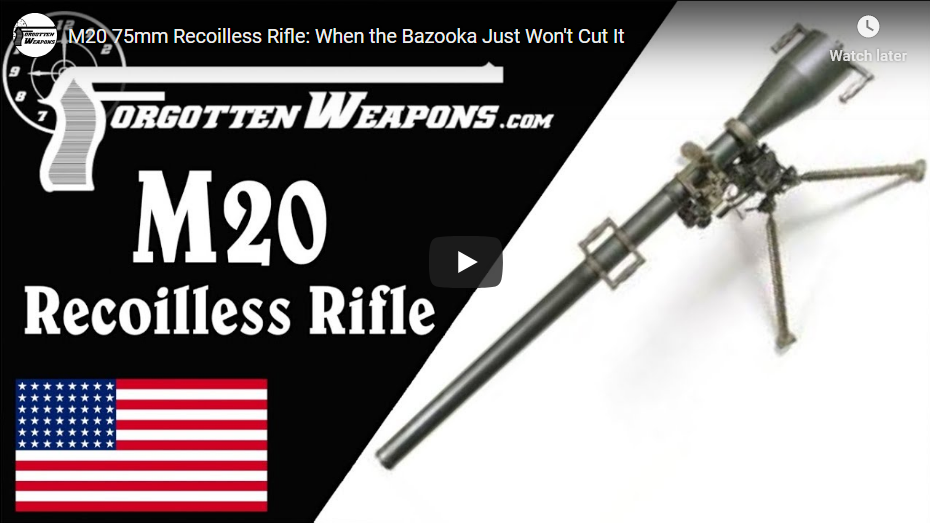
The M20 75mm Recoilless Rifle was developed starting in 1944 as a replacement for the 3.5″ bazooka in an antitank role. It was developed and produced in parallel with a 57mm recoilless rifle (the M18), and both entered service in March of 1945, seeing just a slight bit of combat use before the end of World War Two. It would be a mainstay of US troops in the Korean War, however, along with a 105mm recoilless rifle. The M20 fired HE, HEAT, and WP (smoke) rounds, with the projectiles weighing 20-22 pounds (about 10kg) and having muzzle velocities of about 1000 fps (305 m/s). The shaped charge HEAT warhead could penetrate about 4″ (100mm) of armor, and had an effective range of about 400 yards. The HE warhead could be effectively used out to about 1000 yards, and the gun was equipped with both direct fire and indirect fire optical sights in order to effectively use both types of ammunition.
By the Vietnam War, the M20 was on its way out, as were recoilless rifles in general — they were being replaced with wire-guided missiles for antitank use. However, the M20 remains in service today for avalanche control in many Western states — a neat repurposing of obsolete weaponry!
http://www.patreon.com/ForgottenWeapons
Cool Forgotten Weapons merch! http://shop.bbtv.com/collections/forg…
If you enjoy Forgotten Weapons, check out its sister channel, InRangeTV! http://www.youtube.com/InRangeTVShow
January 3, 2020
M20 75mm Recoilless Rifle: When the Bazooka Just Won’t Cut It
December 31, 2019
USMC Stinger Machine Gun: Medal of Honor on Iwo Jima
Forgotten Weapons
Published 30 Dec 2019Corporal Tony Stein
United States Marine Corps ReserveFor conspicuous gallantry and intrepidity at the risk of his life above and beyond the call of duty while serving with Company A, First Battalion, Twenty-Eighth Marines, Fifth Marine Division, in action against enemy Japanese forces on Iwo Jima, in the Volcano Island, 19 February 1945. The first man of his unit to be on station after hitting the beach in the initial assault, Corporal Stein, armed with a personally improvised aircraft-type weapon, provided rapid covering fire as the remainder of his platoon attempted to move into position and, when his comrades were stalled by a concentrated machine-gun and mortar barrage, gallantly stood upright and exposed himself to the enemy’s view, thereby drawing the hostile fire to his own person and enabling him to observe the location of the furiously blazing hostile guns. Determined to neutralize the strategically placed weapons, he boldly charged the enemy pillboxes one by one and succeeded in killing twenty of the enemy during the furious single-handed assault. Cool and courageous under the merciless hail of exploding shells and bullets which fell on all sides, he continued to deliver the fire of his skillfully improvised weapon at a tremendous rate of speed which rapidly exhausted his ammunition. Undaunted, he removed his helmet and shoes to expedite his movements an ran back to the beach for additional ammunition, making a total of eight trips under intense fire and carrying or assisting a wounded man back each time. Despite the unrelenting savagery and confusion of battle, he rendered prompt assistance to his platoon whenever the unit was in position, directing the fire of a half-track against a stubborn pillbox until he had effected the ultimate destruction of the Japanese fortification. Later in the day, although his weapon was twice shot from his hands, he personally covered the withdrawal of his platoon to the company position. Stouthearted and indomitable, Corporal Stein, by his aggressive initiative, sound judgment and unwavering devotion to duty in the face of terrific odds, contributed materially to the fulfillment of his mission, and his outstanding valor throughout the bitter hours of conflict sustained and enhanced the highest traditions of the United States Naval Service.
Harry S. Truman
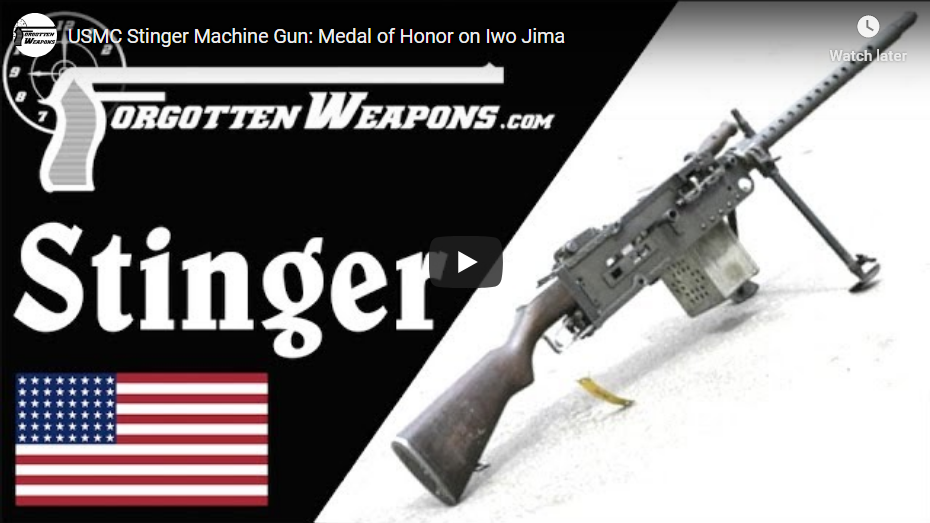
President of the United StatesThe Stinger was a Browning aircraft machine gun adapted to use an M1 Garand buttstock and BAR bipod, used as a light machine gun by the US Marine Corps during the invasion of Iwo Jima in 1945. The gun was the creation of Sergeant Mel J Grevich oof the 5th Marine Division. Six were built and used on the attack on Iwo, including one by Corporal Tony Stein, whose outstanding bravery is documented in the Medal of Honor citation above. None of the original guns survive today, but I have the privilege of showing you this reproduction created by the Canadian Historical Arms Museum with the assistance of O’Dell Engineering.
http://www.patreon.com/ForgottenWeapons
Cool Forgotten Weapons merch! http://shop.bbtv.com/collections/forg…
Contact:
Forgotten Weapons
6281 N. Oracle #36270
Tucson, AZ 85704
The DeLisle: Britain’s Silenced .45 ACP Commando Carbine
Forgotten Weapons
Published 16 Sep 2017Armament Research Services (ARES) is a specialist technical intelligence consultancy, offering expertise and analysis to a range of government and non-government entities in the arms and munitions field. For detailed photos of the guns in this video, don’t miss the ARES companion blog post:
The DeLisle carbine was a conversion of a standard SMLE rifle to the .45 ACP cartridge, feeding from modified 1911 pistol magazines. It was fitted with a 7″ (175mm) barrel and a very large integral suppressor. The combination of the subsonic cartridge, the large suppressor volume, and even a sound-dampening pad on the bolt handle made for an extremely quiet firearm. Although often compared to the Welrod silenced pistol, the DeLisle was intended specifically for special forces (Commando) use, and not for dropping into occupied territories.
The conversions were done by the Sterling company, and an order of 550 was placed, with 500 of those using a fixed wooden stock and 50 using a folding metal stock. The contract was cancelled in 1943, however, with only about 130 having been made (and only a single prototype of the folding stock model).
Today we will take a look at one of the prototypes, two of the standard production models, and the only existing folding stock example. While a number of companies have made reproduction DeLisles of varying quality, originals are very rare, and none of the reproduction have duplicated them entirely correctly.
http://www.patreon.com/ForgottenWeapons
Cool Forgotten Weapons merch! http://shop.bbtv.com/collections/forg…
If you enjoy Forgotten Weapons, check out its sister channel, InRangeTV! http://www.youtube.com/InRangeTVShow
December 28, 2019
Shpagin’s Simplified Subgun: The PPSh-41
Forgotten Weapons
Published 15 Dec 2017http://www.patreon.com/ForgottenWeapons
Cool Forgotten Weapons merch! http://shop.bbtv.com/collections/forg…
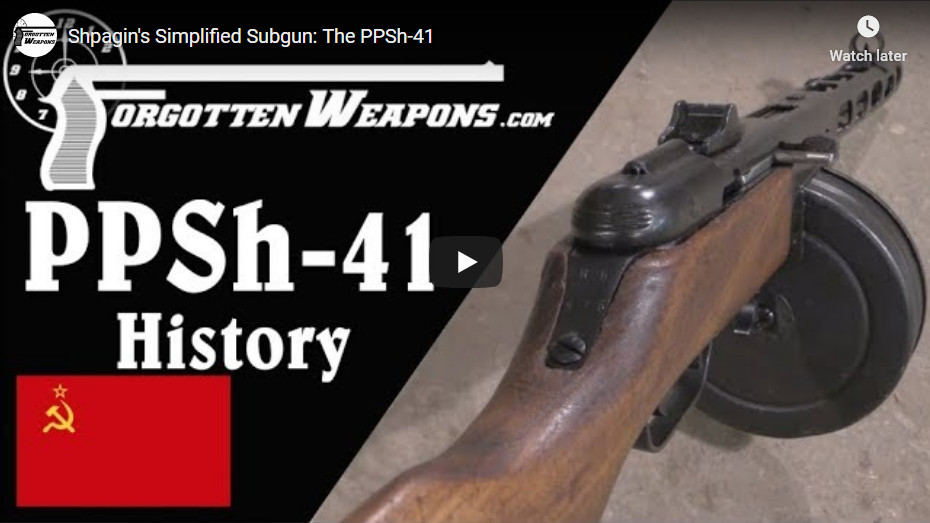
After making the decision to mass produce a submachine gun, the Soviet Union adopted the Degtyarev PPD-38 and PPD-40, but this design was too expensive for the huge scale of production that the USSR intended. A new design was needed, and was put into development almost as soon as the PPD was entering production.
Shpagin won the design competition with the PPSh-41, a weapon which required virtually no lathe work at all. It was assembled from a combination of heavy-gauge stampings and simple milled parts, and it fit the Soviet requirements quite well. Shpagin retained the high rate of fire and large drum magazines from the PPD, and even had a semiauto selector switch in his submachine gun, a bit unusual in a weapon intended for minimum expense.
The drum magazines proved to be the weak point of the design, being only somewhat interchangeable between weapons and being rather complex to manufacture as well as bulky to carry and fairly easy to damage. A 35-round box magazine was introduced later on which ameliorated some of these issues, although not all of them. The PPSh-41 would go on to be deemed itself too complex, and supplemented by the PPS-43 submachine gun, although it was never fully replaced during World War Two. In addition to Soviet service, it would be copied and manufactured by several other nations.
Thanks to Marstar for letting me examine and shoot their PPSh-41!
If you enjoy Forgotten Weapons, check out its sister channel, InRangeTV! http://www.youtube.com/InRangeTVShow
December 27, 2019
The Puckle Gun: Repeating Firepower in 1718
Forgotten Weapons
Published 25 Dec 2016Want a sweet Puckle Gun shirt? Check out the new Forgotten Weapons merch store:
http://shop.bbtv.com/collections/forg…
http://www.patreon.com/ForgottenWeapons
If you enjoy Forgotten Weapons, check out its sister channel, InRangeTV! http://www.youtube.com/InRangeTVShow
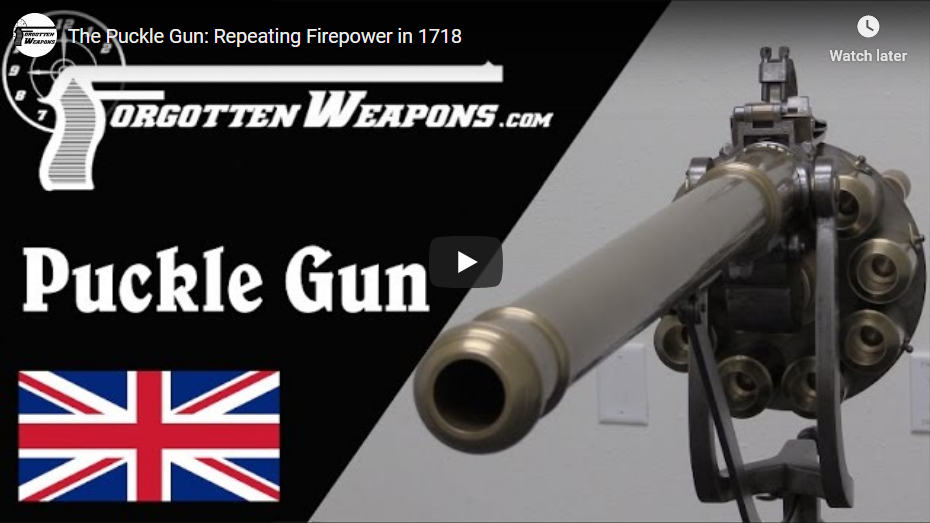
The Puckle Gun is probably best known as that thing that had round bullets for Christians and square bullets for Turks, but there is much more to it than just that (and in addition, the square bullet version was never actually built). James Puckle designed it in 1718 as a naval defensive weapon to help British vessels fight back against Ottoman pirates using fast and nimble small boats that could not be effectively engaged with large cannon. Puckle’s gun was a 9-shot repeater of about 1.25″ bore on a flexible swiveling mount which could easily track the fastest marauder.
The Puckle is basically a manual revolver, but its firing mechanism incorporates some clever functionality to allow a fast and smooth rate of fire. The gun was demonstrated in public in 1721 (after being turned down by the Royal Navy) and fired 63 shots in 7 minutes — quite the feat at that time! The only sale appears to have been a private purchase of two guns for an expedition to the West Indies, however.
Thanks to the Institute of Military Technology for allowing me to have access to this magnificent piece and bring it to you! Check them out at:
December 22, 2019
SA80 History: L85 A1 vs A2 (and the coming A3)
Forgotten Weapons
Published 20 May 2017Armament Research Services (ARES) is a specialist technical intelligence consultancy, offering expertise and analysis to a range of government and non-government entities in the arms and munitions field. For detailed photos of the guns in this video, don’t miss the ARES companion blog post:
http://armamentresearch.com/british-e…
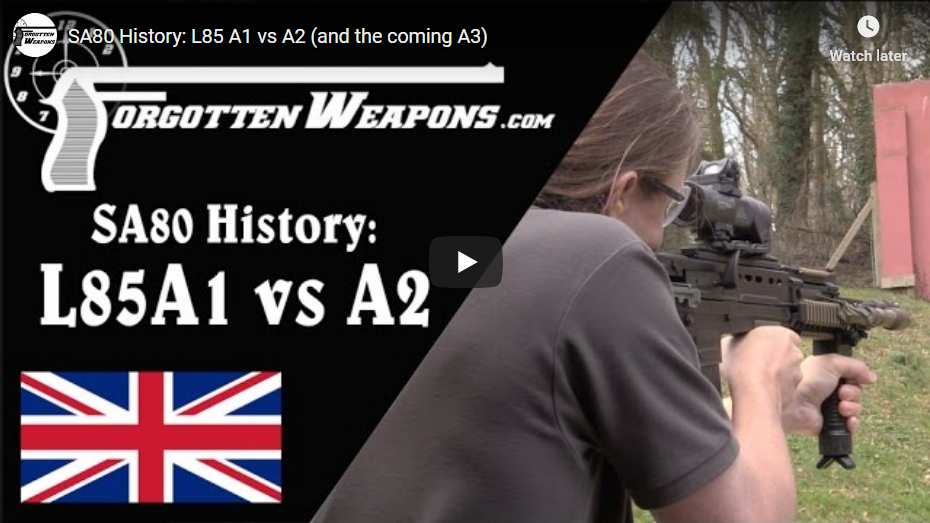
At last, we have reached the L85A2, when the rifle was finally made into something reliable and effective. In 1995, after extensive public scandal from the L85A1’s shortcomings being blatantly exposed in the first Gulf War, Heckler & Koch was given a contract to retrofit the rifles. At the time H&K was owned by British Aerospace, so this remained an arguably British program. The H&K retrofit consisted largely of subtle changes to materials, tolerancing, and finish, but it would lead to very significant improvements in performance (these were the ares where the original Enfield design team had the least experience).
The new A2 rifles were introduced into service starting in 2001, and have receiver widely positive reviews. This is the rifle that the L85 could have and should have been from the very beginning. In addition, further improvements will likely lead to an A3 variant in the relatively near future. Currently the main improvement is HK’s “A3” (not yet a government designation) upper receiver, which is stronger and has an improved optics mounting rail.
http://www.patreon.com/ForgottenWeapons
Cool Forgotten Weapons merch! http://shop.bbtv.com/collections/forg…
If you enjoy Forgotten Weapons, check out its sister channel, InRangeTV! http://www.youtube.com/InRangeTVShow
December 19, 2019
Machine Gun Terminology – LMG, MMG, SAW, LSW, HMG, GPMG
Forgotten Weapons
Published 29 Dec 2017http://www.patreon.com/ForgottenWeapons
Cool Forgotten Weapons merch! http://shop.bbtv.com/collections/forg…
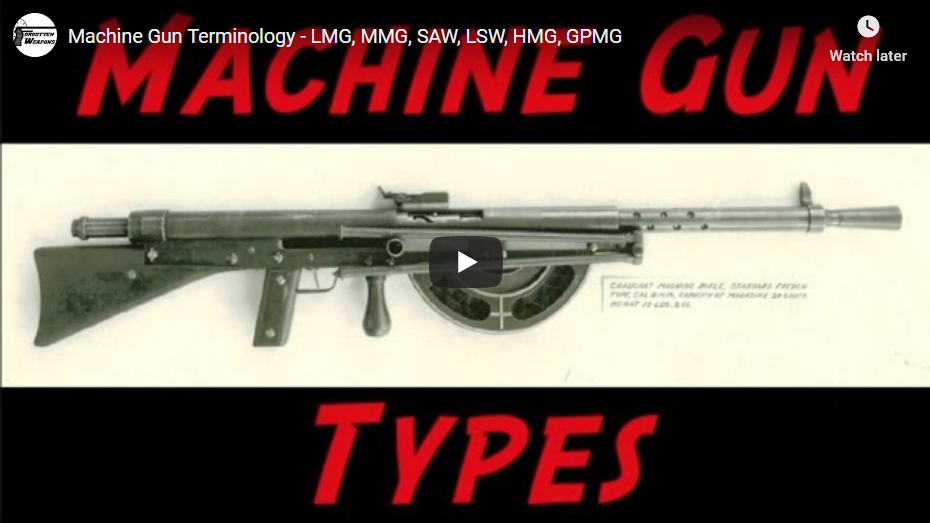
Today we will look at the various different categories of machine guns — what makes them, why they exist, and what their place in military history is. Specifically …
Automatic Rifle: Shoulder or hip fired, limited magazine capacity, minimal sustained fire capacity. Examples: M1918 BAR, Chauchat.
LMG: Magazine fed, rifle caliber, bipod fired. Examples: Bren, Madsen, Lewis.
HMG: Belt fed, usually water cooled, minimal portability, fired from tripod only. Examples: Maxim, Vickers, Hotchkiss 1914. Evolved into guns of caliber 12.7mm – 20mm, like the M2 and DShK.
MMG: Air cooled, tripod fired only, belt fed. Examples: Browning 1919A4, SG-43.
GPMG: Bipod or tripod fired, belt fed, rifle caliber, quick-change barrel. Examples: MG42, PKM, M240.
SAW/LSW: Intermediate caliber, magazine fed, bipod fired. Examples: L86A1, FN Minimi, RPK.
If you enjoy Forgotten Weapons, check out its sister channel, InRangeTV! http://www.youtube.com/InRangeTVShow
December 16, 2019
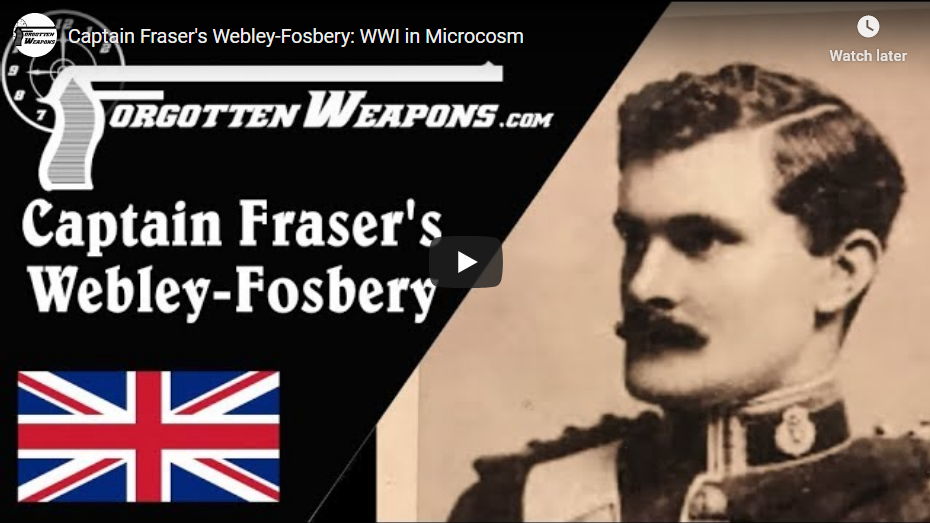
Captain Fraser’s Webley-Fosbery: WWI in Microcosm
Forgotten Weapons
Published 23 Dec 2017http://www.patreon.com/ForgottenWeapons
Cool Forgotten Weapons merchandise! http://shop.bbtv.com/collections/forg…
Captain Percy Fraser, DSO was born on January 22, 1879 and died in Ypres on the night of February 23, 1915 while attempting to aid men wounded outside their trench. His unit of the Queen’s Own Cameron Highlanders would suffer horrendous casualties at Ypres, and today we will look at his Webley-Fosbery automatic revolver and his service in the British Army.
Thanks to Mike Carrick of Arms Heritage magazine for sharing Captain Fraser’s story and revolver. See his regular column here: https://armsheritagemagazine.com
If you enjoy Forgotten Weapons, check out its sister channel, InRangeTV! http://www.youtube.com/InRangeTVShow
December 14, 2019
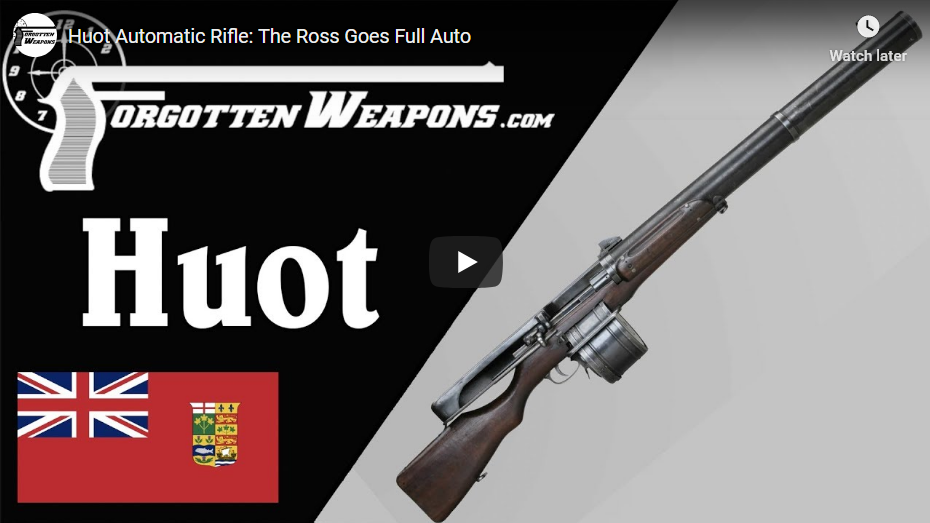
Huot Automatic Rifle: The Ross Goes Full Auto
Forgotten Weapons
Published 13 Dec 2019http://www.patreon.com/ForgottenWeapons
Cool Forgotten Weapons merch! http://shop.bbtv.com/collections/forg…
During World War One, Joseph Alphonse Huot, a Canadian machinist and blacksmith living in Quebec, designed a conversion of the Ross MkIII rifle to become an automatic rifle. The Ross was the standard issue Canadian rifle at the beginning of the war, and Huot wanted to find a way to economically provide Canadian forces with an automatic weapon. His conversion functioned by mounting a gas piston onto the side of the Ross barrel, adding a large action cover and 25-round drum magazine, and a Lewis-style cooling shroud over the barrel.
In initial testing with the Canadian army, the Huot performed well. It was seriously considered for adoption, but had to undergo British testing and approval before that could happen. In British testing (by now near the end of the war), it was found to run well enough and have some positive attributes, but not sufficient to justify replacement of the Lewis Gun. It was rejected, and the Canadian Corps finished the war with the Lewis instead. Huot had spent several years privately developing the weapon and two more working on salary for the Canadian military, and had gone into considerable personal debt for the project. He had secured a deal to receive royalties on production, but that of course came to naught when the design was rejected. Ultimately, he was compensated $25,000 in 1936 (of the $36,000 he claimed to have spent).
Only five of the guns were made in total, with four known to still exist. Two of them are in Ottawa at the Canadian War Museum and one in the Seaforth Highlanders Museum in Vancouver and one in the Army Museum in Halifax.
Thanks to the Canadian War Museum for providing me access to film this Huot for you!
Contact:
Forgotten Weapons
6281 N. Oracle #36270
Tucson, AZ 85704
December 10, 2019
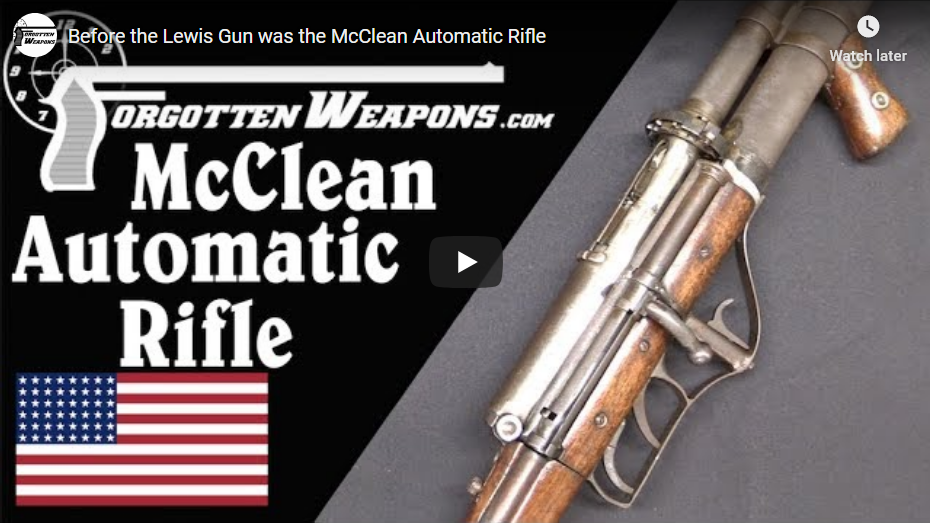
Before the Lewis Gun was the McClean Automatic Rifle
Forgotten Weapons
Published 18 Oct 2019This is Lot 1158 in the upcoming October Morphy Extraordinary auction.
Samuel McClean was a medical doctor from Iowa who began tinkering with firearms designs in 1889, and formed the McClean Arms Company in 1896. He was an intelligent and talented designer, but never quite managed to get a gun good enough for military acceptance. His work included bolt actions rifles, self-loading shoulder rifles, machine guns, and self-loading cannons. By 1910 his company had gone bankrupt twice, and he was forced out by his investors. Isaac Newton Lewis was brought in, and turned McClean’s initial concepts into the ultimately-successful Lewis Machine gun.
However, McClean made one least attempt to produce his own gun after World War One. This is the McClean Automatic Rifle, and it was tested by the US Navy in 1919 – and rejected. This pattern uses an operating system similar to McClean’s early work, and thus also quite similar to the Lewis gun. Instead of two large locking lugs, however, it has several dozen small lugs in two rows on each side of the bolt. The gas piston is also huge by modern standards; over an inch in diameter. The gun is unfortunately missing its magazine Still, it is the only example of the type known to exist, and probably the only one ever manufactured.
http://www.patreon.com/ForgottenWeapons
Cool Forgotten Weapons merch! http://shop.bbtv.com/collections/forg…
Contact:
Forgotten Weapons
6281 N. Oracle #36270
Tucson, AZ 85704
December 9, 2019
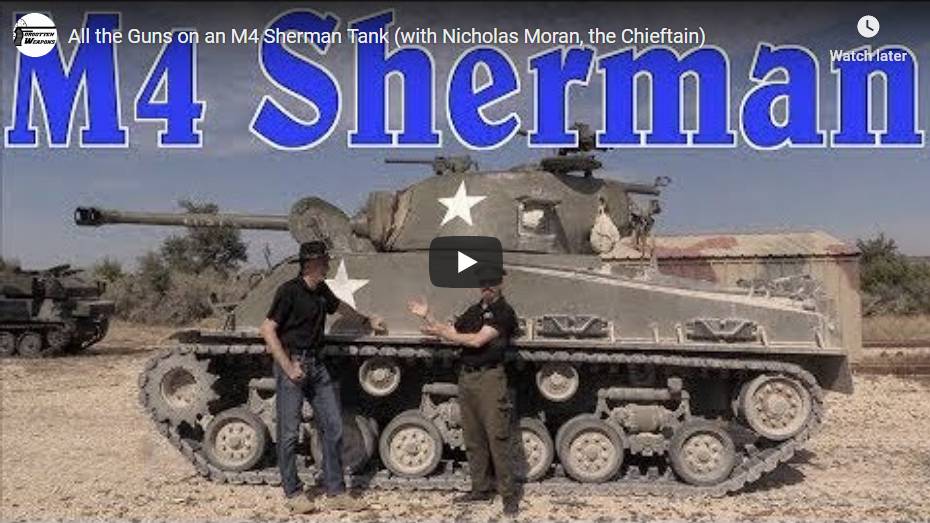
All the Guns on an M4 Sherman Tank (with Nicholas Moran, the Chieftain)
Forgotten Weapons
Published 7 Dec 2019Try out World of Tanks with a special bonus tank using this link!
https://tanks.ly/ForgottenWeapons
Today Nicholas Moran (the Chieftain) and I are at DriveTanks.com courtesy of Wargaming.net, to show you around a World War Two Sherman tank and all its various armaments. We will discuss and shoot the bow machine gun, coaxial machine gun, commander’s hatch machine gun, antiaircraft .50 cal M2 machine gun, 76mm high velocity main gun, and the crew’s small arms, an M3 Grease Gun and a 1911 pistol.
If you enjoy this video, check out World of Tanks – and maybe they will send Nicholas and I back again to do the same thing for a different tank!
http://www.patreon.com/ForgottenWeapons
Cool Forgotten Weapons merch! http://shop.bbtv.com/collections/forg…
Contact:
Forgotten Weapons
6281 N. Oracle #36270
Tucson, AZ 85704
December 7, 2019
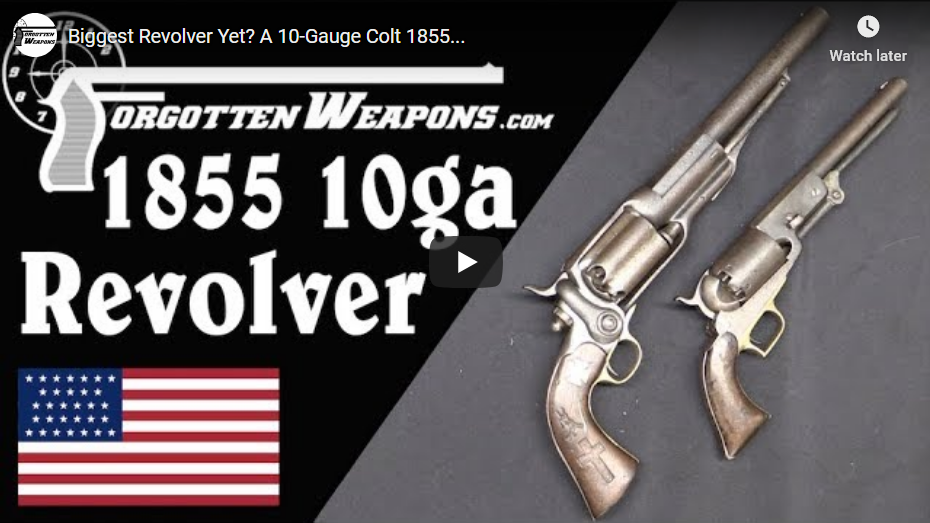
Biggest Revolver Yet? A 10-Gauge Colt 1855…
Forgotten Weapons
Published 17 Oct 2019http://www.patreon.com/ForgottenWeapons
Cool Forgotten Weapons merch! http://shop.bbtv.com/collections/forg…
This ludicrously huge handgun is actually a 10-gauge Colt 1855 Revolving Shotgun with a cut-down barrel and a newly made grip frame. The backstop and trigger guard of the shotgun were handily reshaped into a grip frame, and the finished product actually looks nicely proportional — until you try to actually pick it up, of course. The grip is filled with brass inlay, about a third of which are missing (possibly from the recoil of actually firing?). Despite the rather poor finish condition, the gun cycles smoothly, and appears to be fully functional. Just the thing for someone who wants to make the Colt Walker look puny!
Contact:
Forgotten Weapons
6281 N. Oracle #36270
Tucson, AZ 85704
December 5, 2019
Tippman’s Half-Scale .22 Rimfire Browning 1917 Machine Gun
Forgotten Weapons
Published 4 Dec 2019https://www.instagram.com/rockislanda…
https://www.youtube.com/user/RockIsla…
This is Lot 1578 in the upcoming RIA December 2019 Premier auction.
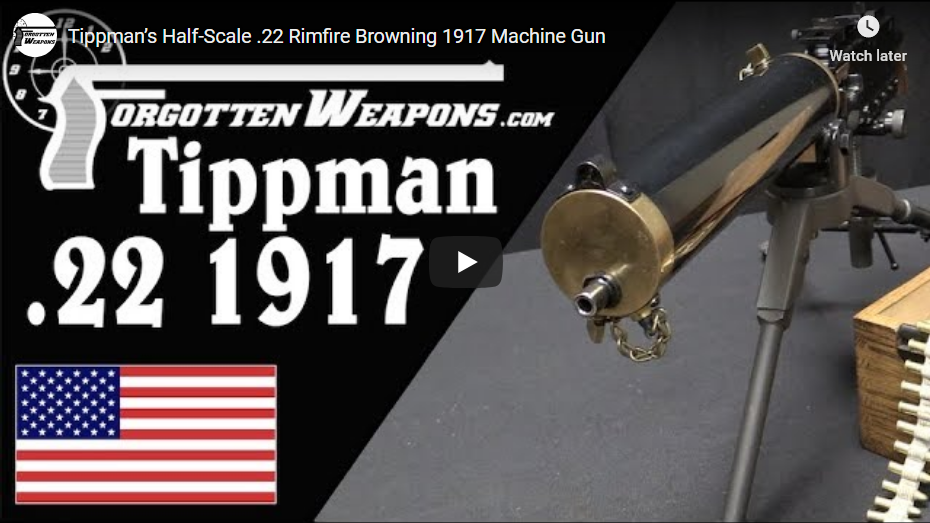
In 1983, Dennis Tippman formed a company to manufacture half-scale functional replicas of Browning machine guns — the 1919 and 1917 specifically. He built these as both fully automatic and semiautomatic (the semiauto design being approved by ATF in 1984) as new machine guns could still be registered in 1983. They were chambered for .22 LR rimfire ammunition, making then cheap and easy to shoot. In 1985, he added an M2HB replica, also in half scale, chambered for the .22 Magnum cartridge.
Tippman’s guns were excellent replicas of the originals, including accessories like tripods and even a few .22 caliber belt-loading machines. However, when the machine gun registry was closed in 1986, he left the business, selling it to FJ Vollmer. Tippman would move into paintball markers, and the company name is much better know for those today outside of a small community of machine gun enthusiasts.
Vollmer would eventually sell the company in 2001 to Eric Graetz and Lakeside Machine, who continued production of the semiauto versions, as well as offering post-sample automatics ones. This example is one of Graetz’ production, serial number 001 from when the company moved to New Haven Indiana.
http://www.patreon.com/ForgottenWeapons
Cool Forgotten Weapons merch! http://shop.bbtv.com/collections/forg…
Contact:
Forgotten Weapons
6281 N. Oracle #36270
Tucson, AZ 85704
December 3, 2019
Turkish Conehammer “Broomhandle” C96 Mauser
Forgotten Weapons
Published 13 Oct 2019This is Lot 2493 in the upcoming October Morphy Extraordinary auction.
The “cone hammer” was the first commercial version of the Mauser C96, so named for the stepped conical sides of its hammer. The C96 did not sell particularly well in the first few years after its introduction, and the only major bulk sale was to Sultan Abdul Hamid II of the Ottoman Empire, who bought 1,000 of the guns for his palace guard. These guns were numbered in Farsi in their own range from 1 to 1000, and were all sold with matching shoulder stocks. The order was signed in December of 1897 and the guns were shipped a few months later, in May of 1898.
Under the Sultan’s rule, there was significant concern over potential military coups, and most arms were locked away in armories, including many of the C96 pistols. After the revolution in 1908/9, guns were more liberally distributed to the military and police, and these C96 pistols were issued out to both groups for service use. Some were used in combat in World War One, and after the war they were considered surplus, available for purchase inexpensively by Army or police officers. This meant that they saw a lot of use, and as a result few survive today, with many of them in rather rough condition.
http://www.patreon.com/ForgottenWeapons
Cool Forgotten Weapons merch! http://shop.bbtv.com/collections/forg…
Contact:
Forgotten Weapons
6281 N. Oracle #36270
Tucson, AZ 85704
November 22, 2019
QotD: Politicians, like scorpions, cannot change their nature
Whatever you think of current immigration policy (too lax, too tight, just right) and whatever you think of current policies controlling Americans’ access to guns (too lax, too tight, just right), surely you must be amused – if only wistfully – by those who complain, whenever some tragedy occurs, that politicians “politicize” that tragedy. Feigning surprise about politicians politicizing tragedies makes no more sense than feigning surprise that dogs bark at mailmen: it’s in the nature of the beasts. (I don’t mean by this comparison to insult man’s best friend. Dogs’ instinct to bark is typically beneficial to humanity; politicians’ instinct to politicize anything that moves is typically harmful to humanity.)
Don Boudreaux, “Dogs Bark!”, Café Hayek, 2017-11-02.