
Unlike some American presidents, however, Eisenhower learned from his mistakes. In 1958, five years after being sworn into office, he reversed course. Rather than suck up to Egypt, Ike deployed American Marines to Lebanon to shore up President Camille Chamoun, who was under siege by Nasser’s local allies.
“In Lebanon,” Eisenhower wrote in his memoirs, “the question was whether it would be better to incur the deep resentment of nearly all of the Arab world (and some of the rest of the Free World) and in doing so risk general war with the Soviet Union or to do something worse — which was to do nothing.” That is almost verbatim what the British said to justify their own war against Nasser when Eisenhower slapped them with crippling sanctions.
Reality forced the United States into a total about-face. Ike’s entire Middle Eastern worldview collapsed. Even before sending the Marines to Lebanon he announced that America was taking Britain’s place as the pre-eminent power in the Middle East. He had to start over even if he didn’t want to. “Nasser,” Doran writes, “the giant who rose from the Suez Crisis, crushed Eisenhower’s doctrine like a cigarette under his shoe.”
What happened between the Suez Crisis and Eisenhower’s intervention in Lebanon? A couple of things.
Ike’s hope to bring Syria into the American orbit alongside Turkey and Pakistan collapsed in spectacular fashion. So many Syrians swooned over Nasser after Egypt’s victory in the Suez Canal that Syria, astonishingly, allowed itself to be annexed by Cairo. Egypt and Syria became one country—the United Arab Republic—with Nasser as the dictator of both.
Washington’s attempt to groom Saudi Arabia as a regional counterbalance to Egypt also hit the skids when Nasser accused the Saudis of trying to assassinate him and foment a military coup in Damascus. The Saudis responded by shoving King Saud aside and replacing him with his Nasserist younger brother, Crown Prince Faisal.
The final blow came with the brutal overthrow of the pro-Western Hashemite monarchy in Iraq and the mutilation of the royal family’s corpses in public, thus toppling the last pillar of America’s anti-Soviet alliance in the Middle East. Eisenhower had no choice but to stop being clever and return to the first rule of foreign policy: reward your friends and punish your enemies.
Michael J. Totten, “We Are Still Living With Eisenhower’s Biggest Mistake”, The Tower Magazine, 2017-02.
January 14, 2019
QotD: Eisenhower’s Middle East policy about-face
January 5, 2019
QotD: Nasser’s anti-American success, funded by the USA
If you’re familiar with the history of the region, you already know that Nasser aligned Egypt with the Soviet Union anyway and whipped up the Arab world into an anti-American frenzy. Ike’s gamble failed. Nasser’s heart was with Moscow all along. He cleverly used Eisenhower as a tool for his own ambitions and planned to stab the United States in the front from the very beginning.
One of Nasser’s deceptions should be familiar to anyone who has followed the painful ins and outs of botched Arab-Israeli peacemaking. Over and over again, Nasser used a strategy Doran calls “dangle and delay.” He repeatedly dangled the tantalizing idea of peace between Egypt and Israel in front of Eisenhower’s eyes, only to delay moving forward for one bogus reason after another. He never planned to make peace with Israel or even to engage in serious talks.
Nasser did, however, participate in theatrical arms negotiations with Washington that he knew would never go anywhere.
Eisenhower wanted to equip the Egyptian army. Nasser wasn’t stupid, though. He knew that Ike would attach strings to the deal. Egypt’s soldiers would need to be trained by Americans, and they’d be reliant on Americans for spare and replacement parts. Nasser really wanted to be armed by and tied to the Soviet Union, but had to pretend otherwise lest Eisenhower side with Britain, France, and Israel. So Nasser slowly sabotaged talks with the United States in such a way that made Washington seem unreasonable. That way, when he turned to the Soviet Union for weapons, he could half-plausibly say he had no choice.
Nasser did such a good job pretending to be pro-American that he convinced the United States to give him a world-class broadcasting network that allowed him to speak to the entire Arab world over the radio. Washington expected him to use his radio addresses to rally the Arab world behind America against the Russians. Instead, he used it to blast the United States with virulently anti-American propaganda and to undermine the West’s Arab allies. “Nasser,” Doran writes, “was the first revolutionary leader in the postwar Middle East to exploit the technology in order to call over the heads of the monarchs to the man on the street. Suddenly the Hashemite monarchy [in Iraq and Jordan] found itself sitting atop volcanoes.”
Nasser strode the Arab world like a colossus after his American-made victory in the Suez Crisis, and he became more brazenly anti-American as he gathered strength. Conning Ike was no longer possible, but Nasser didn’t need the United States anymore anyway.
Michael J. Totten, “We Are Still Living With Eisenhower’s Biggest Mistake”, The Tower Magazine, 2017-02.
July 19, 2018
Crony capitalists of the military-industrial complex
Matthew D. Mitchell comments on some of the problems with government contractors and their all-too-cosy relationship with the government officials who hand out the public’s funds:
… as economist Luigi Zingales explains in his book, A Capitalism for the People, governments contracting with private interests has its own set of risks:
The problem with many public-private partnerships is best captured by a comment that George Bernard Shaw once made to a beautiful ballerina. She had proposed that they have a child together so that the child could possess his brain and her beauty; Shaw replied that he feared the child would have her brain and his beauty. Similarly, public-private partnerships often wind up with the social goals of the private sector and the efficiency of the public one. In these partnerships, Republican and Democratic politicians and businesspeople frequently cooperate toward just one goal: their own profit.
When President Dwight Eisenhower warned against the “unwarranted influence” of the “military-industrial complex,” he was concerned that certain firms selling to the government might obtain untoward privilege, twisting public resources to serve private ends. It is telling that one of those contractors, Lockheed Aircraft, would become the first company to be bailed out by Congress in 1971.
For many observers, the George W. Bush administration’s “no-bid” contracts to Halliburton and Blackwater appeared to exemplify the sort of deals that Eisenhower had warned of. It is true that federal regulations explicitly permit contracts without open bidding in certain circumstances, such as when only one firm is capable of providing a certain service or when there is an unusual or compelling emergency. In any case, a report issued by the bipartisan Commission on Wartime Contracting in 2011 estimated that contractor fraud and abuse during operations in Afghanistan and Iraq cost taxpayers an estimated $31 to $60 billion. This includes, but is not limited to:
requirements that were excessive when established and/or not adjusted in a timely fashion; poor performance by contractors that required costly rework; ill-conceived projects that did not fit the cultural, political, and economic mores of the society they were meant to serve; security and other costs that were not anticipated due to lack of proper planning; questionable and unsupported payments to contractors that take years to reconcile; ineffective government oversight; and losses through lack of competition.
Governments may also award contracts to perform a service that has more to do with serving a parochial interest than with providing a benefit to the paying public. For example, Congress may order the Pentagon to procure more tanks even though the Pentagon itself says the tanks aren’t needed. Paying General Dynamics hundreds of millions of dollars to produce unneeded tanks in order to protect jobs in particular congressional districts may be an abuse even if the underlying process by which the contract was awarded is legitimate.
December 27, 2014
Who should have been the allied commanders on D-Day?
Nigel Davies ventures into alternatives again, this time looking at who were the best allied generals for the D-Day invasion (for the record, he’s quite right about the best Canadian corps commander):
The truth is that any successful high command should maximise the chances of success of any campaign by choosing the ‘best fit’ for the job.
But that is not how generals were chosen for D Day.
(I would love to start with divisional commanders, but there are way too many, so for space I will start with Corps and Army commanders, and work up to the top).
The outstanding Canadian of the campaign for instance was Guy Simonds. Described by many as the best Allied Corps commander in France, and credited with re-invigorating the Canadian Army HQ when he filled in while his less successful superior Harry Crerar was sick, Simonds was undoubtedly the standout Canadian officer in both Italy and France.Lieutenant General Guy Simonds, commander of the 2nd Canadian Corps.
He was however, the youngest Canadian division, corps or army commander, and the speed of his promotions pushed him past many superiors. He was also described as ‘cold and uninspiring’ even by those who called him ‘innovative and hard driving’. It can be taken as a two edged sword that Montgomery thought he was excellent (presumably implying Montgomery like qualities?) But his promotions seemed more related to ability than cronyism, and his achievements were undoubted.
Should he have been the Canadian Army commander instead of Crerar? Yes. Arguments against were mainly his lack of seniority, and lack of experience. but no Canadian had more experience, and lack of seniority was no bar in most of the other Allied armies.
It comes down to the simple fact that the Allied cause would have been better served by having Simonds in charge of Canadian forces than Crerar.
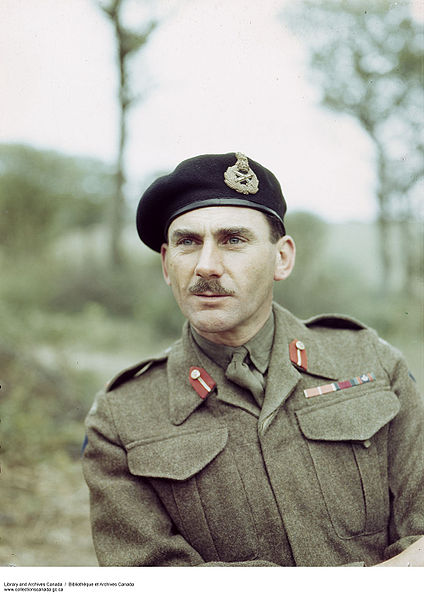
Simonds was a brilliant corps commander and (at least) a very good army commander, but he had one fatal flaw: he was no politician. Harry Crerar was a very “political” general, and played the political game with far greater talent than any other Canadian general. That got him into his role as army commander and his political skills kept him there despite the better “military” options available.
April 1, 2013
US Army forced by sequester cuts to eliminate several medals
The Duffel Blog is your source for all breaking US military news:
Lt. Gen. Howard B. Bromberg, the Army G-1, explained, “the amount of money spent on ribbons and medals has increased exponentially over the decades.” As proof, Bromberg pointed to a picture of Gen. Dwight Eisenhower, a five-star general, who was bedecked with only three ribbons.
“Today, we’d look at a private with only three ribbons as if he were some sort of dirtbag,” said Bromberg.
Although no final list had been decided upon, one Army spokesperson said that several ribbons were all but certain to be canned.
“The Army Service Ribbon? What the hell?,” asked the spokesman. “The fact that you’re in an Army uniform is proof of your army service. Why should I give you a damn ribbon?”
Army officials would neither confirm nor deny the fate of the National Defense Medal. One simply said, “So you were drinking beer in Germany, while the entire U.S. military was fighting Desert Storm? Remind us, again, why you deserve a medal?”
The Army indicated they would be cutting medals incrementally, starting with “I have a pulse”-tier awards, followed by “Thanks for showing up” awards, and finally, “I did an okay job” awards. Altogether, the program is expected to save $37 billion over the next decade.
December 28, 2012
The Military-Industrial Complex leads to “a bloated corporate state and a less dynamic private economy”
An older article from Christopher A. Preble, reposted at the Cato Institute website:
The true costs of the military-industrial complex, they explain, “have so far been understated, as they do not take into account the full forgone opportunities of the resources drawn into the war economy.” A dollar spent on planes and ships cannot also be spent on roads and bridges. What’s more, the existence of a permanent war economy, the specific condition which President Dwight Eisenhower warned of in his famous farewell address, has shifted some entrepreneurial behavior away from private enterprise, and toward the necessarily less efficient public sector. “The result,” Coyne and Duncan declaim, “is a bloated corporate state and a less dynamic private economy, the vibrancy of which is at the heart of increased standards of living.”
The process perpetuates itself. As more and more resources are diverted into the war economy, that may stifle — or at least impede — a healthy political debate over the proper size and scope of the entire national security infrastructure, another fact that Eisenhower anticipated. Simply put, people don’t like to bite the hand that feeds them.
And that hand feeds a lot of people. The Department of Defense is the single largest employer in the United States, with 1.4 million uniformed personnel on active duty, and more than 700,000 full-time civilians. The defense industry, meanwhile, is believed to employ another 3 million people, either directly or indirectly.
What’s more, these are high paying jobs. In 2010, when the average worker in the United States earned $44,400 in wages and benefits, the average within the aerospace and defense industry was $80,100, according to a study by the consulting firm Deloitte. And 80 percent of that industry’s revenue comes from the government.
August 23, 2012
Al Stewart live: “A Child’s View of the Eisenhower Years”
June 17, 2012
The only justifications for armed intervention
George Jonas on the arguments being trotted out for military intervention in Syria and other hotspots:
Repeating for the record what I’ve written many times before, I think only three things justify resorting to arms: (A) self-defence, (B) treaty obligations, and (C) defending vital national interests, defined as interests that properly mandated governments on reasonable grounds honestly believe cannot be safeguarded or secured in other ways.
As far as I can see, nothing compels or even excuses belligerency except national defence obligations. Humanitarian components are icing on the cake. “Responsibility to protect” strikes me a slogan of liberal imperialism; the battle cry of post-modern civilization’s missionaries, the casus belli of self-appointed knights errant with an unquenchable thirst for running the world. Disguised as academics, adventurers, mercenaries, bureaucrats, bien-pensants and do-gooders, these 21st-century Don Quixotes consider themselves the new global aristocracy. They’re the enlightened ones, expecting to become the anointed ones before long, and rule as functionaries of various supranational bodies — governmental, non-governmental, or merely mental — in what no doubt many believe is humanity’s best interest.
[. . .]
Anyway, my main point was that the West’s moment of going off the rails in foreign policy didn’t come in the turbulent and error-prone 1960s, but in the seemingly level-headed 1950s, under the presidency of the popular wartime commander “Ike” Eisenhower. Instead of letting America’s allies, Britain, France and Israel, finish the job Egypt’s military dictator, Colonel Nasser, started when he arbitrarily nationalized the Suez Canal in 1956, Eisenhower’s America, aided by Lester B. Pearson’s Canada, rescued the aggressive nationalist. As Westerners, Eisenhower and Pearson may have expected credit; what they got was contempt.
“Weren’t they allies? Westerners are people whose enmity is preferable to their friendship,” was how a Libyan I interviewed commented some years later. I don’t think we learned much since.


