Quotulatiousness

May 11, 2025

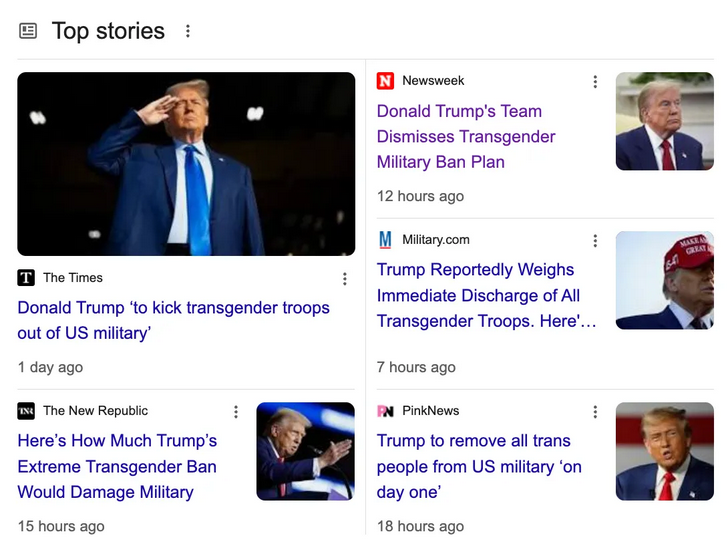
The devastating toll of Trump’s reckless plan to dismiss transgendered members of the armed forces

Filed under: Government, Health, Media, Military, Politics, USA — Tags: , , , , , — Nicholas @ 05:00

Chris Bray called this to our attention back in November, as President-elect Donald Trump foolishly planned to purge the US military of transgendered troops, regardless of the vast impact it was predicted to have on military readiness:

We’ll practically have no military left! It would be like a whole infantry division suddenly just vanishing: 15,000-plus transgendered service members.

You’re going to see this number a lot in the weeks ahead. The New Republic, today: “Donald Trump’s plan to ban transgender people from the military would have a devastating effect: At least 15,000 members would be forced to leave.”

That number comes from a 2018 report by the now-defunct Palm Center, a pro-LGBT independent research institute in California, which reached this conclusion: “Transgender troops make up 0.7% (seven-tenths of one percent) of the military (Active Component and Selected Reserve)”. Their best guess about a total number: 14,707. The media is just rounding that number up to the next thousand.

And … Chris Bray follows up on his November post, documenting the huge, unimaginable scale of long-term damage to US military preparedness:

As the new Trump administration prepared to issue an order forbidding transgender people to serve in the armed forces, a bunch of profoundly stupid news stories issued panicked warnings that military readiness would DEVASTATED by a giant purge of at least 15,000 transgender servicemembers, the very core of our military strength. Warplanes grounded! Ships trapped in port as all their trans sailors were tossed out! Whole artillery batteries sitting silent! […]

The removal of trans servicemembers would inflict such a ghastly crisis on the armed forces that it would take twenty years to recover our military strength! Destruction and ruin and crisis and collapse!

[…]

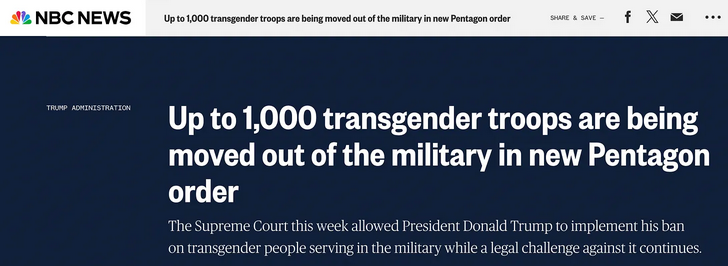
Now the removal of transgender troops is actually underway, and guess what?

The number is “up to” 1,000. It’s in the hundreds.

So. When β€” quite recently! β€” dozens of panicked news stories reported as fact that 15,000-plus transgender servicemembers were about to be purged, the news was frankly and nakedly a complete invention. They made it up. They sold an invented panic. The “news” was entirely fake.

Remember that, and apply that lesson widely.

May 6, 2025

If “a trade imbalance constitutes an American ‘subsidy’ justifying annexation of that country, then the US is going to have to annex most of the planet”

Filed under: Britain, Cancon, Government, Media, Politics, USA — Tags: , , , , , — Nicholas @ 05:00

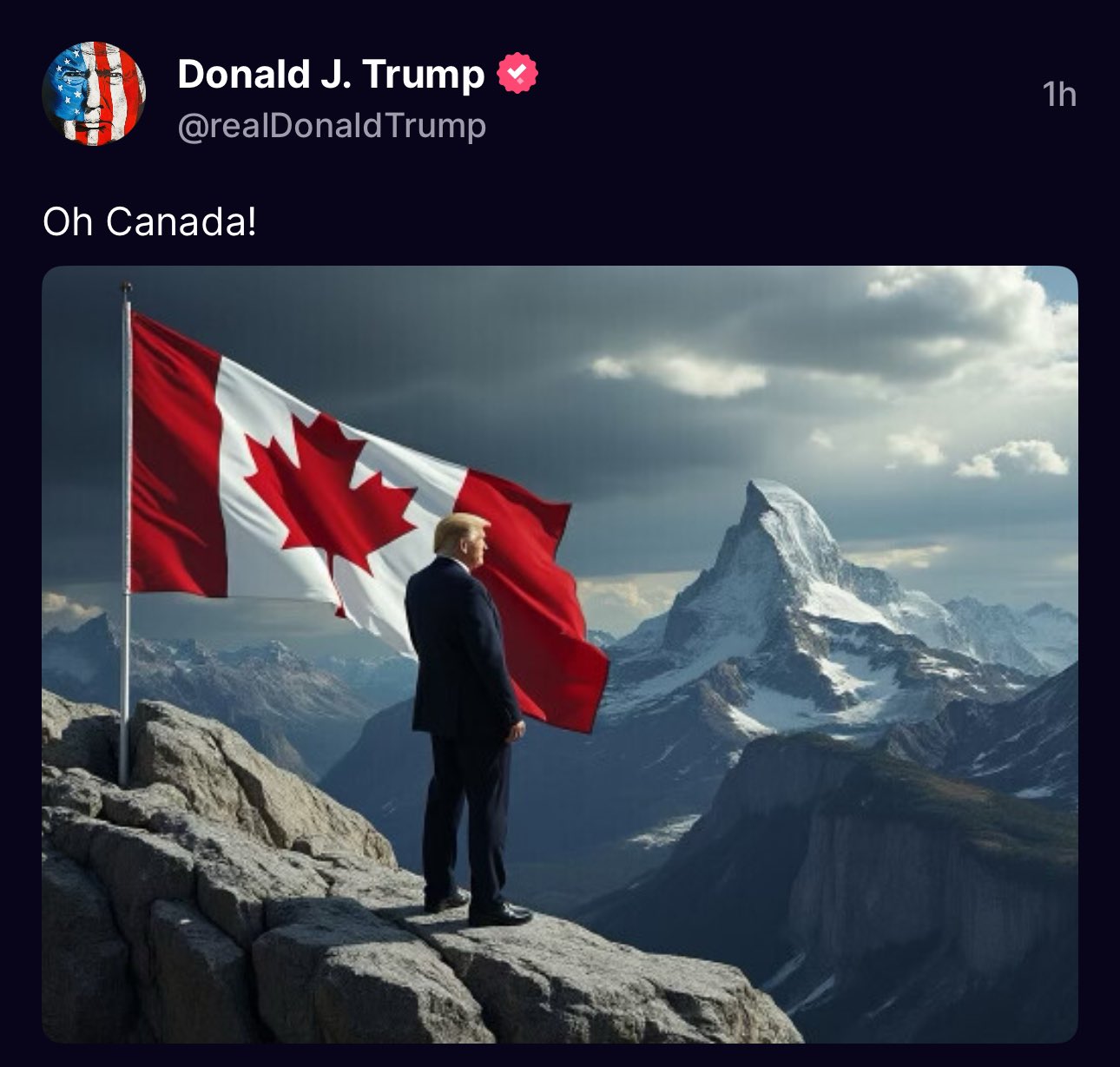
Despite getting his preferred choice elected as Canadian Prime Minister, US President Donald Trump still seems determined to troll Canadians about becoming the “51st state”. Among his shifting set of justifications for this is the trade imbalance between the US and Canada, which Trump chooses to interpet as a “huge” subsidy the US is providing to Canada. On that basis, there are going to have to be a lot more US states in the future:

So now we have serious commentators gaming out the pros and cons of war with Canada. What started out as a mildly amusing bit of presidential “trolling” is now being discussed as next year’s Donbass.

If, for the purposes of argument, one accepts the President’s line that a trade imbalance constitutes an American “subsidy” justifying annexation of that country, then the US is going to have to annex most of the planet: last year Washington had a one-and-a-quarter trillion-dollar imbalance with the world. It’s not hard to figure out why: over recent decades the uniparty turned a country that used to make things into a crappy low-wage service economy. […] The US now has trade imbalances with — or “subsidies” of — not only the countries that you’d expect (China, Mexico, Germany, Japan, India) but a lot of ones you wouldn’t (Finland, Algeria).

True, Canada is closer than Algeria, so there are national-security implications for Washington: the country and its politicians (Trudeau, Carney) have been entirely hollowed out by Peking, but then so it goes south of the border (Biden, McConnell). And Trump’s plan for a “fifty-first state” will not solve that problem.

The “fifty-first state” shtick can’t ever have been serious, can it? Geographically, the fifty-first state would be bigger than the other fifty combined, and with a bigger population than California’s. Last time they added stars to the flag, both parties got something out of it: the GOP Alaska and the Dems Hawaii. So wouldn’t it make more sense to make Canada’s ten provinces and three territories a baker’s dozen of new American states with a couple of senators apiece? Yeah, sure – if you want Republicans never to win a national election again.
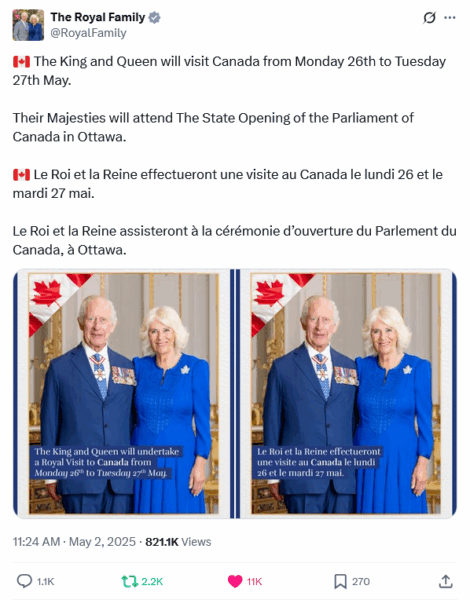
So, aside from last week’s vote, how is the other side reacting? Last Thursday’s print edition of The Spectator contained a curiously phrased squib from my old editor, Charles Moore:

    The President may be only hazily aware that the King, of whom, he says, he has the “honour to be a friend”, is also King of Canada. If, as seems likely, the King follows his mother’s twice-used precedent and opens the new Canadian parliament in person, Trump may come to see that his next-door neighbour is part of a long-standing, legitimate order which Canadian voters are happy to endorse.

Let’s just run that again:

    If, as seems likely, the King follows his mother’s twice-used precedent and opens the new Canadian parliament in person …

The last time his mother opened Parliament in Ottawa was in 1977 — her Silver Jubilee year. Trudeau-wise, Justin’s father Pierre was not keen on it, but didn’t feel he could pick and win a fight with the Palace over it. A quarter-century later, Trudeau’s successor Jean ChrΓ©tien, a towering colossus of micro-pettiness, was annoyed at being given a crappy seat at the Queen Mum’s funeral and so scuttled Her Majesty’s Golden Jubilee throne speech.

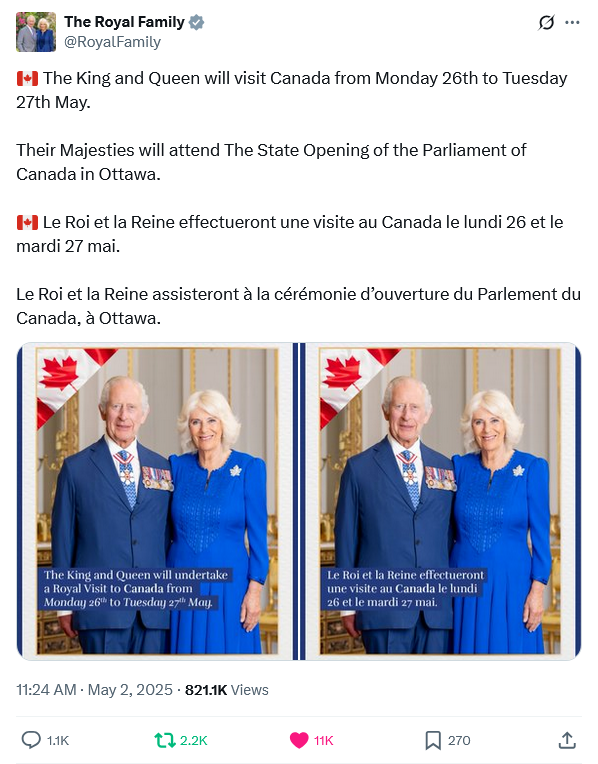
So why would Charles Moore think it “likely” that the King would be opening Parliament in Ottawa later this month? If, as it was in my day, Speccie columns for Thursday’s magazine have to be filed on Tuesday, that would make Moore the first guy in either the Canadian or UK media to know what was not revealed to the world until Friday […]

The King has travelled far less in the first three years of his reign than his mother did: shortly after her Coronation, the Queen set off on a tour of parts of the Commonwealth that kept her away from London for six months. Her son can’t do that because he’s very sick with cancer. So it’s quite something that he’ll land in Ottawa on Monday May 26th, deliver the throne speech the following day, and then fly out again. Carney wouldn’t be doing this if he weren’t going to take the opportunity to put his view of Canadian sovereignty into the Sovereign’s mouth.

So, if Trump really has the “honour to be a friend” of the King, the only point of this 24-hour flying visit is so His Majesty can send the message that friends don’t let friends threaten to steal each other’s countries. In fact, he has made a point of referring to himself as “King of Canada” quite a bit of late. […] The “King of Canada” bit was done at the instigation of Carney. Which is odd. Especially from a party that has spent half-a-century diminishing and degrading the Crown, and for a monarch who is, unlike his mother, largely unloved and unloveable. Yet Carney seems belatedly to have come around to the old-school monarchist view that, without the Sovereign, there is insufficient to distinguish Canada from its domineering southern neighbour — especially when that neighbour keeps talking about taking it. On the other hand, both the King and his Canadian prime minister are bigtime players at the World Economic Forum, so they’re not the most obvious choice for defenders of national sovereignty. On the other other hand, it’s one thing to surrender it to fellow globalists, quite another to surrender it to Donald Trump.

I have no idea where this is headed, and if anyone can enlighten me I’d be happy to hear it. But Trump has doubled down on it, and Carney is playing the King card to oppose it. As longtime readers know, I have a general preference for smaller nations as happier homes for their people. If Alberta or Quebec voted to secede, why would you take the trouble to do that just to become a minor and inconsequential part of another big country?

But, that aside, why would it be in America’s interest to absorb a hostile population of mostly lefties over a vast and unpoliceable landmass? The history of the last thirty years is that China has shown there are subtler ways of taking over the world without firing a shot, while America has persisted in doing it the old-fashioned way and, in Iraq, Afghanistan, Ukraine and elsewhere, has gotten nowhere. Why add Canada to the list?

May 5, 2025

Make America Austere Again?

Filed under: Economics, Government, Media, Politics, USA — Tags: , , , , — Nicholas @ 03:00

The first 100 days of the BOM haven’t been quite what anyone expected. Close allies and trading partners were shocked at the new administration’s devotion to 1920s tariff “diplomacy”, supporters were dismayed to not get lots and lots of perceived wrongdoers of the Biden administration getting perp-walked for the cameras, and ordinary Americans were presented with a much worse domestic economy than they were promised:

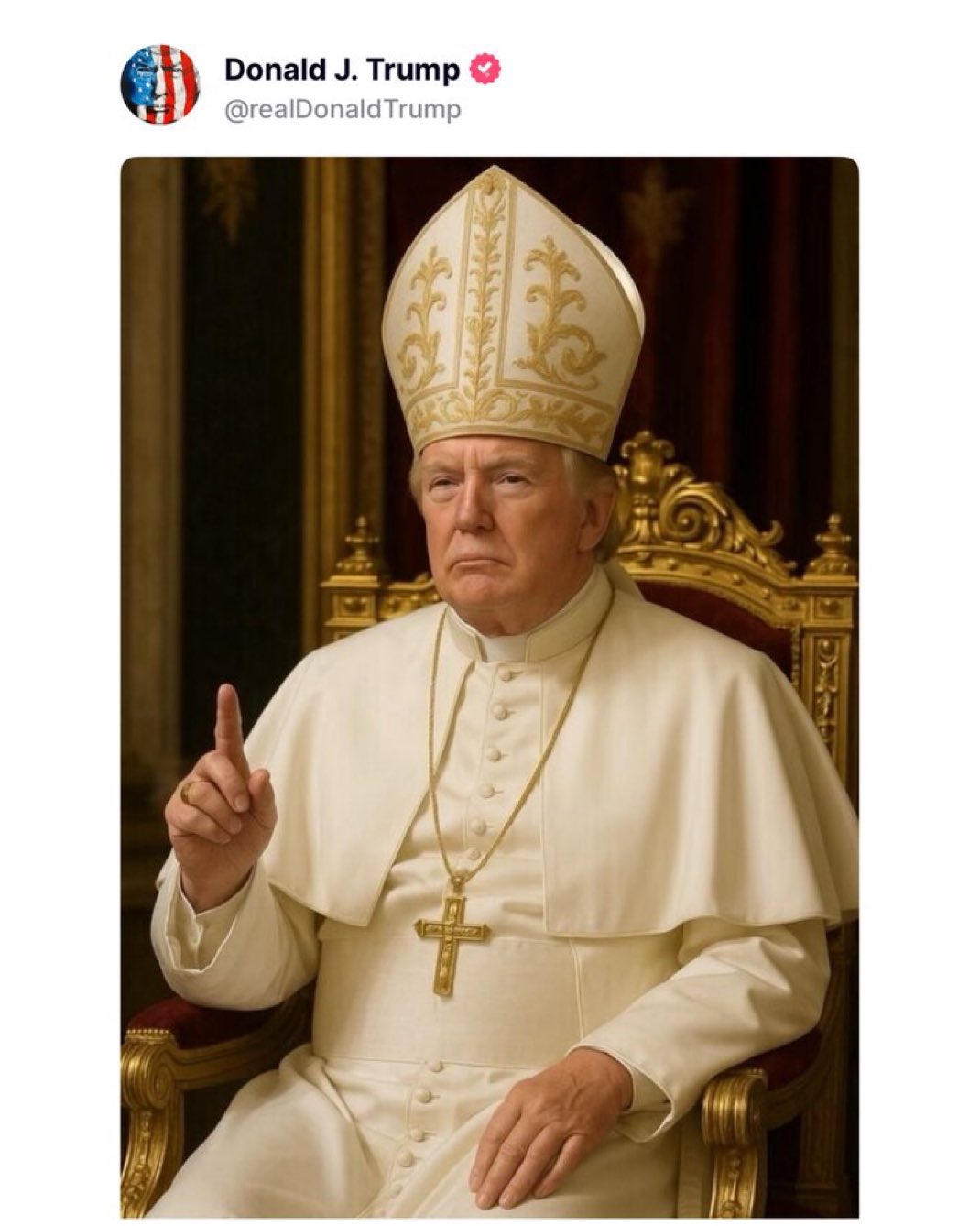
Trump wasn’t totally fixated on economic matters … he still found time in his busy schedule to troll Catholics on his Truth Social platform.

On Wednesday, in the prelude to a cabinet meeting, U.S. President Donald Trump made yet another remark to chill the blood for those concerned about his country. Trump’s cat-and-mouse game of arbitrary changes to American import tariffs is starting to raise concerns about prices and supply chains for consumer goods. The American economy has unexpectedly shrunk in the first 100 days of Trump 2.0, even though workers and businesses are scrambling to make purchases before the effects of Trump tariffs set in. The underlying state of the economy is probably worse than the short-term numbers.

Trump says this is all a matter of “get(ting) rid of the Biden ‘Overhang'”, i.e., it’s his immediate predecessor’s fault. And let’s face it: no other politician on Earth would say anything else 100 days into an executive term. If that was as far as Trump went, it wouldn’t be of unusual concern. What struck me was his separate remark implying that, yeah, tariffs might foul up supply chains a little in the transition to the glorious economy of the future, but haven’t we Americans had it too soft for too long?

“Maybe the children will have two dolls instead of 30 dolls,” the president mused. “So maybe the two dolls will cost a couple bucks more than they would normally.” The message, which brazenly puts the contentment of children front and centre, is one you can’t imagine any other American leader delivering so directly in peacetime: have you all considered being happy with less?

The answer one would expect the median American voter to give is “Hell no”. It’s crazy that I should have to write this, but consumer abundance is a defining feature of the United States! During the Cold War, American supermarkets were the unanswerable argument for economic freedom: you could summarize the United States pretty reasonably as “It’s the country that coined the word ‘super-market'”. In our hyper-interconnected social-media world, I see a dozen conversations a week in which some European boasts of affordable healthcare, walkable neighbourhoods and having July and August and half of September off work every year: the inevitable answer from Americans is “OK, but have you been inside a Buc-ee’s, Gustav?”

Of course, it’s been a very long time since media-decried austerity in government has actually meant any kind of actual reduction in outlay … it’s usually just a (very) slight decrease in the rate of increase rather than actual dollar-value reduction. But, as Chris Bray points out, this time for sure:

I was planning to spend $100 on groceries this morning, but then I decided to slash my grocery budget, so the amount I actually spent on groceries plummeted to just $99.97, plus a small eight dollar supplemental on previously deferred grocery needs, bringing the total to a shockingly parsimonious $107.97. These major cuts caused serious alarm in my household.

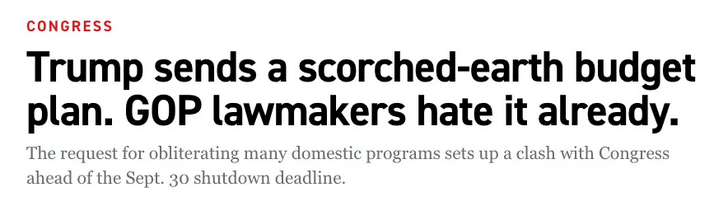
Donald Trump, Politico warns, is scorching the earth:

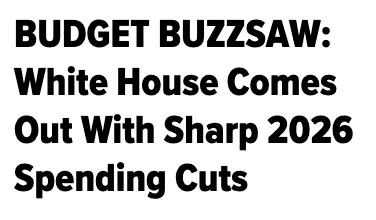
This is the common theme everywhere, as the administration offers the first not-very-detailed hints about its plans for FY β€˜26 discretionary federal outlays. The Huffington Post concludes that Trump is pulling out the BUZZSAW:

The Federal News Network sums up the size of the hit, and compare the topline number to the language about scorched earth and buzzsaws:

    Overall, the administration is looking to increase national security spending next year by 13% and decrease non-defense discretionary spending by 7.6%, meaning the White House is asking for $1.7 trillion for the discretionary budget down from $1.83 trillion this year.

While the White House plans don’t get into the subject of total federal spending, focusing narrowly on discretionary spending, the implication is that federal spending overall will go from about $7 trillion to about … $7 trillion. But TBD.

You can read the entire White House proposal for discretionary funding here. Trump is proposing deep cuts in some federal departments and programs, but is also proposing to offset those cuts with sharp increases in military spending and “homeland security”, meaning border security and sending poor gentle immigrants to places where Chris Van Hollen will fly to stare into their beautiful eyes.

May 2, 2025

Trump’s victory lap after getting his preferred PM elected in Canada

In the National Post, Tristin Hopper rounds up American reactions to the Liberal victory in the Monday election, as many Americans seem to agree that Carney’s win was at least partly their doing:

As the U.S. awoke to a renewed Liberal government on their northern border, Americans of all political persuasions embraced the view that they β€” for better or worse β€” had caused it.

“Carney owes his job to President Donald Trump,” was the Tuesday view of the Washington Post editorial board, declaring that the U.S. president had singlehandedly thwarted the election of a populist Conservative government in Canada.

The Centre for American Progress Action Fund β€” a left-wing Washington, D.C.-based think tank β€” framed Carney’s win as a model for how anti-Trump rhetoric can win elections.

“Prime Minister Carney’s success demonstrates that resistance to President Trump’s bullying has mass popular appeal,” read a statement.

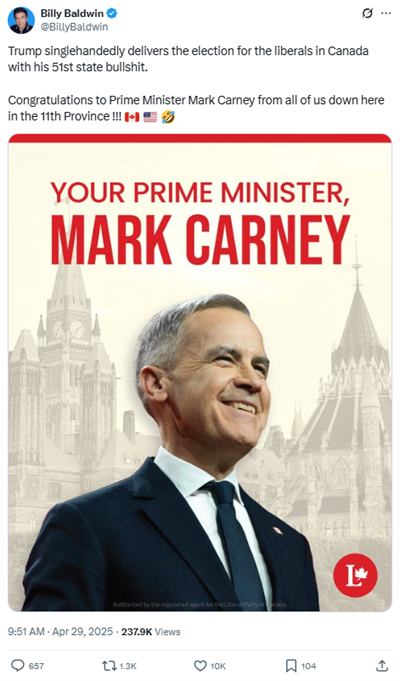
Actor Billy Baldwin, a perennial backer of progressive causes, cheered Carney’s victory with a viral social media post declaring “Trump singlehandedly delivers the election for the liberals in Canada with his 51st state bullsh-t.”

Even Rolling Stone, which put Justin Trudeau on the magazine’s cover in 2017, opined that Canada’s newest Liberal government was effectively a Trump creation. “Donald Trump single-handedly elected a new Canadian Liberal Government that was down 25 points in January with his endless ’51st State’ bloviation,” wrote the publication.

Conservative podcaster Ben Shapiro broke down the Canadian election in an extended segment on his Tuesday show, framing it as a direct failure of Trump’s foreign policy.

“Let’s be real about this; the rhetorical attacks on Canada have not actually resulted in a net good for the United States,” said Shapiro. A perennial critic of Trump’s tariff policy, Shapiro said that the White House’s habit of “yelling at Canada” had helped install a “far left-leaning internationalist” hostile to U.S. interests.

“All of this started off as a joke, and I think President Trump is so committed to the bit at this point that he couldn’t get off the train,” said Shapiro, in reference to Trump’s repeated pledges to turn Canada into the “51st state”.

A Republican consultant quoted anonymously by Politico on Tuesday was of a similar view, saying the outcome in Canada was a “pretty specific result based on the tariffs and 51st state trolling.”

On his Substack, Paul Wells offers some advice to Mark Carney about his dealings with Pierre Poilievre at this awkward time for the Conservative leader:

Stornoway in the Rockcliffe Park area of Ottawa, Ontario. It has been the official residence of the leader of the Official Opposition in Parliament since 1950.

One danger for Mark Carney is that he will be taught how to be a terrible politician by terrible politicians. A low-stakes test case is at hand. In this as in all things, a decent guiding principle should be: Don’t be like your opponent, and don’t be like your predecessor.

The test at hand is the uncomfortable predicament of Pierre Poilievre, who used to be a Member of Parliament and may want to be one again. In the meantime he is still the leader of the Conservative Party of Canada.

Poilievre lost his seat in Carleton on Monday night. This is not entirely his fault. Liberal campaign teams from neighbouring ridings were invited to spend part of their time door-knocking in Poilievre’s riding. But candidates should try to win even when their opponents work hard to defeat them. I bet this thought has occurred to Poilievre since Monday.

The usual route to the Commons, for a leader who is not yet an MP, is to run in a by-election. Often new leaders find a sitting MP somewhere to vacate their seat and enable a by-election. Brian Mulroney ran in Central Nova in 1983, Jean ChrΓ©tien in BeausΓ©jour in New Brunswick in 1990, Stephen Harper in Calgary Southwest in 2002.

Assume Poilievre can find some Conservative MP-elect willing to abandon a seat they just won so Poilievre can try his chance (again). How should Carney react?

It’s really a question in three parts. Should a by-election be held quickly or much later? Should the Liberals run a candidate? Should the Poilievre family keep living at Stornoway, the Opposition leader’s official residence, in the meantime?

I’m hearing from a lot of people who say Carney should wait as long as the law permits β€” up to a half year after a seat opens β€” before calling the by-election; that the Liberals should definitely run a candidate; and that Poilievre and his family should be evicted from their current fancy abode.

I spent part of Wednesday debating these questions with readers on Substack Notes. Most of the people offering this advice β€” let him twist, then hit him hard β€” pointed out that if Poilievre had a say about an adversary’s career plans, he would do everything in his power to make that adversary hurt.

I think it’s bad advice. It manages to be bad tactics and bad for the soul. The two considerations don’t always line up, but here they do.

Carney should call a by-election as soon as possible after a sitting MP resigns β€” 11 days after the notice of vacancy is received, the minimum permitted in law. If asked, he should prefer that the Poilievre family stay at Stornoway in the meantime. And while the third question is less clear, I’d argue that the Liberals should refrain from running a candidate in the by-election.

This plan would have Poilievre back in the Commons as soon as possible, with minimal risk and discomfort. He’ll be lucky to receive such generous treatment and, while I’m less confident than ever that I know how he thinks, what he should feel is gratitude. I suspect the feeling would confuse him.

April 24, 2025

“Call for Admiral Ackbar! Paging Admiral Ackbar. Admiral Ackbar to the white courtesy phone, please.”

Filed under: Cancon, China, Media, Politics, USA — Tags: , , , — Nicholas @ 05:00

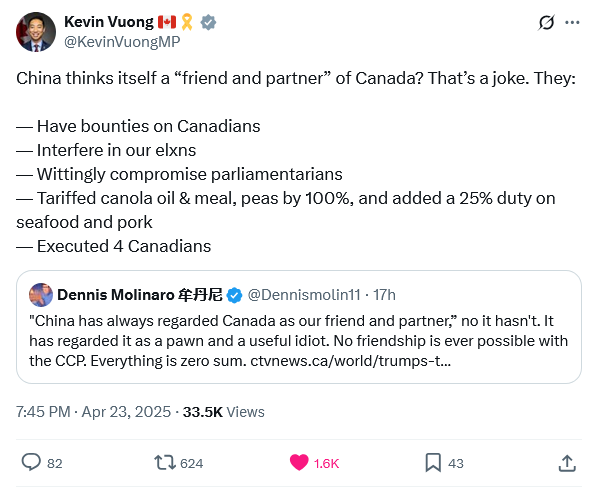
What a wonderful, heartwarming story: those cuddly folks in Beijing are reaching out to Canada to “partner with” as a way of warding off American “bullying”. How nice! What a great idea! With the best possible intentions. What could possibly go wrong?

China’s ambassador says Beijing is offering to form a partnership with Canada to push back against American “bullying”, suggesting the two countries could rally other nations to stop Washington from undermining global rules.

“We want to avoid the situation where humanity is brought back to a world of the law of the jungle again,” Chinese Ambassador Wang Di told The Canadian Press in a wide-ranging interview.

“China is Canada’s opportunity, not Canada’s threat,” he said through the embassy’s interpreter.

Wang β€” whose office requested the interview with The Canadian Press β€” said that China and Canada appear to be the only countries taking “concrete and real countermeasures against the unjustified U.S. tariffs” imposed by U.S. President Donald Trump.

“We have taken notice that, faced with the U.S.’s unilateral bullying, Canada has not backed down,” he said. “Instead, Canada is standing on the right side of the history, on the right side of international fairness and justice.”

He said Beijing and Ottawa should work together to convince other countries not to placate the Trump administration and to make Washington pay a price for breaking global trade rules.

Roland Paris, who leads the University of Ottawa’s graduate school of international affairs, said Beijing has long sought to reshape international institutions to advance its own interests β€” efforts that often have put China at odds with Ottawa’s foreign policy.

He said Canadian businesses should take a cautious approach to China, where they still face the risk of import bans and arbitrary detainment.

“The mercenary use of tariffs and non-tariff barriers that we’re seeing from the Trump administration has been practised for a long time by China in different forms,” Paris said.

“China has played its own version of hardball and abused trade rules in the past to coerce countries, including Canada, that have dared to displease Beijing.”

As the rivalry between the U.S. and China has intensified, Canada has generally followed Washington’s lead on restricting certain types of commerce with China.

Last fall β€” in an effort to protect Canadian auto sector jobs and allay American concerns about threats to supply chains β€” the federal government imposed 100 per cent tariffs on imports of Chinese-made electric vehicles that all but banned Chinese EVs from the Canadian market.

Canada alleged unfair trade practices including “a state-directed policy of overcapacity and oversupply,” and “lack of rigorous labour and environmental standards”.

Beijing retaliated by imposing large tariffs on Canadian canola and pork β€” duties Wang said Beijing is happy to drop if Ottawa drops its own tariffs.

In totally unrelated news, a Conservative candidate has been advised by the RCMP to “pause in-person campaigning” in the current federal election campaign due to threats originating in the People’s Republic of China:

Joseph Tay, the Conservative candidate identified by federal authorities as the target of aggressive Chinese election interference operations, paused in-person campaigning yesterday following advice from federal police, The Bureau has learned.

Two sources with awareness of the matter said the move came after the SITE Task Force β€” Canada’s election-threat monitor β€” confirmed that Tay is the subject of a highly coordinated transnational repression operation tied to the People’s Republic of China. The campaign seeks not only to discredit Tay, but to suppress the ability of Chinese Canadian voters to access his campaign messages online, via cyber operations conducted by Beijing’s internet authorities.

Now, with six days until Canada’s pivotal vote β€” in an election likely to be decided across key Toronto battleground ridings β€” it appears that Tay’s ability to reach voters in person has also been downgraded.

Tay, a journalist and pro-democracy advocate born in Hong Kong, is running for the Conservative Party in the Don Valley North riding. Federal intelligence sources have confirmed that his political activities have made him a top target for Beijing-linked online attacks and digital suppression efforts in the lead-up to next week’s federal election.

Tay’s need to suspend door-knocking yesterday in Don Valley North echoes concerns raised in a neighbouring riding during the 2021 federal campaign β€” where The Bureau previously uncovered allegations of Chinese government intimidation and targeting of voters and a Conservative incumbent. According to senior Conservative sources, Chinese agents attempted to intimidate voters and monitor the door-to-door campaign of then-incumbent MP Bob Saroya in Markham–Unionville.

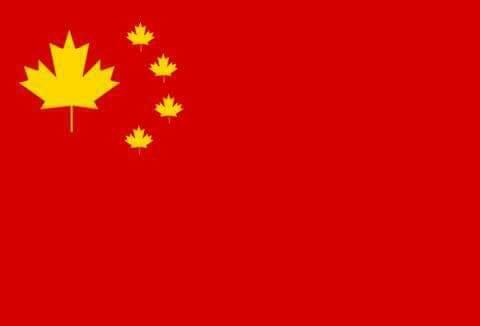
Update: Spotted on the social network formerly known as Twitter:

April 19, 2025

Notes on the English debate

In the National Post, Chris Selley explains the apparent utility of having Bloc QuΓ©bΓ©cois leader Yves-FranΓ§ois Blanchet included in the English-language leaders’ debate:

Bloc QuΓ©bΓ©cois leader Yves-FranΓ§ois Blanchet, 8 November, 2023.
Screencapture from a TVA Nouvelles video via Wikimedia Commons.

Wednesday evening’s French-language leaders’ debate kicked off with a video montage that mentioned President Donald Trump roughly 175 times. (I exaggerate somewhat.) Thursday evening’s English-language leaders’ debate was much less focused specifically on Trump, to an almost bizarre extent. When moderator Steve Paikin offered each leader a chance to ask a question of an opponent, Liberal Leader Mark Carney chose to ask Conservative Leader Pierre Poilievre about the security-clearance drama.

Carney’s campaign clearly believes Poilievre’s Achilles’ heel is Trump. One has to wonder how many Canadians even know the basics of the security-clearance issue. It was a baffling decision.

Ultimately, though, leaving Trump aside was a benefit. One of Carney or Poilievre will be prime minister in a month, and they essentially agree that Trump is too unpredictable to strategize against with any confidence from our current position as a semi-deadbeat country. (Again, I paraphrase.)

The only thing we can really do is focus on our own affairs in ways that would make us more prosperous, safe, happy and independent in every sense. In the long term: diversify our trade partners in every sector, including natural resources; improve border security, not to satisfy Trump’s fentanyl obsession but to prevent the northbound flow of illegal firearms (and because borders are supposed to be secure by definition); rebuild the military, not because Trump demands it but out of respect to our existing commitment to NATO and our self-styled reputation as An Important Country; fix health care; make housing affordable; get a handle on our own opioid crisis; fix our broken justice system. All that jazz.

You might think in a debate on those big national issues Bloc QuΓ©bΓ©cois Leader Yves-FranΓ§ois Blanchet would be extraneous on the stage. I saw plenty of people reacting in real time in that vein: Why is this man here? But in fact Blanchet served a very useful purpose: He was the voice of comfy Canadian inertia; the voice of Quebec continuing to plod along in its own way under Canada’s protective umbrella (ludicrous sovereignty-referendum threats notwithstanding).

Blanchet embodied how Canada might very plausibly abandon the opportunity that Trump’s kick in our rear end, however unjustified, offered us to live up to the greatness Canadian politicians always ascribe β€” often dubiously β€” to this country.

“The building of (new) pipelines will take at least 10 to 14 years. Mr. Trump will be 90 years old, not president … and somebody of course less terrible will be there before you can even dream of having oil through (a new) pipeline,” Blanchet said, kiboshing (as ever) the notion of any new pipeline running through Quebec.

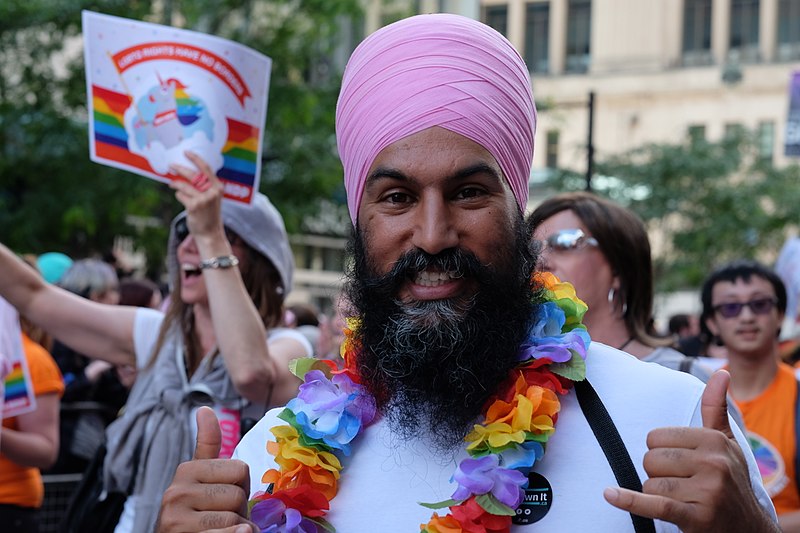
At Rigid Thinking, Damian Penny tries to explain Jagmeet Singh’s performance as the designated interrupter:

Federal NDP leader Jagmeet Singh taking part in a Pride Parade in June 2017 (during the leadership campaign).
Photo via Wikimedia.

I didn’t see the entire English-language, federal leaders debate on Thursday night, but from what I did see each of the leaders accomplished exactly what they set out to do:

  • Pierre Poilievre went on offence against the liberals and tried to show that, despite their new leader, it’s the same bunch that have been running the country for the past decade.
  • Mark Carney portrayed himself as much more measured and serious than either his main opponent or his predecessor.
  • The Bloc guy showed that his only concern is Quebec and by the way everything comes down to immigration.
  • And the NDP’s Jagmeet Singh did everything he had to do to lock down that cushy patronage appointment he’ll receive should Carney be elected Prime Minister on April 28.

    There was far more cross talk and interruptions during Thursday’s English debate compared to the French parlay the night before. Singh in particular seemed prone to interrupt his opponents.

    Poilievre was the main target of Singh’s interjections β€” so much so that at one point Carney told the NDP leader to let his Conservative rival finish his point.

    When Poilievre criticized the industrial carbon tax, Singh jumped in and accused the Conservatives of wanting to let everyone pollute. Poilievre spoke about border issues and Singh accused the former Conservative government of cutting border officers.

    Poilievre at one point tried to make an appeal to voters: “The question that Canadians have to ask…”

    “Why vote for Conservatives?” Singh jumped in before Poilievre could finish.

As of this writing, the venerable NDP is polling about as well in Canada as Marjorie Taylor Greene, and their only real shot at even maintaining major party status is to peel off voters from the Liberals, since no one even considering voting Conservative will vote for Singh’s party.

The Line‘s election Bullshit Bulletin overflowed with bullshit from the debates, including some Mark Carney blarney about pipelines:

Mark Carney had quite a few howlers during Thursday’s debate, one of which was aptly called out by Blanchet (hey, we like the guy, we just don’t think he should be in the debate). Carney wants to portray himself as strongly pro-pipeline, while still respecting Quebec’s ability to effectively veto national projects. That’s bullshit β€” and Carney should stop pretending otherwise.

Carney has been out of the country in recent years, so he may be unaware of how things are actually working. To sum up the last 10 years of internecine battles on this point: Pipelines absolutely fall under federal jurisdiction to approve or disapprove. However, provinces can hold up or significantly delay certain aspects of the process, either through legal challenges, or through sandbagging local permitting processes. The big lesson of the last 10 years is that absolute jackshit can actually get built when provincial governments try to encroach on federal authority to stall projects that fall under the national interest. Duties for First Nations consultation add another complicating step. Lastly, this country couldn’t build a goddamn supermarket (and Singh might try to stop it, even if we could) if conditions veer into the quasi-spiritual realm of “social license” β€” because nobody really knows what that means, or how the bar for “social license” can be cleared when any project at all is even remotely contested or controversial.

Add Bill C-69 to the mix, and what we’re facing is a regulatory quagmire in which the Liberals have made the approvals process practically impossible, and pissed everybody off while doing it. It’s worse than that almost nothing is getting built; the situation is now such a disaster that major projects are no longer even being seriously proposed. Even CEOs of Canadian companies know that their best return on investment is energy projects outside of Canada (see The Line Podcast episode from a week ago and our dispatch last Sunday for discussion of this).

In short, Blanchet is correct, here. A pipeline filled with Alberta oil is not getting through Quebec if Quebec gets a veto. Either we’re in a Confederation in which a federal government has the final say over these things, or Quebec has already separated, and that’s the end of it.

There was also an excellent dissection of the Liberal Party’s endless games with Canadian firearm laws, but it was too long to sensibly excerpt, but if you have any interest or curiosity about why so many Canadian gun owners are pissed off with the feds, it’s worth reading in full.

April 12, 2025

President Trump … or any president … shouldn’t have the unilateral power to levy tariffs

Filed under: Economics, Government, Politics, USA — Tags: , , , , — Nicholas @ 03:00

Love him or hate him — and there are lots of people in both camps — President Donald Trump has the power to randomly throw spanners into the international trade arena … because Congress ceded that power to the presidency long before Trump began his political career:

In response to Donald Trump’s tariff maneuvers, Senator Rand Paul has been arguing that presidents shouldn’t have the power to raise tariffs themselves. Taxing power belongs to Congress, and that’s where tariffs should be born. Trump’s tariffs result from the use of emergency power that Congress gave to the POTUS, and we shouldn’t normalize emergency rule. You can watch him say all of that here.

Every word of that is completely right. I don’t disagree with a single breath of it. I respect Rand Paul, and I’m inordinately fond of his dad. But it misses the point about how we got here, and why, starting with the fact that Congress gave away its taxing authority.

  1. Congress delegated its authority;
  2. Donald Trump used the authority that Congress gave him;
  3. Therefore, Donald Trump is very bad, and what he’s doing is wrong.

The core sickness at the heart of the American republic is Congress, and we keep discussing that sickness by saying that Trump sucks. He’s doing what you gave him the power to do, and he’s not the first.

See also my recent post in which I described a time when Congress made something illegal, than asked the administrative agencies to explain to them what they had just banned. Congress has delegated its authority, over and over again, and the resulting political vacuum is a serious problem. But anyway, TRUMP TRUMP TRUMP.

American political discourse keeps taking a wide range of political pathologies and assigning them to the same account. Orange Man Bad, Orange Man Bad, Orange Man Bad, they explained, with drool running down their chins. Donald Trump is our deflector object, our national excuse. [Problem name here]; OH NO WHY IS TRUMP DOING THIS TO US.

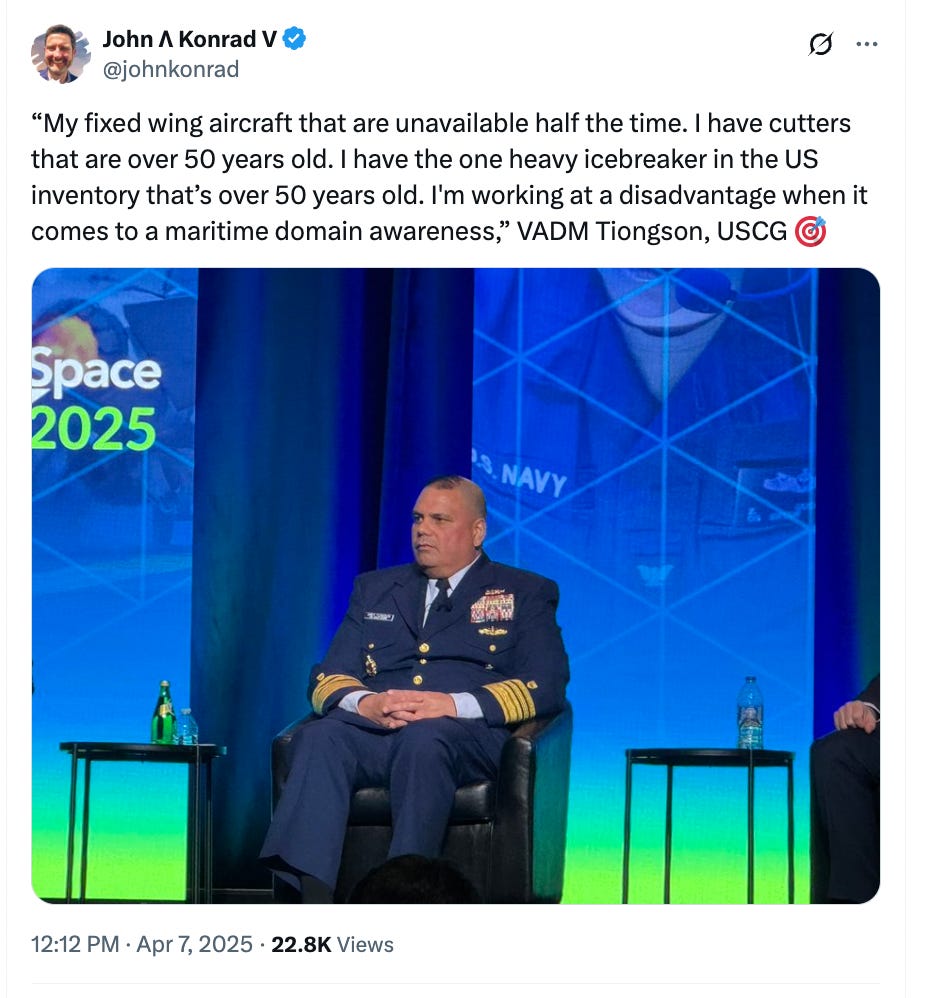
The commandant of the United States Coast Guard spoke at a maritime conference, a few days ago, and he said that the organization he runs wakes up every day and tries to keep the doors from falling off: “The US Coast Guard is less ready today than any other time since World War II. We are on a readiness spiral. Today our fleet of cutters are in significant decline. We are in repair failure mode … No ship today gets underway without cannibalizing others for parts.”

See also, from one of his subordinates:

Serious question: Did all of those problems begin at noon on January 20, 2025?

April 11, 2025

Critical Trade Theory

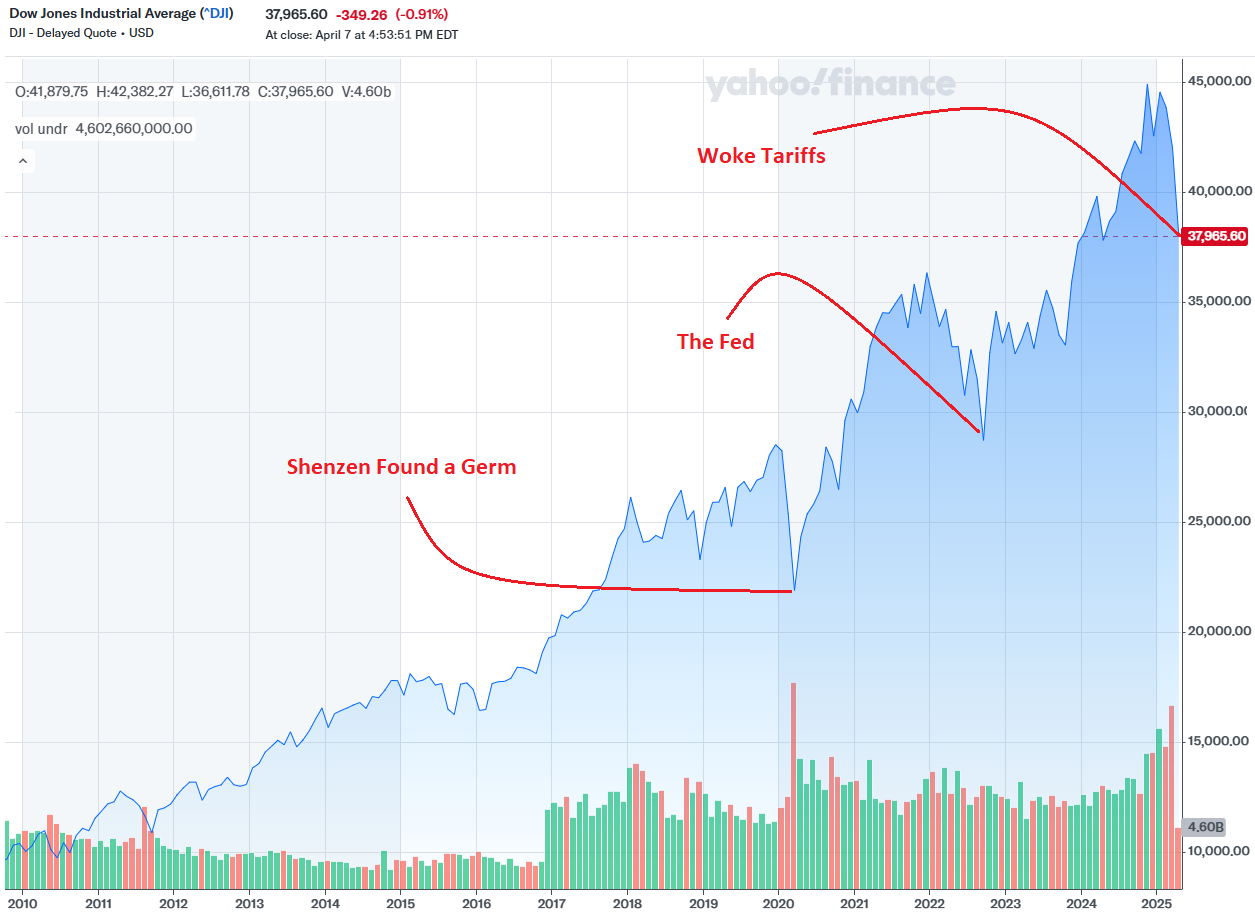
A discussion at the amusingly named Handwaving Freakoutery on the ongoing wave of tariff activity under the Trump II administration, characterizing them as “woke” tariffs:

The great argument playing out in the media right now about the relative value and ethical implications of reciprocal tariffs is not relevant. It is not relevant because these tariffs are not reciprocal tariffs in any measurable way. They aren’t reciprocal, they aren’t sensible, and the justification for them is Woke in every sense of the word. Let’s take a close look at what we might call Critical Trade Theory, back our way into an understanding of what a woke tariff is and how this is definitely that, and close with a quick word about how political realignments portend doom for the left even though the right is really screwing this up. Then we’ll all buy mop handle futures.

Awokening

The Great Awokening of the prior decade was founded in part on the False Cause Fallacy. Our major institutions for the better part of the last ten years were operated by wokerists, who used an Intersectional Matrix of Culturally Encouraged Race and Gender Prejudice to counteract what they viewed as hidden unmeasurable forces such as “systemic racism”. They couldn’t point to the systemic racism, but they knew it must be there because of the imbalance in socioeconomic metrics, and they denied any other possible explanation for the imbalance. Once the False Cause was in place, the devout wokerist was forced to fight the hidden prejudice with overt reverse prejudice, because they couldn’t conceive any other cause.

For example, if black folks have a hard time getting into Harvard or UNC, it must be because society is systemically racist against black people, and no other reason, therefore we should redirect admission slots from Asians who earned them to blacks who didn’t, for race balancing.

Harvard did exactly that, for exactly that reason, and admitted it, and it was sent to the Supreme Court, and the Supreme Court banned it, and then Harvard kept doing it and is still doing it using different words.

Some of our other institutions are still running this wokery program, although the Trump Administration purged much of it from the halls of federal power this year under their DEI ban, and many other institutions used Trump as cover to independently purge it from theirs. But this same smooth-brained thinking wiggled its way right into Trump’s tariff plan last week, through an equation that looks fancy but is something my middle school son could figure out.

[…]

The media thinks these woke tariffs are going to bomb the economy back to the stone age, but when I make the abhorrent choice to read the graphs myself it looks more like January 2024. A 20% tariff on Chinese goods is rough. Adding 34% more to it is rougher. But a 54% tariff on Chinese goods is nothing compared to Shenzhen closing its entire manufacturing sector down because they found a germ, and probably not significantly worse than the Fed turning off the free money spigot in 2022.

These tariffs are going to do goofy shit to the economy. I don’t like the goofy shit they’re likely to do. I think that trade balancing through tariffs is an idea so stupid that only Rust Belt union workers could come up with it, which is why they probably did come up with it, and also probably why Trump won the election by flipping the Rust Belt.

April 10, 2025

Late onset Trump Derangement Syndrome

Filed under: Media, Politics, USA — Tags: , , , , — Nicholas @ 05:00

Ed West diagnoses himself with a raging case of late onset TDS:

What has caused this late-onset TDS, however, is not Trump’s behaviour, but the relative silence of his critics. During Trump’s first term, everyone in the American establishment seemed to be calling him the next Hitler, and this included not just the usual academics and journalists but many major corporations; companies like Nike, Heineken and Airbnb were at the forefront of the “resistance” against the president, a trend labelled “CEO Activism”. It was quite obviously self-interested and performative, because if everyone in your country is calling its leader a fascist dictator, then you probably don’t live in a fascist dictatorship.

I have no idea where I saw this meme, but it makes me laugh

That is not the case this time around, and that is more troubling. I recall from my time volunteering for first aid training that, when you arrive at the scene of an accident, you don’t go to the person screaming in pain, but the individual lying on the ground in stony silence. Similarly, the fact that people working for large corporations now keep quiet about Trump, even as he embarks on the most reckless economic policy in recent years, should probably concern us. The reason they keep quiet — and this is something I have heard from the horse’s mouth — is because they feel that there is a real risk of punitive action if they speak out.

One of the things more moderate folks used to warn the far left activists about using any and all tools to “get” their enemies is that it can — and in this case has — unleashed exactly the same kind of retribution when their former target now has the power to do so. “Muh norms!” indeed.

The constant evocation of fascism is not just mistaken in my view, but neurotic. Western civilisation is emotionally scarred by the violent racial supremacism of the Nazi regime and in particular the Holocaust, the worst crime in history, yet people have a tendency to fight the last war and this isn’t the danger that Trump represents. He is not a white supremacist and not especially motivated by ethnic nationalism. He is, however, authoritarian in nature, prone to be vengeful to those who cross him while also surrounding himself with yes-men, and he does seem to have territorial ambitions, even if they concern a frozen wasteland. Those things are all bad enough in themselves.

Rather than being a new Hitler, a more realistic concern is that Trump represents the 19th century spectre of Caesarism, a man who uses democracy in order to establish himself as an imperial figure. The fear of a Caesar always haunted the founders of the Republic, obsessed with Roman history as they were and sceptical of democracy and mobs.

Trump as a modern Louis Napoleon? A case could certainly be made for it.

Caesars do not come out of nowhere, and the progressivism of the last few years has been deeply illiberal, hostile to freedom of speech and even more so to freedom of association. Jonathan Haidt talked of “decentralized totalitarianism” and it was the chaotic nature of woke progressivism that made it so disconcerting and caused many people, including those same corporate leaders, to stay silent.

Many of the things Trump is now doing are not entirely dissimilar to what radical progressives did when the opportunity arose, in particular the determination that institutions are cleared of their opponents. It is bitterly ironic, for instance, to have the Left accuse Trump of “rewriting history” for ideological reasons (gosh, imagine!). Yet there is something quite different about people scared of online mobs and being scared of the government. Activists, though loud and hysterical, could be ignored if people only had the courage to face them (which they usually didn’t); the state can make your life very difficult indeed. Already the Trump regime has punished law firms which oppose their leader; foreign nationals who’ve expressed criticism of the regime have been detained. These are not good signs.

I’ve sneered at the American critics who worked themselves up into hysterical rages about Trump, not just because of their puritanical piety but because of the lack of awareness about their own behaviour, in particular the conspiracies about Russia and the dishonest, partisan nature of American journalism (Trump is probably the most dishonest president in US history, but it may also be true that he is the most lied about). In the modern liberal imagination, in part because so many people read far more fiction than history, Trumpian figures tend to be opposed by a courageous “resistance”, whereas in reality most dictatorial leaders arise because there are no moderate alternatives, and the opposition is similarly extreme and unpalatable. There were no real goodies in the Spanish Civil War, nor in Syria, nor even in much of central-eastern Europe in the mid-20th century, where fascists fought communists for control of the streets.

April 7, 2025

Those brave, rare contrarians willing to risk everything by … criticizing Trump?

Filed under: Books, Government, Media, Politics, USA — Tags: , , , , , — Nicholas @ 05:00

Chris Bray is deeply concerned that a free society seems unable to produce even a mild array of differing political opinions these days:

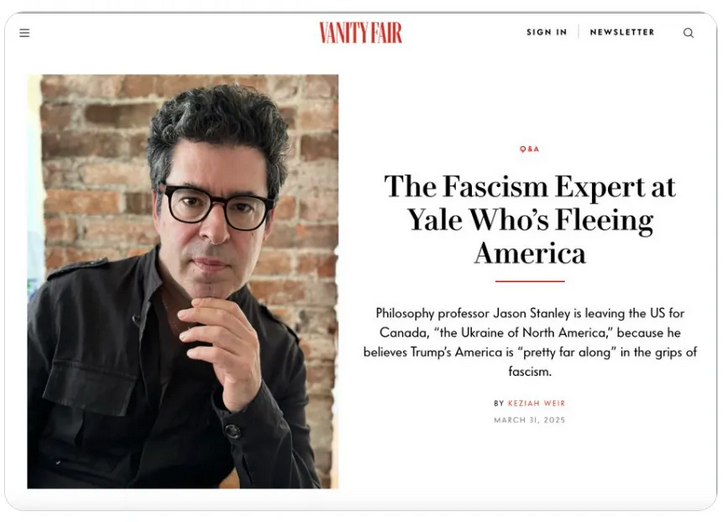
I was at a small independent bookstore today, the exact kind of place that’s supposed to curate a culture of argument and criticism. The prominently displayed books about politics and current events were Timothy Snyder’s book about the terrifying rise of American fascism under that monster Trump, Jason Stanley’s book about the terrifying rise of American fascism under that monster Trump, Anne Applebaum’s book about the terrifying rise of American fascism under that monster Trump, and a bunch of other books by prominent journalists and professors about … okay, try to guess.

On the other side of that exchange, the books by public intellectuals offering a favorable or even neutral view of Trump and the Trump era were … not there? Maybe I just missed them. So every prominent figure moving to the cultural foreground from academia and “mainstream” journalism β€” every brave contrarian, every freethinking intellectual warrior rising against the prevailing fascist sentiment of the age to speak in his own voice as a free person β€” thinks and says the same things, the same ways, with the same evidence and the same framing and the same tone and in the same state of mind. They’re so free and brave and iconoclastic that they’re essentially identical, chanting in intellectual unison.

Forget Trump for a moment and answer this question in general: If you’re living through an era in which every prominent journalist and academic and artist says exactly the same fucking thing all the time, what kind of moment are you living in? Would you call people who all chant in unison the resistance?

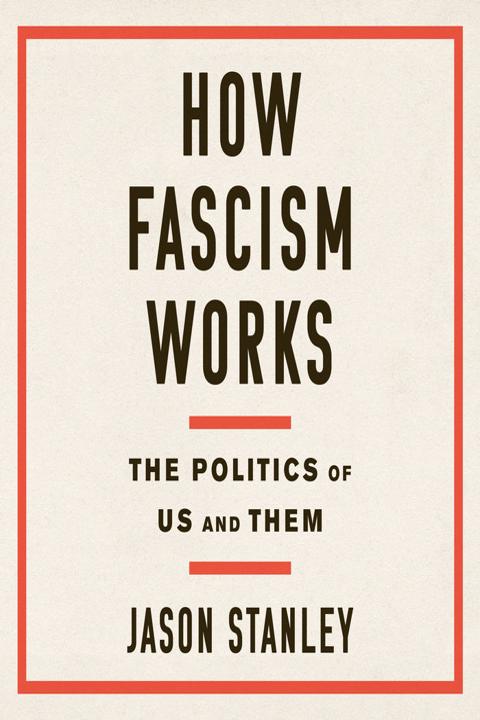
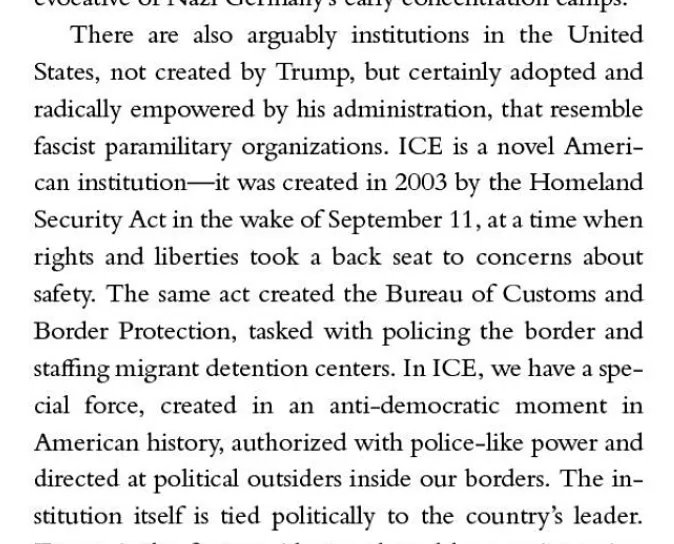
Any engagement with these books reveals their emptiness. Snyder, Stanley, Applebaum, whatever: pick a book, then pick a page. See if it makes sense. Here, I spent a few nauseating minutes today with brave Jason Stanley’s book How Fascism Works: The Politics of Us and Them. Here’s a paragraph from the introduction to the paperback edition:

ICE is novel: It was created after 9/11, by the same law that created a bureau tasked with border protection: a “special force, created in an anti-democratic moment”.

I can’t calibrate the degree to which this person is a fool or a liar, but let’s go with both. The Border Patrol was created in 1924, and was itself the successor agency to a different organization that was created in 1904. You can read that history here. The post-9/11 organization that supposedly created this novel American institution merely reorganized a century-old American institution, making it not the least bit novel. Before ICE, we had INS. Yes, we had a border before 2003, and we policed it. This isn’t a novel concept at all, as it has operated in any form of practice.

You can go through that single amazing paragraph sentence by sentence and tear every last bit of it apart, at the lowest, simplest factual level. The argument isn’t wrong: all of it is wrong, every layer of fact and interpretation. This man is an absolutely enormous jackass. And he’s … important. An important public intellectual, you see.

April 4, 2025

Alberta plays a separate hand

In The Line, Jen Gerson discusses the disconnects between “Team Canada” (such as it is) and Alberta that now have Alberta sending its own delegation to talk to … someone … in Washington DC:

Photo by Jen Gerson, The Line.

Alberta’s periodic bursts of secessionist sentiment operate a little like the aurora that occasionally flash across the prairie sky, in tune with decades-long solar flare cycles. The phenomenon is always fascinating, yet it’s always impossible to know how seriously to take it. It waxes and wanes in line with a number of factors, only some of which can be predicted β€” oil prices, the partisan stripe of the federal government, and the introduction of new regulations.

We are getting another show, of late, and The Line has responded by commissioning some fresh hot polling numbers to determine just how willing Albertans are to take up U.S. President Donald Trump’s call of becoming the 51st state.

It is not a surprise that this is being talked about again. We appear to be on the verge of a potential fourth term of loathed Liberals β€” after being all but promised a Conservative one. Trump has declared economic war, and openly undermines our sovereignty. Alberta has elected a premier who seems to be willing to go much further than leaders past to both threaten the federal government, and align herself with Americans. Danielle Smith has made several appearances in conservative American media institutions to argue against tariffs; she also made a public appeal to her Quebec counterpart to create a common front for greater provincial autonomy. This after threatening to form another “Fair Deal” panel if a future federal government doesn’t meet a list of requests.

In the midst of this revived inter-provincial tension, an Alberta delegation has formed, insisting that it will be travelling to the U.S. in coming weeks to meet with members of the Trump administration.

Who are they meeting? Well, they won’t say.

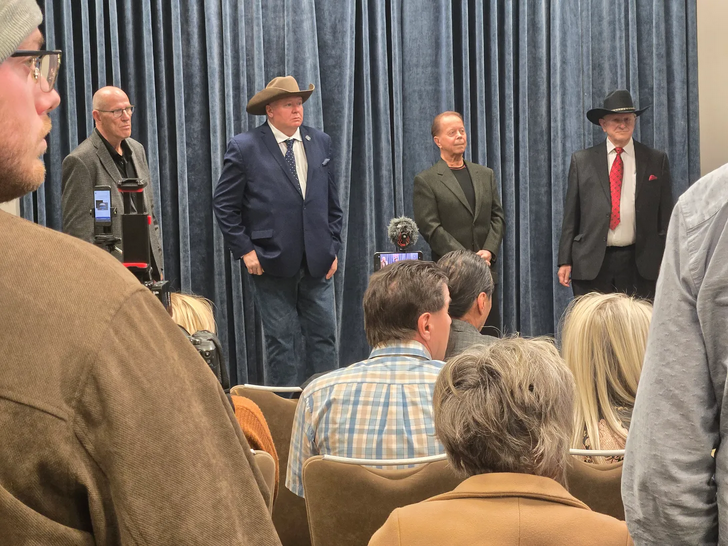
“The response that we’re getting, quite frankly, from the present U.S. administration is very positive. We’ve been advised that the interest in what we’re doing is extremely high, and certainly everything that we’ve seen indicates that this is far from a fool’s errand,” said Jeffrey Rath, an Alberta lawyer leading the delegation, during a press conference last week held just off the lobby of a well-known Calgary hotel. The conference wasn’t well publicized, and it was obscurely signed β€” if you knew, you knew β€” and was thus populated by about 80 fellow travellers of the Alberta independence movement.

“We’ve been advised by the people we’re speaking to in the States to not disclose who it is that we’re talking to at this point,” Rath said. But the goal is clear. They’re going to Washington to meet with representatives of the Trump administration to “determine the level of support that the government of the United States would be prepared to provide to an independent Alberta.”

Admittedly, they’re only independent citizens β€” former Premier Jason Kenney called Rath a “treasonous kook” β€” though the press conference featured one former Conservative MP, LaVar Payne, and the U.S. delegation will reportedly include former Conservative MP Rob Anders.

March 31, 2025

The infighting among the Conservatives is becoming a story in this election

Listening to Jen Gerson and Matt Gurney on The Line podcast a few days ago, I was surprised to hear that the Ontario Progressive Conservatives seem to be trying to actively torpedo the federal Conservative election campaign. While internecine combat among conservative factions is pretty normal, it isn’t quite as normal for it to be happening in the middle of a federal election campaign. It’s almost as if Ontario Premier Doug Ford’s team would rather throw the election to the Liberals than to let Pierre Poilievre’s team score a win. Some friction, sure, but this level of conflict is almost unheard of.

At Acceptable Views, Alexander Brown mulls the chatter he’s been hearing from the campaign trail:

“Something’s really going on here,” says word from on the ground in once-Liberal-safe Toronto.

“The polls say one thing, but we’ve never given out so many signs. We’ve had to print thousands more than usual.”

“We’re actually doing just fine,” says another source high up on the federal campaign trail.

“Don’t believe the chatter from disgruntled so-called conservatives … Nobody here is hanging up their skates. We’ve had a very good week β€” long days notwithstanding! β€” and are beginning to inflict solid brand damage on Carney.”

“The best is yet to come. We are running the campaign we should be running. One that’s true to conservative values and principles.”

On that “chatter”, this non-profit campaigner and writer has no qualms about going weapons-hot.

For those unaware, Ford-“conservative” insiders in Ontario have been taking to the media circuit, issuing complaint after complaint, as both anonymous and named sources, in an effort to pull the Conservatives off of major pocketbook issues such as immigration, housing, affordability, and crime, and on to, all but exclusively, Trump, Trump, Trump.

It matters to them not, apparently, that the Liberals have lucked into booby-trapping both sides of the Trump issue, and that it forces the Conservatives onto uneven terrain.

Drag this out and make it worse, as Carney has largely chosen to do? His elbows are up!

Get shoved around by the administration to the south? See, this is why he’s the one to deal with it. He’s Trump’s enemy!

(Apparently, it also matters not that Carney has received repeated pats on the head and quasi-endorsements from #45, and now, #47.)

The real story here? Allegedly embittered that they were left out of the war-room for reasons of not being all that conservative and being untrustworthy (a point they are now proving over and over again), and wanting to neglect a youth vote they were incapable of turning out, a select few in an Ontario crew think they know best, and would rather engage in public displays of industrial sabotage than keep it private and above the belt.

It’s a ridiculous little consultant slap-fight, at a time when 5000 people are standing out in the rain, to tell a man they don’t know that their Canadian Dream is now a nightmare, that they’re now drowning in debt and don’t feel hope for the future.

“These guys have no idea what they’re talking about. When this is all over, I hope they regret ever weighing in like this.”

For Doug Ford’s campaign manager Kory Teneycke, who has been working the Liberal podcast and media circuit the hardest, it might be worth noting that not every campaign has the advantage β€” nor indulgence β€” of being able to run on Liberal-lite and solely Trump.

The Ontario PCs were granted the easy road of being able to cut the corner to the polls in February, in an election no one asked for, while running Carney-adjacent messaging, and they still couldn’t pick up a seat against the worst Ontario Liberal leader of a generation.

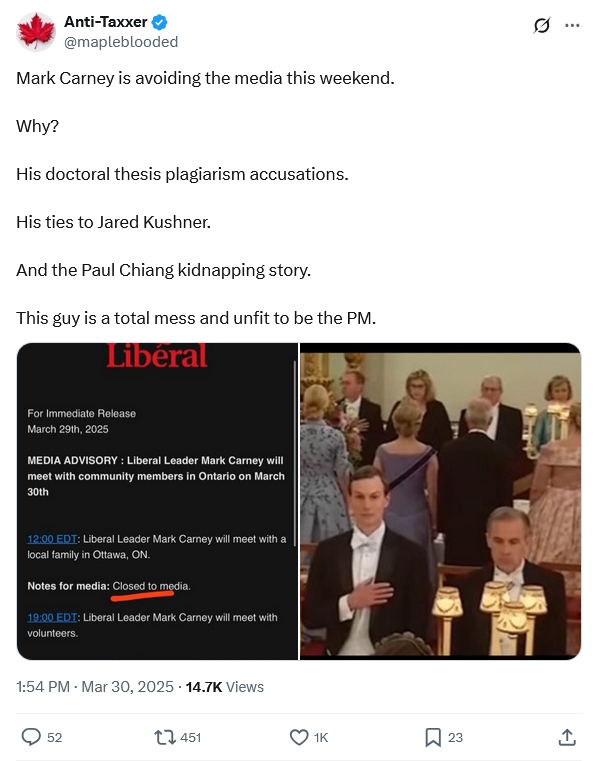
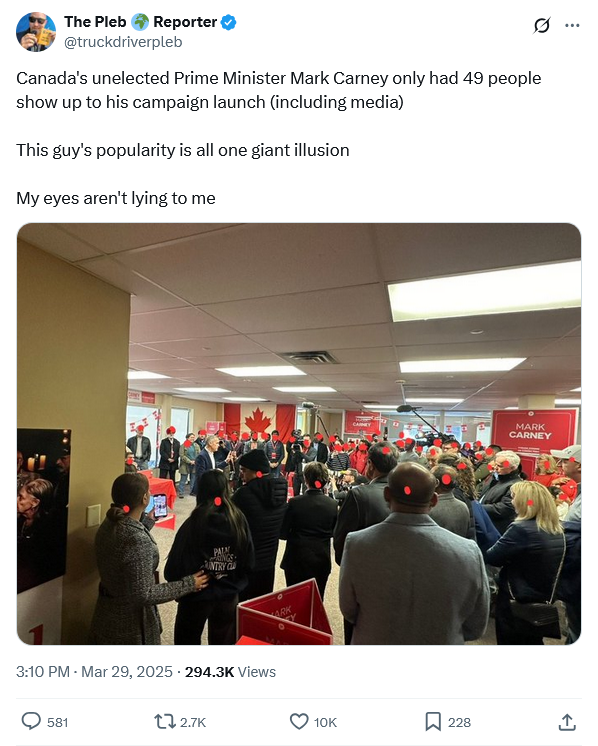
The Line‘s Gerson and Gurney both seem quite taken with the attacks on Poilievre by Ford’s right-hand spokes-hatchetman, but others are reporting lots of enthusiasm on the campaign trail and contrasting it with Carney’s handlers deliberately keeping the PM away from the press as much as they can.

The numbers of people who show up to political events isn’t a dependable metric, but if the disproportion gets to the point that you’re able to hand-count the number of supporters at a given venue, it might be a useful bit of anecdata:

March 24, 2025

Canada could learn from the Finnish example

Filed under: Cancon, History, Military, USA, Weapons — Tags: , , , , — Nicholas @ 05:00

US President Donald Trump tossed several grenades into the still waters of Canadian defence platitudes and forcefully called attention to the clear fact that Canada has been a world-leader in defence freeloading since the late 1960s. In The Line, Tim Thurley suggests that Canada should look more closely at how Finland has maintained its sovereignty with a larger, militarily dominant, and unpredictable neighbour for more than a century:

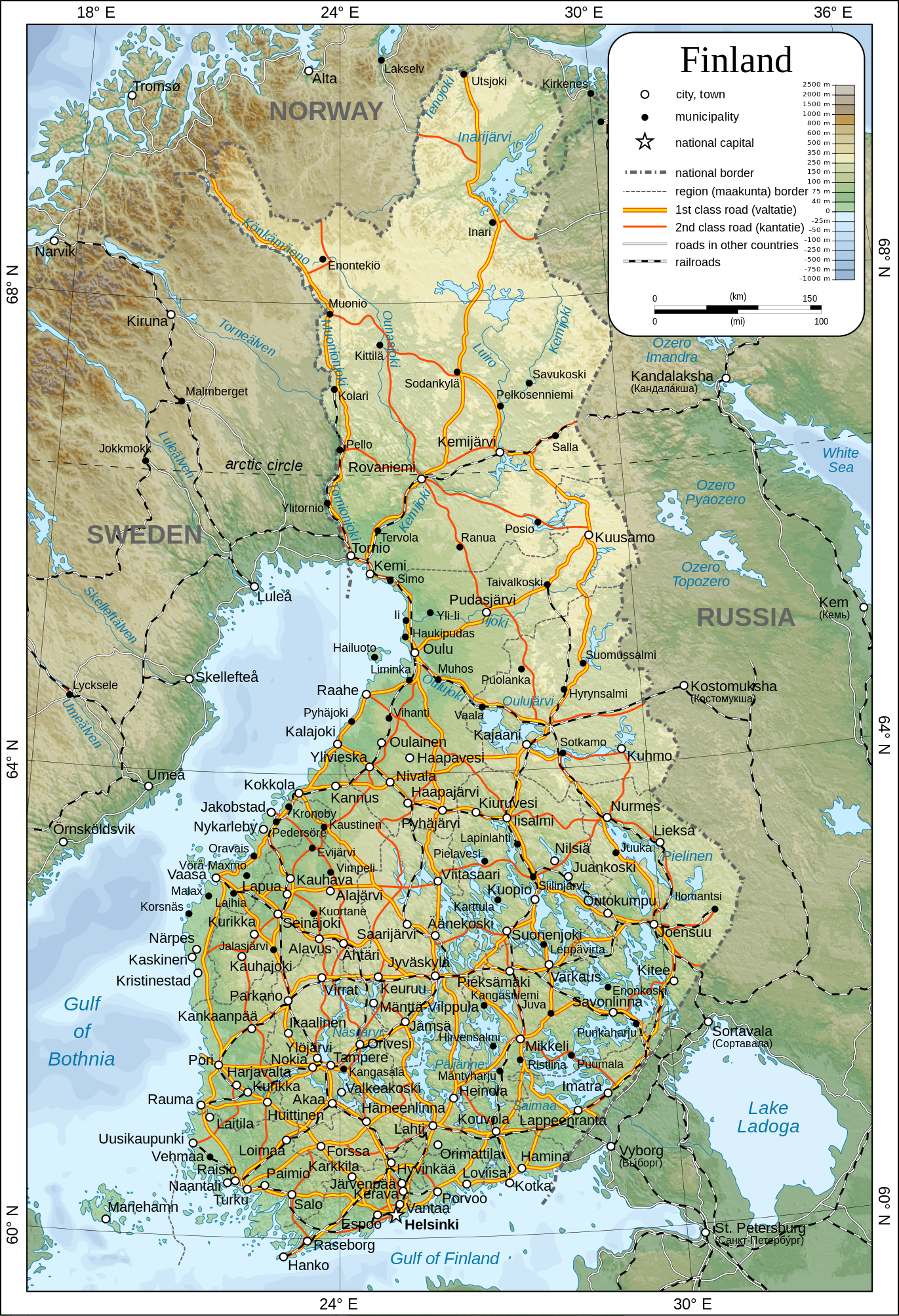
Map of Finland (Suomen kartta) by Oona RΓ€isΓ€nen. Boundaries, rivers, roads, and railroads are based on a 1996 CIA map, with revisions. (via Wikimedia – https://en.wikipedia.org/wiki/File:Map_of_Finland-en.svg)

Canadians pretended we didn’t need to take defence seriously. We justified it with fantasies β€” the world wasn’t that dangerous, threats were distant, and America would rescue us if needed. That delusion is dead. U.S. Republicans and some Democrats don’t trust us to defend our own territory. Trump openly floated annexation and made clear that military protection now comes at a price β€” potentially statehood. Canadian military leaders now describe our closest ally as “unpredictable and potentially unreliable”. And even when America was a sure bet, our overreliance was reckless. Sovereignty requires self-defence; outsourcing it means surrendering power.

We should take cues from nations in similar situations, like Finland. Both of us border stronger powers, control vast, harsh landscapes, and hold valuable strategic resources. We’re internally stable, democratic, and potential targets.

We also share a key strength β€” one that could expand our military recruitment, onshore defence production, rebuild social trust, and bolster deterrence: a strong civilian firearms tradition.

We should be doing everything we can to make that tradition a bigger part of Canadian defence, and a larger part of our economy, too.

That may sound absurd to some Canadians. It shouldn’t. Finland is taking full advantage by attempting to expand shooting and military training for civilians both through private and public ranges and the voluntary National Defence Training Association. Finland is seeking to massively upgrade civilian range capacity by building 300 new ones and upgrading others to encourage civilian interest in firearms and national defence, and is doing so in partnership with civilian firearm owners and existing non-government institutions.

Multiple other states near Finland are investing in similar programs. Poland is even involving the education system. Firearm safety training and target practice for school children are part of a new defence education curriculum component, which includes conflict zone survival, cybersecurity, and first aid training. Poland’s aim is to help civilians manage conflict zones, but also to bolster military recruitment.

Lithuania and Estonia encourage civilian marksmanship as part of a society-wide comprehensive defence strategy. The Lithuanian Riflemen’s Union, one of the small nation’s most recognizable institutions, is a voluntary government-sponsored organization intended to prepare civilians for resistance to an occupying power. It has 15,000 members in a population of 2.8 million. The Estonian Defence League trains mostly-unpaid civilian volunteers in guerrilla warfare. It has an 80 per cent approval rating in Estonia, where over one in every 100 men and women with ordinary jobs have joined to learn defence techniques, including mastering standard-issue military service rifles that they may keep at home, ready to fight on a moment’s notice.

These strategies are modern. These countries are no strangers to cutting-edge modern warfare, necessitated by a common border with an aggressive Russia. But technologies like drones are not a replacement for a trained and motivated citizenry, as the Ukraine conflict illustrates. Against a stronger and more aggressive neighbour, these societies deter and respond to aggression through organized, determined, and trained populations prepared to resist attackers in-depth β€” by putting a potential rifle behind every blade of grass.

Canada, meanwhile, is spending money to hurt our own capacity. It’s coming back to bite us. The Trudeau government misused civilian firearm ownership as a partisan political wedge and ignored the grave flaws of that strategy when they were pointed out, hundreds of times, by good-faith critics. Thousands of firearm models have been banned at massive and increasing expense since 2020 despite no evident public safety benefit. In the recently concluded party leadership race, Mark Carney pledged to spend billions of dollars confiscating them. Government policies eliminating significant portions of business revenue have maimed a firearm industry that historically contributed to our defence infrastructure. Civilian range numbers, which often do double-duty with police and even military use, plunged from roughly 1,400 to 891 in five years. Without civilians to maintain ranges for necessary exercises and qualification shoots, governments must assume the operating expenses, construct new ranges, or fly participants elsewhere to train.

March 23, 2025

Tariffs versus income taxes – pick your poison

Walter Block on the pros and cons (from the government’s point of view) of income taxes and tariffs:

Every fiber of my economic being cries out against tariffs. If they are so good, why doesn’t each state in the US have one against the products of all of the other 49? That is, Ohio could “protect” its industries against the incursions from Arizona. This is obviously silly. One of the important reasons America is so prosperous is that we have a gigantic, internal, free trade area.

Donald Trump supports them on the ground that the McKinley administration was prosperous, and relied upon tariffs. But this is to commit the post hoc ergo propter hoc logical fallacy: that since A precedes B, A must be the cause of B. No, America did indeed become rich during this epoch, but that was in spite of tariffs, not due to their benign influence. If you are looking for a historical episode to shed light on this matter, the Smoot-Hawley Tariff of 1930 will do far better: it greatly worsened an already bad recession, plunging our economy into a deep depression.

Our President also claims that the US is victimized by a negative balance of trade: we buy more from Canada and other countries than they purchase from us. However, I have a horrid balance of trade with McDonald’s and Wal-Mart. I acquire several hundreds of dollars’ worth of their products every year, and neither has yet seen fit to reciprocate with any of my economic services (hint, hint!). On the other hand, I have a very strong positive balance of trade with my employer, Loyola University New Orleans. They pay me a decent salary; apart from a few lunches in their cafeteria, my expenditures to them fill their coffers to a zero degree. Should anyone worry about this sort of thing? Of course not. Ditto for international trade. If Country A buys more from B than it sells to it, money will flow from the former to the latter, reducing prices in the former and raising them in the latter, until matters balance out.

Everyone realizes the foolishness of tariffs when it comes to absolute advantage. No Canadian objects to the importation of bananas from Costa Rica. Producing this tropical product in the frozen North would be financially prohibitive (gigantic hothouses). Ditto for maple syrup in the country to the south. The only way they could produce this item would be to place maple trees in gigantic refrigerators. Ludicrous and prohibitively expensive.

But when it comes to comparative advantage, all too many people are out to lunch insofar as the teachings of Economics 101 are concerned. They fear that other countries might be more efficient than we are; with free trade, they would produce everything, we, nothing, and we would all starve to death from massive unemployment.

March 22, 2025

Fundraising is much tougher for Democrats right now … and they’re not coping well

Filed under: Media, Politics, USA — Tags: , , , , , , — Nicholas @ 03:00

It’s not just Canadian politicians getting driven completely insane by the Bad Orange Man’s antics — he’s even doing it to his domestic opponents in the Democratic party as well:

“REMINDER: It Is Offensive And Possibly Illegal To Photoshop Anything On These Democrats’ Signs That Would Make Them Look Foolish.
The Babylon Bee.

Kansas City Star:

    Democrats Suffer Blow Ahead of Senate Elections

It’s a goddamn slide show, but as it might be amusing I shall wade in. The things I do for you people …

    Sen. Jeanne Shaheen’s retirement is expected to significantly impact the Democratic Party’s prospects for the upcoming Senate elections, amplifying pressure on Senate Minority Leader Chuck Schumer (D-NY). The party’s challenges ahead have heightened with the departures of Sen. Gary Peters (D-MI) and Sen. Tina Smith (D-MN). Democrats must regain four seats to reclaim the majority.

It sure looks like the Donks are planning to get clobbered in 2026. Or, more likely, they anticipate a series of bruising primary fights as the old grift-and-grin Democrats are challenged by True Believers, because as HGG has taught us β€” credit where it’s due β€” SJWs always double down. Batshit insanity is the hill they’ve chosen to die on β€” Trump keeps handing them 80/20 issues, and they keep jumping on the 20 with both feet.

    CNN’s Chris Cillizza recently noted the Party’s challenges in the upcoming Senate elections. With the need for a net gain of four seats, Cillizza expressed concern over potential financial limitations that may hinder effective campaigning.

Yes. “Financial limitations”. Democrat donors are stupid β€” if they weren’t, they wouldn’t be Democrats β€” but even they can see that 80 is way, way bigger than 20.

Oh, and also: It doesn’t help that you’re openly, gleefully endorsing no-shit terrorism against Tesla dealerships β€” and drivers! β€” calling for Musk’s assassination, and so on. It’s a bad look in general, and a bad look in particular, because now the guys with the big checkbooks are wondering if that kind of thing won’t happen to them if they get crosswise with the most lunatic members of the lunatic fringe (hint: It will. As the scorpion said to the frog: can’t be β€˜elped, mate, it’s me nature).

    Cillizza said, “The money that gets spent there playing defense, just to hold Democratic seats, means money that doesn’t get spent playing offense in, let’s say, a state like Ohio, where Democrats are trying to recruit Sherrod Brown, the former senator, to take on John Huston, the appointed Republican senator.”

Yes, a dwindling asset pool forces those kinds of choices. It also doesn’t help that you keep going back to the well like that. One assumes there’s a reason Sherrod Brown is a former senator. Do you have no one else?

Haha, just kidding, obviously you don’t have anyone else. That’s one of the biggest problems with gerontocracy β€” the Groovy Fossils are going to have to be carried out at room temperature, so anyone with anything on the ball has been giving Government a pass since the 1980s. Trump went around the Official GOP for lots of reasons, but not the least of them was: he had to. They have the same gerontocracy problem as the other side of the Uniparty. It’s turtles all the way down.

    Cillizza concluded, “I just do not see it. I don’t see the money there. I don’t see the energy there. I don’t see the candidates there to expand the playing field”.

It won’t be for lack of trying, though. You’ve still got The Media in your pocket, and they can still do some damage. You’ll never get to the 80 side of those 80/20 issues, but you might get it to 50/50 β€” as has been done with abortion, gay “marriage”, and so on. On the other hand, those took 40, 50 years, and The Media hadn’t totally pissed away all its credibility back then. It’s a real corner you’ve backed yourselves into, guys gals persyns.

It also doesn’t help that you’re stupid:

    Democrats have identified potential pickup opportunities in Maine and North Carolina, targeting Sen. Susan Collins (R-ME) and Sen. Thom Tillis (R-NC).

Holy breakdancing Buddha, why would you target them? Thom Tillis is the very definition of “RINO”; Collins is a Leftist, full stop. The next time they vote against the Democrats on any issue of substance will be the first time they’ve ever done it. It’s as predictable as sunrise, so much so that it’s a joke to anyone right of Mao β€” the GOP officially has X number of seats, minus Collins and Murkowski.

    Vulnerabilities among current incumbents, especially Sen. Jon Ossoff (D-GA), have added to the party’s challenges.

    Oh, don’t worry about it β€” the GOP will find some way to throw it. Georgia, Georgia … hey, what’s Herschel Walker up to these days? Think he’s up for another run? Why not parachute in Alan Keyes or Ben Carson? They’re still alive, right? What about “Nikki” “Haley”? She’s gotta keep her arm loose for the 2028 primaries …

      Some Democrats have remained optimistic despite the hurdles. Discussions have included potential candidates such as Rep. Haley Stevens (D-MI) and State Sen. Mallory McMorrow (D-MI) for key races. New Hampshire Democrats have prepared for competitive primaries, with Rep. Chris Pappas (D-NH) considering a bid for Shaheen’s seat.

    As we know, when it comes to crime 13 does 50. When it comes to Leftism, though, it’s more like 20 does 100, and there’s no better illustration than New Hampshire. It should be the reddest state in the union, and people who live there tell me it really is… except for their Congresscritters, because the good people of New Hampshire didn’t shoot every Masshole they could catch. The fine folks in Oregon, Colorado, and (soon enough) Texas know what I mean β€” y’all didn’t introduce migrating Californians to wood chippers when you had the chance.

« Newer PostsOlder Posts »

Powered by WordPress