
Quotulatiousness

April 22, 2012

Danish Dutch design helps rescue the US Coast Guard from further embarrassment

Filed under: Military, USA — Tags: , , , — Nicholas @ 12:01

Strategy Page on the US Coast Guard’s latest cutters:

The U.S. Coast Guard recently commissioned the first of 58 “Fast Response Cutters.” These are 46.8 meter (154 feet) long, 353 ton vessels equipped with a 8 meter (25 foot) rigid hull boat launched and recovered internally from a ramp in the stern (rear) of the ship. Armament of the cutter (as seagoing coast guard ships are called) consists of a remotely controlled 25mm autocannon and four 12.7mm (.50 caliber) machine-guns, plus small arms. Top speed is 52 kilometers an hour and the crew of 22 has sleeping and eating facilities on board so the ship can be at sea five days at a time (and 2,500 hours, or over 100 days, a year at sea). The Fast Response Cutter is basically a slightly larger version of the Danish Dutch Damen Stan 4207 patrol vessel.

The Danish Dutch design was selected four years ago because, a year before the Coast Guard was finally forced to admit defeat in its effort to build an earlier design for 58 new patrol ships (Fast Response Cutters.) The ship builders (Lockheed Martin and Northrop Grumman) screwed up, big time. While the Coast Guard shares some of the blame, for coming up with new concepts that didn’t work out, the shipbuilders are the primary culprits because they are, well, the shipbuilding professionals, and signed off on the Coast Guard concepts. Under intense pressure from media, politicians and the shame of it all the Coast Guard promptly went looking for an existing (off-the-shelf) design, and in a hurry. That’s become urgent because of an earlier screw up.

Six years ago, the Coast Guard discovered that a ship upgrade program made the modified ships structurally unsound and subject to breaking up in heavy seas

Update: Thanks to eagle-eyed commenter Guan Yang who pointed out that the design is actually Dutch, not Danish. I’ve modified the quoted text to match the correct information.
April 12, 2012

Chinese vessels left in possession of Scarborough Shoal as Philippine ship withdraws

Filed under: Asia, China, Military — Tags: , , , — Nicholas @ 09:28

An update on the BBC News website about the stand-off between Chinese and Philippine ships in the disputed Scarborough Shoal area of the South China Sea:

Earlier on Thursday a Philippine coastguard vessel arrived in the area, known as the Scarborough Shoal.

The Philippines also says China has sent a third ship to the scene.

The Philippine foreign minister said negotiations with China would continue. Both claim the shoal off the Philippines’ north-west coast.

The Philippines said its warship found eight Chinese fishing vessels at the shoal when it was patrolling the area on Sunday.

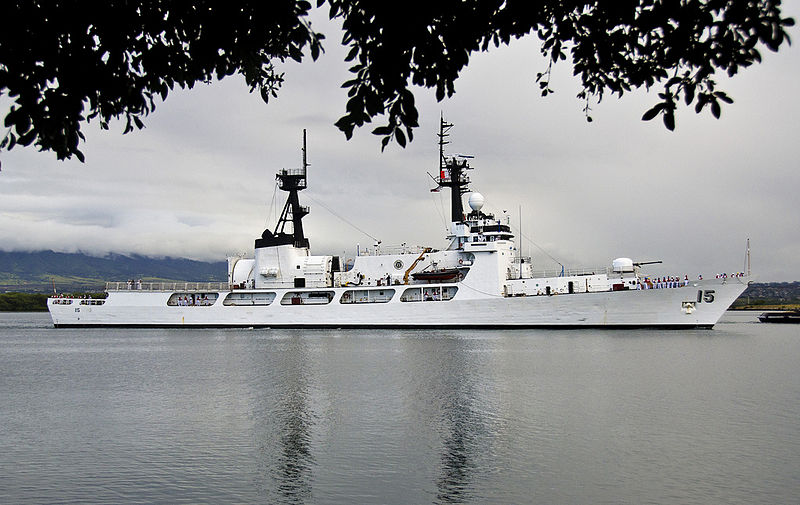
The BBC article doesn’t name the Philippine ship, but it’s likely to be the BRP Gregorio del Pilar (formerly the USCGC Hamilton):


Photo from Wikipedia

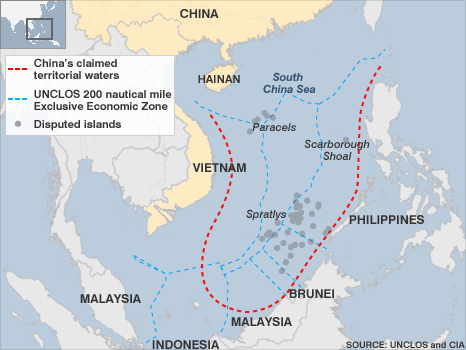
China’s view of its borders in the South China Sea clashes wildly with those of its neighbours and the international community:

In a statement, the Philippines said that its navy boarded the Chinese fishing vessels on Tuesday and found a large amount of illegally-caught fish and coral.

Two Chinese surveillance ships then apparently arrived in the area, placing themselves between the warship and the fishing vessels, preventing the navy from making arrests.

The Philippines summoned Chinese ambassador Ma Keqing on Wednesday to lodge a protest over the incident. However, China maintained it had sovereign rights over the area and asked that the Philippine warship leave the waters.

February 16, 2012

Rum running in the Maritimes during Prohibition

Filed under: Cancon, Economics, France, History, USA — Tags: , , , — Nicholas @ 11:33

I just received a press release about a new documentary to be shown on the CBC this Sunday. Here’s the trailer:

Rum Running is a half hour documentary that will celebrate its world broadcast premiere on CBC Television’s Land & Sea on Sunday, February 19, 2012 at 12 Noon. Rum Running describes the history of rum running and depicts the high stakes role that Nova Scotia and the French Islands of St. Pierre and Miquelon played during the era. The film reveals how thousands of law abiding citizens of Atlantic Canada were lured into the alcohol smuggling trade during Prohibition in the 1920’s and 30s.

October 20, 2011

Timer now started for how quickly Quebec forces Harper to override shipbuilding contract awards

Filed under: Cancon, Economics, Military, Politics — Tags: , , , , , , — Nicholas @ 12:08

The National Post editorial board has lots of nice things to say about the federal government’s attempt to take politics out of the huge shipbuilding contract process:

On Wednesday, the Tory government released its Solomonic decision regarding which shipyards will build $33-billion in new military and non-military vessels over the next two decades. The evaluation of bids for the largest government procurement contract since the Second World War was handled by senior bureaucrats, rather than cabinet ministers. Even the announcement of the winning contractors was made by Francois Guimont, the top civil servant from Public Works and Government Services, rather than his minister or the minister of National Defence, as would have been the case with past contracts of this magnitude.

Of course, that’s not to say there will be no political backlash from the decision. Irving Shipbuilding of Halifax will be given $25-billion to build new joint support ships, Canadian Surface Combatants — a sort of destroyer-frigate hybrid — and offshore patrol vessels capable of sailing off all three of Canada’s coasts — east, west and Arctic. Seaspan Marine of Vancouver will build science vessels for the Coast Guard and for the Fisheries department, plus icebreakers worth a total of $8-billion. That means Davie Shipyard in Levis, Que. was left without a major shipbuilding contract (though Davie is still eligible to bid on a further $2-billion contract to provide smaller government boats, such as Fisheries patrol vessels). It must have been tempting for the Tories to intervene in the contract-award process and toss Quebec a bigger bone. Their recent decision to expand the grasp of the official languages commissioner to several airlines, and their willingness to give new seats to Quebec in the House of Commons (despite the fact Quebec was not underrepresented there), just because Ontario, B.C. and Alberta were getting more, shows the Tories have become very concerned about their appeal to Quebec voters.

You can guarantee that many Quebec politicians will benefit for having yet another stick to beat the federal government with — this would be true in all scenarios except the one where the Quebec shipyard got both contracts. It would be an even better deal for the taxpayers (and perhaps even the Royal Canadian Navy) if the contracts hadn’t been restricted to Canadian shipyards: it wouldn’t fly politically, but it would almost certainly have been better bang for the billions of bucks.

May 27, 2010

Canada’s positive experience of US Prohibition

Filed under: Cancon, Economics, Liberty, USA — Tags: , , , , , , — Nicholas @ 12:07

I knew that individual Canadians did well out of supplying booze to thirsty Americans during the period of Prohibition, but I didn’t realize how well:

. . . Prohibition — perhaps the maddest of mad American dreams [NR: in a dead heat with the current War on Drugs, I think] — did pretty well by our nation from 1920 to 1933. As American writer Daniel Okrent points out in his fine social history of the era, Last Call, the rivers of Canadian booze that flowed south enriched not only the Bronfman liquor empire, but our federal government. Canadians did make and smuggle illegal liquor, evading both Canadian taxes and American law, but we also made millions of litres of the legal, taxed stuff, the ultimate destination of which was of no concern to Ottawa. The amount of alcohol subject to excise tax — most of which went south one way or another — went from 36,000 litres in 1920 to five million 10 years later, and the excise tax on it rose to a fifth of federal revenue, twice as much as income tax.

Few in Canada had the slightest inclination to aid the American government in cracking down on alcohol use. When a U.S. Coast Guard cutter in pursuit of a Lake Erie rum-runner ran aground near Port Colborne, Ont., locals looted the vessel, then filled its engines with sand. About the only Canadians Okrent could unearth who thought the Dominion should help Uncle Sam seal his border were those making a fortune selling alcohol to American visitors. One way or another, most Canadians agreed with the smug satisfaction of CNR president Sir Henry Thornton, whose railway was growing fat off liquor tourism: “The dryer the U.S. is,” opined Sir Henry, “the better it will be for us.”

If there was an upside to what was known — at first, without a trace of irony — as “The Noble Experiment” in the U.S. itself, Okrent is hard-pressed to find it. America had always been awash in alcohol. (Johnny Appleseed’s fruit was inedible, but Americans still embraced his trees — virtually every homestead kept a barrel of hard cider by the door for visitors.) During the sodden 19th century, adult Americans downed 27 litres of pure alcohol each annually. That kind of demand wasn’t going to disappear no matter what the law said.

And yet the lesson has been forgotten. When drug prohibition finally comes to an end, historians will have a field day drawing the obvious comparison between the War on Drugs and the “Noble Experiment”. The theses practically write themselves . . .

« Newer Posts

Powered by WordPress


